
In this article
- Key Takeaways
- Why Hydrotherapy Is Recommended After Canine Surgery
- Pool Therapy vs. Underwater Treadmill: What Is the Difference?
- What Drives the Cost of Canine Hydrotherapy?
- Average Total Cost: Realistic Scenarios
- DIY Hydrotherapy vs. Professional Sessions
- What to Expect at Your First Hydrotherapy Appointment
- Pet Insurance and Hydrotherapy Coverage
- How to Find a Certified Canine Hydrotherapist
- Complementary Care During Rehabilitation
- When to Start and When to Stop
- Final Thoughts on Budgeting for Canine Hydrotherapy
Key Takeaways
- Underwater treadmill sessions typically cost $40 to $80 per 30 minutes, while pool therapy averages $30 to $50 per session.
- A full post surgical hydrotherapy course often runs 8 to 16 sessions, putting total costs between roughly $320 and $1,280 depending on the modality and clinic.
- Cost drivers include geographic location, the type of surgery your dog had, the modality used (pool vs. underwater treadmill), and whether the therapist holds recognised certification.
- Some pet insurance policies cover rehabilitative therapies, but coverage varies widely by provider, plan tier, and whether a veterinarian prescribes the sessions.
- Always confirm your hydrotherapist holds certification from a recognised body such as the Canine Hydrotherapy Association (CHA) or is a Certified Canine Rehabilitation Practitioner (CCRP).
Why Hydrotherapy Is Recommended After Canine Surgery
Hydrotherapy uses the physical properties of water, primarily buoyancy, hydrostatic pressure, and resistance, to support rehabilitation. After orthopaedic procedures such as TPLO (tibial plateau levelling osteotomy) for cruciate ligament repair, femoral head ostectomy, or spinal surgery, dogs face a delicate recovery window. Weight bearing exercise on land can be painful and risky during early healing, whereas water based movement reduces load on joints while still engaging muscles.
Veterinary rehabilitation specialists commonly note that hydrotherapy can help reduce post operative pain and inflammation, rebuild muscle mass lost during rest periods, improve joint range of motion, and support cardiovascular fitness without excessive joint stress. Studies, including research published in the Journal of the American Veterinary Medical Association, have explored early post operative hydrotherapy, though it is worth noting that no universal veterinary guideline currently establishes the ideal start date. Timing should always be determined by the attending veterinary surgeon.
Pool Therapy vs. Underwater Treadmill: What Is the Difference?
Pool (Free Swim) Therapy
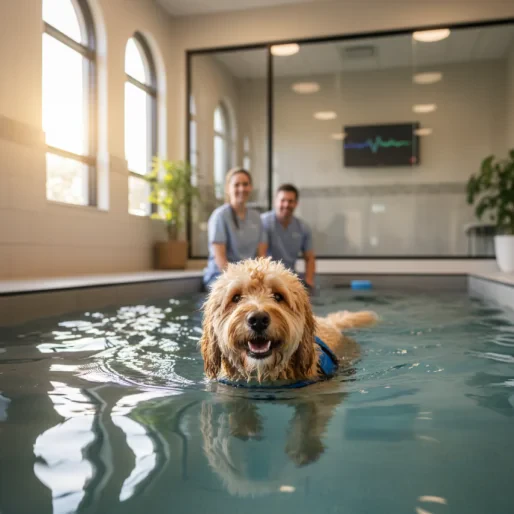
In pool therapy, dogs swim in a heated, purpose built pool with a therapist guiding their movement. This modality is excellent for non weight bearing exercise and cardiovascular conditioning. It is commonly used for dogs recovering from spinal surgery or those with severe joint disease who cannot yet tolerate any ground contact.
Underwater Treadmill Therapy
An underwater treadmill encloses the dog in a chamber that fills with warm water to a controlled depth. The dog then walks on a treadmill belt. Because the therapist can adjust water height and belt speed, this modality allows precise control over how much weight the dog bears. It is frequently preferred for post orthopaedic surgical recovery (such as TPLO or total hip replacement) because it encourages a natural gait pattern.
Cost Comparison at a Glance
- Pool therapy: Typically around $30 to $50 per 30 minute session.
- Underwater treadmill: Typically around $40 to $80 per 30 minute session.
- Initial assessment or consultation: Often $45 to $100, sometimes waived if a treatment package is purchased.
The underwater treadmill tends to cost more because the equipment itself is a significant capital investment for the clinic, often exceeding $30,000 for a veterinary grade unit.
What Drives the Cost of Canine Hydrotherapy?
Geographic Location
As with most veterinary services, prices vary significantly by region. Urban practices and clinics in high cost of living areas (such as major metropolitan centres in the US, UK, or Australia) typically charge at the upper end of the range. Rural or suburban practices may offer lower session fees.
Type and Severity of Surgery
A dog recovering from bilateral TPLO surgery will almost certainly need more sessions than one recovering from a minor soft tissue procedure. The complexity of the case determines the length of the rehabilitation programme, and thus the total cost.
Breed and Size
Larger breeds may require longer sessions or specialised handling. A Great Dane, for example, requires more therapist effort and pool space than a Cavalier King Charles Spaniel. Some clinics apply size based pricing tiers.
Therapist Credentials
Sessions led by a Certified Canine Rehabilitation Practitioner (CCRP) or a veterinary physiotherapist with advanced qualifications may cost more than sessions run by a technician with basic training. However, the clinical oversight is generally considered worth the premium, particularly for complex post surgical cases.
Session Frequency and Package Deals
Most rehabilitation plans call for two to three sessions per week in the early stages, tapering to once per week as the dog progresses. Many clinics offer package pricing that reduces the per session cost. For example, a bundle of 10 underwater treadmill sessions might drop the per session fee from $75 to $65.
Average Total Cost: Realistic Scenarios
Below are approximate total cost ranges for common post surgical hydrotherapy courses. These figures are estimates based on widely reported price ranges and should be confirmed with local providers.
- Mild case (8 sessions, pool therapy): $240 to $400 plus initial assessment.
- Moderate case (12 sessions, underwater treadmill): $480 to $960 plus initial assessment.
- Complex case (16 or more sessions, combination therapy): $800 to $1,280 or more plus initial assessment and periodic veterinary re evaluations.
These figures do not include the cost of the surgery itself or post operative medications. Owners should factor hydrotherapy into their broader surgical budget from the outset.
DIY Hydrotherapy vs. Professional Sessions
Some owners consider swimming their dog in a home pool, lake, or bathtub as a cost saving alternative. While gentle swimming in a safe, calm body of water can provide light exercise for a healthy dog, it is not a substitute for professional post surgical hydrotherapy. Here is why:
- No clinical oversight: A certified therapist monitors gait, compensatory movement patterns, pain responses, and fatigue levels throughout each session.
- No controlled environment: Professional facilities maintain water temperature (typically 28 to 32 degrees Celsius), use ramps or hoists for safe entry and exit, and have hygiene protocols that reduce infection risk to surgical wounds.
- Risk of setbacks: Incorrect exercise intensity or timing after surgery can lead to implant failure, wound dehiscence, or muscle strain, potentially resulting in far higher veterinary bills.
For dogs who have fully recovered and been discharged from rehabilitation, gentle swimming can become part of an ongoing fitness routine. For ideas on low impact exercise after rehab is complete, see our guide on building a DIY garden agility course for dogs.
What to Expect at Your First Hydrotherapy Appointment
Before the Session
The hydrotherapist will request a veterinary referral or surgical report. They will ask about the procedure performed, the date of surgery, current medications, and any movement restrictions set by the veterinary surgeon. Many facilities require proof of up to date vaccinations.
The Assessment
An initial consultation (typically 45 to 60 minutes) involves a physical and gait assessment on land. The therapist will observe the dog's posture, muscle symmetry, range of motion, and comfort level. This assessment informs a tailored rehabilitation plan, including recommended modality, session frequency, water depth, and exercise intensity.
The First Water Session
The first session is usually shorter and gentler than subsequent ones. The goal is to acclimatise the dog to the water environment. For the underwater treadmill, the therapist will guide the dog into the chamber, slowly raise the water level, and start the belt at a very low speed. For pool therapy, the dog will be supported by the therapist and, in many cases, a buoyancy aid. Sessions typically last 15 to 30 minutes initially, building gradually over the rehabilitation programme.
After the Session
Dogs are dried thoroughly, and the therapist will note any observations about gait improvement, muscle engagement, or signs of discomfort. A progress report is often shared with the referring veterinary surgeon.
Pet Insurance and Hydrotherapy Coverage
Whether pet insurance covers hydrotherapy depends on several factors:
- Plan type: Comprehensive or "lifetime" policies are more likely to cover rehabilitative therapies than accident only plans.
- Veterinary prescription: Most insurers require that a veterinarian formally prescribes hydrotherapy as medically necessary. Self referred sessions are rarely covered.
- Policy sub limits: Some policies cap complementary or rehabilitative therapy coverage at a set annual amount (for example, $500 to $1,500 per year).
- Waiting periods: If hydrotherapy relates to a condition that arose during the policy waiting period, the claim may be denied. For a deeper explanation, see our article on pet insurance waiting periods.
Owners exploring employer sponsored pet benefits may find that some workplace plans include rehabilitation therapy. Our guide on employer pet insurance in 2026 examines these options in detail.
Payment Plans and Financial Assistance
If insurance does not cover hydrotherapy or the out of pocket cost is still significant, consider:
- Clinic payment plans: Many rehabilitation centres offer interest free instalment options.
- Veterinary financing services: Third party financing (such as CareCredit in the US) can spread costs over several months.
- Charitable funds: Organisations like The Pet Fund or breed specific rescue groups sometimes assist with rehabilitation costs.
Skipping prescribed rehabilitation to save money can lead to poorer surgical outcomes, prolonged recovery, and potentially more expensive corrective procedures. Financial planning before surgery is strongly recommended.
How to Find a Certified Canine Hydrotherapist
Certification matters. The difference between a "trained" and a "certified" hydrotherapist is significant: certification requires formal education, supervised clinical hours, and ongoing professional development.
Recognised Certifying Bodies and Directories
- Canine Hydrotherapy Association (CHA): Maintains a directory of approved hydrotherapy centres, primarily in the UK. Members must hold at least a Level 3 qualification and complete 25 hours of continuing professional development annually.
- Certified Canine Rehabilitation Practitioner (CCRP): Awarded by the University of Tennessee's programme, recognised internationally. A CCRP credential indicates advanced training in canine rehabilitation, including hydrotherapy.
- Certified Canine Rehabilitation Therapist (CCRT): Awarded by the Canine Rehabilitation Institute. Another internationally recognised credential.
- National Association of Registered Canine Hydrotherapists (NARCH): A UK based register of qualified practitioners.
Questions to Ask Before Booking
- What certification or qualification do you hold, and through which body?
- How many post surgical rehabilitation cases do you handle each month?
- Do you communicate directly with my dog's veterinary surgeon?
- What is the water temperature, and how often is water quality tested?
- Can you provide a written treatment plan with expected milestones?
- What is your pricing structure, and do you offer packages or payment plans?
Red Flags to Watch For
- No verifiable certification or unwillingness to share credentials.
- No requirement for a veterinary referral before treating a post surgical patient.
- No temperature controlled water or visible hygiene protocols.
- Guarantees of specific outcomes (responsible therapists set goals, not guarantees).
Complementary Care During Rehabilitation
Hydrotherapy is often one component of a broader recovery plan. Owners should also discuss with their veterinary team:
- Nutrition: Proper nutrition supports tissue repair and maintains a healthy weight, reducing joint load. For older dogs in recovery, our senior dog nutrition guide provides useful dietary considerations.
- Land based physiotherapy: Stretching, range of motion exercises, and balance work prescribed by a rehabilitation professional.
- Pain management: Ongoing veterinary oversight of pain medication or anti inflammatory protocols.
- Weight management: Excess body weight places additional stress on healing joints and can slow recovery.
When to Start and When to Stop
There is no one size fits all timeline. Published veterinary literature has explored early post operative hydrotherapy (within 3 to 5 days for some spinal surgery cases), but starting too soon may carry an increased risk of wound complications. General professional consensus suggests:
- Starting: Most dogs begin hydrotherapy between 10 and 14 days post surgery, once the surgical wound has adequately healed and sutures or staples have been removed. The veterinary surgeon must give clearance.
- Progressing: Frequency typically starts at two to three sessions per week and reduces as the dog regains strength and mobility.
- Completing: A rehabilitation programme commonly spans 6 to 12 weeks, though complex cases may extend further. Discharge criteria usually include restored range of motion, adequate muscle mass, and return to comfortable daily function.
Final Thoughts on Budgeting for Canine Hydrotherapy
Hydrotherapy is an investment in surgical outcomes. The cost, while not insignificant, is modest compared to the price of the surgery itself and the potential expense of managing complications from inadequate rehabilitation. When budgeting for a planned orthopaedic or spinal procedure, veterinary practice management professionals recommend building rehabilitation costs into the overall treatment estimate from day one.
By choosing a certified hydrotherapist, communicating closely with the veterinary team, and exploring insurance or financing options, owners can give their dogs the best possible chance of a full, comfortable recovery.
Frequently Asked Questions
Content Disclosure
This article was created using state-of-the-art AI models with human editorial oversight. It is intended for informational and entertainment purposes only and does not constitute veterinary medical advice. Always consult a licensed veterinarian for your pet's specific health needs. Learn more about our process.