
In this article
- Key Takeaways
- Understanding EU Pet Travel Rules in 2026
- Pre-Flight Veterinary Checklist
- Airline Carrier Dimensions: A Comparison
- Cabin vs. Cargo: Which Is Right for Your Cat?
- Veterinary Sedation Guidance
- Stress Reduction Without Medication
- Emergency Kit for Flying With a Cat
- Seasonal Considerations for Cat Air Travel
- Printable Pre-Flight Summary Checklist
Key Takeaways
- EU Regulation 2016/429 (the Animal Health Law) replaces Regulation 576/2013 for non-commercial pet movement from 21 April 2026, tightening traceability and health documentation requirements.
- For intra-EU flights, a valid EU Pet Passport with a current rabies vaccination and ISO-compliant microchip remains the core requirement.
- Most European airlines cap in-cabin carrier dimensions at roughly 40 x 30 x 24 cm and set a combined weight limit (cat plus carrier) of around 8 to 10 kg.
- The AVMA advises against sedating pets for air travel due to cardiovascular, respiratory, and thermoregulation risks; most airlines refuse visibly sedated animals.
- Preparation, including crate training and a pre-flight veterinary health check, is widely regarded as the single most effective way to reduce feline travel stress.
Understanding EU Pet Travel Rules in 2026
For more than a decade, Regulation (EU) No 576/2013 governed how cats, dogs, and ferrets moved between EU member states. From 21 April 2026, those rules transition to the broader Animal Health Law framework under Regulation (EU) 2016/429. The practical impact on cat owners flying within the EU is mostly about stricter enforcement and clearer traceability rather than a wholesale rewrite of existing obligations.
What Stays the Same for Intra-EU Cat Travel
- Microchip identification: Every cat must carry an ISO 11784/11785 compliant transponder (15 digits). A tattoo applied before 3 July 2011 is still accepted if it remains clearly readable, but in practice, nearly all cats travelling in 2026 will need a microchip.
- Rabies vaccination: Cats must be vaccinated against rabies at a minimum age of 12 weeks. At least 21 days must pass between the primary vaccination and travel. Boosters must be kept up to date according to the vaccine manufacturer's protocol.
- EU Pet Passport: When travelling from one EU country to another, the EU Pet Passport is the standard document. It is valid for the life of the animal, provided rabies vaccination status remains current and the microchip number matches the passport record.
What Changes Under the Animal Health Law
- Tighter requirements around registration and traceability of microchipped animals.
- Standardised enforcement timelines across all member states.
- For cats arriving from outside the EU (e.g. the UK or the US), a single-use Animal Health Certificate (AHC) is strictly required for every trip; pet passports are not accepted.
Cat owners planning intra-EU flights should confirm their pet passport is up to date and verify the microchip is scannable well before the travel date. Veterinary guidelines recommend a routine chip scan at each annual check-up.
Pre-Flight Veterinary Checklist
A thorough vet visit at least four to six weeks before departure gives enough lead time to address any gaps. Use this checklist during the appointment:
- Microchip scan: Confirm the chip reads correctly and matches the number in the EU Pet Passport.
- Rabies vaccination review: Verify the vaccine is in date. If a booster is needed, allow the full 21-day validity window before the flight.
- General health assessment: Discuss your cat's fitness to fly, particularly if the cat is a senior, brachycephalic (flat-faced), pregnant, or has a chronic condition such as heart disease or respiratory issues. Senior cats in particular benefit from a broader wellness screen; for more on that topic, see Spring Wellness Checklist for Senior Cats.
- Parasite treatment: Some member states require documented tapeworm treatment (Echinococcus multilocularis) administered by a vet one to five days before entry. This applies notably when entering Finland, Ireland, and Norway. The treatment must be recorded in the pet passport. For broader parasite prevention guidance, owners may find Spring Parasite Prevention: What New Pet Owners Get Wrong helpful.
- Anxiety management plan: Discuss stress-reduction strategies (covered in detail below). If your vet considers pharmacological support appropriate, this appointment is the time to plan it.
Airline Carrier Dimensions: A Comparison
Carrier size requirements differ between airlines, and getting this wrong can mean being turned away at the gate. The table below summarises typical maximum dimensions for major European carriers. Always confirm directly with the airline before booking, as policies can change at short notice.
Typical In-Cabin Carrier Limits (2026)
- Air France and KLM: approximately 46 x 28 x 24 cm; combined weight (cat plus carrier) usually capped at 8 kg.
- Lufthansa: approximately 55 x 40 x 23 cm; combined weight limit typically around 8 kg.
- Norwegian: approximately 43 x 31 x 20 cm; soft-sided carriers that compress to fit under the seat are generally preferred.
- Vueling: approximately 45 x 39 x 21 cm; combined weight limit typically 8 to 10 kg.
- Pegasus Airlines: approximately 50 x 32 x 32 cm; one of the more generous allowances.
A carrier measuring around 40 x 30 x 24 cm is commonly cited as a safe middle-ground size that fits under most European airline seats. Soft-sided carriers are frequently recommended because they can compress slightly to fit tighter under-seat spaces.
Carrier Selection Tips
- Choose a carrier with adequate mesh ventilation on at least two sides.
- Ensure the cat can stand, turn around, and lie down comfortably inside.
- Line the base with an absorbent pad in case of accidents.
- Attach a luggage tag with your name, destination, and phone number to the carrier.
- Place a familiar-smelling blanket or worn t-shirt inside to provide a calming scent anchor.
Cabin vs. Cargo: Which Is Right for Your Cat?
In-Cabin Travel
Most European airlines that accept pets allow cats in the cabin, provided the carrier fits under the seat and the combined weight stays within the airline's limit (typically 8 to 10 kg). In-cabin travel is generally considered the lower-stress option because the cat stays close to its owner in a pressurised, climate-controlled passenger cabin.
Common in-cabin rules:
- The carrier must remain closed and under the seat for the entire flight.
- Airlines typically limit the number of pets per cabin (often one or two per flight), so advance booking is essential.
- A pet fee is charged in addition to the passenger fare, commonly ranging from around 25 to 75 EUR for short-haul intra-EU flights, though prices vary considerably.
- The cat must not cause a disturbance. Excessive vocalisation can, in theory, result in the animal being removed before departure.
Cargo (Hold) Travel
Cats that exceed the in-cabin weight limit, or that are travelling on airlines without in-cabin pet policies, may need to fly in the cargo hold. The hold is pressurised and temperature-controlled on most modern aircraft, but the experience is significantly more stressful for animals.
Key cargo considerations:
- An IATA-compliant rigid crate is mandatory. The crate must meet strict specifications for size, ventilation, construction material, and locking mechanisms.
- Temperature restrictions apply. Many airlines will not accept animals in the hold when ground temperatures at departure or arrival airports exceed approximately 29 to 30 °C or drop below roughly 7 °C.
- Brachycephalic (snub-nosed) cat breeds face higher respiratory risk in the hold; some airlines refuse them for cargo transport entirely.
- Additional health documentation or a veterinary fitness-to-fly certificate may be required for cargo travel.
Owners concerned about heat-related risks in warmer months should review Heat Stress in Indoor Cats: When It's an Emergency for guidance on recognising early warning signs.
Veterinary Sedation Guidance
The question of whether to sedate a cat for a flight is one of the most common concerns among travelling pet owners. Professional consensus, including guidance from the American Veterinary Medical Association (AVMA), is clear: sedation is generally not recommended for air travel.
Why Sedation Is Discouraged
- Cardiovascular and respiratory depression: Sedatives can suppress heart rate and breathing, which becomes more dangerous at altitude where cabin pressure is lower than at ground level.
- Impaired thermoregulation: Sedated cats cannot regulate body temperature as effectively, increasing the risk of hypothermia (in the hold) or overheating.
- Loss of protective reflexes: A sedated cat cannot brace itself if the carrier shifts during turbulence or handling, raising injury risk.
- No mid-flight intervention: If a sedated cat develops complications during a flight, there is no veterinary care available until landing.
Most European airlines will refuse to board a cat that appears sedated or heavily medicated. This policy aligns with AVMA guidance and is designed to protect animal welfare.
When a Vet May Prescribe Medication
In specific cases, a veterinarian may determine that a mild anxiolytic (anti-anxiety medication, distinct from full sedation) is appropriate. This decision should always be based on:
- An individual risk-benefit assessment of the cat's temperament, health history, and flight duration.
- A trial dose administered at home before travel day to observe the cat's response.
- Careful timing so the medication is effective during the most stressful phases (boarding, takeoff, landing).
Owners should never administer human anti-anxiety medications, antihistamines, or over-the-counter calming supplements without explicit veterinary approval, as many are toxic to cats or interact unpredictably at altitude.
Stress Reduction Without Medication
Behavioural preparation is widely recognised as the most effective strategy for calm feline travel. Veterinary behaviourists typically recommend beginning the process at least two to four weeks before the flight.
Crate Training Protocol
- Week 1: Leave the carrier open in a room the cat frequents. Place treats and a favourite blanket inside. Allow the cat to explore voluntarily.
- Week 2: Begin feeding meals inside the carrier with the door open. Introduce short periods with the door closed (a few minutes at a time) while you remain nearby.
- Week 3: Close the door for longer stretches (15 to 30 minutes). Carry the cat in the carrier around the house to simulate movement.
- Week 4: Take short car rides with the cat in the carrier to normalise the sensation of transport.
Day-of-Flight Calming Strategies
- Withhold food for approximately four hours before departure to reduce the risk of motion sickness, but maintain access to water until you leave for the airport.
- Use a synthetic feline facial pheromone spray (applied to the carrier lining 15 to 30 minutes before placing the cat inside) if recommended by your vet.
- Speak calmly and avoid excessive handling at the airport. Cats typically respond better to quiet reassurance than to being taken in and out of the carrier.
- Cover the carrier with a light breathable cloth to reduce visual stimulation during busy airport environments.
Emergency Kit for Flying With a Cat
Pack a small carry-on pouch with the following essentials:
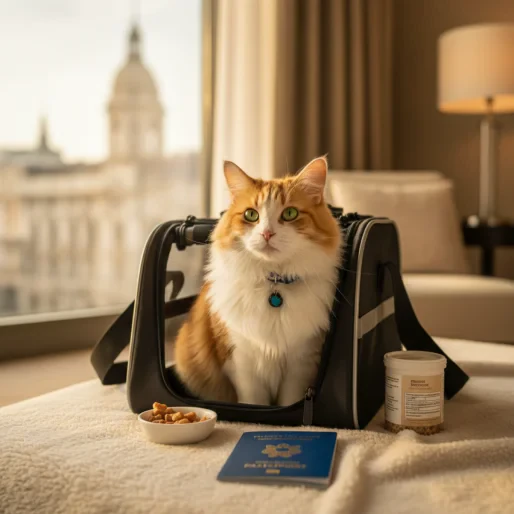
- EU Pet Passport (with current rabies vaccination record).
- Printed copy of the airline's pet policy and booking confirmation showing the pet reservation.
- Microchip number written down separately in case the passport is misplaced.
- Absorbent pads and a small pack of unscented pet wipes for in-carrier clean-up.
- A collapsible water bowl and a small bottle of water.
- A spare zip-lock bag with a small portion of the cat's regular food for delays.
- Contact details for a veterinary clinic near your destination airport.
- Any prescribed medication with the vet's dosage instructions.
- A recent photograph of the cat on your phone, in case the cat escapes and you need to show airport staff.
For owners who also travel with dogs, GPS Pet Trackers in 2026 Compared reviews tracking devices that add an extra layer of security during transit.
Seasonal Considerations for Cat Air Travel
Summer (June to August)
- Ground temperatures at southern European airports can exceed airline thresholds for cargo transport. Book early morning or late evening flights when possible.
- Ensure the carrier has maximum ventilation. Avoid dark-coloured carriers that absorb heat.
- Carry extra water and a cooling mat insert for the carrier floor.
Winter (November to February)
- Cold tarmac temperatures can affect cargo-hold travellers. A thermal blanket inside the crate helps maintain body warmth.
- Indoor airport environments may be overheated; watch for signs of panting or restlessness.
Spring and Autumn
- Generally the most comfortable seasons for pet air travel within Europe, with moderate ground temperatures and fewer weather-related flight disruptions.
- Spring travellers should ensure parasite treatments are current, as flea and tick activity increases during warmer months.
Printable Pre-Flight Summary Checklist
Use this condensed checklist as a quick reference before departure day:
- ☐ EU Pet Passport with current rabies vaccination.
- ☐ Microchip scanned and confirmed readable.
- ☐ Tapeworm treatment recorded (if required by destination country).
- ☐ Airline pet booking confirmed; pet fee paid.
- ☐ Carrier dimensions verified against airline policy.
- ☐ Carrier labelled with owner contact details.
- ☐ Absorbent pad placed in carrier base.
- ☐ Familiar scent item inside carrier.
- ☐ Emergency travel kit packed.
- ☐ Food withheld four hours before departure; water available until leaving home.
- ☐ Veterinary clinic near destination airport identified.
- ☐ Printed copy of airline pet policy in hand luggage.
- ☐ Any vet-prescribed medication packed with dosage instructions.
Safe cat travel is largely about thorough preparation. By completing each step in this checklist, owners can significantly reduce risk and stress for both themselves and their feline companion. For those also arranging care for other pets while away, What Pet Sitting Insurance Should Cover outlines the key protections to look for in a pet sitter.
Frequently Asked Questions
Content Disclosure
This article was created using state-of-the-art AI models with human editorial oversight. It is intended for informational and entertainment purposes only and does not constitute veterinary medical advice. Always consult a licensed veterinarian for your pet's specific health needs. Learn more about our process.