Choosing a dog daycare in Australia means assessing staff ratios, heat safety protocols, and behavioural screening suited to local conditions. This guide covers what Australian dog owners should look for, from play style grouping to bushfire smoke policies.
Key Takeaways
- Professional guidelines suggest staff-to-dog ratios of roughly 1:6 to 1:10, with lower ratios for puppies, mixed-size groups, or extreme heat days.
- Australian daycares must manage summer heat (regularly above 35°C), high UV exposure, and bushfire smoke risk as part of safe play group operations.
- Effective facilities group dogs by size, energy level, and play style, which is especially important given the prevalence of high-drive working breeds like Kelpies and Border Collies in Australian daycare populations.
- Behavioural screening before admission should span at least one to two sessions and include questions about bite history, resource guarding, and vaccination status.
- Red flags include no temperament testing, overcrowded yards with no shade, and staff using aversive tools such as spray bottles, prong collars, or alpha rolls.
Why Play Group Management Matters for Australian Dogs
Dog daycare is increasingly popular across Australian cities and regional centres, reflecting the nation's high rate of pet ownership. However, the quality of play group management directly affects canine welfare. Poorly supervised or randomly assembled groups can lead to stress, fear conditioning, resource guarding incidents, and bite injuries. The Australian Veterinary Association (AVA) emphasises that structured socialisation and appropriate supervision are essential for dogs in group care settings.
Australia's climate and wildlife hazards add layers of complexity that generic international advice does not address. Outdoor play yards in Queensland, New South Wales, and Western Australia can reach ground temperatures dangerous enough to burn paw pads during summer months. Bushfire smoke events can make outdoor play unsafe for days at a time. Facilities in tick-prone coastal areas from northern New South Wales through to Far North Queensland must also account for paralysis tick risk. Understanding these local factors helps owners choose a daycare that is genuinely equipped for Australian conditions.
How Dogs Interact in Groups: Australian Considerations
Dogs are social animals, but not every dog thrives in a large, free-form play group. Canine social behaviour is shaped by early socialisation history, breed-typical tendencies, individual temperament, and prior learning. This is particularly relevant in Australia, where popular breeds include high-energy working dogs (Kelpies, Cattle Dogs, Border Collies) alongside Staffordshire Bull Terriers, Labrador Retrievers, and a wide variety of mixed breeds.
Arousal and Overstimulation
In group play, arousal can escalate quickly. Healthy play involves frequent role reversals, self-handicapping, and play signals such as the play bow. When arousal tips into overstimulation, dogs may begin body-slamming, pinning, mounting, or engaging in relentless chasing without pauses. Australian working breeds are often bred for sustained high activity, meaning they may take longer to self-regulate in group settings. Professional trainers recognise this shift as the point where staff intervention is needed.
Stress Signals Staff Should Recognise
Well-trained daycare staff should identify stress signals including lip licking, yawning out of context, whale eye (showing the whites of the eyes), tucked tails, displacement sniffing, and attempts to hide. These subtle signals often precede more overt warnings such as growling, snapping, or freezing. Facilities that wait for overt aggression before intervening are reacting too late.
For more on how breed traits affect group dynamics, see What to Tell Your Dog Sitter About Your Dog's Breed Traits.
Heat, UV, and Smoke: Environmental Management in Australian Daycares
Australian daycares face environmental challenges that facilities in temperate climates rarely encounter. Owners should assess how a facility manages these risks as a core part of their evaluation.
Heat and UV Protocols
On days above 32°C, outdoor play should be limited to early morning and late afternoon. Ground surface temperature on concrete or artificial turf can exceed air temperature by 20°C or more in direct sun. Quality facilities will have shaded outdoor areas (shade sails or solid roofing over at least 50% of outdoor space), access to fresh water at multiple stations, cooling mats or paddling pools, and a clear policy for cancelling or moving outdoor play indoors when temperatures exceed a set threshold, typically around 35°C to 37°C.
UV exposure is also a concern for dogs with thin coats, pink skin, or light-coloured noses. Breeds such as Dalmatians, Bull Terriers, and Whippets are particularly vulnerable to sunburn.
Bushfire Smoke Days
During bushfire season (typically October through March, though increasingly variable), smoke haze can make outdoor play hazardous. Dogs with brachycephalic airways (Bulldogs, Pugs, French Bulldogs) are at heightened risk. Ask the daycare whether they monitor air quality index (AQI) readings and at what threshold they move all dogs indoors. A facility with no indoor play space may need to close entirely on poor air quality days.
Wildlife and Tick Hazards
Daycares in semi-rural areas or near bushland should have protocols for snake sightings, especially during warmer months when brown snakes and tiger snakes are active. Facilities in paralysis tick zones (coastal areas of eastern Australia) should conduct tick checks and require dogs to be on current tick prevention. [LOCAL_VET_EMERGENCY_en-au]
Staff-to-Dog Ratios
Staffing ratios are arguably the single most important safety variable. Professional recommendations typically suggest a ratio of 1 staff member to every 6 to 10 dogs, though several factors should lower that number.
Factors That Should Lower the Ratio
- Groups including puppies under 6 months: A ratio closer to 1:4 or 1:5 is advisable.
- Mixed-size groups: When dogs under and over approximately 15 kg share space, closer supervision is essential to prevent predatory drift.
- Extreme heat days: Staff need to monitor hydration, panting levels, and signs of heat stress individually, which is harder at higher ratios.
- New or recently admitted dogs: Dogs in their first week are still adjusting and may display atypical behaviour.
What to Ask the Facility
Ask directly: "What is your staff-to-dog ratio during peak hours?" A facility that cannot answer clearly may not have a formal policy. Follow up by asking whether ratios change when staff take breaks, during feeding times, or during transitions between indoor and outdoor areas. Many Australian daycares charge between $40 and $75 AUD per day; staffing is typically the largest cost driver, so unusually cheap rates may indicate understaffing.
Grouping by Play Style, Not Breed Alone
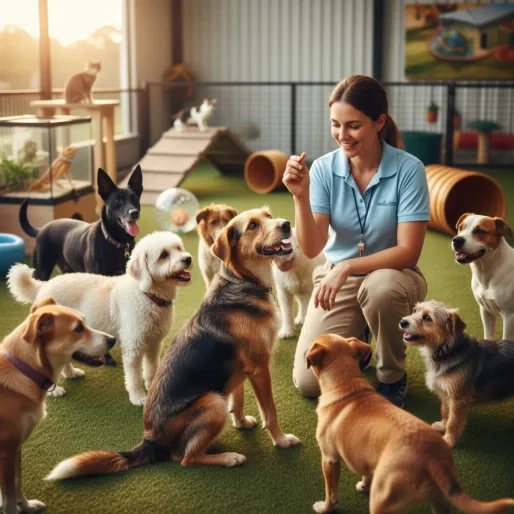
Grouping dogs purely by breed is overly simplistic. A calm, elderly Labrador has little in common behaviourally with a high-drive adolescent Kelpie. Effective daycares group by a combination of size, energy level, play style, and social confidence.
Play Style Categories
- Body slammers and wrestlers: Dogs who prefer full-contact play. Staffordshire Bull Terriers, Boxers, and many bully-type mixes often fall here.
- Chasers and runners: Dogs who prefer pursuit games. Kelpies, Border Collies, Cattle Dogs, and Greyhounds often gravitate toward this style, though herding breeds may nip during chase play, which can upset other dogs.
- Gentle or parallel players: Dogs who prefer proximity without intense interaction. Many Cavalier King Charles Spaniels, senior dogs, and lower-confidence dogs do well in this group.
- Rough-and-tumble generalists: Highly social dogs comfortable across styles. Many Labradors, Golden Retrievers, and well-socialised mixed breeds fit here.
Size Separation
Most guidelines recommend separating dogs into at least two size categories, typically under and over approximately 15 kg. Some facilities use three tiers: small (under 10 kg), medium (10 to 25 kg), and large (over 25 kg). Ask: "Do you ever mix size groups, and under what circumstances?"
Behavioural Screening and Vaccination Requirements
A thorough behavioural screening before a dog joins a play group is one of the strongest indicators of a quality facility.
What a Good Screening Looks Like
- Owner questionnaire: Covering the dog's socialisation history, known triggers, bite history, resource guarding tendencies, and any veterinary behavioural diagnoses.
- Individual assessment: Staff observe the dog alone in the facility to gauge how it handles the new environment.
- Graduated introduction: The dog meets one or two calm "ambassador" dogs before joining a larger group.
- Ongoing evaluation: Reputable facilities reassess dogs periodically, especially after absences or reported changes in behaviour.
Vaccination Requirements in Australia
Australian daycares should require proof of current C5 vaccination, which covers distemper, hepatitis, parvovirus, parainfluenza, and Bordetella bronchiseptica (kennel cough). Some facilities accept C3 with a separate kennel cough intranasal vaccine. Puppies should have completed their primary vaccination course before entering group play. Facilities should also ask about tick and flea prevention status, particularly in endemic areas.
Breed-Specific Legislation
Owners should be aware that breed-specific legislation (BSL) varies by state and territory in Australia. Restricted breeds (such as the American Pit Bull Terrier, Dogo Argentino, Japanese Tosa, Fila Brasileiro, and Presa Canario) are subject to specific regulations in most jurisdictions, and some daycares may decline to accept restricted or declared dangerous dogs due to insurance and liability requirements. Check your state or territory's companion animal legislation for current rules.
Red Flags and Common Mistakes
- Prioritising aesthetics over management: A stylish facility with poor supervision is far less safe than a plain but well-staffed one.
- No heat policy: Any Australian daycare without a written extreme heat protocol is a serious concern.
- Aversive tools: Prong collars, choke chains, shock collars, citronella sprays, or shake cans conflict with force-free principles endorsed by the AVA and international bodies such as the IAABC.
- Not visiting during operating hours: Tours conducted when no dogs are present reveal nothing about group management. Ask to observe a play session in progress.
- Ignoring your dog's signals after daycare: A dog who comes home hypervigilant or with increased reactivity on walks may be stressed, not "tired from playing."
- No structured rest periods: Dogs need downtime during a full day of care. Facilities offering nonstop play for 8 to 10 hours risk chronic overstimulation.
If you use a pet camera at home to observe your dog's behaviour after daycare, it can reveal whether your dog is decompressing normally. Learn more at How Indoor Pet Cameras Help You Monitor Behaviour While Away.
When to Consult a Professional Behaviourist
Some situations require expertise beyond what daycare staff can provide. Owners should consult a qualified veterinary behaviourist or a trainer with credentials such as CPDT-KA (Certification Council for Professional Dog Trainers) or membership in the Pet Professional Guild Australia (PPGA) if:
- Their dog has been asked to leave one or more daycares due to aggression or inability to settle.
- The dog shows increased leash reactivity after starting daycare.
- Resource guarding behaviour has developed or worsened.
- The dog displays compulsive behaviours such as repetitive circling or excessive licking after sessions.
Professional assessment can determine whether daycare is appropriate for that individual dog, or whether alternatives such as private dog walking, small-group outings, or in-home care would be a better fit. For emergency behavioural concerns in young dogs, consult Recognising When Symptoms Require Immediate Vet Attention.
Evaluation Checklist for Australian Dog Daycares
- Staff-to-dog ratio is clearly stated and maintained at 1:6 to 1:10 (lower for puppies, mixed sizes, or hot days).
- Dogs are grouped by size, energy level, and play style.
- A structured behavioural screening spans at least one to two sessions before full group admission.
- Staff can describe canine stress signals when asked.
- Only positive reinforcement and force-free management tools are used.
- Structured rest periods are built into the daily schedule.
- Current C5 vaccination (or equivalent) is required, along with tick and flea prevention in endemic areas.
- A written extreme heat and bushfire smoke policy exists.
- Outdoor areas have adequate shade covering at least half the space.
- Owners are welcome to observe a live play session before enrolling.
- Daily reports include specific behavioural observations.
- The facility has a clear incident protocol, including how and when owners are notified.
Choosing the right daycare is one of the most consequential decisions an owner can make for a social dog's wellbeing. By understanding what professional-standard play group management looks like in the Australian context, owners can confidently select a facility that keeps their dog safe, happy, and behaviourally healthy year-round.
Frequently Asked Questions
What vaccinations should an Australian dog daycare require? ↓
How should Australian daycares manage extreme heat days? ↓
What is a safe staff-to-dog ratio for daycare in Australia? ↓
Are there breed restrictions at Australian dog daycares? ↓
What should I do if my dog seems stressed after daycare? ↓

Mark Sullivan
Certified Professional Dog Trainer
Certified professional dog trainer — positive-reinforcement methods for every breed and behavioural challenge.
Content Disclosure
This article was created using state-of-the-art AI models with human editorial oversight. It is intended for informational and entertainment purposes only and does not constitute veterinary medical advice. Always consult a licensed veterinarian for your pet's specific health needs. Learn more about our process.