
In this article
- Key Takeaways
- Why Australian Conditions Change the Equation
- Feeder Types and Portion Accuracy
- Wet Food in Australian Heat: A Serious Risk
- Wi-Fi Failures and Power Outages
- Preventing Jams and Tampering
- Water Sources: More Critical in Australian Climates
- Litter, Environment, and Seasonal Hazards
- Cats with Medical Conditions
- Finding a Reliable Pet Sitter or Boarding Facility
- Testing Your Feeder: The Recommended Timeline
- Myth vs Reality
- Quick Reference Fact Box
- Final Word
Key Takeaways
- Smart feeders reliably dispense dry food on a schedule, but they are not a substitute for a human checking in on your cat, particularly during Australian summers when heat poses a genuine risk.
- Portion accuracy varies by feeder type and kibble shape, with dispensing errors of 10 to 20 percent common in gravity and rotating tray models.
- Wi-Fi and app connectivity can fail without warning, so always confirm your feeder works offline before heading away.
- Wet food feeders carry serious food safety risks in Australian ambient temperatures, especially above 30°C, where spoilage can begin within two hours.
- Every weekend plan should include a backup caregiver, multiple water sources, clean litter provisions, and awareness of seasonal hazards like extreme heat or bushfire smoke.
Why Australian Conditions Change the Equation
Australia's climate introduces variables that many global feeder guides overlook. Summer temperatures regularly exceed 40°C in parts of New South Wales, Victoria, Queensland, South Australia, and Western Australia. Even in well-insulated homes, indoor temperatures can climb significantly if air conditioning fails during a power outage, which is more common during peak demand heatwave days. This affects both food freshness and your cat's hydration needs.
The Australian Veterinary Association (AVA) recommends that cats should not be left unattended in environments where indoor temperatures cannot be reliably controlled. During summer weekends away, a smart feeder alone is never sufficient. A trusted person, whether a friend, neighbour, or professional pet sitter, should check that your home's cooling is functioning, water sources are topped up, and your cat is showing no signs of heat stress such as panting, lethargy, or drooling.
In tropical regions like Far North Queensland and the Top End, humidity adds another layer of concern. High moisture levels accelerate dry food staleness and can encourage mould growth in the hopper within 48 hours if the feeder is not sealed properly.
Feeder Types and Portion Accuracy
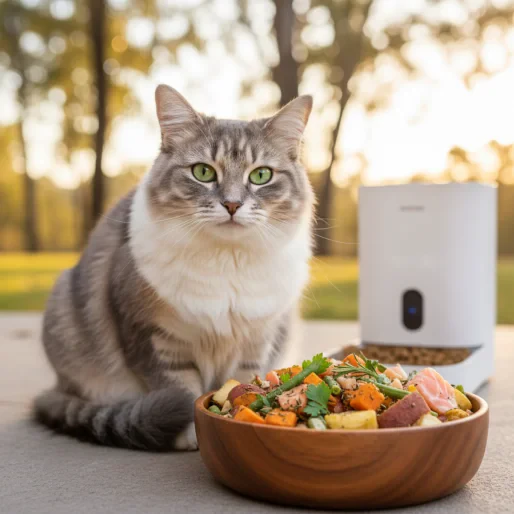
The three main feeder types available in Australia are hopper (auger) models, rotating tray feeders, and gravity feeders. Hopper feeders with auger mechanisms typically deliver portions within 5 to 10 percent of the target amount and are the most reliable for weekend use. Rotating tray feeders use pre-portioned compartments, removing dispensing variability but limiting flexibility. Gravity feeders are the least suitable for controlled feeding, as they allow cats to eat freely and often lead to overconsumption.
The World Small Animal Veterinary Association (WSAVA) emphasises the importance of accurate calorie control, particularly for overweight cats. With feline obesity rates in Australia estimated to affect a significant proportion of the domestic cat population, portion accuracy matters. Before any trip, weigh several test portions using a kitchen scale to verify the feeder dispenses the correct amount with your specific kibble brand and shape. Irregularly shaped or very small kibble pieces are more prone to jamming or over-dispensing.
Wet Food in Australian Heat: A Serious Risk
Wet cat food left at room temperature is a bacterial growth risk after roughly two to four hours under standard conditions. In Australian summers, where indoor temperatures without air conditioning can easily reach 30°C or higher, that window shrinks further. Some feeders include ice packs or sealed compartment lids, but these typically keep food safe for only four to eight hours at best, and considerably less in warm environments.
Over a 48 to 60 hour weekend, no consumer-grade feeder can safely maintain wet food through multiple meals in Australian conditions. Cats that eat exclusively wet food present a genuine challenge. In these cases, arranging for a professional pet sitter or boarding facility is the only responsible option.
Wi-Fi Failures and Power Outages
A well-designed smart feeder should store the feeding schedule on the device itself and dispense meals regardless of internet connectivity. If the feeder relies entirely on cloud-based commands, a Wi-Fi outage or router reset could mean missed meals. Before purchasing, confirm that the feeder supports offline scheduling.
Power outages deserve special attention in Australia. Summer storms, bushfire-related grid shutdowns, and heatwave load-shedding can all knock out mains power. Many smart feeders include battery backup using D-cell or AA batteries, which keeps the dispensing motor and clock running. However, battery backup typically does not power the camera or Wi-Fi module. Install fresh batteries before every trip, even if the feeder is normally plugged in. Feeders without any battery backup option are unsuitable for unsupervised use in Australia.
Preventing Jams and Tampering
Jams are the worst-case scenario for a weekend away. Prevention strategies include using uniformly shaped, medium-sized kibble as recommended by the feeder manufacturer, avoiding overfilling or underfilling the hopper, cleaning the dispensing mechanism before each trip, and running a full 24-hour test at home before relying on the feeder unsupervised.
Cats are persistent problem solvers. Australian cat forums are full of accounts of cats prying open lids, batting at dispensing chutes, or knocking feeders off benchtops. Hopper feeders with twist-lock lids and narrow dispensing channels tend to be the most tamper-resistant. Heavier feeders or those with anti-tip bases are worth considering. Some owners secure feeders to the wall or place them inside a sturdy enclosure. Test your cat's determination well before your trip.
Water Sources: More Critical in Australian Climates
At minimum, two independent water sources are recommended for any weekend absence. A pet water fountain with a filter is a solid primary source, and a heavy, tip-resistant bowl of fresh water serves as backup. In Australian conditions, where dehydration risk is higher during warm months, three water stations spread across different rooms is a better approach. Cats on dry food diets need more water than those eating wet food, and a single water bowl is a single point of failure: it can be tipped, contaminated, or simply run dry faster in the heat.
Automatic water fountains can also malfunction, so redundancy is essential. Consider placing one water source in the coolest room of the house, away from direct sunlight.
Litter, Environment, and Seasonal Hazards
For a weekend absence, provide at least two clean litter boxes (the standard guideline from veterinary professionals is one per cat plus one extra). In warmer weather, litter can develop odour more quickly, which may discourage use and lead to toileting issues.
Before leaving, conduct a home safety check. Secure windows and doors (keeping in mind that cats should be kept indoors or in secure enclosures in many Australian council areas to protect native wildlife). If your property backs onto bushland, be aware of seasonal snake activity, particularly in spring and summer. Brown snakes and tiger snakes are among the most dangerous, and a cat left alone has no human to intervene if an encounter occurs through a screen door or open window.
During bushfire season, consider whether your area is at risk and whether smoke exposure could affect your cat's respiratory health. If a total fire ban or severe weather warning is issued for your area while you are away, your backup caregiver should know the plan for evacuating your cat.
Animal Emergency Service (AES)
Call the Animal Emergency Service or find your nearest 24-hour emergency vet clinic.
AES operates in QLD, NSW, and VIC. For other states, search for your nearest after-hours veterinary hospital.
Cats with Medical Conditions
Cats with diabetes, kidney disease, hyperthyroidism, or other conditions requiring precise meal timing, medication, or monitoring should not be left with only an automatic feeder. Diabetic cats receiving insulin injections need a human to administer medication and watch for signs of hypoglycaemia. Even cats on oral medications cannot be reliably dosed via a feeder.
The AVA's position is clear: medically complex cats need hands-on care during owner absences. Discuss a boarding or in-home sitting plan with your veterinarian before travelling.
Finding a Reliable Pet Sitter or Boarding Facility
For daily check-ins, consider a professional pet sitter accredited through a recognised Australian body such as Pet Sitters Australia. When evaluating boarding catteries, look for facilities that meet the relevant state or territory standards. In Victoria, for example, boarding establishments must comply with the Domestic Animals Act 1994. In New South Wales, local councils administer boarding facility approvals. Ask about cat-only boarding areas, ventilation, cooling systems, and emergency veterinary arrangements.
If you are considering a professional pet sitter for daily visits, our guide on How to Become a Certified Pet Sitter in Australia explains the training and standards to look for when hiring one. Our article on how to choose a boarding facility covers evaluation criteria that apply to cat boarding as well.
Testing Your Feeder: The Recommended Timeline
Most experienced owners and pet care professionals recommend at least one to two weeks of supervised use before relying on a feeder during an absence. During this period, verify portion accuracy with a kitchen scale, observe whether your cat eats comfortably from the feeder, check for jamming or dispensing issues, confirm that the app and notifications work reliably, and test what happens during a simulated power or Wi-Fi outage. A single successful run is not enough. Run through multiple full daily cycles to catch intermittent problems.
Myth vs Reality
Myth: A smart feeder and a water fountain mean my cat is fully sorted for the weekend.
Reality: Food and water are only two needs. Litter hygiene, temperature control (critical in Australian summers), medical emergencies, and emotional wellbeing all require a human presence or at least a daily check-in.
Myth: Indoor cats in Australia are safe from all hazards when left alone.
Reality: Heatstroke from air conditioning failure, bushfire smoke infiltration, and even snake encounters through screen doors are real risks that a feeder cannot address.
Myth: Feeders with Wi-Fi always let you monitor meals remotely.
Reality: Wi-Fi-dependent features fail when the internet drops. Only feeders with local onboard scheduling continue dispensing reliably during outages.
Myth: Automatic feeders are perfectly accurate with portion sizes.
Reality: Most consumer feeders have a margin of error from 5 to 20 percent depending on kibble type and mechanism. Gravity feeders offer the least control.
Quick Reference Fact Box
- Maximum recommended alone time (healthy adult cat): 24 to 48 hours, with at least one daily human check-in.
- Typical dry food feeder portion accuracy: Within 5 to 15 percent for hopper/auger models; less predictable for gravity models.
- Wet food safety at Australian room temperature: Approximately 2 hours at 30°C or above; up to 4 hours below 25°C.
- Battery backup runtime: Typically 3 to 6 months on standby; check manufacturer specs for active dispensing duration.
- Recommended test period before a trip: 1 to 2 weeks of supervised daily use.
- Minimum water sources for an Australian weekend: 2 to 3 independent sources in different locations, preferably in the coolest rooms.
- Minimum litter boxes for a weekend: 2 clean boxes (one per cat plus one extra).
Final Word
Smart automatic feeders are a genuinely useful tool for Australian cat owners who travel, but they work best as one piece of a well-considered weekend plan. The feeder handles scheduled dry food delivery. Everything else, from fresh water to litter hygiene to temperature management and emergency response, requires backup systems, redundancy, or a trusted person stopping by. In a country where summer heat can turn a comfortable home into a dangerously warm environment within hours of an air conditioning failure, the human safety net is not optional. Test thoroughly, plan for failures, account for seasonal hazards, and always have someone your cat can rely on.
Frequently Asked Questions
Content Disclosure
This article was created using state-of-the-art AI models with human editorial oversight. It is intended for informational and entertainment purposes only and does not constitute veterinary medical advice. Always consult a licensed veterinarian for your pet's specific health needs. Learn more about our process.