Retired greyhounds transitioning to Canadian homes face unique challenges from harsh winters to provincial regulations. This guide covers behaviour, climate safety, and evidence-based care for new greyhound owners across Canada.
Key Takeaways
- Retired greyhounds are low-energy indoors, typically needing only a 20 to 30 minute walk, but Canadian winters demand cold-weather gear and adjusted routines.
- Prey drive is a hardwired sighthound trait requiring structured management, not punishment. The Canadian Veterinary Medical Association (CVMA) supports force-free training methods.
- Greyhounds sleep 16 to 18 hours daily and need orthopaedic bedding to prevent pressure sores on their thin skin.
- Provincial animal welfare legislation varies: familiarise yourself with your province's licensing, leash laws, and muzzle regulations before adoption.
- Consult a veterinary behaviourist or IAABC-certified consultant if fear, anxiety, or predatory behaviour escalates beyond manageable levels.
Why Canadian Adopters Should Know the Greyhound's Background
Greyhounds raised in racing environments have a developmental history unlike most companion dogs. Socialised primarily with other greyhounds, housed in kennel settings, and conditioned to chase a lure, they develop three core behavioural tendencies: a calm indoor temperament, pronounced prey drive, and a deep need for rest and nesting. None of these traits are pathological. They are normal behavioural adaptations shaped by genetics and lived experience.
In Canada, most retired racing greyhounds are rehomed through dedicated adoption organisations that import dogs from the United States, as domestic racing has largely ceased. This means many dogs arriving in Canada have never experienced snow, freezing temperatures, or the seasonal extremes that characterise much of the country. Understanding this gap in experience is essential for a smooth transition.
The Three-Three-Three Transition Timeline
The First Three Days: Overwhelm and Shutdown
A newly adopted greyhound may appear withdrawn, refuse food, startle at household sounds (televisions, furnaces cycling on, garage doors), or freeze on unfamiliar surfaces. Many racing greyhounds have never lived inside a home. Stairs, hardwood floors, glass patio doors, and mirrors are entirely novel stimuli.
During Canadian winters, the first few days present an additional layer of sensory overload. Snow, ice, road salt, and sub-zero temperatures are completely foreign. A greyhound encountering snow for the first time may refuse to walk or lift its paws repeatedly. Keep initial outdoor trips very short (5 minutes or less in temperatures below minus 10°C) and watch closely for signs of discomfort.
Three Weeks: Emerging Personality
Around the three-week mark, the dog's true temperament surfaces. Owners may notice increased confidence or, conversely, the emergence of anxiety-based behaviours previously suppressed. Resource guarding, separation distress, and noise sensitivity commonly appear during this phase.
This is the ideal time to establish predictable routines around feeding, walks, and rest. Greyhounds, having spent their lives on highly structured schedules, find routine deeply reinforcing. In Canada, where daylight hours shift dramatically between seasons, maintaining consistent walk times year-round helps stabilise the dog's expectations.
Three Months: Settled but Still Learning
By approximately three months, most retired greyhounds have integrated into household rhythms. However, behavioural maturation can extend well beyond this window. Some greyhounds require six months or longer to fully decompress, particularly those with limited socialisation histories.
Canadian Winter Safety for Greyhounds
Greyhounds have virtually no subcutaneous body fat and a thin single-layer coat, making them exceptionally vulnerable to cold. In much of Canada, where temperatures routinely drop below minus 20°C and can reach minus 30°C or colder on the Prairies and in Northern Ontario, winter management is not optional.
Cold Weather Essentials
- Insulated coat or snowsuit: A fleece-lined, waterproof coat that covers the chest, belly, and back is essential. Expect to spend $60 to $150 CAD on a well-fitted greyhound coat from Canadian pet retailers. Standard dog coats rarely fit a greyhound's deep chest and narrow waist; look for sighthound-specific designs.
- Protective boots: Road salt and de-icing chemicals (commonly calcium chloride) are toxic if ingested through paw licking and can cause chemical burns on paw pads. Boots rated for Canadian winters typically cost $40 to $80 CAD. If the dog refuses boots, a paw wax balm offers partial protection.
- Shortened walks: In temperatures below minus 15°C, limit outdoor time to 10 to 15 minutes. Watch for signs of hypothermia: shivering, reluctance to move, whining, or lifting paws. Frostbite can affect ear tips and tail ends.
- Indoor enrichment: On days when outdoor exercise is unsafe, snuffle mats, food puzzle toys, and flirt poles (used indoors with supervision) help channel energy and predatory motor patterns into safe outlets.
Spring and Summer Considerations
In Central and Eastern Canada, summer humidity can push humidex values above 35°C. Greyhounds are susceptible to heatstroke due to their lean build and high muscle mass. Walk during early morning or evening hours, carry water on every outing, and avoid hot pavement. A general guideline: if the asphalt is too hot for your palm held flat for seven seconds, it is too hot for paw pads.
Tick-borne illness is an increasing concern across Southern Ontario, Quebec, the Maritimes, and parts of British Columbia. Discuss tick prevention with your veterinarian, as Lyme disease cases in dogs continue to rise in these regions.
Prey Drive: Management in the Canadian Context
Prey drive in greyhounds is not aggression. It is a genetically influenced predatory motor sequence: orient, eye, stalk, chase, grab, bite. Racing further reinforces the chase phase. This becomes a management concern when the household includes cats, rabbits, small dogs, or when encountering urban wildlife such as squirrels, rabbits, and raccoons common in Canadian neighbourhoods.
Management Strategies
- Physical separation: Baby gates, closed doors, and separate living zones are non-negotiable when prey drive is present.
- Muzzle conditioning: Many retired greyhounds arrive muzzle-trained. Maintaining positive muzzle associations through counter-conditioning (pairing the muzzle with high-value treats) provides an essential safety layer. Note that some Canadian municipalities have specific muzzle bylaws; check your local regulations.
- Leash management outdoors: Greyhounds should not be off leash in unfenced areas. A long line (5 to 10 metres) in secure spaces offers a compromise. Many Canadian off-leash dog parks are unfenced, so use extreme caution. A greyhound in full sprint can reach 65 km/h and will not respond to recall once prey drive is triggered.
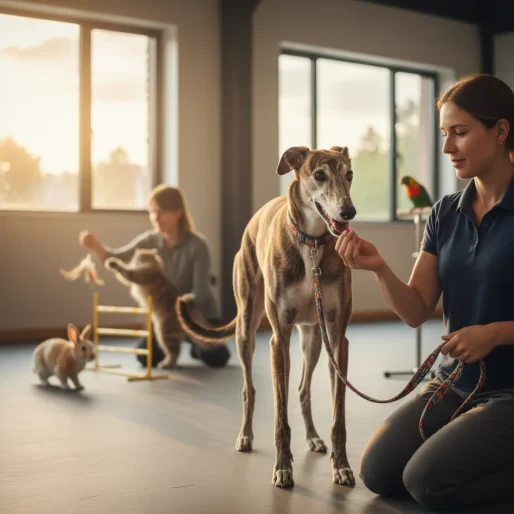
- Controlled introductions with small animals: Follow systematic desensitisation protocols. Begin with scent exchange, progress to visual exposure below the reactivity threshold, and reinforce calm behaviour.
What Not to Do
Punishment-based approaches, including leash corrections, shock collars, or verbal reprimands for chasing behaviour, are contraindicated. The CVMA's position statement on humane training supports the use of positive reinforcement methods. Research consistently demonstrates that aversive methods increase fear and anxiety without reliably suppressing predatory behaviour.
Sleep, Nesting, and Bedding
Greyhounds rest or sleep 16 to 18 hours per day. This is normal and not a sign of depression or illness, provided the dog is alert during waking hours.
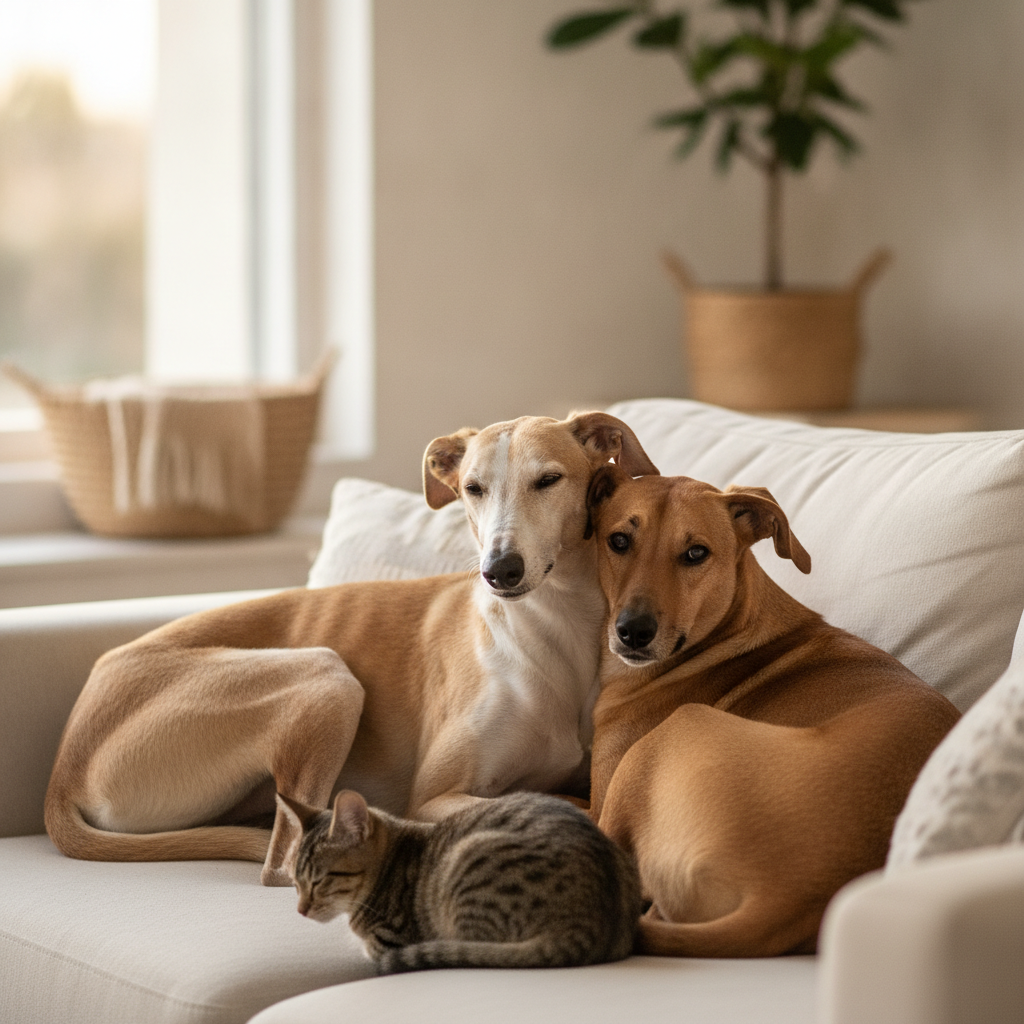
Pronounced nesting behaviour includes circling, pawing at bedding, dragging blankets, and "roaching" (lying on their backs with legs in the air). Roaching indicates comfort and relaxation.
Because greyhounds have very low body fat and thin skin, pressure sores develop easily on elbows, hocks, and hips. Orthopaedic or memory foam beds are strongly recommended. In Canadian winters, placing the bed away from drafty windows and exterior walls helps maintain warmth. A heated pet pad (thermostatically controlled) can provide additional comfort for older retirees, typically costing $40 to $70 CAD.
For greyhounds showing joint stiffness, particularly older retirees, Dog Hydrotherapy After Surgery: Canadian Cost Guide can support mobility and comfort.
Provincial Regulations and Veterinary Considerations
Canadian pet owners should be aware of several regulatory and health considerations specific to greyhound adoption:
- Provincial licensing: Most municipalities require dog licensing. Fees vary widely, from around $20 to $60 CAD annually. Some municipalities offer reduced fees for spayed or neutered dogs, which most retired greyhounds will be.
- Breed-specific legislation: As of the time of writing, no Canadian province has breed-specific legislation targeting greyhounds. However, Ontario's former pit bull ban (repealed in 2024) illustrates that breed legislation can change. Stay current with your provincial and municipal bylaws.
- Core vaccinations: The CVMA recommends core vaccines including rabies (legally required in most provinces), distemper, adenovirus, parvovirus, and parainfluenza. Discuss a vaccination schedule with your veterinarian, as some retired racers may have incomplete or undocumented vaccine histories.
- Greyhound-specific anaesthesia risks: Greyhounds metabolise certain drugs differently due to their low body fat and unique liver enzyme profile. Barbiturate-based anaesthetics are avoided in greyhounds. Ensure your veterinarian is aware of sighthound-specific protocols before any surgical or dental procedure.
- Pet insurance: With veterinary costs rising across Canada, pet insurance is worth considering. Expect premiums of $40 to $80 CAD per month for a retired greyhound, depending on age and province. Pre-existing conditions from racing careers (often orthopaedic) may be excluded.
ASPCA Animal Poison Control / Local Emergency Vet
Call the ASPCA Poison Control hotline (also serves Canada) or contact your nearest emergency veterinary hospital.
The ASPCA hotline charges a consultation fee. For non-poison emergencies, search for a 24-hour veterinary hospital in your city.
Fear, Anxiety, and When to Seek Professional Help
Retired greyhounds frequently present with context-specific anxiety. Common triggers include novel surfaces, household sounds, isolation distress, and handling sensitivity. For grooming approaches that minimise stress, see the Low-Stress Grooming for Anxious Dogs in Canada resource.
Counter-conditioning and systematic desensitisation remain the gold standard for fear-based behaviours. For noise sensitivity, playing recorded sounds at low volume during mealtimes and gradually increasing volume over weeks is effective. For surface aversion, non-slip mats or rugs creating "stepping stone" paths across slippery floors allow the dog to navigate while confidence builds.
Seek professional assessment from a veterinary behaviourist (Diplomate ACVB) or IAABC-certified consultant if fear responses escalate despite consistent efforts over two to four weeks, the dog displays aggression in any context, self-injurious behaviour occurs, or separation distress is severe. In Canada, veterinary behaviourists can be located through the American College of Veterinary Behaviorists directory, which includes Canadian diplomates. Your primary care veterinarian may also recommend adjunctive pharmacological support when behaviour modification alone is insufficient.
First-Week Checklist for Canadian Greyhound Adopters
- Orthopaedic bed with washable cover, plus two or more soft blankets for nesting.
- Correctly fitted martingale collar (standard collars slip over a greyhound's narrow head).
- Non-slip mats or rugs for hardwood and tile floors.
- Baby gates for room separation, especially with small pets.
- A basket muzzle with positive conditioning treats.
- High-value training treats for counter-conditioning.
- Insulated, sighthound-specific winter coat and protective boots.
- Paw wax or balm for salt and ice protection.
- Municipal dog licence application for your city or town.
- A predictable daily schedule shared with all household members.
- Contact details for a local veterinary behaviourist or IAABC consultant.
A Rewarding Choice for Canadian Homes
Adopting a retired greyhound is an exercise in patience, empathy, and behavioural literacy. With science-based management, realistic expectations around prey drive, and a commitment to the decompression timeline, retired greyhounds consistently prove to be among the most rewarding adoption choices. Their calm indoor temperament, gentle disposition, and adaptability to apartments and houses alike make them well suited to Canadian living, provided owners prepare for the seasonal demands of the climate and understand the unique needs of these remarkable dogs.
For families considering digestive health support during the transition, the probiotics guide offers evidence-based options. Owners managing seasonal allergy flare-ups will also find targeted nutritional guidance helpful.
Frequently Asked Questions
Can retired greyhounds handle Canadian winters? ↓
Do I need a licence for a greyhound in Canada? ↓
Are greyhounds safe around cats and small pets? ↓
How much does pet insurance cost for a retired greyhound in Canada? ↓
What anaesthesia risks are specific to greyhounds? ↓

David Okafor
Certified Animal Behaviourist
Certified animal behaviourist — science-based strategies for fear, anxiety, reactivity, and behavioural challenges.
Content Disclosure
This article was created using state-of-the-art AI models with human editorial oversight. It is intended for informational and entertainment purposes only and does not constitute veterinary medical advice. Always consult a licensed veterinarian for your pet's specific health needs. Learn more about our process.