Canadian cat daycares vary widely in quality, and provincial licensing rules add another layer to evaluate. Here is how to find a facility that delivers genuine feline enrichment, not just supervised storage.
Key Takeaways
- Enrichment focused cat daycares provide vertical climbing structures, scent zones, and hiding spots aligned with natural feline behaviour.
- Provincial licensing requirements in Canada vary; always confirm a facility holds current municipal or provincial permits.
- Group size limits of 6 to 10 cats per supervised space are a strong quality indicator endorsed by the Canadian Veterinary Medical Association (CVMA) welfare framework.
- Canadian winters create unique transport risks: sub-zero temperatures demand insulated carriers and minimal car-to-door exposure.
- Red flags include overcrowding, no vertical space, heavy reliance on kennels, and a strong ammonia smell.
Why Enrichment Standards Matter for Canadian Cat Owners
Cats are not small dogs, and feline daycare must respect a fundamentally different set of behavioural needs. Cats are territorial, scent driven, and often solitary by preference. A facility that places multiple unfamiliar cats in a room with a few toys is not providing enrichment; it may be generating chronic low-grade stress.
The Canadian Veterinary Medical Association (CVMA) recognises the five pillars of a healthy feline environment originally outlined by the American Association of Feline Practitioners (AAFP) and the International Society of Feline Medicine (ISFM): a safe space, multiple separated resources, opportunities for play and predatory behaviour, positive human interaction, and respect for the importance of scent. These pillars should be visible in any facility you are considering.
In Canada, pet care is regulated at the provincial and sometimes municipal level. Ontario, British Columbia, Alberta, and Quebec each maintain different licensing frameworks for boarding and daycare facilities. Before visiting, confirm the cattery holds the permits required in your municipality, and check whether your province mandates inspections or complaint mechanisms through bodies such as the Ontario SPCA, the BC SPCA, or the equivalent in your region.
Side by Side Comparison: Enrichment Focused vs. Basic Cat Daycare
| Feature | Enrichment Focused Cattery | Basic or Budget Cattery |
|---|---|---|
| Vertical Space | Floor to ceiling climbing walls, multi-level shelving, catwalks | One or two low cat trees, mostly floor level |
| Scent Enrichment | Dedicated scent zones with catnip, silver vine, valerian; rotated regularly | Occasional catnip toy, no structured scent programme |
| Group Size | 6 to 10 cats per supervised zone, temperament matched | No stated limit or groups exceeding 15 without clear supervision |
| Hiding Spots | Multiple enclosed hides at varying heights, igloo beds, tunnels | Few or no dedicated hiding options |
| Staff Training | Trained in feline body language, stress signals, low-stress handling | General animal care knowledge, limited feline-specific training |
| Introduction Protocol | Gradual introduction over hours or days, isolation room for newcomers | Cats placed into communal area on arrival |
| Litter and Resources | N+1 rule (one litter box per cat plus one extra), separated feeding stations | Shared litter trays and communal feeding bowls |
| Typical Daily Cost (CAD) | $30 to $55 per day, depending on province and level of service | $18 to $28 per day |
What to Look for in a Canadian Cattery
Climbing Structures and Vertical Territory
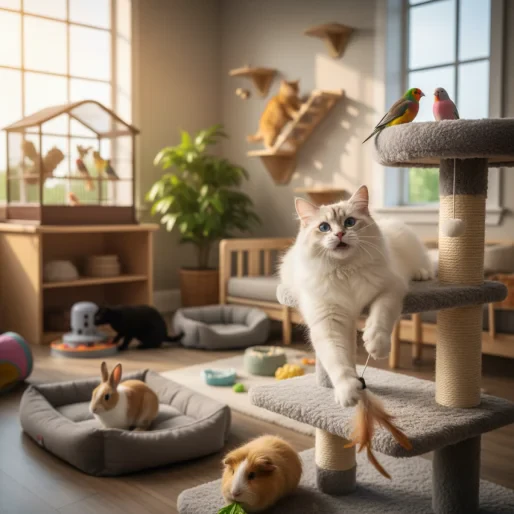
Cats instinctively seek height to survey their surroundings and feel secure. ISFM environmental guidelines treat vertical space as a welfare requirement, not a luxury. An enrichment-focused daycare should offer wall-mounted shelving, multi-level platforms, and catwalks that allow cats to move above ground level. This is especially important in group settings where a less confident cat needs to escape social pressure without physical confrontation.
Look for facilities where vertical structures are distributed throughout the space rather than clustered in one corner. Dead-end perches, where a cat can be cornered by another, are a design flaw. The best layouts provide multiple escape routes at every level.
Scent Zones and Olfactory Enrichment
Cats experience the world primarily through scent. A daycare that addresses this offers rotating scent stations using safe botanicals such as catnip (Nepeta cataria), silver vine (Actinidia polygama), Tatarian honeysuckle, and valerian root. Research published in BMC Veterinary Research suggests silver vine may elicit a positive response in a broader percentage of cats than catnip alone, making a varied programme more inclusive.
Scent zones also redirect attention, reduce boredom, and can diffuse tension. Some facilities use synthetic feline facial pheromone diffusers in communal areas, which veterinary literature associates with reduced stress signs in unfamiliar environments.
Group Size and Temperament Matching
This is perhaps the single most important differentiator. Forcing 15 or 20 unfamiliar cats into one room contradicts their social biology. Professional guidelines generally recommend keeping group sizes in the range of 6 to 10 per supervised space, with cats matched by energy level and sociability.
Ask the daycare how they assess temperament. Reputable Canadian facilities conduct an intake evaluation (often called a "meet and greet" or temperament screen) that examines how the cat responds to handling, novel environments, and the presence of other cats. Cats assessed as solitary or fearful should have access to individual suites rather than being placed in a group by default.
Hiding Spots, Rest Zones, and the Concept of Choice
The concept of "choice and control" is central to modern feline welfare science. A good cattery does not force interaction. It provides enclosed hiding spaces (covered beds, tunnels, elevated igloos) where a cat can retreat. Facilities that treat hiding as "antisocial" misunderstand feline behaviour. A cat that hides initially and gradually emerges over a few days is displaying a normal, healthy coping strategy.
Canadian Climate Considerations: Winter and Summer Risks
Climate is a factor that Canadian cat owners must weigh more heavily than those in milder regions. In provinces like Alberta, Manitoba, Saskatchewan, Ontario, and Quebec, winter temperatures regularly drop below minus 20 °C, and stretches of minus 30 °C are not unusual. Transporting a cat to daycare under these conditions introduces real risk.
Use a hard-sided, insulated carrier for winter drop-offs. Pre-warm your vehicle for at least 10 minutes before placing the cat inside. Ask the facility about their entrance design: a double-door vestibule or heated entryway prevents a blast of frigid air each time the door opens. Facilities that have cats housed near exterior doors without climate buffering should be questioned.
In summer, particularly in southern Ontario and Quebec where humidex values can exceed 40 °C, confirm the cattery has reliable air conditioning. Cats are susceptible to heat stress, and brachycephalic breeds like Persians and Exotic Shorthairs face elevated risk. Ask whether the facility monitors indoor temperature and what their threshold is for activating cooling.
On the Pacific coast, British Columbia offers milder conditions year-round, but coastal catteries should still maintain good ventilation and manage humidity, especially during prolonged rain seasons.
Provincial Licensing and What to Verify
Canada does not have a single national licensing standard for pet care facilities. Regulation falls to provinces and municipalities. Here is what to look for:
- Ontario: The Provincial Animal Welfare Services Act (PAWS Act) sets out standards for animal care. Municipal business licensing may also apply. Confirm the facility is registered and has not been subject to compliance orders.
- British Columbia: The BC SPCA conducts facility assessments and the Prevention of Cruelty to Animals Act applies. Some municipalities require kennel licences.
- Alberta: The Animal Protection Act governs welfare standards. Municipal bylaws often require kennel or cattery permits.
- Quebec: The Animal Welfare and Safety Act (MAPAQ oversight) requires permits for facilities housing animals commercially. Quebec also mandates specific space and care standards.
Regardless of province, always ask to see current business licences and inquire whether the facility carries liability insurance. A cattery that is evasive about licensing is a red flag.
Vaccination and Health Requirements
Most reputable Canadian catteries require proof of current core vaccinations before admission. The CVMA and provincial veterinary associations recommend that cats entering a group facility be vaccinated against feline viral rhinotracheitis, calicivirus, and panleukopenia (the FVRCP combination). Many facilities also require a current rabies vaccination, which is mandatory by law in several provinces including Ontario.
Some catteries request a negative feline leukemia virus (FeLV) test, particularly for cats entering communal play areas. Discuss your cat's vaccination status with your veterinarian well in advance of the first booking, as some vaccines require a two-week lead time before they confer protection.
Lifestyle Match: Which Type of Daycare Fits Your Cat?
The Social, Confident Cat
Cats well socialised from kittenhood and relaxed around unfamiliar cats can thrive in a group daycare with temperament-matched cohorts and plenty of vertical escape routes. Breeds commonly noted for higher sociability include the Ragdoll, Burmese, and Siamese, though individual variation always matters more than breed labels.
The Shy or Senior Cat
For timid or older cats (especially those with mobility limitations or conditions like kidney disease requiring renal diets), a group setting may cause more stress than benefit. Seek facilities offering individual suites with personalised enrichment: puzzle feeders, window perches, and one-on-one human interaction. Some catteries provide "semi-social" options where a shy cat has a private room with a mesh window into the communal area, allowing observation without forced participation. For related guidance on senior nutrition, see Renal Diets for Senior Dogs: A Canadian Guide.
The Bonded Pair
Bonded cats should stay together. A quality daycare accommodates pairs in shared suites or places them in the same social group. Separating a bonded pair can cause significant distress. For more on this topic, see Why Adopting a Bonded Pair of Cats Is Easier.
Red Flags During a Facility Tour
- Strong ammonia or chemical smell: Suggests inadequate cleaning or poor ventilation.
- No separation between cats and dogs: Cross-species noise and scent exposure is a major feline stressor.
- No hiding options: Every cat should have at least one enclosed retreat.
- Overcrowded communal rooms: More than 10 to 12 cats in a single unsupervised space is cause for concern.
- Staff unable to describe their intake process: A lack of protocol suggests cats are grouped without care.
- No veterinary emergency plan: The facility should have a documented relationship with a local veterinary clinic and a clear emergency protocol.
ASPCA Animal Poison Control / Local Emergency Vet
Call the ASPCA Poison Control hotline (also serves Canada) or contact your nearest emergency veterinary hospital.
The ASPCA hotline charges a consultation fee. For non-poison emergencies, search for a 24-hour veterinary hospital in your city.
- Reluctance to allow tours: Transparent facilities welcome visits. Refusal is a significant warning sign.
- No proof of licensing or insurance: In every Canadian province, commercial animal care requires some form of permit.
Questions to Ask Before Booking
- What is your maximum group size per room, and how do you decide which cats share a space?
- How do you introduce a new cat to the group?
- What enrichment do you provide daily (climbing, scent, puzzle feeders, interactive play)?
- What training do staff receive in feline behaviour and stress signals?
- How do you handle a cat that is not eating or showing signs of distress?
- Can you accommodate prescription diets or medication administration?
- Do you offer webcam or photo updates?
- What is your veterinary emergency protocol, and which clinic do you work with?
- Are you licensed in this municipality and do you carry liability insurance?
- How do you manage winter drop-offs and summer heat?
Decision Checklist
- The facility offers vertical climbing structures at multiple heights.
- Scent enrichment (catnip, silver vine, pheromone diffusers) is part of the daily routine.
- Group sizes are capped and cats are temperament matched.
- Every cat has access to at least one private hiding spot.
- Staff can articulate their feline body language training and stress protocols.
- There is a gradual introduction process for new cats.
- The facility is separated from dog boarding (soundproofing at minimum).
- Litter boxes follow the N+1 rule and are cleaned frequently.
- A veterinary emergency plan is in place and clearly communicated.
- Current provincial or municipal licensing and insurance are confirmed.
- Winter transport and summer cooling protocols are established.
- Core vaccinations (FVRCP, rabies) are required for all cats.
- The facility welcomes tours and trial visits.
If a facility checks most or all of these boxes, it is likely one that genuinely prioritises feline welfare. If several remain unchecked, continue the search.
When Daycare Is Not the Right Fit: In-Home Cat Sitting
For cats that are highly territorial or anxious in unfamiliar settings, in-home pet sitting may be a better option. A professional sitter visiting twice daily can maintain the cat's routine, environment, and scent landscape without the stress of transport, which is especially relevant during harsh Canadian winters. This is also worth considering for cats with medical needs or behavioural sensitivities. For guidance on automated feeding during short absences, see Smart Cat Feeders for Weekend Trips: A Full FAQ. For tips on choosing a boarding facility for dogs in the same household, see How to Choose a Dog Boarding Facility in Canada.
Choosing the right daycare is ultimately about matching the facility's design and philosophy to your cat's individual temperament, while also confirming the cattery meets Canadian regulatory and welfare standards appropriate to your province.
Frequently Asked Questions
Do Canadian cat daycares require vaccinations? ↓
How much does cat daycare typically cost in Canada? ↓
How do I safely transport my cat to daycare in a Canadian winter? ↓
Are cat daycares licensed in Canada? ↓
What group size is appropriate for a cat daycare? ↓

Priya Nair
Dog Breed Advisor & Adoption Counsellor
Dog breed advisor and adoption counsellor — honest breed comparisons and lifestyle matching for prospective owners.
Content Disclosure
This article was created using state-of-the-art AI models with human editorial oversight. It is intended for informational and entertainment purposes only and does not constitute veterinary medical advice. Always consult a licensed veterinarian for your pet's specific health needs. Learn more about our process.