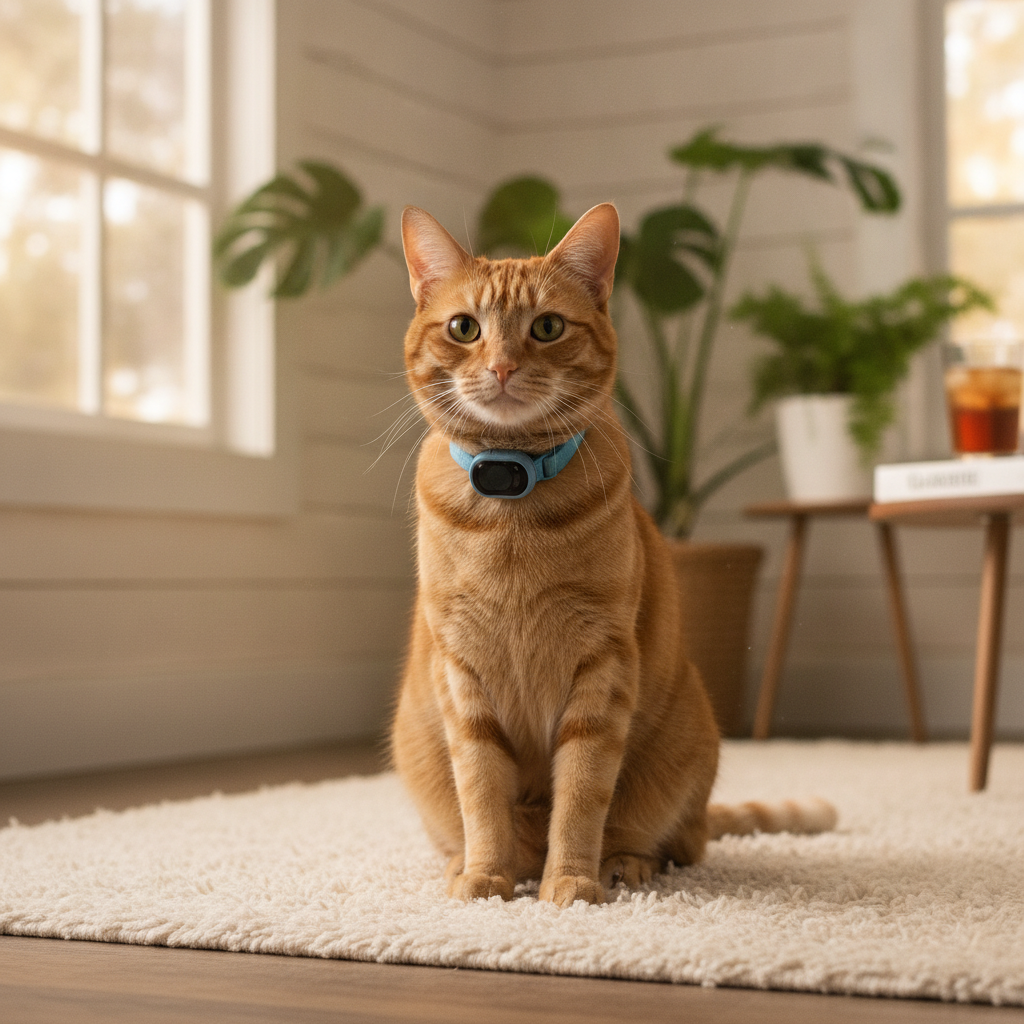
UK cat owners have two strong GPS tracker options in Tractive CAT Mini and Weenect Cat XS, as the popular Fi Mini only works in the United States. This guide compares both on coverage, cost in GBP, and suitability for British outdoor cats.
Key Takeaways
- Fi Mini does not work in the UK. It operates exclusively on Verizon's US network, so British cat owners should focus on Tractive and Weenect.
- Tractive CAT Mini offers the broadest international coverage (175+ countries including the UK), the most detailed wellness features, and a device cost of around £40.
- Weenect Cat XS provides the lowest long-term subscription cost (from roughly £3 per month on a two-year plan) and strong multi-network coverage across the UK and Europe.
- Since June 2024, microchipping has been compulsory for cats in England. A GPS tracker complements, but never replaces, a registered microchip and a collar with visible ID.
Why UK Cat Owners Should Consider GPS Tracking
The UK's temperate maritime climate means outdoor cats roam year-round, but summer brings particular risks. Longer daylight hours from May through August encourage wider territorial exploration. Increasingly warm British summers, with temperatures regularly exceeding 25°C in southern England, push cats further from home in search of shade, water, and prey. Seasonal garden work, open windows, and neighbourhood barbecues create novel escape routes and distractions.
A GPS tracker provides a live or near-live location feed, turning a frantic door-to-door search into a directed retrieval effort. For UK cat owners, the choice effectively comes down to two devices: Tractive CAT Mini and Weenect Cat XS. The Fi Mini, despite its excellent battery life and lightweight design, operates solely on Verizon's LTE-M network in the United States and is entirely non-functional in the UK.
UK Legal Context: Microchipping and Identification
Under The Microchipping of Cats (England) Regulations 2023, all cats in England must be microchipped by the time they reach 20 weeks of age. This came into effect on 10 June 2024. Scotland, Wales, and Northern Ireland have their own microchipping timelines, though the direction of travel is consistent across all four nations. The Animal Welfare Act 2006 also places a general duty of care on cat owners, which includes taking reasonable steps to prevent suffering, including preventing cats from becoming permanently lost.
A GPS tracker does not satisfy the legal microchipping requirement, as microchips are passive and permanent, whereas trackers rely on battery power and cellular signals. However, the two technologies serve different purposes: a microchip identifies a found cat when scanned at a veterinary practice or rescue centre, while a GPS tracker helps locate the cat before it needs to be found by someone else. Professional guidance from organisations such as the British Veterinary Association (BVA) and Cats Protection consistently recommends layering multiple identification methods.
Side-by-Side Comparison for UK Cat Owners
| Feature | Tractive CAT Mini | Weenect Cat XS |
|---|---|---|
| Weight | ~25 g | ~27 g |
| Battery life (typical) | 2 to 5 days | 3 to 10 days |
| Waterproof rating | IPX7 | IP67 |
| Connectivity | LTE-M, 2G | LTE-M, NB-IoT, 2G |
| UK coverage | Yes (175+ countries) | Yes (100+ countries) |
| Real-time tracking | Yes (2 to 3 sec updates) | Yes (10 sec default) |
| Device price (approx.) | ~£40 | ~£40 to £48 |
| Cheapest subscription | ~£4/month (5-year Basic) | ~£3/month (2-year plan) |
| Activity tracking | Activity, wellness alerts | Basic activity |
| Attachment method | Breakaway collar or clip | Included collar or clip |
Weight and Wearability for British Breeds
Veterinary guidance generally suggests that wearable devices should not exceed roughly 3 to 5 percent of a cat's body weight. A typical British Shorthair weighs between 4 and 8 kg, placing both trackers well within safe limits. Even for smaller breeds or younger cats around 3 kg, a 25 to 27 g device represents less than 1 percent of body weight.
The 2 g difference between Tractive (25 g) and Weenect (27 g) is negligible for most cats. Collar fit and breakaway safety are more important considerations. The RSPCA advises that any cat collar should be fitted with a quick-release or snap-open mechanism to prevent strangulation if the collar catches on a branch or fence. Both Tractive and Weenect offer breakaway-compatible attachment options, but owners should verify that the tracker clip does not interfere with the breakaway function.
Battery Life in UK Conditions
British weather introduces specific battery considerations. Cold, damp conditions during autumn and winter can reduce lithium-ion battery performance, while the relatively mild summers are kinder to battery longevity than hotter climates.
In power-saving mode (location updates every few minutes while the cat stays within a Wi-Fi or GPS safe zone), Weenect can stretch to around 10 days. Tractive typically lasts two to five days. Activating real-time or LIVE tracking mode drains both devices significantly faster: Tractive commonly drops to under two days, while Weenect falls to about three days of continuous tracking.
For owners who find charging every two to three days impractical, Weenect's longer battery life may tip the balance. Establishing a routine of charging the tracker overnight once or twice a week, perhaps alongside a feeding schedule, helps prevent gaps in coverage.
Cellular Coverage Across the UK
Both trackers rely on cellular networks to transmit location data. Tractive partners with multiple UK carriers across LTE-M and 2G networks. Weenect adds NB-IoT alongside LTE-M and 2G, which can provide better penetration in rural areas where traditional mobile signal is patchy.
Coverage is generally strong across urban and suburban England, but cat owners in rural Wales, the Scottish Highlands, or parts of Northern Ireland should check each manufacturer's coverage map before purchasing. Areas with weak 4G and no 2G fallback may render either tracker unreliable. Weenect's NB-IoT capability can offer an advantage in some rural pockets, as NB-IoT is designed for better indoor and underground penetration.
Subscription Costs in GBP
Every GPS cat tracker requires a cellular data subscription. There is no way around this recurring cost.
- Tractive: Basic plans start at around £4 per month on long-term commitments (five-year plan), while the one-year Basic plan runs approximately £7 per month. The Premium tier, which adds worldwide coverage, extended location history, and wellness data, costs about £8 per month on a one-year plan. Tractive offers a 30-day money-back guarantee.
- Weenect: The most affordable long-term option, with two-year plans starting around £3 per month. An annual plan runs approximately £6.50 per month. An optional Premium pack with added features costs an extra £2.50 per month.
When budgeting, factor in at least two to three years of subscription fees. A £40 device with a £4 monthly subscription costs £136 over two years, while the same device with a £3 monthly subscription totals £112. Over three years, these differences become more pronounced.
Which Tracker Suits Your Situation?
Urban or Suburban Cat Owner
Both trackers perform well in built-up areas with strong mobile coverage. Tractive edges ahead if wellness monitoring and activity alerts are priorities, offering a more comprehensive app experience with detailed health insights.
Rural Cat Owner
Weenect's NB-IoT connectivity may provide more reliable coverage in areas where standard LTE-M signal is weak. Check the coverage map for your specific postcode before committing.
Budget-Conscious Owner
Weenect wins on long-term subscription cost. Over a typical three-year ownership period, Weenect's two-year plan saves roughly £36 compared to Tractive's equivalent Basic plan.
Owner Who Travels to Europe with Their Cat
Both trackers work across Europe. Tractive's 175+ country coverage and Premium roaming tier make it the safer bet for frequent travellers. Remember that travelling with a cat to the EU from the UK now requires an Animal Health Certificate (AHC) issued by an Official Veterinarian, as the previous EU Pet Passport system no longer applies post-Brexit.
Owner Wanting Detailed Health Data
Tractive's Premium plan offers the most comprehensive wellness monitoring, including activity patterns and wellness alerts that can flag changes in behaviour worth discussing with a vet.
Does Real-Time Tracking Actually Help Find a Lost Cat?
Real-time GPS tracking is arguably the most valuable feature when a cat fails to return home. The ability to watch movement patterns on a live map helps determine whether a cat is stuck in a neighbour's shed, hiding under dense vegetation, or moving through a specific area.
However, several real-world limitations apply in UK conditions:
- Signal gaps: GPS signals weaken indoors, under dense garden vegetation, and inside structures like sheds and garages, which are precisely the places British cats tend to hide.
- Battery trade-off: Real-time mode accelerates battery drain significantly. If the battery dies while the cat is missing, the tracker becomes useless.
- Urban interference: Terraced housing, stone walls, and narrow alleyways common in many UK towns can degrade GPS accuracy.
- Geofence precision: No GPS geofence is accurate enough to mark a single garden boundary. Professional consensus suggests setting the zone slightly larger than the desired boundary to reduce false alerts.
The recommended approach is to use GPS tracking as one layer of a multi-strategy search. A GPS tracker works best alongside a registered microchip, a collar with a visible tag bearing a phone number, and neighbourhood awareness. Posting on local community Facebook groups and alerting nearby veterinary practices remain highly effective steps.
Contact your registered vet's out-of-hours service or find your nearest Vets Now emergency clinic.
All UK vet practices must provide 24/7 emergency cover. Your vet's answerphone will direct you to the on-call service.
Helping a Newly Adopted Cat Transition to Outdoor Access
Cats Protection recommends keeping a newly adopted cat indoors for at least three to four weeks before allowing supervised outdoor access. A GPS tracker worn during those first outdoor sessions provides reassurance and data about how far the cat ventures, helping owners adjust boundaries gradually.
Early GPS data can reveal whether a cat stays close to home or immediately pushes territorial limits. This insight helps determine whether full outdoor access, a catio, or supervised garden time is the safest long-term arrangement. For cats adopted from UK rescue centres, this gradual approach aligns with the duty of care obligations under the Animal Welfare Act 2006.
Decision Checklist for UK Cat Owners
- Is your cat microchipped? This is a legal requirement in England. Ensure the microchip details are up to date on an approved database before relying on a GPS tracker.
- How often can you recharge? If every two to three days is impractical, Weenect's longer battery life is the better fit.
- What is your annual budget? Under £50 per year: Weenect's two-year plan is the most realistic option. £50 to £100 per year: Tractive Basic or Weenect annual. Over £100 per year: Tractive Premium for full wellness features.
- Do you live in a rural area? Check coverage maps for both Tractive and Weenect using your postcode. Weenect's NB-IoT may offer an edge in patchy signal areas.
- Will you travel to Europe with your cat? Ensure your tracker subscription covers roaming. Tractive Premium is the strongest option for international travel.
- Does your collar have a breakaway mechanism? Both the RSPCA and BVA advise quick-release collars for cats. Confirm that your chosen tracker attachment does not compromise this safety feature.
Final Thoughts
For UK cat owners, the GPS tracker decision is effectively a two-horse race between Tractive CAT Mini and Weenect Cat XS. Tractive leads on wellness features and international coverage, while Weenect offers better battery life and the lowest long-term subscription cost. Both provide genuine peace of mind for owners of outdoor cats across Britain.
Whichever device you choose, it should complement your cat's registered microchip, a properly fitted breakaway collar with a visible ID tag, and awareness of local community networks. Together, these layers of identification and tracking represent the most robust approach to keeping an outdoor cat safe through the British summer and beyond.
Frequently Asked Questions
Does the Fi Mini GPS tracker work in the UK? ↓
Is a GPS tracker a legal substitute for microchipping my cat in the UK? ↓
Which GPS cat tracker has the best coverage in rural UK areas? ↓
How much does a GPS cat tracker cost per year in the UK? ↓
Are GPS cat tracker collars safe for cats? ↓

Priya Nair
Dog Breed Advisor & Adoption Counsellor
Dog breed advisor and adoption counsellor — honest breed comparisons and lifestyle matching for prospective owners.
Content Disclosure
This article was created using state-of-the-art AI models with human editorial oversight. It is intended for informational and entertainment purposes only and does not constitute veterinary medical advice. Always consult a licensed veterinarian for your pet's specific health needs. Learn more about our process.