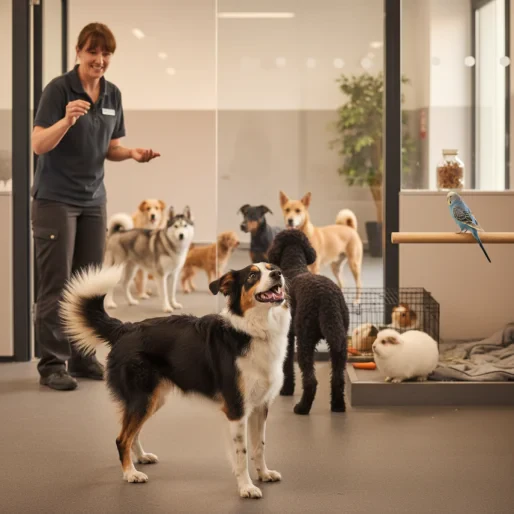
Choosing a dog daycare in the UK means understanding staffing ratios, play group management, and legal requirements under the Animal Welfare Act 2006. This guide covers what British dog owners should look for and what red flags to avoid.
Key Takeaways
- Professional guidelines suggest staff-to-dog ratios of roughly 1:6 to 1:10, with lower ratios for puppies, mixed size groups, or dogs new to the facility.
- UK daycares must hold an Animal Activities Licence issued by the local authority under the Animal Welfare (Licensing of Activities Involving Animals) (England) Regulations 2018 (with equivalent legislation in Wales, Scotland, and Northern Ireland).
- Effective daycares group dogs by size, play style, and temperament, not by breed alone, which is especially important given the XL Bully restrictions now in force.
- Behavioural screening before admission is a hallmark of a well-run facility and should include structured assessments over multiple sessions.
- Staff should demonstrate fluency in canine body language and use only positive reinforcement or negative punishment (removal of a desired outcome) to manage behaviour.
Why Play Group Management Matters for UK Dog Owners
Dog daycare has grown rapidly across the UK, driven by longer working hours and increased dog ownership following the pandemic. However, not all facilities operate to the same standard. The quality of a daycare's play group management directly affects canine welfare: poorly supervised or randomly assembled groups can lead to stress, fear conditioning, resource guarding incidents, and bite injuries.
In England, commercial dog daycare providers are required to hold an Animal Activities Licence under the Animal Welfare (Licensing of Activities Involving Animals) (England) Regulations 2018. Scotland, Wales, and Northern Ireland have equivalent licensing frameworks. A licence means the facility has been inspected by the local authority, but licensing standards vary between councils, and a licence alone does not guarantee excellent play group management. Owners need to look deeper.
The Animal Behaviour and Training Council (ABTC), the UK's regulatory body for animal trainers and behaviourists, endorses force-free, evidence-based approaches to dog management. This guide explains what to look for when evaluating a daycare's approach to grouping, staffing, and behavioural screening.
UK Legal Considerations: Breed Restrictions and Mandatory Requirements
Before choosing a daycare, UK owners should be aware of the legal landscape. The Dangerous Dogs Act 1991 prohibits the ownership of certain types of dog, including Pit Bull Terriers, Japanese Tosas, Dogo Argentinos, and Fila Brasileiros. Since February 2024, XL Bully type dogs are also banned under an amendment to the Act; owners with existing XL Bullies must hold a Certificate of Exemption, and the dog must be neutered, microchipped, and kept on lead and muzzled in public. A reputable daycare will be aware of these restrictions and will ask about exemption status before admitting any dog that may fall under the legislation.
All dogs in England must be microchipped by eight weeks of age, and cats must be microchipped from June 2024 onwards. A daycare that does not verify microchip status or vaccination records (including core vaccines and kennel cough, typically the Bordetella bronchiseptica and parainfluenza combination) is cutting corners on basic safety.
How Dogs Interact in Groups: What Staff Must Understand
Dogs are social animals, but not every dog thrives in a large, free-for-all play group. Canine social behaviour is shaped by early socialisation history, breed-typical tendencies, individual temperament, and prior learning. A dog well-socialised between 3 and 14 weeks may still find a chaotic daycare stressful if the environment exceeds its arousal threshold.
Arousal and Overstimulation
In group play, arousal (the physiological state of excitement or alertness) escalates quickly. Healthy play involves frequent role reversals, self-handicapping, and play signals such as the play bow. When arousal tips into overstimulation, dogs may begin body-slamming, pinning, mounting, or engaging in relentless chasing. Trained staff recognise this shift as the point where intervention is needed.
Stress Signals Staff Should Recognise
Qualified daycare staff should identify stress signals including lip licking, yawning out of context, whale eye (showing the whites of the eyes), tucked tails, displacement sniffing, and attempts to hide or climb onto furniture. These subtle signals often precede growling, snapping, or freezing. Facilities that wait for overt aggression before intervening are reacting too late. The ABTC recommends that anyone working professionally with dogs can demonstrate an understanding of canine body language and learning theory.
Staffing Ratios: The Numbers That Keep Dogs Safe
Staffing ratios are arguably the single most important safety variable. Professional recommendations typically suggest 1 staff member to every 6 to 10 dogs, though this depends on group composition.
Factors That Should Lower the Ratio
- Puppies under 6 months: Young dogs require more supervision. A ratio closer to 1:4 or 1:5 is advisable.
- Mixed size groups: When small and medium dogs share space, closer supervision prevents predatory drift, where play can shift toward predatory motor patterns in larger dogs.
- Newly admitted dogs: Dogs in their first week are still adjusting and may display atypical behaviour.
- Dogs with known anxiety or reactivity: These dogs need a handler who can monitor subtle stress signals without being pulled away to manage another situation.
What to Ask the Facility
Ask directly: "What is your staff-to-dog ratio during peak hours?" A facility that gives a vague response may not have a formal policy. Follow up by asking whether ratios change when staff take breaks, during feeding, or during transitions between indoor and outdoor areas. Supervision gaps during transitions are a common and underappreciated risk.
Grouping Dogs: Size, Energy, and Play Style
Grouping by breed alone is overly simplistic. A calm, elderly Labrador Retriever has little in common behaviourally with a high-drive adolescent Labrador from working lines. Effective UK daycares group by size, energy level, play style, and social confidence.
Play Style Categories
- Body slammers and wrestlers: Dogs who prefer full-contact play. Staffordshire Bull Terriers, Boxers, and many bull breeds often enjoy this style.
- Chasers and runners: Dogs who prefer pursuit games. Collies, Springer Spaniels, and sighthounds such as Greyhounds and Whippets often gravitate toward this, though herding breeds may nip during chase play, which can upset other dogs.
- Gentle or parallel players: Dogs who prefer proximity without intense interaction. Many toy breeds, senior dogs, and those with lower social confidence do well here.
- Rough-and-tumble generalists: Highly social dogs comfortable across play styles. Many Cocker Spaniels, Golden Retrievers, and well-socialised crossbreeds fit this group.
Size Separation
Most guidelines recommend separating dogs into at least two size categories, typically under and over approximately 13 to 15 kg. Some facilities use three tiers: small, medium, and large. Ask: "Do you ever mix size groups, and under what circumstances?"
Behavioural Screening: The Intake Process That Protects Every Dog
A thorough behavioural screening before a dog joins a play group is one of the strongest indicators of quality. In the UK, licensing conditions require facilities to have procedures for introducing new animals, but the depth of screening varies significantly.
What a Good Screening Looks Like
Professional standard screening typically unfolds over one to three sessions and includes:
- Owner questionnaire: Covering socialisation history, known triggers, bite history, resource guarding tendencies, and any veterinary behavioural diagnoses.
- Individual assessment: Staff observe the dog alone to gauge its response to the environment, novel sounds, and unfamiliar people.
- Graduated introduction: The dog meets one or two calm, socially confident "ambassador" dogs before joining a larger group.
- Ongoing evaluation: Reputable facilities reassess dogs periodically, especially after absences or reported changes in behaviour at home.
Red Flags in the Screening Process
Be cautious if a facility accepts dogs with no screening, does not ask about bite history, does not require vaccination records, or claims every dog is welcome regardless of temperament. Some dogs genuinely do not enjoy group play, and a responsible facility will say so.
Climate Considerations for UK Daycares
The UK's temperate maritime climate brings specific challenges. During wet autumn and winter months, outdoor play areas can become waterlogged and muddy, increasing the risk of slips and creating hygiene concerns. Ask how the facility manages wet weather: do they have adequate indoor space, or do dogs simply stay outside in the rain? In increasingly warm summers, particularly during heatwaves that have become more common, facilities should have a clear heat management protocol. Dogs such as Bulldogs, Pugs, and other brachycephalic breeds are at elevated risk of heat stress. A good facility will reduce activity levels when temperatures exceed approximately 25°C, provide shaded areas and fresh water, and may cancel outdoor sessions entirely during extreme heat.
Equipment and Methods: What to Look For
Ask what tools staff use. Acceptable management tools include drag lines (lightweight leads attached to harnesses), baby gates, and exercise pens for time-outs. Red flags include prong collars, choke chains, shock or e-collars, citronella spray devices, or rattle cans. The use of electronic shock collars on dogs is banned in Wales under the Animal Welfare (Electronic Collars) (Wales) Regulations 2010, and similar bans have been proposed in England and Scotland. Any facility using such devices is not operating to Professional Standards.
Common Mistakes UK Owners Make
- Assuming a licence means excellence: The Animal Activities Licence confirms minimum standards have been met. It does not guarantee sophisticated play group management.
- Prioritising aesthetics over management: A stylish facility with poor supervision is far less safe than a plain but well-staffed one.
- Assuming all play is good play: A group of 20 dogs running together may look fun, but unstructured free-for-alls are a risk factor for injuries.
- Not visiting during operating hours: Tours with no dogs present tell you nothing about group management. Ask to observe a live session.
- Ignoring post-daycare behaviour: A dog who comes home hypervigilant, with increased lead reactivity, or who seems shut down rather than pleasantly tired may be stressed, not exercised. Monitoring behaviour after sessions is essential.
- Overlooking rest periods: Dogs need structured rest. Facilities offering nonstop play for 8 to 10 hours risk chronic overstimulation.
When to Consult a Professional Behaviourist
Some situations require expertise beyond what daycare staff can provide. Consider consulting an ABTC-registered Clinical Animal Behaviourist or a veterinary behaviourist if your dog has been asked to leave daycares due to aggression or fear, shows increased reactivity after starting daycare, develops resource guarding, or displays compulsive behaviours such as repetitive circling or excessive licking after sessions. A professional assessment can determine whether daycare suits that individual dog or whether alternatives such as private walks, small group sessions, or in-home care would be more appropriate.
Contact your registered vet's out-of-hours service or find your nearest Vets Now emergency clinic.
All UK vet practices must provide 24/7 emergency cover. Your vet's answerphone will direct you to the on-call service.
Evaluation Checklist for UK Dog Daycares
- The facility holds a valid Animal Activities Licence from the local authority.
- Staff-to-dog ratio is clearly stated and maintained at 1:6 to 1:10 (lower for puppies or mixed size groups).
- Dogs are grouped by size, energy level, and play style.
- A structured behavioural screening process spans at least one to two sessions.
- Staff can describe canine stress signals when asked.
- Only force-free management tools are used, consistent with ABTC guidelines.
- Structured rest periods are built into the schedule.
- The facility requires vaccination records (including kennel cough) and verifies microchip status.
- Owners are welcome to observe a live play session before enrolling.
- Daily reports include specific behavioural observations, not just generic updates.
- A clear incident protocol exists, including when and how owners are notified.
- The facility is aware of breed-specific legislation and checks exemption documentation where relevant.
Frequently Asked Questions
Do UK dog daycares need a licence to operate? ↓
What is a safe staff-to-dog ratio for UK dog daycares? ↓
Are XL Bully dogs allowed in UK dog daycares? ↓
What vaccinations should a UK daycare require? ↓
How should a UK daycare manage hot weather? ↓
Who should I consult if my dog struggles with daycare? ↓

Mark Sullivan
Certified Professional Dog Trainer
Certified professional dog trainer — positive-reinforcement methods for every breed and behavioural challenge.
Content Disclosure
This article was created using state-of-the-art AI models with human editorial oversight. It is intended for informational and entertainment purposes only and does not constitute veterinary medical advice. Always consult a licensed veterinarian for your pet's specific health needs. Learn more about our process.