A positive reinforcement guide to socialising your puppy at outdoor cafes and markets during Mediterranean summer evenings. Covers heat safety, paw protection, calm settle work, and a six week confidence plan.
Key Takeaways
- Time it right: Wait until ambient temperatures drop below roughly 24 to 26 degrees Celsius and pavement passes the seven second hand test before any outing.
- Protect the paws: Carry water, choose shaded routes, and inspect paw pads before, during, and after each session.
- Read the puppy, not the plan: Lip licks, yawns, whale eye, and freezing are early overstimulation signals that override any training agenda.
- Settle is a skill: Calm under table behaviour is built at home first, then transferred to progressively busier environments using shaping and duration work.
- Six week structure: Confidence builds in graded exposures, starting at the quiet edge of a square and progressing to busier market evenings.
- LIMA always: Least Intrusive, Minimally Aversive principles, endorsed by the IAABC and CCPDT, guide every step. Aversive tools have no place in puppy socialisation.
Understanding Why Outdoor Cafes and Markets Matter
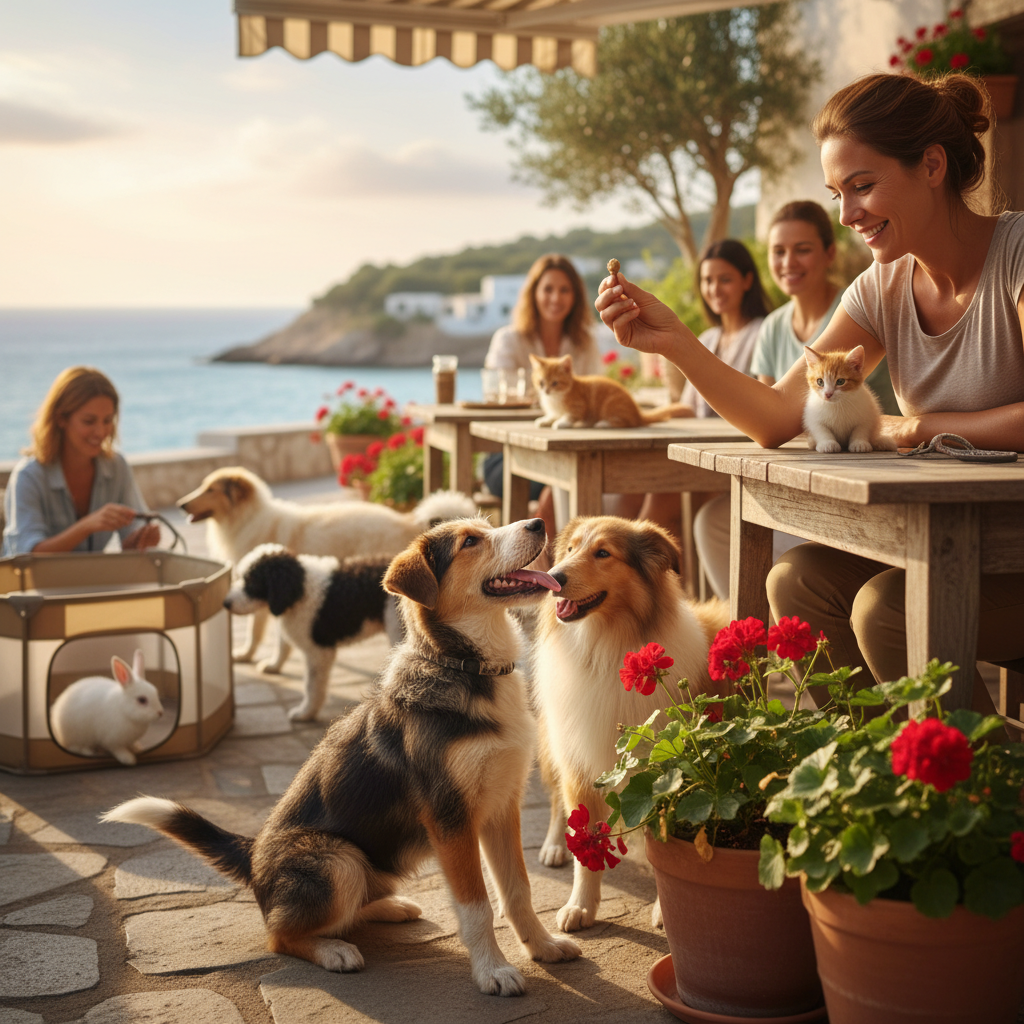
The socialisation window for puppies, generally accepted by veterinary behaviourists to span roughly three to fourteen weeks of age, is when neurological openness to novelty is at its peak. The American Veterinary Society of Animal Behavior (AVSAB) position statement on puppy socialisation emphasises that controlled, positive exposure during this period is more protective against future behaviour problems than strict isolation until vaccinations are complete. Mediterranean coastal towns, with their evening passeggiata culture, bustling weekend markets, and dog friendly cafe terraces, offer an extraordinary natural classroom for this learning, provided the experience is curated rather than random.
Puppies do not arrive pre wired to enjoy clattering cutlery, scooter horns, accordion buskers, or the smell of grilled sardines drifting over a piazza. They learn to interpret these stimuli as safe through repeated, low intensity exposure paired with positive outcomes. When exposure is too intense, too sudden, or coincides with discomfort such as heat stress, the same environment can imprint as threatening. This is why the structure of the outing matters more than the number of outings.
Training Prerequisites Before You Leave the House
Vaccination and Veterinary Clearance
Confirm with the attending veterinarian which environments are appropriate for the puppy's current vaccination status. Many veterinarians, following WSAVA vaccination guideline principles, support carefully managed socialisation in lower risk areas before the full primary course is complete, often using a carry sling or padded mat to limit ground contact in unknown locations.
Equipment Checklist
- A flat, well fitted Y shaped harness (no slip leads, no prong or shock collars).
- A 1.5 to 2 metre fixed length lead. Retractable leads are not appropriate in crowded settings.
- A lightweight, washable settle mat that travels with the puppy as a portable comfort cue.
- A high value reinforcer pouch: small, soft, pea sized treats the puppy does not get at any other time.
- Collapsible water bowl and at least 500 ml of cool water per hour out.
- A back up exit plan, such as a carry sling for small breeds or a known quiet side street for larger ones.
Foundation Behaviours
Three behaviours should be fluent at home before any cafe visit: a name response with eye contact, a hand target (nose to palm), and the beginnings of a mat settle. These give the handler a way to redirect attention, move the puppy through tight spaces, and anchor calm behaviour without relying on leash pressure.
Heat Safe Timing Windows for Mediterranean Evenings
From June through early September across the Mediterranean basin, daytime surface temperatures on stone, asphalt, and dark tile can far exceed safe contact thresholds for canine paw pads. Veterinary dermatology references generally place the risk of pad burns at surface temperatures above approximately 50 degrees Celsius, which can occur on dark asphalt even when air temperature feels moderate.
Practical timing guidance for summer cafe outings:
- Avoid the 11:00 to 18:00 window entirely for ground level exposure, regardless of cloud cover.
- Earliest evening start: Roughly 60 to 90 minutes before sunset, only after a hand test confirms pavement is comfortable. Press the back of the hand to the ground for seven seconds. If it cannot be held there comfortably, it is not safe for paws.
- Optimal window: The hour after sunset through about two hours later, when stone surfaces have released stored heat and crowds are present but not yet at peak density.
- Session length: First exposures should run 10 to 15 minutes. Even confident adolescent puppies rarely benefit from sessions beyond 30 to 40 minutes in summer conditions.
For breed specific heat considerations, the companion article on heat tolerant dog breeds outlines which body types tolerate warm evening work more readily than brachycephalic or double coated puppies. Owners of double coated breeds should also review why double coated dogs should not be shaved in summer before adjusting grooming for cafe outings.
Paw Pad Protection on Hot Pavement
Puppy pads are softer and thinner than adult pads, and the keratin layer that toughens with age has not yet developed. Protective measures include:
- Route planning: Walk on light coloured stone, shaded side streets, and grass verges where available. Avoid black asphalt and dark composite decking.
- Carry to the cafe: For small breeds and very young puppies, a sling carry from the car or apartment to the chosen terrace reduces hot ground contact and frames the outing as calm from the start.
- Booties only when conditioned: Protective boots can help on unavoidable hot surfaces, but they must be introduced through gradual desensitisation at home over multiple sessions. A puppy who has never worn boots will not problem solve them on a busy market street.
- Paw inspection: After every outing, check between toes for redness, blistering, or embedded debris (olive pits, broken shells, and cigarette ends are common Mediterranean hazards).
Reading Overstimulation Signals in Crowded Settings
Overstimulation is the single most common reason a promising cafe outing becomes a setback. Puppies cannot verbalise overwhelm, but their body language is consistent and well documented in ethological literature. Handlers should scan for these signals every 30 to 60 seconds:
Early signals (de escalate immediately)
- Repeated lip licking when no food is present.
- Yawning outside of waking or resting transitions.
- Sudden scratching or shaking off when not wet.
- Slowed blink rate or wide eyed scanning (sometimes called whale eye).
- Refusing previously high value treats.
Mid range signals (end the session)
- Freezing in place when a person or dog approaches.
- Tucked tail held low and tight.
- Panting that does not match the ambient temperature.
- Attempting to climb the handler or hide under the chair.
Late signals (exit calmly, do not punish, log the trigger)
- Growling, snapping, or lunging.
- Trembling, drooling, or sudden shutdown (lying flat, unresponsive).
Reaching the late signal stage is not a training failure of the puppy. It is data: the intensity, distance, or duration was too high. The next session should reduce one of those three variables.
Positive Reinforcement, Step by Step: Building a Calm Settle Under the Table
Settle is a duration behaviour built through shaping, the operant conditioning process of reinforcing successive approximations toward the final picture. CPDT-KA and IAABC certified trainers commonly structure it as follows:
Stage 1: Mat value at home
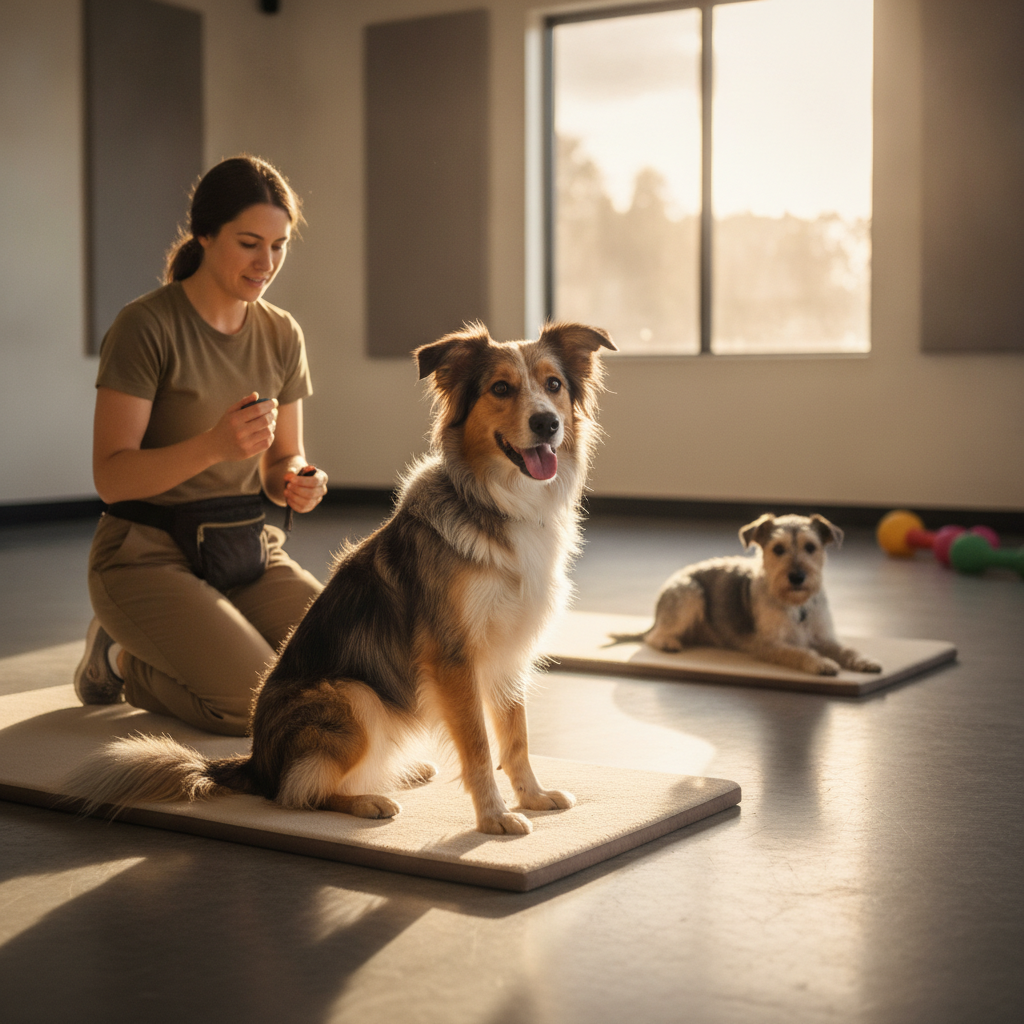
Place the mat in a quiet room. Mark and reward any interaction with it (a paw, a sniff, a sit). Within two to three short sessions, most puppies offer lying down on the mat. Reward generously, then release with a consistent cue such as "all done."
Stage 2: Duration and disengagement
Reinforce the puppy for staying on the mat as duration grows from 5 seconds to 5 minutes. Introduce mild distractions: a dropped sock, a soft knock, a person walking past. The goal is voluntary disengagement, where the puppy notices the distraction and chooses to remain settled.
Stage 3: Settle in the garden or balcony
Transfer the mat outdoors at home. Add ambient noise such as a radio at low volume. Reward calm breathing, soft eyes, and chin down on the mat. Sessions of 10 to 15 minutes are sufficient.
Stage 4: Quiet cafe edge
Choose a cafe terrace at off peak hours, ideally just as it opens for the evening. Place the mat under or beside the table. Reinforce calm at a high rate initially (one small treat every 5 to 10 seconds), then taper as the puppy relaxes. Keep the first session under 15 minutes.
Stage 5: Progressive crowd density
Across subsequent sessions, gradually increase the cafe's activity level, the proximity of foot traffic, and the variety of sounds. Each step should produce the same relaxed body language seen at home.
Stage 6: Market exposure
Markets are higher intensity than cafes due to unpredictable movement, food smells at nose level, and louder voices. Begin at the market's perimeter, settle on a mat, and watch from a distance the puppy can handle. Only move closer when relaxation is consistent.
Common Mistakes Owners Make
- Treating socialisation as exposure alone: Simply being in a busy place is not socialisation. Without positive associations and calm states, exposure can sensitise rather than habituate.
- Letting strangers crowd the puppy: Well meaning passers by often want to pet or pick up the puppy. Handlers should politely decline interactions the puppy has not opted into.
- Forcing greetings with other dogs: Not every dog at a cafe is socially appropriate. Parallel presence is more valuable than forced nose to nose contact.
- Ignoring heat indicators: Panting at a stationary cafe table in 28 degree air is not normal puppy enthusiasm. It is thermal load.
- Using leash corrections for stress behaviours: Aversive responses to a stressed puppy increase the negative association with the environment and undermine LIMA principles.
- Overlong sessions: A tired puppy is a reactive puppy. Quality and brevity outperform endurance every time.
Troubleshooting Slow Progress
If a puppy is not relaxing at the cafe by the third or fourth visit, professional consensus suggests revisiting three variables before pushing forward:
- Distance: Move the mat further from the foot traffic or street edge. Sometimes two extra metres transforms the session.
- Duration: Cut the session in half. A puppy that succeeds for 7 minutes is more useful than one that struggles for 20.
- Density: Choose a quieter cafe, an earlier evening hour, or a weekday rather than a Saturday.
Also examine the reinforcer. Treats that work in the kitchen often lose value in high arousal environments. A higher value option, used only in public, can restore engagement. For puppies showing persistent leash tension or pulling toward the door, structured conditioning sessions at home, similar to those described in the backyard dog conditioning circuit for summer evenings, can help with general impulse control and physical self regulation.
A Six Week Confidence Plan
The following framework is a template, not a prescription. Faster or slower progression is normal and should be guided by the individual puppy.
Week 1: Foundations at home
Mat value, name response, hand target, and calm harness wearing. Two short sessions per day.
Week 2: Neighbourhood baseline
Evening walks on quiet streets. Practise settle on a mat outside the home gate for 5 to 10 minutes. Begin pavement temperature checks every outing.
Week 3: Quiet cafe edge
Two visits to a low traffic cafe at opening time. Settle for 10 to 15 minutes. End sessions while the puppy is still relaxed.
Week 4: Moderate cafe activity
Two visits to a busier cafe at mid evening. Introduce mild ambient music and waiter movement. Sessions up to 20 minutes.
Week 5: Market perimeter
Settle work at the quiet edge of a weekly market. Brief 10 to 15 minute exposures, then exit calmly. Reinforce voluntary check ins with the handler.
Week 6: Integrated outing
A short walk through a lightly populated market followed by a settled cafe stop. Total outing length 30 to 40 minutes. The puppy should show fluid movement, soft body language, and willing engagement throughout.
Owners who travel during the high season or rely on care providers should also vet helpers carefully. The guide on hiring a trustworthy in home pet sitter this summer outlines questions to ask about handling, heat management, and emergency planning.
When to Bring in a Professional Trainer or Behaviourist
Professional involvement is appropriate when:
- The puppy shows late stage stress signals (growling, snapping, shutdown) on more than one outing.
- Fear generalises to environments that were previously tolerated.
- There is a known traumatic history (rescue, prior attack, transport stress).
- The handler feels unsafe managing the puppy in public.
- Progress plateaus for more than two weeks despite reducing distance, duration, and density.
Look for credentials such as CPDT-KA (Certified Professional Dog Trainer, Knowledge Assessed), KPA CTP, IAABC ADT, or for clinical behaviour cases, a veterinary behaviourist (DACVB or ECAWBM accredited). Reputable professionals operate under LIMA principles and will not recommend prong collars, shock collars, or alpha based methods for socialisation.
Final Notes for Mediterranean Summer Handlers
Successful summer socialisation is built on three quiet disciplines: respecting the heat, reading the puppy, and ending sessions early. The Mediterranean evening is a generous training environment, but it rewards handlers who prioritise the puppy's nervous system over the appeal of a long aperitivo. The puppy who learns to settle calmly under a cafe table at 14 weeks is the adult dog who travels well, integrates into family life, and copes with novelty for the next decade.
Frequently Asked Questions
What is the safest time of evening to take a puppy to a Mediterranean cafe in summer? ↓
How do I know if my puppy is overstimulated at a busy market? ↓
Can I socialise my puppy at cafes before they have finished their vaccinations? ↓
How long should the first cafe settle session last? ↓
What equipment should I avoid using for puppy socialisation? ↓
When should I contact a professional trainer instead of continuing on my own? ↓

Mark Sullivan
Certified Professional Dog Trainer
Certified professional dog trainer — positive-reinforcement methods for every breed and behavioural challenge.
Content Disclosure
This article was created using state-of-the-art AI models with human editorial oversight. It is intended for informational and entertainment purposes only and does not constitute veterinary medical advice. Always consult a licensed veterinarian for your pet's specific health needs. Learn more about our process.