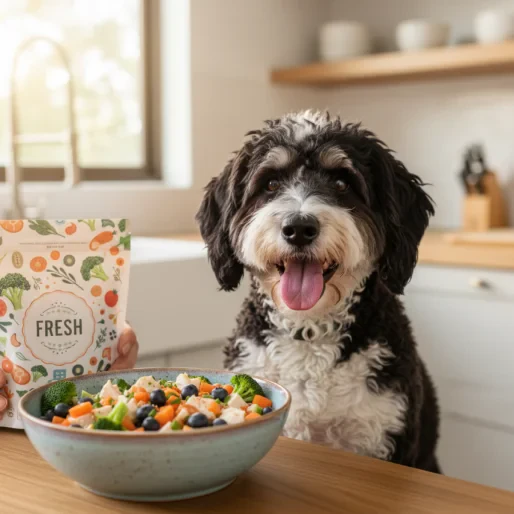
A thorough comparison of raw and fresh cooked dog food delivery services available in the UK for 2026, with costs in GBP, FEDIAF compliance guidance, and FSA food safety considerations. Covers cold chain logistics, nutritional adequacy, and which option suits different household types.
Key Takeaways
- In the UK, dog food nutritional adequacy is assessed against FEDIAF (European Pet Food Industry Federation) guidelines rather than AAFCO profiles. Confirm any subscription service meets FEDIAF standards for your dog's life stage.
- Daily costs for UK delivery services typically range from around £2 to £5 for small dogs, rising to £12 to £22 for giant breeds, depending on protein source and recipe complexity.
- The Food Standards Agency (FSA) oversees pet food safety, and all commercially sold dog food in the UK must comply with the Animal Feed (England) Regulations. Raw pet food carries specific additional handling requirements.
- The British Veterinary Association (BVA) does not recommend raw feeding due to pathogen risks to both pets and humans. Fresh cooked options offer similar whole food ingredients with a significantly lower bacterial hazard.
- Cold chain reliability is especially important given the UK's variable climate, with increasingly warm summers creating higher risk of transit temperature breaches.
How Personalised Dog Food Delivery Works in the UK
Subscription dog food services have expanded significantly across the UK market since 2024. These services use online profiling tools, asking owners to input their dog's breed, weight, age, body condition, activity level, and any known health issues, to generate a tailored feeding plan delivered on a regular schedule.
The two primary formats are:
- Raw meal delivery: Flash frozen meals containing muscle meat, organ meat, and ground bone, packed with dry ice or gel packs in insulated boxes.
- Fresh cooked delivery: Gently cooked meals using whole food ingredients, vacuum sealed and shipped refrigerated or frozen.
Both categories are regulated under UK animal feed legislation, with the FSA and local authority trading standards responsible for enforcement. However, important differences exist in food safety profiles, nutritional validation, and practical suitability for different households.
UK Regulatory Framework: What Governs These Products?
Unlike the US system built around AAFCO, the UK follows FEDIAF nutritional guidelines, which set minimum and maximum nutrient levels for complete pet foods across defined life stages. Any product labelled as "complete" must meet these thresholds.
Key Regulatory Bodies
- FSA (Food Standards Agency): Oversees safety and hygiene standards for pet food manufacturing in England, Wales, and Northern Ireland. Food Standards Scotland covers Scotland.
- DEFRA (Department for Environment, Food and Rural Affairs): Sets the broader legislative framework for animal feed, including pet food.
- PFMA (Pet Food Manufacturers' Association): The UK industry body. PFMA members commit to a code of practice that includes FEDIAF compliance, though membership is voluntary.
- Trading Standards: Local authority officers who enforce labelling accuracy and can investigate misleading claims.
Raw Pet Food: Additional Requirements
Raw pet food in the UK is classified as an animal by-product under Regulation (EC) No 1069/2009 (retained in UK law post-Brexit). Manufacturers must be registered and approved by the Animal and Plant Health Agency (APHA). Products must meet microbiological standards, including limits on Salmonella and Enterobacteriaceae, before sale. Despite these controls, the BVA and the British Small Animal Veterinary Association (BSAVA) both advise against raw feeding, citing the risk of pathogen transmission to pets and household members.
Side by Side Comparison for UK Buyers
| Factor | Raw Meal Delivery | Fresh Cooked Delivery |
|---|---|---|
| Typical ingredients | Muscle meat, organ meat, ground bone; some recipes add vegetables or supplemental oils | Whole proteins (chicken, beef, lamb, turkey), vegetables, grains or pulses, added vitamins and minerals |
| UK nutritional standard | Should meet FEDIAF profiles, but compliance varies. Ask for documentation. | More commonly formulated to FEDIAF standards with veterinary nutritionist input |
| Pathogen risk | Higher: Salmonella, Listeria, and E. coli have been detected in UK raw pet food surveys | Lower: the cooking step substantially reduces bacterial load |
| Shipping method | Frozen with dry ice; must stay at or below minus 18°C | Refrigerated or frozen; target 0°C to 4°C for chilled packs |
| Home storage | Freezer essential; thaw portions in the fridge before serving | Fridge for up to 7 days typically; freezer for longer storage |
| Shelf life once opened | 2 to 3 days in the fridge after thawing | 4 to 7 days refrigerated, depending on the brand |
| Personalisation depth | Protein choice and portion sizing; limited recipe variation | Multiple recipes, calorie adjustments, allergy exclusions, life stage formulas |
| Veterinary nutritionist involvement | Present at some brands; absent at many smaller producers | More commonly employed or consulted by established UK fresh food companies |
Cost Per Day in GBP by Dog Size (2026 Estimates)
These ranges reflect typical UK subscription pricing in 2026. Actual costs vary with protein source, recipe complexity, and subscription length.
| Dog Size | Approximate Weight | Raw Delivery (per day) | Fresh Cooked Delivery (per day) | Premium Kibble (per day) |
|---|---|---|---|---|
| Small | Up to 10 kg | £2.50 to £5 | £1.50 to £4 | £0.80 to £1.50 |
| Medium | 10 to 25 kg | £5 to £10 | £4 to £8 | £1.20 to £2.50 |
| Large | 25 to 40 kg | £8 to £15 | £6.50 to £12 | £1.50 to £3 |
| Giant | Over 40 kg | £12 to £22 | £10 to £18 | £2.50 to £5 |
Practical cost considerations for UK owners:
- Longer subscription commitments (monthly rather than weekly) often carry discounts of around 10% to 20%.
- Using fresh or raw food as a topper on quality kibble can reduce daily costs by 40% to 60% while still providing whole food variety.
- For medium to giant breed dogs on full raw plans, a standalone chest freezer is often necessary. Factor in the purchase cost (typically £150 to £300) and ongoing energy usage.
- Delivery charges vary; many services offer free delivery on regular subscriptions, but one-off orders may incur a fee of £3 to £6.
Cold Chain Safety in the UK Climate
The UK's temperate maritime climate presents specific cold chain challenges. Summer temperatures now regularly exceed 30°C in parts of England, and delivery vehicles, doorsteps, and postal depots can become unexpectedly warm between May and September.
What Good Cold Chain Practice Looks Like
- Production: Manufacturing in temperature controlled, FSA-registered (or APHA-approved for raw) facilities with documented hygiene protocols.
- Packaging: Vacuum sealed portions in insulated boxes with sufficient dry ice or gel packs rated for at least 48 hours of transit time.
- Transit monitoring: Responsible services include temperature indicator strips or digital loggers so you can verify the shipment stayed within safe ranges.
- Last mile delivery: Partnerships with couriers experienced in perishable goods. Some services specify morning delivery windows or use refrigerated vans for final delivery legs.
Red Flags
- Parcels arriving partially thawed with no temperature indicator included.
- No safe handling or thawing instructions on the packaging or accompanying materials.
- Inability to explain the cold chain process when you contact the company directly.
- Absence of batch or lot coding on individual meal packets.
If you receive a delivery that appears compromised, do not feed it to your dog. Contact the supplier and, if you suspect a food safety issue, report it to your local authority trading standards office.
Contact your registered vet's out-of-hours service or find your nearest Vets Now emergency clinic.
All UK vet practices must provide 24/7 emergency cover. Your vet's answerphone will direct you to the on-call service.
Ingredient Sourcing: UK Considerations
"Human Grade" in a UK Context
The term "human grade" does not carry specific legal definition under UK pet food regulations in the same way it does under AAFCO in the US. Some UK brands use the term to indicate that their ingredients are sourced from abattoirs licensed for human food production, which is a meaningful quality signal. However, watch for vaguer alternatives ("human quality," "kitchen grade") that imply the same standard without meeting it.
What to Verify
- Does the brand specify the species and cut of meat used (e.g. "British chicken breast" rather than "poultry")?
- Are meat sources from UK or EU facilities inspected by the FSA or equivalent national authority?
- Can the company provide third party audit results or certifications?
- For raw brands: is the manufacturer APHA-registered as required for raw pet food production?
Veterinary nutritionists consistently emphasise that sourcing transparency, while valuable, matters less than whether the finished diet is nutritionally complete. A diet made from premium British ingredients but formulated without proper nutrient balancing can cause serious deficiencies over time.
Separating Marketing From Evidence
Claims With Reasonable Support
- Improved palatability: Many dogs prefer fresh or raw food over kibble. This is well documented in palatability studies.
- Reduced stool volume: Higher digestibility of whole food ingredients frequently results in smaller, firmer stools.
- Identifiable ingredients: Fresh and raw diets allow owners to recognise individual components, a legitimate transparency advantage.
Claims That Lack Robust Evidence
- "Biologically appropriate" or "ancestral" diets: Dogs have undergone significant genetic adaptation since diverging from wolves, including enhanced starch digestion. The premise that domestic dogs require a wolf-like diet is not supported by current research.
- Raw food cures allergies or disease: Peer-reviewed literature does not support these claims. Improvements some owners observe may relate to higher quality ingredients or the removal of specific allergens, not the raw format itself.
- "No fillers" or "no by-products": These are marketing terms. Ingredients like rice, barley, and organ meats (sometimes labelled by-products) can be highly nutritious.
The BVA recommends that owners consult an RCVS-registered veterinary surgeon before making significant dietary changes, particularly when a dog has existing health conditions such as seasonal allergies.
Household Safety: A UK Perspective
Public Health England (now the UK Health Security Agency) has flagged antimicrobial-resistant bacteria found in raw pet food as a potential human health concern. Households with young children, elderly residents, pregnant women, or immunocompromised individuals should consider this risk carefully.
Safe handling protocols for raw diets include:
- Thaw in the fridge only, never at room temperature.
- Use dedicated bowls and utensils, washed thoroughly after every meal.
- Discard uneaten portions within 30 minutes of serving.
- Wash hands with soap and water after handling raw pet food.
- Store raw pet food separately from human food in the freezer and fridge.
Which Option Suits Your Situation?
Fresh Cooked Delivery May Suit You If:
- Your household includes children, elderly family members, or anyone with a compromised immune system.
- You want FEDIAF-compliant meals with minimal handling precautions.
- Fridge space is available but freezer capacity is limited (common in smaller UK kitchens).
- Your dog has digestive sensitivities or is transitioning from a shelter or rescue environment, where cooked food is generally better tolerated initially.
Raw Delivery May Suit You If:
- All household members are healthy adults who are comfortable with raw meat handling.
- You have dedicated freezer space (a standalone unit is advisable for medium to giant breeds).
- Your veterinary surgeon supports a raw plan for your specific dog, ideally one formulated by a specialist in veterinary nutrition (holders of the RCVS Recognised Specialist status or a European College of Veterinary and Comparative Nutrition diploma).
- You are committed to rigorous kitchen hygiene throughout.
A Hybrid Approach Works Well If:
- Cost is a significant factor, particularly for larger breeds where full subscription plans can exceed £400 per month.
- You want whole food benefits without full subscription pricing; using fresh or raw food as a kibble topper is a practical compromise.
Transitioning Your Dog
Veterinary guidelines recommend transitioning to any new diet over 7 to 14 days, gradually increasing the proportion of new food. This is especially important for rescue dogs, who may have unknown dietary histories and stress-related digestive sensitivity. Before starting any premium feeding plan, a health check (including baseline blood work) with your vet is advisable, particularly for dogs whose medical history is incomplete.
Puppies and senior dogs require life-stage-specific formulation. FEDIAF distinguishes nutrient requirements for growth (with separate thresholds for early and late growth in large breeds) and adult maintenance. Confirm that any subscription service offers validated recipes for your dog's life stage.
Decision Checklist
- ☐ Budget: Multiply the daily estimate from the table above by 30. Can you sustain this monthly cost for the life of your dog?
- ☐ Storage: Do you have enough fridge or freezer space for weekly or fortnightly deliveries?
- ☐ Household safety: Are there vulnerable individuals in your home? If so, fresh cooked is the safer default.
- ☐ FEDIAF compliance: Does the brand confirm its recipes meet FEDIAF nutritional guidelines? Can they provide a full nutrient analysis on request?
- ☐ Veterinary nutritionist: Does the company employ or consult a qualified veterinary nutritionist?
- ☐ Cold chain evidence: Does the service include temperature indicators and clear handling instructions?
- ☐ Veterinary alignment: Have you discussed the planned diet with your RCVS-registered vet?
- ☐ Realistic expectations: Are you choosing this food based on verified nutritional benefits, or primarily on marketing claims?
Final Perspective
The UK market for personalised dog food delivery has matured considerably, but quality, safety standards, and scientific rigour still vary widely between providers. The most reliable services share common traits: FEDIAF-compliant formulations developed with qualified veterinary nutritionists, transparent sourcing from FSA or APHA-inspected facilities, robust cold chain logistics with verifiable temperature monitoring, and honest communication about what the evidence does and does not support.
The best food for any individual dog is one that is nutritionally complete, safe, palatable, and sustainable within the owner's budget and lifestyle. Whether that means a full raw subscription, a fresh cooked plan, a kibble and topper combination, or quality traditional kibble, evidence-based nutrition should always take priority over trend-driven marketing.
Disclaimer: This content is AI-generated for educational purposes only and does not replace consultation with an RCVS-registered veterinary surgeon or qualified veterinary nutritionist. Always consult your vet before making significant changes to your dog's diet.
Frequently Asked Questions
Is raw dog food legal in the UK? ↓
What nutritional standards should UK dog food delivery services meet? ↓
How much does fresh dog food delivery cost per month in the UK? ↓
Is raw dog food safe around children? ↓
What should I do if my raw dog food delivery arrives thawed? ↓

Priya Nair
Dog Breed Advisor & Adoption Counsellor
Dog breed advisor and adoption counsellor — honest breed comparisons and lifestyle matching for prospective owners.
Content Disclosure
This article was created using state-of-the-art AI models with human editorial oversight. It is intended for informational and entertainment purposes only and does not constitute veterinary medical advice. Always consult a licensed veterinarian for your pet's specific health needs. Learn more about our process.