British spring brings unpredictable temperature swings that create unique welfare risks for garden pond fish, from hypoxic distress and spawning injuries to parasite-driven flashing. This guide explains what each behaviour signals, how UK regional conditions influence the risks, and when to contact a fish health specialist.
Key Takeaways
- British spring is characterised by repeated temperature reversals that delay filter re-establishment and create cycles of ammonia and nitrite elevation even in well-maintained ponds.
- Surface activity requires careful interpretation: slow thermoregulatory positioning near the surface is normal, but gasping or piping affecting multiple fish simultaneously is an emergency requiring immediate action.
- Spawning chases in UK garden ponds typically begin when water temperatures consistently reach 16 to 20°C, which may not occur until May or June in northern England, Scotland, or Wales.
- Flashing is an irritation-relief behaviour that should always prompt water chemistry testing before any treatment product is considered.
- The Animal Welfare Act 2006 legally recognises the welfare needs of fish kept in England and Wales, placing a duty of care on pond keepers to respond to health concerns in a timely and evidence-based manner.
Why British Spring Is the Most Challenging Season for Pond Fish
The UK's temperate maritime climate creates a spring transition that is far less predictable than in continental Europe. Pond water temperatures in a typical garden may reach 10°C by late February in the South West of England, yet remain stubbornly below 8°C well into April across parts of Scotland, northern England, and upland Wales. More problematically, British spring temperatures rarely rise in a steady, consistent curve. A mild fortnight is frequently interrupted by a return to near-freezing overnight air temperatures, a cold northerly wind event, or an unseasonal frost. These temperature reversals repeatedly suppress biological filtration activity just as nitrifying bacteria colonies begin to re-establish, creating cycles of toxic ammonia and nitrite elevation that can catch even experienced pond keepers off guard.
For koi and goldfish keepers in the UK, this unpredictability means that behavioural changes associated with spring cannot be tied to a fixed calendar date. Pond temperature should be monitored directly with a reliable thermometer, and the fish themselves treated as the most immediate indicator of whether conditions are within safe parameters. The Fish Veterinary Society (FVS), the principal UK professional body representing veterinarians and aquatic health specialists working with fish, consistently emphasises that attentive behavioural observation remains the most accessible and timely diagnostic tool available to pond owners between formal assessments.
The Animal Welfare Act 2006, which applies in England and Wales (with equivalent legislation in Scotland under the Animal Health and Welfare (Scotland) Act 2006 and in Northern Ireland under the Welfare of Animals Act (Northern Ireland) 2011), legally recognises fish as animals whose welfare needs must be met by those responsible for their care. This legislative context means that dismissing unusual pond fish behaviour as inconsequential is not simply a husbandry oversight: it may constitute a welfare compliance concern for keepers with substantial collections.
Increased Surface Activity: Thermoregulation or Hypoxic Distress?
As pond temperatures begin to climb in British spring, fish naturally spend more time in the upper water column where solar heating warms surface layers ahead of deeper water. This thermoregulatory positioning is entirely normal. Koi and goldfish moving slowly near the surface on sunny mornings, with gills operating at a relaxed rate and fins held in a natural position, are exhibiting seasonal behaviour consistent with their physiology as ectotherms.
The concern arises when surface congregating is accompanied by rapid or laboured gill movement, repeated breaking of the water surface in a gasping or piping pattern, or when the majority of fish are simultaneously crowding areas of existing surface disturbance such as a waterfall outlet or air stone. These signs indicate dissolved oxygen depletion and should be treated as an emergency until water testing confirms otherwise.
Several factors specific to British garden ponds amplify this risk. Blanketweed, comprising filamentous algae most commonly of the genera Cladophora and Spirogyra, proliferates rapidly from March onwards as day length increases and available nutrients from winter debris enter the water column. During daylight hours, dense blanketweed produces oxygen through photosynthesis. Overnight, it switches to respiration and consumes oxygen from the water at precisely the time when natural surface agitation is lowest. Pond keepers who notice their fish appearing distressed in early morning but recovering by mid-morning are frequently observing this nocturnal oxygen depletion cycle. Increasing overnight aeration and managing blanketweed burden are the primary responses.
If any fish are observed piping at the surface, additional surface agitation should be introduced immediately by repositioning an existing air pump, running a waterfall or fountain continuously, or fitting a venturi attachment to a pump return.
Contact your registered vet's out-of-hours service or find your nearest Vets Now emergency clinic.
All UK vet practices must provide 24/7 emergency cover. Your vet's answerphone will direct you to the on-call service.
Spawning Chases: What UK Pond Keepers Need to Know
Spawning activity in UK garden ponds typically begins when water temperatures consistently reach the range of 16 to 20°C. In a southerly, sheltered garden this threshold may be crossed from late April, but in northern England, Wales, and Scotland it may not arrive reliably until May or even early June. The unpredictable nature of British spring means spawning may be delayed, interrupted, and restarted across several weeks rather than occurring as a single concentrated event, which itself prolongs the period of physical and immunological stress on females.
Male koi and goldfish develop white, rough tubercles (breeding stars) on their pectoral fins and gill covers in the weeks preceding spawning. When females become gravid with eggs, males pursue them vigorously, pressing against the flanks and abdomen to stimulate egg release. In a well-structured pond with floating plants, adequate depth, and a reasonable ratio of males to females, this behaviour typically resolves within one to two days and causes no lasting harm.
The welfare concern arises when the male-to-female ratio is heavily skewed, as is common in UK garden pond collections assembled informally over several years, or when pond dimensions (many UK suburban ponds are compact, often under 3,000 litres) offer the female little opportunity to retreat and rest. Sustained pursuit across multiple consecutive days, compounded by the temperature fluctuations that repeatedly interrupt and restimulate the spawning drive in a typical British spring, can result in significant physical injury. Scale loss, torn fins, and open abrasions on the dorsal surface of females are clear indicators that intervention is needed.
Post-spawning immune suppression is a well-recognised phenomenon in pond fish. Open wounds in a UK pond environment provide direct entry points for opportunistic bacteria, particularly Aeromonas hydrophila and Pseudomonas species, which are highly active at late-spring water temperatures. Any fish sustaining visible injuries should be transferred to a clean, temperature-matched holding vessel and assessed by a fish health professional promptly. Providing additional refuge structure through floating aquatic plants such as water hawthorn, or bunches of oxygenating plants like hornwort, widely available from UK aquatic retailers, offers practical seasonal cover without requiring permanent planting.
Flashing and Flicking: A Behaviour That Always Warrants Investigation
Flashing, in which a fish rapidly rolls to one side and rubs its body against a surface before resuming normal swimming, is an irritation-driven behaviour. It is rarely benign, and UK pond conditions in spring create a particular convergence of triggers that make it one of the most diagnostically significant behaviours of the season.
The primary causes fall into three categories. First, ectoparasite burden: anchor worm (Lernaea species), fish lice (Argulus species), and skin and gill flukes (Gyrodactylus and Dactylogyrus species) all reproduce more rapidly as water temperatures rise, and their populations frequently outpace the recovery of fish immune function after winter suppression. Second, water chemistry irritation: elevated ammonia or nitrite, or the significant daily pH swings produced by algal photosynthesis in spring pond water, can directly irritate gill and skin tissue in the complete absence of any parasite. Third, secondary bacterial or fungal gill disease, which commonly develops following initial water quality or parasite insult.
A critical consideration for UK pond keepers is that many treatment products available in aquatic retail carry real risks to biological filtration bacteria, to invertebrates including pond snails and freshwater shrimps, and to aquatic plants. Applying a broad-spectrum treatment without first confirming water quality and identifying the specific causative organism is a common and potentially harmful error. The British Veterinary Association (BVA) supports a structured, diagnosis-first approach to fish health management, consistent with its broader guidance on evidence-based treatment across all companion species.
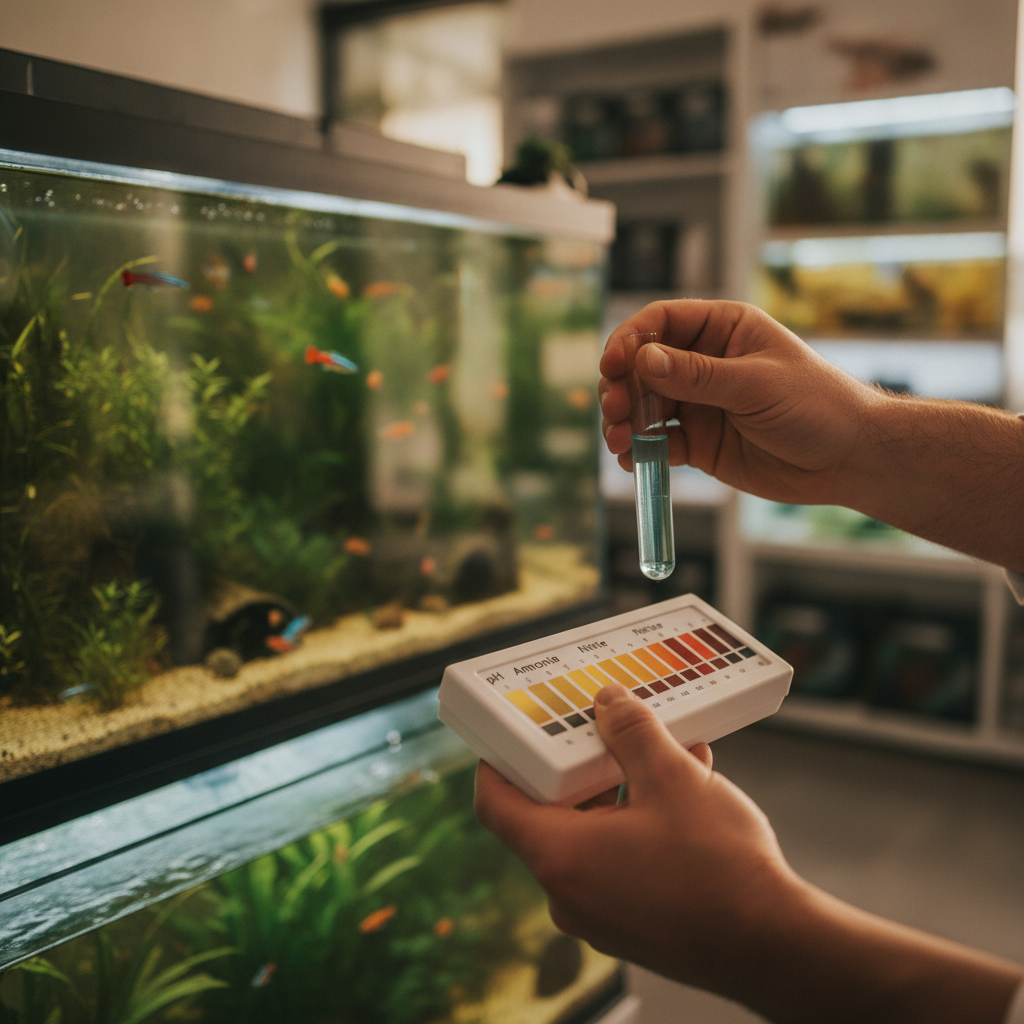
The correct diagnostic sequence is: test water chemistry first, checking ammonia, nitrite, nitrate, pH, and dissolved oxygen. If parameters are acceptable, inspect fish carefully for visible parasites around the pectoral fin bases, gill margins, and dorsal surface. If no parasite is identifiable by direct observation and flashing persists, a mucus scrape examined microscopically by a fish health specialist will identify gill flukes, skin flukes, and other microscopic organisms invisible to the naked eye. The FVS maintains a directory of qualified fish health professionals across the UK who can perform pond-side diagnostics.
Spring Water Quality in British Garden Ponds
Regional water chemistry variation across the UK adds an important layer of complexity. Hard water areas, predominant across much of south and east England, provide natural carbonate buffering that stabilises pH and may mask early ammonia toxicity. Soft water areas, common across Wales, the South West, Scotland, and parts of northern England, provide far less buffering capacity, meaning pH can swing considerably during periods of active algal growth. Because the proportion of the highly toxic un-ionised form of ammonia increases as pH rises, a soft water pond experiencing a pH spike from midday photosynthesis may present a substantially greater ammonia toxicity risk than the total ammonia reading alone suggests.
Key parameters to monitor throughout the British spring transition include ammonia (target: as close to zero as possible), nitrite (target: zero), nitrate (target: below 40 ppm, managed through partial water changes), pH (target: stable between 7.0 and 8.5, with attention to daily swing magnitude), and dissolved oxygen (target: above 7 mg per litre). Partial water changes in the range of 10 to 20 percent at a time represent the safest and most effective correction for elevated nitrate, but UK tap water must always be dechlorinated before addition. Many UK water suppliers now use chloramine rather than chlorine as the primary disinfectant, and this compound requires a dechlorinator specifically formulated to neutralise chloramine. A standard sodium thiosulphate product designed for chlorine alone is insufficient in chloramine-treated supply areas.
Environmental Pressures Specific to UK Garden Ponds in Spring
Grey heron (Ardea cinerea) predation is a significant and frequently underestimated source of behavioural disruption for UK pond fish in spring. Herons are year-round residents across virtually the entire UK and become particularly active from late winter as they feed young in the nest. A heron visit that does not result in a successful capture can still leave surviving fish in a state of acute fear-based stress for several days, manifesting as prolonged hiding in deeper areas, sustained refusal to feed, and exaggerated startle responses to movement near the water surface. These presentations should not be misinterpreted as illness. Physical deterrence through pond netting, deep-water refuge structures, or motion-activated deterrents represents the most practical long-term approach. Garden ponds shallower than approximately 60 cm across their full depth, which is common in many UK suburban installations, offer fish limited refuge from heron strike and represent a structural risk factor that is worth addressing as part of the spring review.
Stocking density should also be reassessed in spring. Fish that were appropriately sized relative to pond volume the previous autumn will have grown, and spring is the season at which overcrowding first becomes apparent through sustained surface activity, escalating aggression during spawning chases, and elevated ammonia despite apparent filter function. Any collection that has grown through breeding over previous seasons warrants a considered assessment of volume relative to the number and size of fish currently present.
When to Seek Specialist Assessment
Professional advice from a fish health specialist should be sought when multiple fish display any of the behaviours described simultaneously rather than as isolated incidents, when flashing persists despite water quality tests returning acceptable results across repeated testing, when spawning injuries are observed on any fish, when any fish death occurs even if apparently isolated, when behaviour fails to return to a normal baseline within one to two weeks of spring conditions establishing, or when visible lesions, ulceration, abnormal posture, or loss of balance accompany any other behavioural sign.
The World Aquatic Veterinary Medical Association (WAVMA) and the British Veterinary Association (BVA) both formally recognise fish as sentient animals whose welfare merits the same structured, evidence-based assessment applied to any companion species. Early specialist involvement consistently leads to better clinical outcomes than delayed intervention after disease has progressed. The combination of unpredictable British weather, regional water chemistry variation, and the convergence of spawning stress with biological filter re-establishment makes the spring window the period of greatest risk in the UK pond calendar.
Contact your registered vet's out-of-hours service or find your nearest Vets Now emergency clinic.
All UK vet practices must provide 24/7 emergency cover. Your vet's answerphone will direct you to the on-call service.
Frequently Asked Questions
When does spawning usually start in UK garden ponds? ↓
How do I tell whether my fish are gasping due to low oxygen or just warming up near the surface? ↓
My fish are flashing but my water test results look fine. What should I do next? ↓
Am I legally required to treat sick pond fish in the UK? ↓
How can I reduce the risk of heron attacks on my pond fish in spring? ↓

David Okafor
Certified Animal Behaviourist
Certified animal behaviourist — science-based strategies for fear, anxiety, reactivity, and behavioural challenges.
Content Disclosure
This article was created using state-of-the-art AI models with human editorial oversight. It is intended for informational and entertainment purposes only and does not constitute veterinary medical advice. Always consult a licensed veterinarian for your pet's specific health needs. Learn more about our process.