
In this article
- Key Takeaways
- Why Spring Grazing Suits the British Climate
- Legal Responsibilities for UK Owners
- Vaccinations Before Outdoor Access
- Building a Predator-Proof Run for UK Gardens
- Preparing the Grazing Area
- Temperature Management in British Spring
- Gradual Grass Introduction
- Supervision and Session Length
- Post-Grazing Checks
- When to Contact a Vet Immediately
- Ongoing Maintenance
- Quick Reference Checklist
Key Takeaways
- UK foxes, including bold urban foxes, are the primary predator threat: use weld mesh (not chicken wire) with bolt-snap locks and a fully enclosed roof.
- Under the Animal Welfare Act 2006, owners have a legal duty to protect rabbits and guinea pigs from pain, suffering, and disease, including hazards in outdoor enclosures.
- British spring temperatures can swing from near-freezing mornings to 20°C afternoons in a single day: monitor conditions at ground level, not standing height.
- Rabbits in the UK must be vaccinated against myxomatosis and both strains of RVHD before any outdoor access, as wild rabbit populations carry these diseases.
- Gradually introduce fresh grass over 7 to 10 days to prevent gastrointestinal stasis or dangerous bloat.
Why Spring Grazing Suits the British Climate
The UK's temperate maritime climate makes spring one of the best windows for outdoor grazing. Daytime temperatures across England, Wales, Scotland, and Northern Ireland typically sit between 8°C and 16°C from late March through May, which falls comfortably within the safe range for both species. Direct sunlight supports natural vitamin D synthesis, while varied foraging stimulates natural behaviours that indoor housing alone cannot replicate.
However, British springs are notoriously unpredictable. A bright April morning can give way to heavy showers, gusty winds, or even a late frost by mid-afternoon. Owners need a setup that accounts for rapid weather shifts, persistent dampness, and the UK's thriving fox population.
Legal Responsibilities for UK Owners
The Animal Welfare Act 2006 (and its equivalents in Scotland and Northern Ireland) places a duty of care on anyone responsible for an animal. For outdoor grazing, this means providing a suitable environment, protection from pain and suffering, and safeguarding against injury and disease. Failing to protect a rabbit or guinea pig from foreseeable outdoor hazards, such as an insecure run or known toxic plants, could constitute an offence under the Act.
The RSPCA and the Rabbit Welfare Association and Fund (RWAF) both publish detailed guidance on outdoor housing standards. The RWAF recommends a minimum run size of 3 m x 2 m x 1 m for a pair of rabbits, and professional consensus supports at least 1.5 m x 1 m for two guinea pigs, though larger is always preferable.
Vaccinations Before Outdoor Access
Before placing any rabbit on outdoor grass in the UK, vaccination status must be current. Wild rabbit populations across Britain carry myxomatosis and rabbit viral haemorrhagic disease (RVHD1 and RVHD2). Both diseases are frequently fatal, and RVHD2 can kill without obvious prior symptoms.
Veterinary guidelines from the British Veterinary Association (BVA) and the RWAF recommend annual vaccination against all three diseases. Combined vaccines are widely available through UK veterinary practices, typically costing between £40 and £70 per rabbit depending on the practice and region. Rabbits should be fully vaccinated at least two weeks before their first outdoor grazing session of the year.
Guinea pigs do not require routine vaccinations in the UK but should have a general health check before the spring grazing season begins, particularly to assess dental health and check for early signs of respiratory infection.
Building a Predator-Proof Run for UK Gardens
The Fox Problem
Foxes are present across virtually every part of the UK, from rural farmland to inner-city gardens. Urban foxes in particular can be remarkably bold, visiting gardens in broad daylight. A standard chicken wire enclosure offers almost no protection: foxes can tear through it within minutes. Cats, sparrowhawks, buzzards, red kites, magpies, stoats, and weasels are also potential threats depending on location.
Materials and Construction
- Weld mesh panels: Use a gauge no wider than 13 mm x 25 mm for guinea pigs. Source from UK hardware suppliers or specialist pet enclosure companies.
- Framing: Pressure-treated, pet-safe timber or powder-coated steel. Avoid wood treated with older preservatives containing arsenic compounds.
- Roof: Fully enclosed mesh or solid panel. This is non-negotiable in the UK, where birds of prey are protected under the Wildlife and Countryside Act 1981, meaning deterrents are limited. A roof keeps pets safe without disturbing raptors.
- Locks: Bolt-snap fasteners or combination padlocks. Foxes can nose open hook-and-eye latches, and corvids (particularly magpies and crows) are adept at manipulating simple catches.
- Ground security: Attach a mesh skirt extending 30 cm outward, flat on the ground, and weigh it down with paving slabs. Alternatively, drive ground pegs through the frame base into the soil. Badgers, present in many UK gardens, are powerful diggers.
Shade and Weather Protection
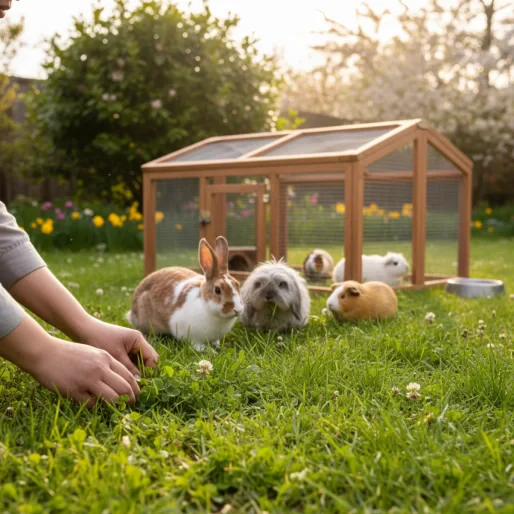
Cover at least one third of the roof with a waterproof tarpaulin or heavy-duty shade cloth. British spring showers arrive without warning, and wet fur combined with wind chill can drop a small animal's body temperature quickly. Place a solid hideaway shelter (a wooden arch, tunnel, or upturned box with an entrance cut) inside the run. Both rabbits and guinea pigs are prey animals and become visibly stressed without somewhere to retreat.
Preparing the Grazing Area
Lawn Chemical Safety
Many UK homeowners apply moss killer, weedkiller, or lawn feed in early spring. Products containing ferrous sulphate, glyphosate, or phenoxy herbicides are toxic to small animals. Any area treated with lawn chemicals within the previous four to six weeks must be considered unsafe. If a neighbouring garden has been treated and borders your grazing area, allow an additional buffer zone of at least one metre.
Toxic Plants Common in British Gardens
Spring growth in the UK produces rapid weed emergence. The following are commonly found in British gardens and are toxic to rabbits and guinea pigs:
- Buttercup (Ranunculus spp.): Abundant across UK lawns. Contains protoanemonin, causing mouth irritation, drooling, and gut pain.
- Foxglove (Digitalis purpurea): Native to Britain and widespread in borders, hedgerows, and wild patches. Contains cardiac glycosides; even small amounts can be fatal.
- Ragwort (Jacobaea vulgaris): Subject to control under the Weeds Act 1959 and the Ragwort Control Act 2003. Contains pyrrolizidine alkaloids causing irreversible liver damage. Commonly found on waste ground and field edges adjacent to gardens.
- Bindweed (Convolvulus spp.): Extremely common in UK gardens; twining vine with trumpet-shaped white or pink flowers.
- Privet (Ligustrum spp.): One of the most popular hedging plants in the UK. Leaves and berries are toxic to small herbivores.
- Hemlock (Conium maculatum): Found along UK waterways, roadsides, and sometimes garden edges. Tall white umbrella-shaped flowers, purple-blotched stems. Extremely poisonous.
- Lily of the valley (Convallaria majalis): Commonly planted in shaded UK borders. Cardiac glycosides throughout the plant.
- Yew (Taxus baccata): Prevalent in British churchyards, parks, and garden hedging. All parts except the red aril flesh are highly toxic, and dried clippings remain dangerous.
- Daffodil (Narcissus spp.): Iconic British spring bulb. All parts, especially the bulb, contain lycorine and are toxic.
Before each session, walk the grazing area at ground level and remove any unidentified plants. The RWAF maintains an online guide to safe and unsafe plants. Photograph anything uncertain and cross-reference before allowing access.
Spring also brings plant toxicity risks for other pets. Cat owners should be aware that lilies are extremely dangerous: see Lily Poisoning in Cats: A Spring Emergency Guide.
Temperature Management in British Spring
The ideal outdoor temperature range for both species is 10°C to 20°C. Conditions up to 25°C are acceptable with adequate shade and water. Above 26°C, the risk of heatstroke rises sharply, particularly for rabbits, which lack effective cooling mechanisms.
British spring mornings can be surprisingly cold, sometimes near or below 5°C in northern England and Scotland even in late April. Guinea pigs are less cold-tolerant than rabbits and should not be placed outdoors below 10°C. A practical approach is to wait until mid-morning, when ground-level temperatures have risen, and bring animals inside by late afternoon as temperatures drop.
Place an outdoor thermometer at pet height (ground level, not on a fence post) inside the run, ideally one with a maximum and minimum memory function. On sunny days, ground-level temperatures inside an enclosed run can be several degrees warmer than ambient air, particularly on dark soil or paving.
Signs of Heat Stress
- Rapid or open-mouth breathing
- Lethargy, lying flat with limbs extended
- Wet nose and chin from excessive salivation
- Red or very pale ears (rabbits)
If heat stress is suspected, move the animal indoors immediately, offer water, gently dampen the ears with cool (not ice-cold) water, and contact your veterinary practice.
Contact your registered vet's out-of-hours service or find your nearest Vets Now emergency clinic.
All UK vet practices must provide 24/7 emergency cover. Your vet's answerphone will direct you to the on-call service.
Gradual Grass Introduction
A rabbit or guinea pig transitioning from a winter diet of hay and dried food to fresh spring grass is at significant risk of gastrointestinal stasis or bloat. Veterinary guidance recommends starting with 15 to 20 minutes of grazing on day one, increasing by 10 to 15 minutes daily over 7 to 10 days. Monitor droppings closely: soft, clumped, or mucus-coated droppings indicate digestive disturbance and the introduction pace should be slowed.
For rabbits with longer coats, the spring transition also involves grooming considerations. See Spring Grooming Guide for Long-Haired Rabbits for breed-specific advice.
Supervision and Session Length
Even in a well-secured run, check on animals at least every 15 to 20 minutes. Positioning the run within view of a kitchen or living room window makes this manageable. Never leave rabbits or guinea pigs outdoors overnight in a temporary run: British spring nights bring dew-soaked ground, unpredictable temperature drops, and active nocturnal predators including foxes, badgers, stoats, and owls.
Recommended Session Lengths
- Cool days (10°C to 16°C): Up to 2 to 3 hours for rabbits; 1 to 2 hours for guinea pigs.
- Warm days (17°C to 24°C): 1 to 2 hours with mandatory shade.
- Hot days (above 25°C): Early morning or late evening only, under one hour. Consider skipping outdoor time entirely during heatwaves.
Mixed-Species Caution
The RWAF and the RSPCA both advise against housing rabbits and guinea pigs together. Rabbits can injure guinea pigs with powerful hind-leg kicks, and rabbits commonly carry Bordetella bronchiseptica, which causes serious respiratory illness in guinea pigs. Separate runs or closely supervised, time-limited shared sessions are the safer approaches.
Post-Grazing Checks
After each outdoor session, carry out a brief body check:
- Ticks: Present in many UK gardens, particularly those near woodland, heathland, or deer habitats. Check around the ears, neck, and belly.
- Fly eggs: Small white or yellow clusters on fur, especially around the rear end. Flystrike (myiasis) is a genuine emergency in the UK, particularly from late spring onward. Blowfly larvae can burrow into skin within 12 to 24 hours in warm conditions.
- Grass seeds: Can lodge near eyes, ears, or between toes.
- Appetite and droppings: A rabbit that stops eating or produces no droppings for more than a few hours may be experiencing GI stasis, which requires urgent veterinary attention.
When to Contact a Vet Immediately
Seek emergency veterinary care if you observe:
- Open-mouth breathing, gasping, or blue-tinged gums
- Complete loss of appetite lasting more than a few hours (GI stasis risk in rabbits)
- A bloated, hard abdomen
- Visible maggots or fly eggs on fur or skin
- Sudden collapse, seizures, or inability to stand
- Signs of plant poisoning: drooling, pawing at the mouth, diarrhoea, tremors
- Any bite wound, however small, as puncture wounds harbour deep infection
Save your veterinary practice's emergency number in your phone before the first outdoor session. Many UK practices use out-of-hours providers such as Vets Now for evenings and weekends.
Contact your registered vet's out-of-hours service or find your nearest Vets Now emergency clinic.
All UK vet practices must provide 24/7 emergency cover. Your vet's answerphone will direct you to the on-call service.
For guidance on managing veterinary costs in the UK, see Vet Visit Costs in the UK: Budget Friendly Alternatives.
Ongoing Maintenance
- Before each session: Walk the area to check for new weed growth, wild animal droppings, slug pellets, and wind-blown litter.
- Weekly: Inspect all mesh joins, locks, and frame connections. UK rain and UV exposure degrade materials faster than expected.
- Monthly: Move the run to a fresh patch of grass. This reduces parasite build-up and allows the lawn to recover.
- Seasonally: As spring turns to summer, reassess shade coverage and increase flystrike vigilance. Review any changes to pet welfare regulations: see New Pet Ownership Laws in the UK for 2026.
Quick Reference Checklist
- Rabbit vaccinations (myxomatosis, RVHD1, RVHD2) up to date
- Run built with weld mesh, fully enclosed roof, bolt-snap locks
- Ground edges skirted or pegged against digging predators
- Toxic weeds (including yew and daffodil growth) identified and removed
- Shade covering at least one third of the run; waterproof section for rain
- Hideaway shelter and fresh hay inside the run
- Clean water accessible, tested, and positioned in shade
- Thermometer placed at ground level inside the run
- Grass introduced gradually over 7 to 10 days
- Visual checks every 15 to 20 minutes
- Post-session body check (ticks, fly eggs, grass seeds)
- Vet emergency number saved in phone
Frequently Asked Questions
Content Disclosure
This article was created using state-of-the-art AI models with human editorial oversight. It is intended for informational and entertainment purposes only and does not constitute veterinary medical advice. Always consult a licensed veterinarian for your pet's specific health needs. Learn more about our process.