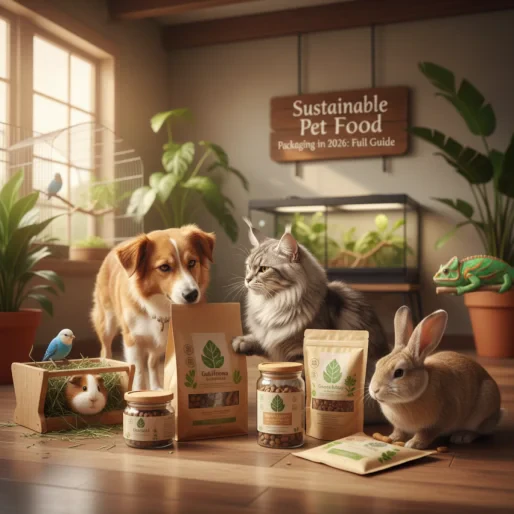
UK pet owners now have more sustainable packaging options than ever, from compostable pouches to mono-material recyclable bags. This guide covers local recycling infrastructure, OPRL labels, refill stations, and carbon footprint certifications relevant to Britain.
Key Takeaways for UK Pet Owners
- Compostable pouches require industrial composting, which is available through council food waste collections in many (but not all) local authorities across England, Scotland, Wales, and Northern Ireland.
- Recyclable mono-material bags made from a single polymer can be taken to supermarket front-of-store collection points, even if your council does not accept flexible plastics kerbside.
- OPRL (On-Pack Recycling Label) is the most reliable UK-specific guide for determining whether pet food packaging is recyclable in your area.
- Carbon footprint labels verified against PAS 2050 or by the Carbon Trust offer the most credible environmental claims in the British market.
- Refill stations for dry pet food are growing in independent pet shops and selected supermarkets, particularly in larger cities.
Introduction: Pet Food Packaging Waste in Britain
The UK's roughly 12 million dogs and 11 million cats generate a substantial volume of pet food packaging waste each year. Multi-layer flexible pouches, combining plastics, foils, and adhesives to preserve freshness, have long been a recycling headache. Most councils cannot process them through standard kerbside collections, meaning they end up in general waste and ultimately landfill or energy-from-waste facilities.
Two alternatives are gaining traction: compostable pouches made from plant-based materials, and recyclable mono-material bags constructed from a single polymer. Both aim to address the waste problem, but the right choice depends on the recycling and composting infrastructure available in your local authority area. This guide examines each option through a UK lens, covering council collections, OPRL labelling, carbon footprint standards developed in Britain, and where to find refill stations across the country.
Compostable vs Recyclable: A UK Comparison
| Feature | Compostable Pouches | Recyclable Mono-Material Bags |
|---|---|---|
| Primary Material | PLA (polylactic acid), cellulose films, or starch blends | Single-polymer PE (polyethylene) or PP (polypropylene) |
| UK Disposal Route | Council food waste bin (where accepted) or industrial composting facility | Supermarket front-of-store flexible plastic collection points, or kerbside where accepted |
| Decomposition | Approximately 90 to 180 days at 55 to 60°C in industrial facilities | Not applicable: material is reprocessed into new products |
| Shelf Life | Typically 6 to 12 months | Typically 12 to 18 months |
| Typical Price Premium | Around 15% to 40% above conventional pouches, adding roughly £0.20 to £0.80 per bag at retail | Around 5% to 20% above conventional pouches |
| Best Suited For | Dry kibble and treats; less reliable for wet food | Dry and semi-moist foods; improving for wet food lines |
| Key UK Certification | TUV OK Compost Industrial or Home; Seedling Logo (EN 13432) | OPRL "Recycle" or "Recycle at Recycling Points" |
Understanding UK Disposal Infrastructure
Council Food Waste Collections and Composting
Under the Environment Act 2021, all local authorities in England are expected to provide separate food waste collections. Scotland, Wales, and Northern Ireland already have widespread food waste collection schemes. Where these collections feed into industrial composting or anaerobic digestion facilities operating at 55 to 60°C, compostable pet food pouches that meet EN 13432 can theoretically be processed alongside food waste.
However, many councils currently instruct residents not to place compostable packaging in food waste bins, as processing facilities may not be equipped to handle it. Before placing compostable pet food pouches in your food waste caddy, check your council's specific guidance on their website or through the WRAP (Waste and Resources Action Programme) Recycling Locator.
Flexible Plastic Recycling
Kerbside collection of flexible plastic films remains limited across the UK. The planned introduction of consistent collections through the Simpler Recycling reforms aims to improve this, but rollout timelines vary. In the meantime, major supermarkets including Tesco, Sainsbury's, Co-op, and Asda operate front-of-store collection points for flexible plastics. Mono-material pet food bags displaying the OPRL "Recycle at Recycling Points" label can be dropped off at these locations.
This makes mono-material bags a more immediately practical option for most UK households, as the supermarket drop-off network is already well established.
Reading the OPRL Label on Pet Food Packaging
The On-Pack Recycling Label (OPRL) scheme is the UK's primary consumer-facing recycling guidance system. Pet food packaging may carry one of the following designations:
- "Recycle": Widely accepted in kerbside collections across the UK. Typically seen on rigid plastic tubs, cardboard outers, and metal tins.
- "Recycle at Recycling Points": Not accepted kerbside but can be taken to supermarket front-of-store collection points or household waste recycling centres. Mono-material flexible bags often carry this label.
- "Don't Recycle": The packaging cannot be recycled through any mainstream UK system. Multi-layer pouches frequently receive this designation.
Checking for the OPRL label is the single most reliable step a UK pet owner can take when choosing between products on the shelf.
Carbon Footprint Labels: The UK Context
Britain has a particular connection to carbon footprint labelling. The PAS 2050 standard, developed by BSI (British Standards Institution) in partnership with Defra and the Carbon Trust, was one of the world's first methodologies for measuring the lifecycle greenhouse gas emissions of products. The Carbon Trust's carbon footprint label, which some UK pet food brands now display, verifies claims against this framework.
What to Look For
- Carbon Trust Footprint Label: Confirms that the product's carbon footprint has been independently measured and verified. Some labels also indicate a commitment to reduction over time.
- PAS 2050 or ISO 14067 reference: The methodology behind the CO2e figure. A label referencing one of these standards is more credible than a self-declared figure.
- Scope disclosure: Check whether the carbon figure covers cradle-to-grave (full lifecycle) or only cradle-to-gate (up to the point of manufacture). The brand's website should clarify this.
Carbon labels remain voluntary in the UK. Comparing figures across brands is only meaningful when the same methodology and scope have been used.
Refill Stations Across the UK
Refill stations for dry pet food and treats allow owners to bring reusable containers and purchase by weight, eliminating single-use packaging entirely. In the UK, availability is moderate and growing, concentrated in the following areas:
- London: Multiple independent zero-waste shops and selected pet retailers offer pet food refills, particularly in boroughs with strong sustainability communities.
- Bristol, Brighton, and Edinburgh: These cities have well-established zero-waste retail scenes that frequently include pet food options.
- Manchester, Leeds, and Glasgow: Availability is expanding, primarily through independent pet shops and health food stores.
- Smaller towns and rural areas: Coverage remains patchy. Some farm shops and independent pet retailers offer loose kibble and treats, but it is not yet widespread.
When using refill stations, ensure the container is clean and dry. Ask the retailer about the food's batch number and best-before date for your records, particularly if you have a dog or cat with dietary sensitivities. For pets transitioning to a new food sourced from a refill station, guidance on Switch Your Dog to Fresh or Cooked Food Safely (UK) remains relevant.
Eco-Certification Logos Relevant to UK Shoppers
Pet food packaging sold in the UK may carry a range of environmental logos. The most meaningful ones include:
Compostability
- TUV Austria OK Compost Industrial: Confirms EN 13432 compliance for industrial composting.
- TUV Austria OK Compost Home: A stricter standard confirming breakdown at lower temperatures (around 20 to 30°C), suitable for garden compost heaps. Relatively rare on pet food packaging but worth seeking out.
- Seedling Logo: Administered by European Bioplastics, also confirming EN 13432 compliance.
Recyclability
- OPRL: The most UK-relevant label, as described above.
- Green Dot: This logo indicates the manufacturer contributes to a packaging recovery scheme. It does not mean the packaging itself is recyclable. This distinction catches many consumers out.
Broader Sustainability
- Carbon Trust Footprint Label: Verified carbon measurement.
- B Corp: A whole-business sustainability certification, not packaging-specific but indicative of broader environmental commitment.
- FSC or PEFC: Relevant for paper or cardboard components, confirming responsibly managed forest sourcing.
Third-party verification is always more reliable than self-declared claims. This principle applies across pet care decisions, from evaluating packaging credentials to checking Pet Groomer Credentials: What UK Owners Should Check or Responsible Breeder vs Puppy Farm: 2026 UK Guide.
Choosing the Right Option for Your Household
Compostable Pouches Suit You If:
- Your council accepts compostable packaging in food waste collections (check your local authority website)
- Your pet primarily eats dry food or treats
- You already use your council food waste caddy regularly
- You are comfortable with a higher price premium, typically £0.30 to £0.80 extra per bag
Recyclable Mono-Material Bags Suit You If:
- You shop at a supermarket with a front-of-store flexible plastic collection point
- You want a longer shelf life, useful for bulk buying or multi-pet households
- You prefer a more moderate cost increase
- You want to keep materials in the circular economy rather than converting them to compost
Refill Stations Suit You If:
- An independent pet shop or zero-waste store offering pet food refills is within a reasonable distance
- Your pet eats dry kibble or treats that dispense well from bulk bins
- Eliminating packaging entirely is your priority
- You already bring reusable bags and containers when shopping
Practical Checklist for UK Pet Owners
- Check your council's recycling and food waste guidance: Use the WRAP Recycling Locator or your local authority website to confirm what is accepted in your area.
- Identify your pet's food type: Dry kibble is compatible with all three sustainable options. Wet food currently has fewer sustainable packaging choices.
- Look for the OPRL label on any packaging claiming to be recyclable. This is the UK standard.
- Verify carbon claims: If a product displays a CO2e figure, check whether it references PAS 2050, ISO 14067, or Carbon Trust verification.
- Locate your nearest collection point: For mono-material bags, find your nearest supermarket flexible plastic drop-off. For compostable pouches, confirm your council's food waste policy.
- Consider your budget: Factor sustainable packaging costs into overall pet care spending, alongside essentials such as vaccinations, microchipping (mandatory for dogs and cats in the UK), and insurance.
- Reassess annually: UK recycling infrastructure is changing rapidly, particularly with Simpler Recycling reforms. What is not accepted today may be accepted next year.
Contact your registered vet's out-of-hours service or find your nearest Vets Now emergency clinic.
All UK vet practices must provide 24/7 emergency cover. Your vet's answerphone will direct you to the on-call service.
Looking Ahead
The UK's regulatory landscape is moving towards greater packaging accountability. Extended Producer Responsibility (EPR) reforms, which require manufacturers to fund the full cost of managing packaging waste, are reshaping how pet food companies think about their materials. The Plastic Packaging Tax, which applies a levy of £217.85 per tonne on packaging containing less than 30% recycled content, provides further financial incentive for brands to shift towards recyclable or compostable formats.
For UK pet owners, these policy changes should translate into better labelling, wider recycling acceptance, and more sustainable options on supermarket and pet shop shelves throughout 2026 and beyond. Staying informed and checking labels at the point of purchase remains the most effective way to support the transition. Owners interested in broader sustainability steps may also find guidance on reducing aquarium energy and water waste and other aspects of sustainable pet care useful.
Frequently Asked Questions
Can I put compostable pet food pouches in my council food waste bin? ↓
Where can I recycle mono-material pet food bags in the UK? ↓
What does the Green Dot logo mean on pet food packaging? ↓
Are there refill stations for pet food near me in the UK? ↓
How can I tell if a carbon footprint label on pet food is credible? ↓

Priya Nair
Dog Breed Advisor & Adoption Counsellor
Dog breed advisor and adoption counsellor — honest breed comparisons and lifestyle matching for prospective owners.
Content Disclosure
This article was created using state-of-the-art AI models with human editorial oversight. It is intended for informational and entertainment purposes only and does not constitute veterinary medical advice. Always consult a licensed veterinarian for your pet's specific health needs. Learn more about our process.