
In this article
- Key Takeaways
- Why Hong Kong's Summer Climate Demands a Different Standard
- Climate-Controlled vs. Outdoor: A Hong Kong Comparison
- What to Assess at a Climate-Controlled Facility in Hong Kong
- Outdoor Daycare in Hong Kong Above 30C: What Responsible Practice Requires
- Breed Considerations for Hong Kong's Dog Population
- Cost Considerations in Hong Kong
- Decision Checklist for Hong Kong Owners
Key Takeaways
- Humidity is the critical amplifier in Hong Kong: relative humidity of 80 to 95 percent during summer significantly reduces the efficiency of panting as a cooling mechanism, meaning dogs in active group play face a substantially greater physiological burden than the air temperature alone would suggest.
- Brachycephalic breeds dominate Hong Kong's dog population and face the highest daycare heat risk. French Bulldogs, Pugs, Shih Tzus, and Cavalier King Charles Spaniels are among the most commonly registered breeds in the city, and veterinary guidance places their elevated risk threshold at 24 to 26 degrees Celsius, well below a typical Hong Kong summer day.
- The Hong Kong Observatory's Very Hot Weather Warning (issued when temperatures reach or are expected to reach 33 degrees Celsius) is a useful public reference, but dogs in active group settings face meaningful risk at lower temperatures when humidity is high.
- Typhoon signal protocols are a non-negotiable consideration. Every prospective daycare facility should have a written procedure covering mid-session signal changes, including Signal No. 3 and Signal No. 8, before enrolment is confirmed.
- AFCD licensing establishes minimum operational standards for commercial boarding and daycare in Hong Kong, but does not prescribe specific temperature or humidity thresholds for play environments. Active owner verification of heat management protocols remains essential.
Why Hong Kong's Summer Climate Demands a Different Standard
Hong Kong's summer months, running broadly from June through September, are not simply hot. Temperatures that regularly reach 32 to 36 degrees Celsius combine with relative humidity frequently above 85 percent to create a heat burden on active dogs that is categorically different from dry heat at the same temperature. Dogs cool themselves almost entirely through panting, a process dependent on evaporative heat loss from the respiratory tract. When ambient humidity is high, evaporation is less efficient, meaning a dog in an active group play environment in Hong Kong's summer is working significantly harder to achieve the same cooling effect than a dog at comparable temperatures in a drier climate.
The Agriculture, Fisheries and Conservation Department (AFCD) licenses commercial boarding and daycare premises in Hong Kong and conducts welfare inspections. However, licensing requirements address minimum operational standards and do not prescribe specific temperature or humidity thresholds for group play environments. A licensed facility is not automatically one that meets a veterinary standard of heat management during peak summer conditions. Direct assessment of protocols and physical infrastructure remains the owner's responsibility, regardless of licensing status.
The Hong Kong Observatory provides public guidance including the Very Hot Weather Warning and the Extreme Heat Information service, which are useful contextual references. Professional veterinary guidance, however, aligns heat risk in active dogs with thresholds meaningfully below these public warning levels, particularly when humidity is a compounding factor. Group daycare involves sustained social arousal and physical exertion, which elevates physiological heat demand above what a resting dog experiences. For a detailed overview of heat-related illness recognition and prevention, see Late Summer Heatstroke: A Proactive Prevention Guide for Pet Owners.
Climate-Controlled vs. Outdoor: A Hong Kong Comparison
| Factor | Climate-Controlled Daycare | Outdoor Daycare |
|---|---|---|
| Temperature and humidity | Active cooling and dehumidification; play areas typically maintained at 18 to 24 degrees Celsius | Follows ambient outdoor conditions; humidity typically 80 to 95 percent in summer |
| Typhoon disruption risk | Indoor facilities can often continue operating through lower signal levels with appropriate infrastructure | Outdoor sessions typically suspended at Typhoon Signal No. 3 or above; full closure at Signal No. 8 |
| Suitability for common HK breeds | Appropriate for French Bulldogs, Pugs, Shih Tzus, and other brachycephalic breeds throughout summer | Not appropriate for brachycephalic breeds above 28 degrees Celsius in humid conditions |
| Approximate daily cost | Typically HKD 350 to 700 or above for full-day sessions | Typically HKD 200 to 400; quality and welfare standards vary widely |
| Operational reliability | Year-round consistency; weather and typhoon cancellations minimised | Subject to cancellation during heat events, typhoon signals, and Black Rainstorm Warnings |
| Air quality | Filtered indoor air reduces exposure during regional pollution episodes | Outdoor air quality variable; pollution events affect dogs with respiratory vulnerabilities |
What to Assess at a Climate-Controlled Facility in Hong Kong
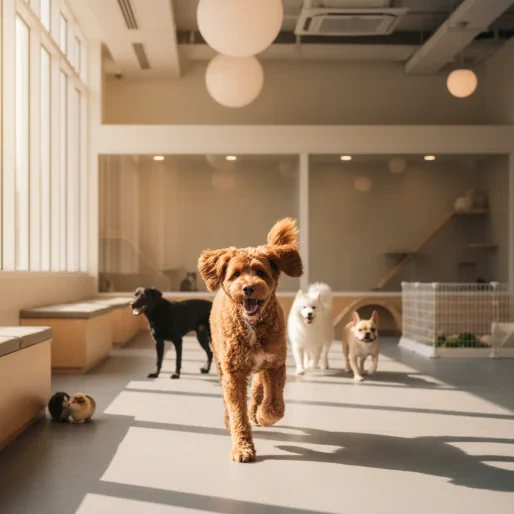
Climate control in a Hong Kong context means more than a cooling unit in a reception area. For active dogs across a full operating day, including the hottest afternoon hours of July and August, the entire play floor must be maintained at a temperature that supports safe thermoregulation. Commercial premises in Hong Kong vary considerably in the coverage and capacity of their air conditioning systems, and the difference between a cooled reception and a genuinely cooled play environment can be significant. Humidity reduction is equally important: even a cooled space at 24 degrees Celsius with residual high humidity creates meaningfully greater physiological demand on a panting dog than a dry environment at the same temperature. Ask staff to demonstrate environmental monitoring readings in the play area during a midday summer visit, not during a cooler morning tour.
Staff Training and Monitoring Protocols
The Hong Kong Veterinary Association (HKVA) and the SPCA Hong Kong publish animal welfare guidance aligned with international standards. Staff at a reputable daycare should be able to describe, without prompting, the early heat stress indicators they actively monitor: laboured or disproportionate panting, excessive drooling, red or congested gum colour, reluctance to move, vomiting, or any episode of disorientation. In humid conditions, clinical deterioration can progress quickly, and the interval between early warning signs and emergency status is shorter than in dry climates. Ask directly what the staff-to-dog ratio is during active play. Professional canine welfare guidance commonly references one staff member per 10 to 15 dogs during group play as a working benchmark, with lower ratios enabling closer individual monitoring. For emergency veterinary contact in Hong Kong, refer to
SPCA Hong Kong / Emergency Vet Clinics
Contact the SPCA Hong Kong or your nearest 24-hour emergency veterinary clinic.
Several private veterinary hospitals in Hong Kong offer round-the-clock emergency care.
Typhoon Signal Protocols
Any prospective daycare facility in Hong Kong should be able to provide a written protocol covering what happens when typhoon signals change during an operating day. Specifically: what is the procedure when Signal No. 1 is raised, when Signal No. 3 is raised, and critically, when Signal No. 8 is hoisted mid-session. Does the facility hold dogs safely until owners can collect them? Are emergency overnight arrangements available? Is there an automated notification system for owners? These are practical questions, not hypothetical ones. Typhoon disruptions to normal working hours occur regularly between June and October, and a clear written protocol is a straightforward indicator of professional operational standards.
Outdoor Daycare in Hong Kong Above 30C: What Responsible Practice Requires
Outdoor daycare in Hong Kong's summer months presents substantially greater complexity than in lower-humidity climates. High ambient humidity means that even well-shaded outdoor environments retain a level of heat burden that climate-controlled facilities eliminate entirely. Responsible operators adapt their entire summer schedule and infrastructure around active heat management rather than treating it as a contingency measure.
Shade, Surfaces, and Airflow
Shade must be sufficient for all enrolled dogs to rest simultaneously, not simply for a portion of the group. Permanent roofed structures or purpose-built sail cloth installations are more reliable than tree canopy, which shifts through the day and can be inadequate during the direct afternoon hours. Ground surface temperature is a frequently overlooked risk factor: concrete and paving in direct sunlight can reach temperatures substantially above ambient air temperature, and paw contact with these surfaces causes rapid localised heat absorption. Grass, rubber matting, or wood-chip surfaces under shade structures are considerably safer. The practical check of placing the back of a hand flat on the surface for seven seconds gives a reasonable indication of whether the surface is safe for dogs to stand or lie on. Airflow within sheltered outdoor areas can also be limited in Hong Kong's urban layout, where surrounding buildings reduce natural ventilation. Shade coverage alone does not guarantee adequate airflow.
Activity Scheduling and Enforced Rest
In Hong Kong's summer climate, the window for safe outdoor active play is narrow. Responsible facilities should concentrate high-intensity group play before 9am and after 5pm, with the extended midday period reserved for supervised rest in shaded, ventilated areas. Active cooling infrastructure such as misting stations, shallow splash areas, and cooling mats in shaded rest zones represents a meaningful operational standard in Hong Kong's high-humidity context, where shade and water provision alone offers a reduced margin of safety compared with drier climates. Any outdoor facility unable to clearly describe what enforced supervised rest looks like operationally between 10am and 4pm in July and August warrants careful scrutiny.
Breed Considerations for Hong Kong's Dog Population
Hong Kong's registered dog population skews heavily toward brachycephalic and small breeds. French Bulldogs, Pugs, Shih Tzus, Pomeranians, Maltese, and Cavalier King Charles Spaniels collectively account for a substantial proportion of the city's pet dogs, and all carry elevated heat risk profiles in group daycare settings. French Bulldogs and Pugs have structural airway compressions that reduce the efficiency of thermoregulation through panting. Veterinary guidance consistently identifies these breeds as being at elevated risk at temperatures above 24 to 26 degrees Celsius, which is below the temperature range that prevails across most of Hong Kong's summer. For these animals, climate-controlled daycare is the appropriate standard of care throughout the summer months, not an optional premium. For further context on brachycephalic health management, see Flying with Brachycephalic Pets: Risks, Airline Bans, and Safety FAQs.
Golden Retrievers and Labrador Retrievers are also popular in Hong Kong and, while more physiologically capable than brachycephalic breeds, their size and typical play intensity mean that outdoor daycare above 30 degrees Celsius in high humidity requires rigorously verified protocols rather than assumptions based on breed reputation. Senior dogs (generally over eight years of age), clinically overweight dogs, and dogs with diagnosed cardiac or respiratory conditions share elevated risk profiles regardless of breed, and the same caution applies. Breed-specific heat tolerance cannot be assessed from registration data alone. Consultation with a registered veterinarian regarding individual heat tolerance and relevant health considerations before summer enrolment is appropriate professional practice.
Cost Considerations in Hong Kong
Climate-controlled daycare in Hong Kong typically ranges from approximately HKD 350 to HKD 700 or above for a full-day session. The operating cost of near-continuous air conditioning across a Hong Kong summer, combined with the facility overhead of a dedicated indoor play environment, represents legitimate cost rather than arbitrary margin. Outdoor facilities typically charge in the range of HKD 200 to HKD 400 per day, with higher-quality operators who invest in shade structures, misting systems, and adequate staffing pricing toward the upper end. The lowest-priced outdoor option in a Hong Kong summer frequently corresponds to the lowest level of heat management infrastructure.
Emergency veterinary treatment for heat-related illness in Hong Kong ranges from several thousand HKD for moderate cases requiring intravenous fluid therapy and overnight monitoring, to tens of thousands of HKD for severe presentations requiring intensive care. The additional monthly expenditure of a quality climate-controlled facility is modest relative to this range for the breeds and age profiles most at risk in the city's climate.
Decision Checklist for Hong Kong Owners
About Your Dog
- Is the dog a brachycephalic breed (French Bulldog, Pug, Shih Tzu, Cavalier King Charles Spaniel, or similar)? If yes: climate-controlled daycare is the appropriate standard of care throughout Hong Kong's summer months, regardless of facility marketing claims.
- Is the dog over eight years of age, clinically overweight, or does the dog have a diagnosed cardiac or respiratory condition? If yes: prioritise climate-controlled facilities and consult a registered veterinarian before enrolment.
- Has the dog shown heat sensitivity during outdoor walks or play in Hong Kong's summer, including persistent shade-seeking, reluctance to move, or disproportionate panting? If yes: outdoor daycare above 28 degrees Celsius is not appropriate.
- Is the dog a healthy adult of lean build with a short single coat and a documented history of heat tolerance at comparable temperatures? If yes: outdoor daycare may be appropriate, provided facility protocols are directly and thoroughly verified.
About the Facility
- Can staff confirm and demonstrate temperature and humidity levels in the active play area during a midday summer visit, using monitoring equipment rather than estimation?
- Is there a written typhoon signal protocol covering mid-session changes at Signal No. 3 and Signal No. 8, including owner notification and dog welfare procedures?
- Is shade coverage sufficient for all enrolled dogs to rest simultaneously, and does it remain effective throughout the afternoon hours as the sun tracks across the space?
- Are enforced rest periods during peak heat hours documented and supervised operationally, not simply available in principle?
- Is fresh water available continuously from multiple points across the facility, with a documented cleaning and refilling schedule?
- Is the facility AFCD-licensed, and are staff trained in canine first aid with specific competency in recognising heat-related illness?
- Is there a registered veterinary clinic on call or within close proximity? Refer to for emergency veterinary contact information in Hong Kong.
SPCA Hong Kong / Emergency Vet Clinics
Contact the SPCA Hong Kong or your nearest 24-hour emergency veterinary clinic.
Several private veterinary hospitals in Hong Kong offer round-the-clock emergency care.
For a comprehensive guide to what to assess during a daycare site visit, see Choosing a Pet Daycare: Red Flags and Green Flags on Your First Visit.
In Hong Kong's summer months, the gap between a well-managed and a poorly managed daycare facility is wider than in most other climates. High temperature combined with extreme humidity compresses the margin between safe and unsafe conditions for active dogs. Owners who visit facilities during peak operating hours, ask detailed questions about heat management and typhoon protocols, and match their choice to their individual dog's breed and health profile are making a decision that genuinely serves their animal's welfare rather than defaulting to the nearest or cheapest available option.
Frequently Asked Questions
Content Disclosure
This article was created using state-of-the-art AI models with human editorial oversight. It is intended for informational and entertainment purposes only and does not constitute veterinary medical advice. Always consult a licensed veterinarian for your pet's specific health needs. Learn more about our process.