Hong Kong's compact living spaces make enrichment-focused cat daycares especially valuable. Here is how to evaluate facilities in the city for genuine feline welfare.
Key Takeaways
- In Hong Kong's small flats, cat daycares that provide vertical climbing structures, scent zones, and hiding spots can supplement limited home enrichment.
- Group size limits of 6 to 10 cats per supervised space are critical in the city's typically compact commercial premises.
- Hong Kong's subtropical humidity and summer heat (often above 33°C) mean climate control and ventilation are non-negotiable facility features.
- Red flags include overcrowding, no vertical space, heavy reliance on kennels, poor ventilation, and a strong ammonia smell.
- Trial visits and transparent policies are hallmarks of facilities that genuinely prioritise cat welfare.
Why Enrichment Matters Even More in Hong Kong
Hong Kong's residential reality, where many cats live in flats of 30 to 50 square metres, makes environmental enrichment a genuine welfare concern rather than a luxury add-on. Cats kept in small spaces without adequate stimulation can develop behavioural problems including over-grooming, inappropriate elimination, and inter-cat aggression in multi-cat households.
A quality cat daycare in Hong Kong should address this by offering spatial complexity that most owners simply cannot replicate at home. The International Society of Feline Medicine (ISFM) and the American Association of Feline Practitioners (AAFP) identify five pillars of a healthy feline environment: a safe space, multiple separated resources, opportunities for play and predatory behaviour, positive human interaction, and respect for the cat's sense of smell. These principles apply universally, but take on particular urgency in a high-density urban environment.
Climate Considerations for Hong Kong Cat Daycares
Hong Kong's subtropical climate introduces facility requirements that temperate-region guides rarely mention. Between May and September, temperatures regularly exceed 33°C with humidity above 80%. During typhoon season (typically June to October), facilities must have contingency plans for signal 8 or above conditions when transport becomes impossible.
When evaluating a cattery, check for:
- Temperature control: Air conditioning should maintain indoor temperatures between 22°C and 26°C year-round. Ask whether the system has backup power in case of outages during typhoons.
- Dehumidification: High humidity promotes fungal skin infections (dermatophytosis) and respiratory issues. A well-run facility monitors humidity and keeps it below 60% indoors.
- Ventilation standards: Adequate air exchange reduces airborne pathogen transmission, particularly important given the density of cats in commercial spaces.
- Typhoon protocol: The facility should have a clear policy on drop-off and collection during adverse weather warnings, and sufficient supplies (food, litter, medication) for extended stays if owners cannot collect on time.
Comparing Enrichment-Focused and Basic Catteries in Hong Kong
| Feature | Enrichment-Focused Cattery | Basic Cattery |
|---|---|---|
| Vertical Space | Floor-to-ceiling climbing walls, multi-level shelving, catwalks maximising limited floor area | One or two low cat trees, mostly floor-level use of space |
| Scent Enrichment | Dedicated scent zones with catnip, silver vine (matatabi), valerian; rotated regularly | Occasional catnip toy, no structured programme |
| Group Size | 6 to 10 cats per supervised zone, temperament-matched | No stated limit or groups exceeding 12 to 15 in tight quarters |
| Climate Control | Maintained 22 to 26°C, humidity monitoring, backup power | Basic air conditioning, no humidity management |
| Staff Training | Trained in feline body language, stress signals, and low-stress handling | General animal care knowledge, limited feline-specific training |
| Introduction Protocol | Gradual introduction over hours or days, isolation room for newcomers | Cats placed into communal area on arrival |
| Daily Rate | Typically $250 to $450 per day | Around $150 to $220 per day |
What to Look for in a Hong Kong Cat Daycare
Vertical Territory in Compact Spaces
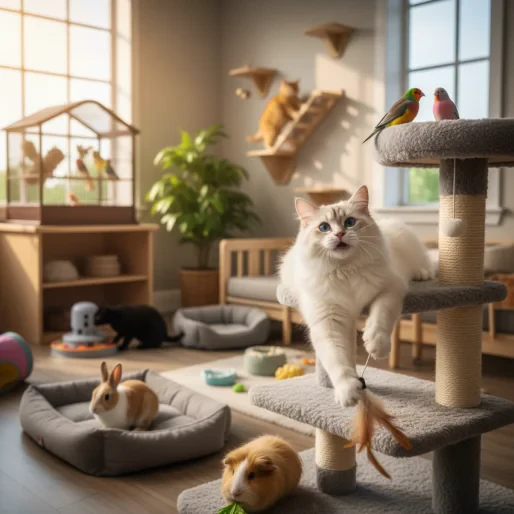
Given that commercial rents drive most Hong Kong catteries into premises of 50 to 150 square metres, vertical design is not optional. Wall-mounted shelving, ceiling-height climbing poles, and elevated catwalks effectively multiply usable territory. The ISFM environmental guidelines classify vertical space as a welfare requirement, not a luxury. In Hong Kong's constrained footprints, this is doubly true.
Look for facilities where vertical structures are distributed throughout the space rather than clustered in one corner. Dead-end perches (where a cat can be cornered by another) represent a design flaw. Quality layouts provide multiple escape routes at every level.
Scent Enrichment and Olfactory Programmes
Cats experience the world primarily through scent. Effective daycares offer rotating scent stations using safe botanicals including catnip (Nepeta cataria), silver vine (Actinidia polygama, widely available in Hong Kong given its popularity in East Asian pet markets), Tatarian honeysuckle, and valerian root. Research published in BMC Veterinary Research suggests that silver vine may elicit a positive response in a broader percentage of cats than catnip alone.
Synthetic feline facial pheromone diffusers in communal areas are another positive sign, associated in veterinary literature with reduced stress markers in unfamiliar environments.
Group Size and Temperament Assessment
This is perhaps the single most important differentiator. Forcing 15 or more unfamiliar cats into one room contradicts their social biology. Professional guidelines recommend keeping group sizes in the range of 6 to 10 per supervised space, with cats matched by energy level and sociability.
Ask the daycare how they assess temperament. Reputable facilities conduct an intake evaluation that examines how the cat responds to handling, novel environments, and other cats. Cats assessed as solitary or fearful should have access to individual suites. In Hong Kong, where many cats are kept as sole pets in flats and may have limited socialisation history, this screening step is especially important.
Noise Separation From Dog Boarding
Many Hong Kong pet facilities offer both dog and cat boarding under one roof due to space constraints and high rents. If this is the case, confirm that soundproofing between sections is effective. Constant barking triggers chronic stress in cats. The cat area should feel noticeably quieter upon entry.
Lifestyle Match: Which Daycare Suits Your Cat?
The Social, Confident Cat
Cats that have been well socialised and show relaxed body language around unfamiliar cats can thrive in managed group daycare. Breeds commonly kept in Hong Kong that sometimes show higher sociability include British Shorthairs, Ragdolls, and Scottish Folds, though individual variation always matters more than breed generalisation.
The Shy or Senior Cat
For timid cats or older cats with mobility limitations, group settings may cause more stress than benefit. Seek facilities offering individual suites with personalised enrichment: puzzle feeders, window perches, and one-on-one human interaction sessions. Some Hong Kong catteries provide "semi-social" options where a shy cat has a private room with a mesh panel allowing observation of communal areas without forced participation.
The Flat-Dwelling Solo Cat
Many Hong Kong cats live as sole pets in small flats and may have had limited exposure to other cats since kittenhood. These cats are not necessarily antisocial but may need a slower, more structured introduction process. A trial half-day visit is particularly important for this profile.
Regulatory Context in Hong Kong
While the Agriculture, Fisheries and Conservation Department (AFCD) primarily regulates dog licensing and animal trading, cat owners should be aware of several relevant points:
- There is currently no mandatory licensing for cats in Hong Kong, but microchipping is strongly recommended by the Hong Kong Veterinary Association (HKVA) and most boarding facilities require it.
- Facilities operating as animal boarding establishments should hold a valid licence. Ask to see their documentation.
- Cats should be up to date on core vaccinations (feline panleukopenia, calicivirus, herpesvirus) before entering any group care environment. Most reputable daycares in Hong Kong require proof of vaccination.
- Rabies vaccination, while legally mandated for dogs, is recommended for cats that board regularly.
Red Flags During a Facility Tour
- Strong ammonia or chemical smell: Suggests inadequate cleaning or poor ventilation, especially problematic in humid conditions.
- No separation between cats and dogs: Cross-species noise and scent exposure is a major feline stressor.
- No hiding options: Every cat should have at least one enclosed retreat.
- Overcrowded communal rooms: More than 10 to 12 cats in a single unsupervised space warrants serious concern.
- No climate control monitoring: In Hong Kong's humidity, this is a health risk, not just a comfort issue.
- No veterinary emergency plan: The facility should have a relationship with a local veterinary clinic and a clear protocol for emergencies.
- Reluctance to allow tours: Transparent facilities welcome visits.
SPCA Hong Kong / Emergency Vet Clinics
Contact the SPCA Hong Kong or your nearest 24-hour emergency veterinary clinic.
Several private veterinary hospitals in Hong Kong offer round-the-clock emergency care.
Questions to Ask Before Booking
- What is your maximum group size per room, and how do you decide which cats share a space?
- How do you introduce a new cat to the group?
- What enrichment do you provide daily (climbing, scent, puzzle feeders, interactive play)?
- What training do staff have in feline behaviour and stress signals?
- How do you handle a cat that is not eating or is showing signs of distress?
- Can you accommodate prescription diets or medication administration?
- What is your typhoon contingency plan?
- Do you offer webcam or photo updates via WhatsApp or similar?
- What is your veterinary emergency protocol and which clinic do you use?
Decision Checklist
- The facility offers vertical climbing structures maximising limited floor area.
- Scent enrichment (silver vine, catnip, pheromone diffusers) is part of the daily routine.
- Group sizes are capped at 6 to 10 and cats are temperament-matched.
- Every cat has access to at least one private hiding spot.
- Staff can articulate their feline body language training and stress protocols.
- There is a gradual introduction process for new cats.
- The facility is separated from dog boarding by effective soundproofing.
- Climate control maintains 22 to 26°C with humidity below 60%.
- A typhoon and adverse weather policy is clearly communicated.
- Proof of vaccination is required for all cats.
- A veterinary emergency plan is in place with a named local clinic.
- The facility welcomes tours and trial visits.
Alternatives: In-Home Cat Sitting in Hong Kong
For cats that are highly territorial or anxious in unfamiliar settings, in-home pet sitting may be preferable to any daycare facility. A professional sitter visiting once or twice daily can maintain the cat's routine and scent landscape without the stress of transport. This is especially relevant for Hong Kong cats accustomed to a quiet flat environment, for senior cats with medical needs, or during typhoon season when transport to a facility may be unpredictable.
Choosing the right daycare is ultimately about matching the facility's design and philosophy to the individual cat's temperament. In Hong Kong's unique context of compact spaces, subtropical climate, and high urban density, facilities that invest in vertical territory, climate management, scent enrichment, and small group sizes are providing genuine welfare value.
Frequently Asked Questions
How much does enrichment-focused cat daycare cost in Hong Kong? ↓
Do cats need to be vaccinated before entering daycare in Hong Kong? ↓
What should a cat daycare in Hong Kong do during a typhoon signal 8? ↓
Is cat daycare suitable for a cat that has always lived alone in a Hong Kong flat? ↓

Priya Nair
Dog Breed Advisor & Adoption Counsellor
Dog breed advisor and adoption counsellor — honest breed comparisons and lifestyle matching for prospective owners.
Content Disclosure
This article was created using state-of-the-art AI models with human editorial oversight. It is intended for informational and entertainment purposes only and does not constitute veterinary medical advice. Always consult a licensed veterinarian for your pet's specific health needs. Learn more about our process.