
In this article
- Key Takeaways
- Why Step Up and Recall Matter for Companion Birds
- Understanding Avian Learning and Motivation
- Training Prerequisites
- Positive Reinforcement Step by Step Technique
- Common Body Language Misreads
- Four Week Spring Training Plan
- Common Mistakes Owners Make
- Troubleshooting Slow Progress
- When to Bring in a Professional
- Final Thoughts
Key Takeaways
- Step up and recall are foundational cues that improve safety, veterinary handling, and the overall human bird bond.
- Clicker training pairs a distinct sound marker with a food reward, allowing precise communication of desired behaviour.
- Training sessions for parrots and cockatiels should last roughly three to five minutes, repeated two to three times daily.
- Misreading avian body language (such as pinning eyes or raised crest) is one of the most common reasons training stalls.
- A structured four week plan can take most companion parrots from target training to reliable indoor recall.
- If a bird shows persistent fear, aggression, or self harming behaviour, consultation with a certified avian behaviour consultant is essential.
Why Step Up and Recall Matter for Companion Birds
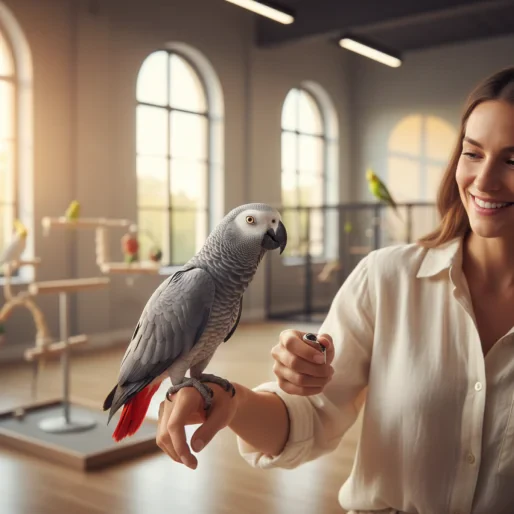
Step up (voluntarily stepping onto a hand or perch on cue) and recall (flying or walking to a person on cue) are not party tricks. According to the International Association of Animal Behavior Consultants (IAABC), these two behaviours rank among the most important safety cues a companion bird can learn. A reliable step up simplifies cage cleaning, nail trims, and emergency evacuation. A solid recall can prevent a startled cockatiel from landing on a hot stove or flying out an open window.
In operant conditioning terms, both cues rely on positive reinforcement: the bird performs a behaviour and immediately receives something it values (usually a small food treat), which increases the likelihood of that behaviour happening again. The LIMA (Least Intrusive, Minimally Aversive) framework, endorsed by both the IAABC and the Animal Behavior Management Alliance (ABMA), places positive reinforcement at the top of the intervention hierarchy. Aversive methods such as towelling a bird into compliance, shaking the perch, or pressing against the chest to force a step up are strongly discouraged because they erode trust and can trigger bite responses.
Understanding Avian Learning and Motivation
Parrots and cockatiels are highly social, cognitively complex animals. Research published in journals such as Applied Animal Behaviour Science and Animal Cognition confirms that psittacines can learn multi step cue chains and demonstrate problem solving comparable to that of young primates. Their willingness to engage in training, however, hinges on motivation and emotional state.
Food Motivation Basics
Most positive reinforcement bird training uses small, high value food rewards. Sunflower seeds, millet spray fragments, or tiny pieces of nutrient dense pellet work well for cockatiels. Larger parrots may prefer pine nuts, almond slivers, or small safflower seeds. The key is identifying a treat the bird does not receive in its regular diet so it retains novelty value. Consulting an avian veterinarian before adjusting diet is always recommended.
The Role of the Clicker
A clicker (or a consistent verbal marker such as a short, crisp "yes") serves as a bridge signal: it marks the exact instant the bird performs the desired behaviour and tells the bird that a reward is on the way. Because parrots are auditory learners, the distinct click sound can be conditioned in as few as five to fifteen repetitions (click, then treat, repeated in quick succession). Some trainers prefer a quieter "i click" style tool for noise sensitive birds like cockatiels, whose startle threshold tends to be lower than that of larger psittacines.
Training Prerequisites
Equipment Checklist
- Clicker or verbal marker: choose one and remain consistent.
- High value treats: pre portioned into tiny pieces no larger than a sunflower kernel.
- Target stick: a chopstick, dowel, or dedicated bird target stick with a coloured tip.
- Treat pouch or small dish: keep rewards within reach so delivery is fast (ideally under two seconds after the click).
- Quiet, familiar room: remove mirrors, open windows, ceiling fans, and other distractions or hazards.
Environment and Timing
Training is most productive when the bird is alert and mildly hungry, typically in the morning before the main meal or in the late afternoon. Avoid training immediately after a large feeding or during a bird's quiet rest period. For households with multiple pets, consider the advice in our Pet Sitter Emergency Guide on creating safe, separated training spaces.
Session Length Guidelines
Professional avian trainers and IAABC consultants generally recommend sessions of three to five minutes for cockatiels and small parrots, and five to eight minutes for medium to large parrots. Ending a session while the bird is still engaged ("quit while you are ahead") preserves motivation for the next round. Two to three short sessions per day typically produce faster progress than one long session.
Positive Reinforcement Step by Step Technique
Phase 1: Clicker Conditioning (Days 1 to 3)
- Sit near the bird at a comfortable, non threatening distance.
- Click the clicker once, then immediately offer a treat through the cage bars or on an open palm.
- Repeat ten to fifteen times per session until the bird visibly orients toward the treat hand at the sound of the click. This indicates the bird has formed the association: click equals reward.
Phase 2: Target Training (Days 3 to 7)
- Present the target stick about two to three centimetres from the bird's beak.
- Most parrots will investigate by leaning toward or touching the stick with their beak. The instant beak contacts stick, click and treat.
- Gradually increase the distance the bird must move to touch the target.
- Add a verbal cue ("touch") just before presenting the stick, once the bird is reliably targeting.
Target training is the scaffolding for both step up and recall. It teaches the bird that moving toward something on cue produces rewards, a concept known in behavioural science as shaping through successive approximation.
Phase 3: Step Up (Week 2)
- With the bird on a flat perch or table (not inside the cage initially), present your index finger or hand as a perch, held just below chest height of the bird.
- Hold the target stick just beyond your hand so the bird must step onto your finger to reach it.
- The instant one foot touches your hand, click and treat. Do not wait for a full step up in early repetitions: reward the attempt.
- Across several sessions, shape the behaviour until the bird places both feet on your hand before receiving the click.
- Introduce the verbal cue "step up" just before presenting your hand, once the bird is reliably stepping on.
- Fade the target stick gradually by making it less visible or holding it further away until the verbal cue and hand presentation alone produce the step up.
Important: never push your hand into the bird's chest. This flooding technique is aversive and frequently triggers a bite. If the bird leans away, that is communication: it is saying "not right now." Respect the refusal and try again later.
Phase 4: Recall (Weeks 3 to 4)
- Begin with the bird on a perch and the trainer standing roughly 30 centimetres away.
- Present the target stick (or an open hand with a visible treat) and use the cue word "come" or a distinct whistle.
- For flighted birds, the initial recall may involve a short hop or glide. For clipped birds, it may be a walk along a table. Both are valid starting points.
- Click and reward immediately upon arrival.
- Increase distance in very small increments (roughly 15 centimetres per session) only after three to five consecutive successful recalls at the current distance.
- Practice in different locations within the home once the bird is recalling reliably across two metres or more.
Spring is an excellent season to begin recall training because natural daylight hours are longer, supporting the active phase of most psittacine circadian rhythms. For owners also training other pets this season, our Nosework for Senior Dogs: A Spring Training Guide offers complementary positive reinforcement scheduling tips.
Common Body Language Misreads
One of the most frequent reasons bird training fails is that owners misinterpret avian body language. Unlike dogs and cats, birds communicate primarily through feather position, eye dilation, and subtle postural shifts.
- Pinning (rapid pupil dilation and contraction): often mistaken for curiosity alone. In context, pinning combined with fanned tail feathers and a rigid posture signals over arousal or aggression. Continuing to train in this state risks a bite.
- Raised crest (cockatiels): a tall, fully erect crest can indicate excitement, fear, or alarm. Owners frequently read it as "happy and engaged." Check the rest of the body: slicked feathers and leaning away suggest fear, not enthusiasm.
- Beak grinding: a soft, side to side grinding motion typically indicates contentment and relaxation. It is a sign the bird feels safe, not that it is about to bite.
- Fluffed feathers with one foot tucked: resting posture. Training a bird in this state yields poor results because the bird is signalling it wants to rest, not work.
- Lunging with open beak: a clear warning. This is not "testing" the hand; it is a defensive threat. Back away calmly and reassess the training environment.
Monitoring bird body language through a camera can help owners review sessions objectively. Our AI Pet Cameras With Face ID: Multi Pet Guide 2026 covers camera options suitable for bird rooms.
Four Week Spring Training Plan
Week 1: Foundation
- Days 1 to 3: Clicker conditioning (two to three sessions daily, ten to fifteen reps each).
- Days 4 to 7: Introduce target stick. Goal: bird touches stick five times consecutively in a session.
Week 2: Step Up
- Days 8 to 10: Lure step up using target stick. Click and treat for any foot movement toward the hand.
- Days 11 to 14: Shape full two foot step up. Introduce verbal cue "step up." Begin fading target stick.
Week 3: Early Recall
- Days 15 to 17: Short distance recall (30 centimetres) on a tabletop or between two perches.
- Days 18 to 21: Increase to one metre. Introduce recall cue word or whistle.
Week 4: Generalisation and Proofing
- Days 22 to 25: Practice recall across two metres in the primary training room. Vary your position (standing, sitting, different angles).
- Days 26 to 28: Introduce mild distractions (background music, another person in the room). Practice step up and recall in a second room.
Note: this timeline assumes a healthy, socialised bird that is already comfortable with the owner's presence. Rescue birds, recently rehomed parrots, or birds with a history of aversive handling may need significantly longer, sometimes several months, at the foundation stage.
Common Mistakes Owners Make
- Sessions that are too long: exceeding five minutes with a cockatiel often leads to frustration and regression.
- Inconsistent marker timing: clicking too late (even one to two seconds after the behaviour) weakens the association. Precision matters.
- Treat quality complacency: using the same pellet the bird eats daily as a reward offers little motivation. Reserve special treats exclusively for training.
- Training inside the cage: many birds are territorial about their cage. Attempting step up training through the cage door can trigger defensive behaviour that owners misread as stubbornness.
- Skipping target training: jumping directly to step up without a target training foundation removes a critical communication bridge.
- Punishing refusal: withdrawing attention, covering the cage, or raising the voice when a bird refuses a cue undermines trust and violates LIMA principles.
Troubleshooting Slow Progress
If training plateaus after two or more weeks at the same step, consider the following adjustments.
- Reassess treat value: try offering a novel treat. Some birds respond better to texture variety (a small piece of warm cooked sweet potato, for instance) than to seed alone.
- Reduce criteria: if the bird stopped stepping up fully, go back to rewarding a single foot lift. Shaping should always move at the bird's pace.
- Change the environment: a bird that stalls in the living room may progress faster in a quieter room with fewer visual stimuli.
- Check health: sudden regression or reluctance to step up can indicate foot pain, arthritis, or illness. An avian veterinary exam is warranted if the bird's behaviour changes without an obvious environmental cause.
- Evaluate the relationship: if the bird was previously subjected to forced handling, trust rebuilding can take months. Patience and consistency are essential.
When to Bring in a Professional
Professional help from a certified avian behaviour consultant (look for IAABC certification or equivalent credentials) is recommended when:
- The bird displays persistent biting during training, despite consistent positive reinforcement protocols.
- Feather destructive behaviour or self mutilation appears or worsens.
- The bird shows extreme fear responses (prolonged freezing, repeated panic flights, night frights increasing in frequency).
- Multiple household birds are involved, and aggression between birds complicates training.
- The owner suspects an underlying medical condition affecting behaviour.
Owners relocating internationally with birds should also be aware of legal requirements and microchipping standards. Our Pet Microchip Data When Moving Countries: 2026 Guide provides relevant details for cross border pet transport.
Final Thoughts
Teaching a parrot or cockatiel to step up and recall on command is one of the most rewarding investments a bird owner can make. Rooted in positive reinforcement science and guided by the LIMA framework, this training strengthens the bond between human and bird while building practical safety behaviours. The four week plan outlined above provides a structured starting point, but every bird is an individual. Progress may be faster or slower depending on species, history, and temperament. The guiding principle remains the same: let the bird set the pace, mark and reward generously, and never resort to force.
Frequently Asked Questions
Content Disclosure
This article was created using state-of-the-art AI models with human editorial oversight. It is intended for informational and entertainment purposes only and does not constitute veterinary medical advice. Always consult a licensed veterinarian for your pet's specific health needs. Learn more about our process.