Hong Kong's subtropical humidity above 80% makes aquarium cooling a unique challenge. This guide covers species selection, chiller solutions, typhoon preparedness, and monthly maintenance tailored to the city's hot, wet summers.
Key Takeaways
- Hong Kong summer humidity regularly exceeds 80%, rendering clip-on fan cooling almost useless for aquariums. A chiller is typically the only reliable mechanical cooling option.
- Selecting species comfortable at 28 to 32 °C reduces dependence on expensive chiller units in small Hong Kong flats.
- Typhoon season (June to October) brings the risk of prolonged power outages; a battery air pump kit is essential.
- Hong Kong tap water is treated with chlorine or chloramine by the Water Supplies Department (WSD). Always use a dechlorinating agent before adding tap water to the tank.
- Evaporation in air-conditioned flats can still remove 3 to 7% of tank volume weekly, requiring consistent top-off routines.
- A monthly maintenance calendar from May through September keeps water quality stable during peak subtropical heat.
Why Hong Kong's Climate Demands a Specific Approach
Standard tropical aquarium guides assume moderate ambient humidity and room temperatures around 20 to 25 °C. Hong Kong's summers tell a different story. From June to September, outdoor temperatures average 30 to 33 °C, indoor humidity in non-air-conditioned rooms can exceed 85%, and the Hong Kong Observatory has recorded peak readings above 35 °C in recent years. These conditions mean dissolved oxygen drops faster, beneficial filter bacteria consume ammonia at an accelerated rate, and evaporative cooling fans (which rely on dry air) become largely ineffective. This guide addresses every decision specific to setting up a freshwater tank in a Hong Kong flat.
Choosing the Right Spot in a Hong Kong Flat
Space and Structural Considerations
- Avoid window walls. Many Hong Kong flats have large windows facing south or west. Place the tank against an interior wall or a north-facing wall to minimise direct sunlight, which raises temperature unpredictably and triggers algae blooms.
- Check floor load carefully. A filled 200-litre tank weighs roughly 230 kg. In older tong lau buildings or village houses, confirm that the floor can handle concentrated weight. A stand that distributes load across a wider footprint is advisable.
- Compact footprint matters. In flats under 40 square metres, a 60 to 120-litre tank (roughly 60 cm long) is more practical than a 200-litre setup. Nano tanks in the 30 to 45-litre range also work well for heat-tolerant species like Endler's Livebearers.
- Air conditioning strategy. If the tank room has a split-unit AC set to 25 °C during summer, that alone may keep water temperature in the safe 26 to 28 °C range. Ensure the AC does not blow directly onto the water surface, which causes uneven evaporation.
- Power strip safety. Hong Kong uses BS 1363 three-pin plugs. Use a surge-protected extension board rated for continuous aquarium loads, and keep all cables above floor level to prevent water contact.
Species That Suit Hong Kong's Subtropical Heat
Choosing fish that naturally inhabit warm, shallow tropical waters means the tank can run at 28 to 32 °C without constant chiller intervention. The species below are commonly available at Tung Choi Street (Goldfish Street) in Mong Kok and at specialist aquarium shops across Hong Kong.
Comfortable at 28 to 30 °C
- Endler's Livebearer (Poecilia wingei): Hardy, colourful, and widely bred across Southeast Asia. Tolerates up to 30 °C with ease. Typically priced from around $10 to $30 HKD per fish at Goldfish Street.
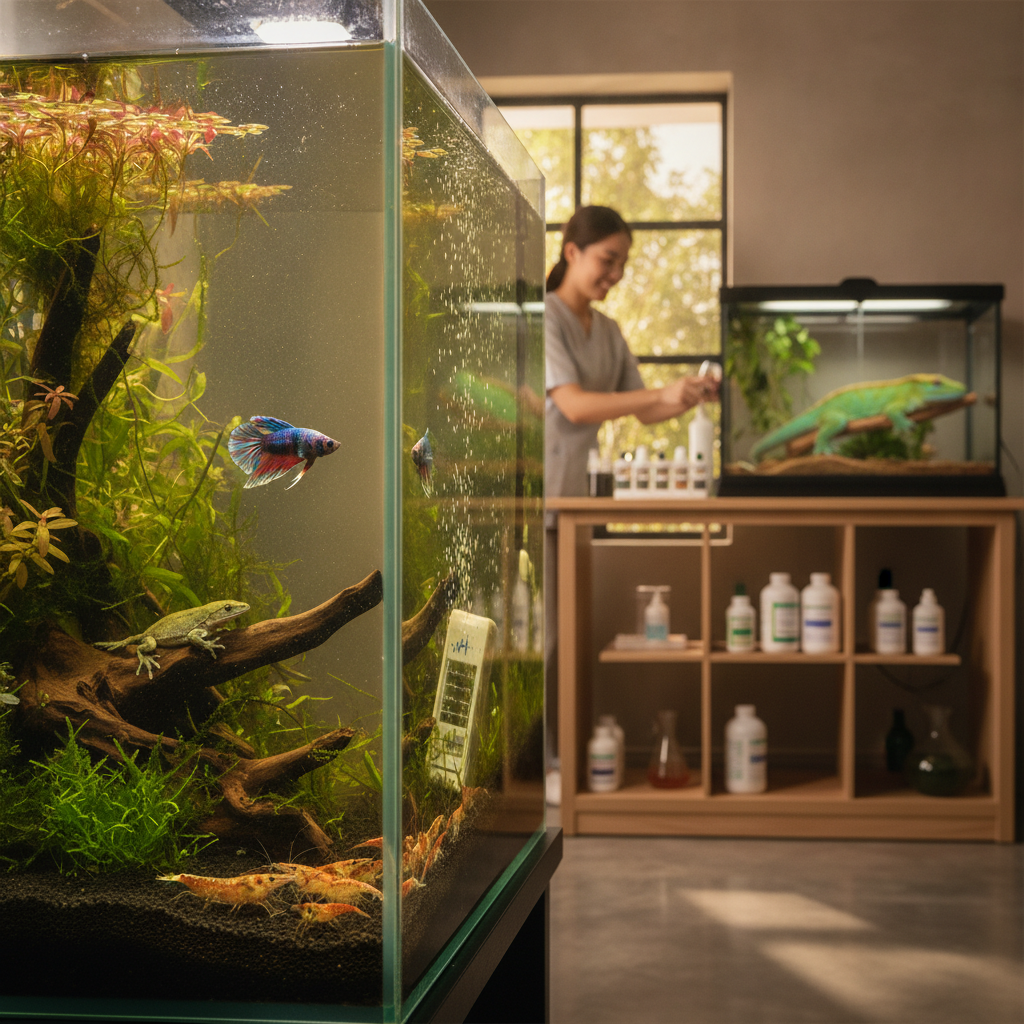
- Bristlenose Pleco (Ancistrus sp.): Excellent algae control, handles 28 to 30 °C provided oxygen levels are maintained with adequate surface agitation.
- Cherry Barb (Puntius titteya): Peaceful schooling fish suited to 26 to 30 °C, readily available in Hong Kong.
- Kuhli Loach (Pangio kuhlii): Bottom-dwelling species native to tropical Southeast Asia, comfortable up to 30 °C.
Comfortable at 30 to 32 °C
- German Blue Ram (Mikrogeophagus ramirezi): One of the few cichlids that genuinely prefers higher heat (28 to 32 °C). Demands soft, clean water.
- Pearl Gourami (Trichopodus leerii): A labyrinth breather that takes atmospheric oxygen, reducing stress when dissolved oxygen dips in warm water.
- Cardinal Tetra (Paracheirodon axelrodi): Tolerates 30 to 31 °C in soft, well-oxygenated water. Best kept in schools of eight or more.
- Rummy-Nose Tetra (Hemigrammus rhodostomus): Does well up to 31 °C in groups of six or more.
Species to Avoid in Uncooled Hong Kong Tanks
- White Cloud Mountain Minnow (prefers 16 to 22 °C, ironically native to Guangdong but a cool-water species)
- Goldfish and fancy goldfish varieties (prefer 18 to 24 °C; despite Goldfish Street's name, these struggle in uncooled summer setups)
- Zebra Danio for long-term keeping (stress symptoms appear above 28 °C in many captive-bred lines)
Cooling Solutions: Why Fans Fail in Hong Kong
Clip-on aquarium fans rely on evaporative cooling: air blows across the surface, water evaporates, and the tank cools by 2 to 4 °C. This works efficiently when ambient humidity stays below 60%. In Hong Kong, summer humidity commonly sits between 75 and 95%, which dramatically reduces evaporation efficiency. Fans may lower temperature by only 0.5 to 1 °C in these conditions while still increasing water loss.
Aquarium Chillers: The Practical Choice
- How they work: A compressor-based unit chills water flowing through it, functioning like a small refrigerator.
- Pros: Precise temperature control regardless of humidity. Essential for sensitive species or any setup without reliable air conditioning.
- Cons: Higher initial cost (typically $1,500 to $5,000 HKD for freshwater-rated units), significant electricity draw, and waste heat that must be vented away from the tank area.
- Where to buy: Specialist shops along Tung Choi Street stock several chiller brands. Online aquarium retailers serving Hong Kong also carry inline and drop-in models.
Quick Decision Guide for Hong Kong
- If the tank room has AC reliably set to 25 °C or below during summer: a chiller is usually unnecessary. The heater acts as a thermostat to prevent dips when the AC cycles off at night.
- If the room has no AC or AC is used only intermittently: a chiller is the safer investment, given Hong Kong's humidity renders fans largely ineffective.
- If keeping temperature-sensitive species (discus, crystal shrimp): a chiller is essential regardless of AC availability.
Hong Kong Tap Water and Top-Off Routines
The Water Supplies Department (WSD) treats Hong Kong's municipal water with chlorine or chloramine as disinfectants. Both are toxic to fish and must be neutralised. Always add a dechlorinating agent to tap water before using it for water changes or top-offs. The WSD confirms this guidance on its official water-use tips page.
Evaporation Management
- Use a tight-fitting glass or acrylic lid. This can reduce evaporation by 50% or more, which is especially important in air-conditioned rooms where dry, cool air accelerates surface evaporation.
- Top off only with dechlorinated freshwater. As water evaporates, dissolved minerals remain behind, gradually raising total dissolved solids (TDS). Never top off with mineral water or pre-mixed salt water in a freshwater tank.
- Mark the normal water line with a small piece of tape on the glass. Top off when the level drops 1 to 2 cm below the mark.
- Keep a covered bucket of dechlorinated, temperature-matched water ready at all times so top-offs do not shock livestock.
- Monitor TDS weekly. If TDS rises more than 20% above baseline, increase water change frequency.
Typhoon Season Power Outage Plan
Hong Kong's typhoon season runs from June to October. While the city's electricity grid (served by CLP Power in Kowloon, the New Territories, and outlying islands, and HK Electric on Hong Kong Island and Lamma Island) is generally reliable, severe typhoons can cause localised outages lasting hours or, in extreme cases, days. Typhoon Mangkhut in 2018 interrupted power to approximately 40,000 CLP customers.
Emergency Kit for Hong Kong Fishkeepers
- Battery-powered air pump with tubing and an airstone. This is the single most critical item: without filtration and surface agitation, oxygen levels can drop dangerously within hours in warm water.
- Uninterruptible power supply (UPS) rated for the filter pump. Even a small UPS can keep a hang-on-back filter running for 30 to 60 minutes during brief outages.
- Frozen water bottles. Keep two or three sealed bottles in the freezer. If the AC fails during a typhoon and room temperature climbs above 33 °C, float a bottle (wrapped in thin cloth) in the tank. Remove it once the target temperature is reached.
- Liquid ammonia and nitrite test kit. After a filter shutdown exceeding two hours, the biological filter may partially crash. Test daily for 72 hours after power returns.
- Dechlorinator. Always treat tap water before emergency water changes.
Step-by-Step Typhoon Response
- When a T8 signal or above is hoisted, switch off non-essential tank equipment (lights, auto-feeder) to reduce electrical load.
- Activate the battery air pump immediately if power is lost.
- Reduce feeding to once daily at half ration to limit ammonia production.
- If the outage lasts more than four hours and water temperature exceeds 33 °C, float a frozen bottle wrapped in cloth.
- Once power returns, restart the filter first. Leave lights off for at least an hour to reduce fish stress.
- Test water parameters daily for three days after the outage.
Monthly Maintenance Calendar: May to September
May: Setup and Baseline
- Record baseline water parameters (ammonia, nitrite, nitrate, pH, TDS, temperature) at the same time each day for one week.
- Install and test the cooling solution. Confirm it maintains target temperature during afternoon peaks.
- Inspect all electrical connections and replace any frayed cables before the hottest months.
- Clean or replace filter media. Rinse biological media in old tank water, never tap water.
June: Monsoon Onset
- Perform a 20 to 25% water change with temperature-matched, dechlorinated water.
- Measure TDS before and after. If TDS has risen more than 20% from baseline, increase water change frequency to every five days.
- Check the tank lid seal. Replace warped or cracked lids that allow excess evaporation.
- Confirm the typhoon emergency kit is complete and batteries are fresh.
July: Peak Heat
- Increase surface agitation by angling the filter outflow upward or adding a secondary airstone.
- Reduce lighting to six hours daily to limit heat from the fixture and slow algae growth.
- Perform a 20 to 25% water change.
- Test the battery air pump for ten minutes to confirm charge.
- Inspect fish for heat stress signs: rapid gill movement, gasping at the surface, lethargy, or colour loss.
August: Mid-Summer Deep Clean
- Siphon substrate thoroughly, focusing on areas under decorations where waste accumulates.
- Perform a 25 to 30% water change.
- Clean the filter pump impeller. Mineral buildup from evaporation top-offs can slow it over time.
- Scrub algae from glass panels. Growth typically peaks in August.
September: Transition
- As temperatures begin to ease, monitor for rapid overnight cooling. Ensure the heater thermostat is set to 26 to 28 °C.
- Perform a 20 to 25% water change.
- Gradually extend lighting back to eight hours.
- Restock the emergency kit: replace batteries, refill dechlorinator, return frozen bottles to the freezer.
- Record end-of-summer parameters and compare to the May baseline.
Printable Summary Checklist
- ☐ Tank placed on an interior wall, away from south or west-facing windows.
- ☐ Floor and stand rated for total filled weight (230 kg per 200 litres).
- ☐ Surge-protected extension board installed; cables above floor level.
- ☐ Heat-tolerant species selected (comfort range 28 to 32 °C).
- ☐ Chiller installed and tested, or AC room confirmed at 25 °C or below.
- ☐ Tight-fitting lid in place to reduce evaporation.
- ☐ Dechlorinated top-off water stored in a covered container.
- ☐ Typhoon emergency kit assembled: battery air pump, frozen bottles, ammonia test kit, dechlorinator.
- ☐ Heater positioned horizontally near tank bottom with a guard.
- ☐ Monthly water change schedule set (20 to 25% minimum).
- ☐ TDS and temperature logged weekly from May through September.
- ☐ Filter media cleaned in old tank water monthly.
- ☐ Battery air pump tested monthly.
- ☐ Lighting reduced to six hours daily during peak heat months.
Emergency Contact Information
If fish display acute distress (mass gasping, erratic swimming, or sudden deaths), take these immediate steps:
- Perform an immediate 25% water change with temperature-matched, dechlorinated water.
- Maximise surface agitation with an airstone or by lowering the water level slightly below the filter outflow.
- Contact a veterinary professional with aquatics experience or reach out to an established local fishkeeping community for species-specific guidance.
SPCA Hong Kong / Emergency Vet Clinics
Contact the SPCA Hong Kong or your nearest 24-hour emergency veterinary clinic.
Several private veterinary hospitals in Hong Kong offer round-the-clock emergency care.
For further reading on managing aquarium costs and sustainability, see Cut Your Aquarium's Energy and Water Waste in 2026.
Frequently Asked Questions
Do clip-on aquarium fans work in Hong Kong's summer humidity? ↓
Is Hong Kong tap water safe for aquarium fish? ↓
Which tropical fish species tolerate Hong Kong's summer heat without a chiller? ↓
How should I prepare my aquarium for typhoon season in Hong Kong? ↓
Can I keep goldfish in an uncooled Hong Kong flat during summer? ↓

Tom Ashford
Pet Safety & Home Consultant
Pet safety and home-proofing specialist — systematic hazard prevention and emergency preparedness for pet owners.
Content Disclosure
This article was created using state-of-the-art AI models with human editorial oversight. It is intended for informational and entertainment purposes only and does not constitute veterinary medical advice. Always consult a licensed veterinarian for your pet's specific health needs. Learn more about our process.