Retired greyhounds carry unique behavioural traits shaped by their racing background. This guide covers prey drive management, sleep nesting, transition timelines, and science based strategies for a smooth adoption.
Key Takeaways
- Retired greyhounds are typically low energy indoors, requiring only moderate daily exercise despite their athletic background.
- Prey drive toward small animals is a hardwired sighthound trait, not a training failure, and requires structured management rather than punishment.
- Sleep nesting behaviour is normal and essential: greyhounds may sleep 16 to 18 hours a day and need supportive, padded resting surfaces.
- Most ex-racing dogs follow a predictable adjustment arc often described by rescue organisations as the "three-three-three" rule: three days, three weeks, three months.
- Consult a certified applied animal behaviourist (CAAB) or veterinary behaviourist if fear, anxiety, or predatory behaviour escalates beyond manageable levels.
Understanding the Retired Greyhound: Where Behaviour Begins
Greyhounds raised in a racing environment have a developmental history unlike most companion dogs. From an early age, they are socialised primarily with other greyhounds, housed in kennel settings, and conditioned to chase a lure. This upbringing shapes three core behavioural tendencies that new owners encounter: an unusually calm indoor temperament, pronounced prey drive, and a deep need for rest and nesting. None of these traits are pathological. They are normal behavioural adaptations to the greyhound's genetic heritage and lived experience.
A common misconception is that ex-racing greyhounds are hyperactive or require hours of running. In reality, professional consensus among sighthound welfare organisations and behavioural researchers consistently notes that greyhounds are sprinters, not endurance athletes. Short bursts of intense activity are followed by long periods of rest. Owners commonly report that their adopted greyhound settles into household life more quietly than many smaller, higher-drive breeds.
The Three-Three-Three Transition Timeline
Rescue organisations widely reference a general adjustment framework for newly adopted dogs, often called the "three-three-three" guideline. While not a rigid scientific model, it offers a useful approximation of what to expect.
The First Three Days: Overwhelm and Shutdown
During this period, a retired greyhound may appear unusually withdrawn, refuse food, startle at common household sounds (televisions, dishwashers, doorbells), or freeze on unfamiliar surfaces such as hardwood or tile. This is not disobedience. It reflects genuine sensory overload. Many racing greyhounds have never lived inside a home. Glass doors, mirrors, stairs, and slippery floors are entirely novel stimuli.
Management strategies during this phase include keeping the environment quiet, limiting introductions to new people or animals, offering meals in a low-traffic area, and providing a clearly defined resting space. Flooding the dog with new experiences during this window risks triggering a fear response that becomes harder to modify later, a phenomenon well documented in behavioural literature as sensitisation.
Three Weeks: Emerging Personality
Around the three-week mark, the dog's true temperament begins to surface. Owners may notice increased confidence, more willingness to explore, or, conversely, the emergence of anxiety-based behaviours that were previously suppressed. Resource guarding, separation distress, and noise sensitivity commonly appear during this phase. On the Fear, Anxiety, and Stress (FAS) scale used by Fear Free certified professionals, dogs in this window frequently fluctuate between FAS 2 (mild anxiety, lip licking, turning away) and FAS 3 (moderate distress, attempts to escape, trembling).
This is the ideal time to establish predictable routines around feeding, walks, and rest periods. Greyhounds, having spent their lives on highly structured schedules, tend to find routine deeply reinforcing.
Three Months: Settled but Still Learning
By approximately three months, most retired greyhounds have integrated into the household rhythm. However, it is important to recognise that behavioural maturation in a new environment can extend well beyond this window. Some greyhounds require six months or longer to fully decompress, particularly those with limited socialisation histories or those who experienced aversive training methods in their racing career.
Sleep Nesting: Why Your Greyhound Sleeps So Much
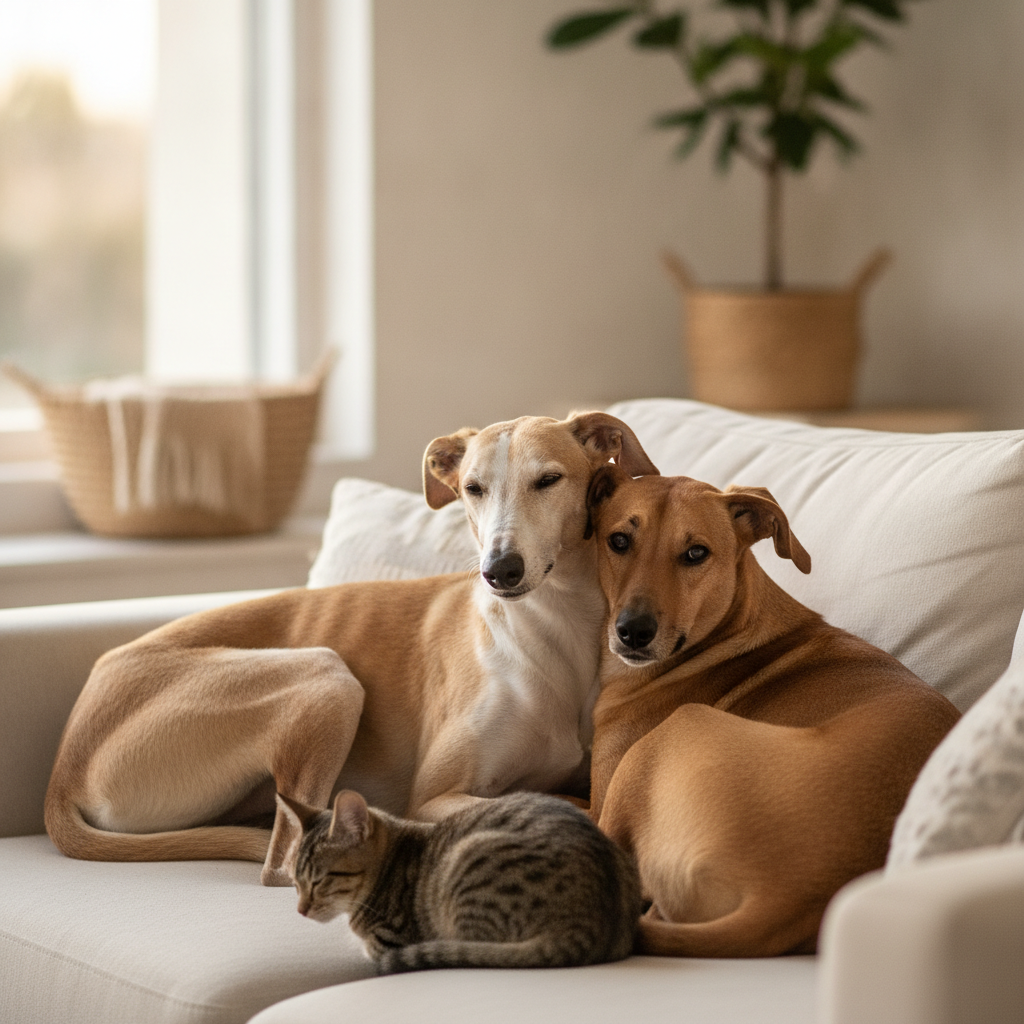
New greyhound owners are frequently surprised by how much their dog sleeps. Estimates from sighthound rescue organisations and veterinary sources suggest greyhounds rest or sleep for 16 to 18 hours per day. This is normal for the breed and is not a sign of depression or illness, provided the dog is alert and responsive during waking hours.
The Nesting Instinct
Greyhounds exhibit pronounced nesting behaviour: circling, pawing at bedding, dragging blankets into piles, and "roaching" (lying on their backs with legs in the air). This roaching posture, while amusing to observe, is a strong indicator of comfort and relaxation. It exposes the vulnerable belly and is rarely seen in dogs experiencing fear or anxiety.
Bedding Requirements
Because greyhounds have very low body fat and thin skin, they are prone to pressure sores on bony prominences such as elbows, hocks, and hips. Orthopaedic or memory foam beds are strongly recommended. A bed should be large enough for the dog to stretch fully, as greyhounds often sleep in extended lateral recumbency. Providing multiple blankets allows the dog to arrange its own nest, which can serve as an enrichment activity in itself.
For greyhounds showing signs of joint stiffness, particularly older retirees, hydrotherapy and rehabilitation options can support mobility and comfort.
Prey Drive: Root Causes and Realistic Management
Prey drive in greyhounds is not aggression. It is a genetically influenced, highly reinforced predatory motor sequence: orient, eye, stalk, chase, grab, bite. In sighthounds, the chase phase is disproportionately amplified. Racing training further strengthens this sequence through classical conditioning: the sight of a moving lure becomes strongly associated with arousal and pursuit.
Is Prey Drive Normal?
Yes. Prey drive is a normal, species-typical behaviour in all dogs, but it is especially pronounced in sighthound breeds. It becomes a management concern when the household includes cats, rabbits, small dogs, or other small animals.
When Does It Become a Problem?
Prey drive crosses into a welfare concern when it results in injury to other animals, when the greyhound cannot disengage from arousal even after the stimulus is removed, or when trigger stacking (multiple stimuli combining to escalate arousal) leads to redirected behaviour toward people or objects.
Assessment Before Adoption
Reputable greyhound rescue organisations typically conduct small-animal assessments, sometimes called "cat tests," before placement. However, it is critical to understand the limitations of these evaluations. A dog that appears calm around a stationary cat in a controlled environment may respond very differently to a running cat in an open garden. These assessments provide a starting point, not a guarantee.
Management Strategies
- Physical separation: Baby gates, closed doors, and separate living zones are non-negotiable when prey drive is present. Management is not a failure; it is responsible ownership.
- Muzzle conditioning: Many retired greyhounds arrive muzzle-trained from their racing days. Maintaining positive muzzle associations through counter-conditioning (pairing the muzzle with high-value treats) provides an essential safety layer for outdoor walks and mixed-pet households.
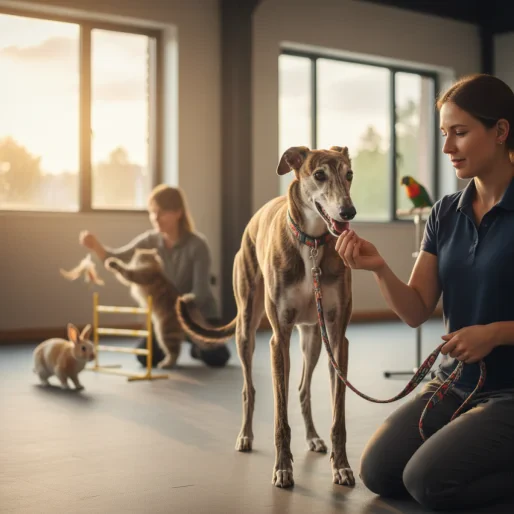
- Controlled introductions: If the greyhound has passed preliminary assessments for living with cats or small dogs, introductions should follow a systematic desensitisation protocol. Begin with scent exchange (swapping bedding), progress to visual exposure at a distance below the dog's reactivity threshold, and reinforce calm behaviour with treats and calm praise.
- Lead management outdoors: Greyhounds should not be allowed off lead in unfenced areas unless reliable recall has been thoroughly proofed, which, given the strength of predatory chase instincts, is often unrealistic. A long line (5 to 10 metres) in secure open spaces offers a compromise between freedom and safety.
- Enrichment to redirect drive: Flirt poles (used under supervision and with clear start and stop cues), snuffle mats, and food puzzle toys can channel predatory motor patterns into safe outlets. The ethical toy materials guide covers options that are both safe and sustainable.
What Not to Do
Punishment-based approaches, including leash corrections, shock collars, or verbal reprimands for chasing behaviour, are contraindicated. Research published in journals such as Applied Animal Behaviour Science and position statements from the IAABC (International Association of Animal Behavior Consultants) consistently demonstrate that aversive methods increase fear and anxiety without reliably suppressing predatory behaviour. Punishment may suppress visible signs of arousal while leaving the underlying motivation intact, creating a dog that is harder to read and potentially more dangerous.
Fear, Anxiety, and Stress in the Transition Period
Retired greyhounds frequently present with context-specific anxiety. Common triggers include:
- Novel surfaces: Tile, hardwood, glass, and reflective floors can cause freezing or avoidance.
- Household sounds: Appliances, television, music, and especially sudden loud noises.
- Isolation distress: Having lived in group kennel environments, some greyhounds struggle significantly with being left alone. This is distinct from true separation anxiety (distress specific to the absence of one attachment figure) and may resolve more quickly with gradual alone-time training.
- Handling sensitivity: Some ex-racing dogs are not accustomed to being touched on their feet, ears, or hindquarters. For grooming guidance that minimises stress, see the low-stress grooming for anxious dogs resource.
Behaviour Modification Techniques
Counter-conditioning and systematic desensitisation remain the gold standard for fear-based behaviours. The principle is straightforward: pair the feared stimulus (at a sub-threshold intensity) with something the dog values (food, play, social contact), and gradually increase exposure as the dog's emotional response shifts from fear to neutral or positive.
For noise sensitivity, this might involve playing recorded sounds at very low volume during mealtimes, increasing volume incrementally over days or weeks. For surface aversion, placing non-slip mats or rugs to create "stepping stone" paths across slippery floors allows the dog to navigate the home while confidence builds.
When to Consult a Professional
Seek assessment from a certified applied animal behaviourist (CAAB), a veterinary behaviourist (Diplomate ACVB), or an IAABC-certified consultant if:
- Fear responses escalate despite consistent modification efforts over two to four weeks.
- The dog displays aggression (growling, snapping, biting) in any context.
- Self-injurious behaviour occurs, such as excessive licking, tail chewing, or attempts to escape that result in physical harm.
- Separation-related distress is severe (vocalisation lasting more than 30 minutes, destructive behaviour, house soiling despite being otherwise house-trained).
A professional may also recommend adjunctive pharmacological support in collaboration with the dog's veterinarian. Medications such as selective serotonin reuptake inhibitors or situational anxiolytics can lower baseline anxiety enough for behaviour modification protocols to take effect.
Why Greyhounds Make Surprisingly Calm Family Dogs
Despite their imposing size and athletic build, retired greyhounds consistently rank among the calmest indoor companions across multiple temperament surveys conducted by breed organisations. Several factors contribute to this:
- Low indoor energy: After a moderate walk of 20 to 30 minutes, most greyhounds are content to sleep for hours.
- Quiet temperament: Greyhounds are generally not excessive barkers. Vocalisation is usually limited to specific triggers rather than ambient noise.
- Gentle disposition: Greyhounds tend toward soft, conflict-avoidant social styles. They frequently rank low on scales measuring confrontational behaviour toward humans.
- Adaptability to smaller spaces: Contrary to the assumption that a large dog needs a large home, greyhounds adapt well to flats and apartments provided they receive daily outdoor exercise.
For families considering diet and digestive health during the transition period, the probiotics guide offers evidence-based options that may support gut health during this stressful adjustment. Similarly, owners managing seasonal allergy flare-ups will find targeted nutritional guidance helpful.
Practical First-Week Checklist for New Greyhound Owners
- Orthopaedic bed with washable cover, plus two or more soft blankets for nesting.
- Correctly fitted martingale collar (standard buckle collars can slip over a greyhound's narrow head).
- Non-slip mats or rugs for any slippery flooring.
- Baby gates for room separation, especially if other small pets are present.
- A basket muzzle with positive conditioning treats.
- High-value training treats for counter-conditioning work.
- A predictable daily schedule written out and shared with all household members.
- Contact details for a local CAAB, IAABC consultant, or veterinary behaviourist.
Final Perspective
Adopting a retired greyhound is an exercise in patience, empathy, and behavioural literacy. These dogs have spent their formative months and years in a world structured entirely around performance. The transition to companion life asks them to learn an entirely new set of rules, often without the developmental foundation that puppies raised in homes receive. The reward, however, is a profoundly gentle, quiet, and affectionate companion. With science-based management, realistic expectations around prey drive, and a commitment to the decompression timeline, retired greyhounds consistently prove themselves to be among the most rewarding adoption choices for families, couples, and individuals alike.
If you are planning to travel with your newly adopted greyhound, review the 2026 EU pet travel regulations well in advance to ensure compliance with microchip, vaccination, and documentation requirements.
Frequently Asked Questions
How long does it take a retired greyhound to adjust to a new home? ↓
Can retired greyhounds live safely with cats or small pets? ↓
Why does my greyhound sleep so much? ↓
Do retired greyhounds need a lot of exercise? ↓
When should I consult a professional behaviourist for my greyhound? ↓

David Okafor
Certified Animal Behaviourist
Certified animal behaviourist — science-based strategies for fear, anxiety, reactivity, and behavioural challenges.
Content Disclosure
This article was created using state-of-the-art AI models with human editorial oversight. It is intended for informational and entertainment purposes only and does not constitute veterinary medical advice. Always consult a licensed veterinarian for your pet's specific health needs. Learn more about our process.