Indian summers push aquarium water well past safe limits, especially in plains cities where 40 to 45 °C is routine. This guide compares fans, chillers, and DIY fixes with India specific pricing, humidity considerations, and power outage planning.
Key Takeaways for Indian Aquarists
- Indian summer temperatures (March to June) routinely exceed 40 °C in most plains cities, pushing aquarium water to dangerous levels far faster than in temperate countries.
- Monsoon humidity (June to September) severely reduces fan effectiveness, making evaporative cooling unreliable during the very months it is needed most in coastal and eastern India.
- Clip on aquarium fans (₹1,000 to ₹3,500) suit nano and small freshwater tanks up to roughly 100 litres, but only in drier regions or air conditioned rooms.
- Aquarium chillers (₹10,000 to ₹60,000 depending on capacity) provide thermostat controlled precision and are essential for reef tanks, axolotls, discus, and crystal red shrimp setups across India.
- DIY methods (frozen bottles, room fans, partial water changes) serve as short term emergency measures but cannot sustain safe temperatures through a multi week Indian heatwave.
- Power cuts during peak summer are common in many Indian states, making backup planning (battery air pumps, UPS systems, ice reserves) a critical part of any cooling strategy.
Why Indian Summers Are Especially Dangerous for Aquariums
Water retains heat far longer than air. In cities such as Delhi, Nagpur, Jaipur, and Ahmedabad, where daytime highs cross 42 to 46 °C between April and June, indoor room temperatures in non air conditioned homes commonly reach 36 to 40 °C. An aquarium in such a room can climb to 34 °C or higher within a single afternoon.
Most tropical freshwater fish (tetras, gouramis, barbs, and livebearers commonly kept in India) begin showing heat stress signs when water exceeds 28 to 30 °C. Coldwater species like goldfish, a popular choice in Indian households, are at risk even earlier. Elevated water temperature reduces dissolved oxygen, accelerates ammonia toxicity, and triggers bacterial blooms that can wipe out an entire tank.
The challenge intensifies during the monsoon transition (June to July in most of India). Temperatures may remain high while humidity jumps to 80 to 95 percent in coastal cities such as Mumbai, Chennai, Kolkata, and Kochi. This combination renders evaporative cooling methods nearly useless, creating a dangerous gap for hobbyists who rely solely on fans.
Comparison Table: Cooling Options for Indian Conditions
| Factor | Clip On / Aquarium Fans | Aquarium Chillers | DIY and Household Methods |
|---|---|---|---|
| Best tank size | Nano to small (up to roughly 100 litres) | Medium to large (75 litres and above) | Any size as a temporary fix |
| Typical purchase cost (India) | ₹1,000 to ₹3,500 | ₹10,000 to ₹60,000 depending on capacity | Near zero to minimal |
| Cooling capacity | 2 to 4 °C below ambient in dry conditions; less in humid climates | Maintains a precise set point regardless of ambient temperature or humidity | Unpredictable; typically 1 to 3 °C temporarily |
| Energy use | Very low (2 to 10 watts per fan) | Moderate to high (50 to 500+ watts depending on unit size) | Negligible to low |
| Effectiveness in Indian monsoon humidity | Significantly reduced above 75 percent humidity | Unaffected by humidity | Variable; frozen bottles unaffected, fans less effective |
| Reliability during power cuts | Stops immediately; low wattage allows UPS backup | Stops immediately; high wattage makes UPS backup expensive | Independent of electricity (frozen bottles, manual water changes) |
| Maintenance | Low; top off evaporated water regularly | Moderate; clean condenser coils, ensure adequate ventilation | High; requires constant manual effort |
Option 1: Aquarium Cooling Fans
How they work
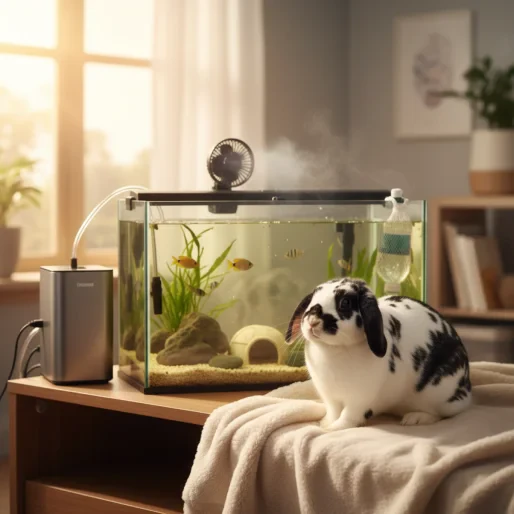
These small fans clip onto the tank rim or back glass and blow air across the water surface, accelerating evaporation. Since evaporation is an endothermic process, it pulls heat from the water. Many models sold on Indian e-commerce platforms include a basic thermostat that activates the fan above a set temperature.
When fans work well in India
- Dry heat regions: In cities like Jaipur, Jodhpur, and parts of the Deccan plateau where pre-monsoon humidity stays below 50 to 60 percent, fans can lower water temperature by 2 to 4 °C and keep small tanks in a safe range.
- Air conditioned rooms: If the room is already cooled to 25 to 27 °C, a fan provides an extra buffer that keeps water comfortably below 28 °C for most tropical species.
- Planted freshwater nano tanks: Hobbyists keeping hardy species such as guppies, endlers, and hardy shrimp varieties in tanks under 60 litres often find fans adequate when paired with a digital thermometer.
When fans fall short
- Coastal and high humidity zones: In Mumbai, Chennai, Kolkata, and much of Kerala, monsoon season humidity (80 to 95 percent) reduces evaporative cooling to nearly zero.
- Extreme peak summer: When room temperature exceeds 38 °C in non air conditioned spaces, a fan dropping water temperature by 3 °C still leaves the tank at 35 °C, well above safe limits.
- Saltwater tanks: Rapid evaporation concentrates salinity. Indian marine hobbyists using fans must monitor specific gravity closely and top off with RO water frequently.
Indian pricing and availability
Single fan units are widely available on Indian aquarium supply websites and marketplaces, typically ranging from ₹1,000 to ₹2,000. Dual and quad fan arrays cost ₹2,500 to ₹3,500. Monthly electricity cost is negligible, often under ₹50 even with continuous summer operation.
Option 2: Aquarium Chillers
How they work
Chillers use a refrigeration compressor to actively remove heat from water pumped through the unit. An internal thermostat maintains the set temperature within approximately 0.5 °C. Inline models connect between the canister filter outlet and the tank return. Drop in coil models sit inside a sump.
Why chillers are often essential in India
- Humidity independent: Unlike fans, chillers use active refrigeration. Performance remains consistent whether humidity is 30 percent in Rajasthan or 90 percent in coastal Karnataka.
- Critical for sensitive species: Axolotls (requiring water below 20 °C), discus, crystal red shrimp, and reef corals all need precise, reliable cooling that only a chiller can deliver during Indian summers.
- Multi month coverage: Indian summers often stretch from March to June, with lingering heat into monsoon season. A chiller provides autonomous, round the clock protection across this entire period.
Limitations in the Indian context
- Higher purchase cost: Small chillers rated for 100 to 200 litres typically cost ₹10,000 to ₹25,000 in India. Larger reef grade units can reach ₹40,000 to ₹60,000 or more.
- Electricity costs: A 1/10 HP chiller draws around 100 to 150 watts while running. With frequent compressor cycling during peak summer, monthly electricity costs may increase by ₹400 to ₹1,500 depending on local tariff rates and ambient temperature.
- Heat exhaust: Chillers expel warm air, raising the room temperature. In a small, poorly ventilated Indian flat, this creates a feedback loop. Placing the chiller near a window or in a ventilated area is important.
- Voltage fluctuations: In areas prone to voltage instability, using a stabiliser or UPS to protect the chiller compressor is advisable. Sudden power surges can damage the unit.
Indian sourcing
Aquarium chillers are available through specialist aquarium retailers in major cities (Delhi, Mumbai, Bengaluru, Hyderabad, Chennai) and via Indian e-commerce platforms. Some hobbyists import units directly, though import duties and warranty limitations should be considered.
Option 3: DIY and Household Methods
Common approaches used in India
- Frozen water bottles: Sealed bottles of ice floated in the tank or placed in the sump. Provides temporary relief but bottles melt within 2 to 3 hours in peak Indian summer heat.
- Room air conditioning: Running household AC to cool the room indirectly cools the tank. Effective but adds substantially to electricity bills, especially in cities with high per unit tariffs.
- Partial water changes with cooler water: Replacing 10 to 15 percent of tank water with slightly cooler, dechlorinated water offers brief relief. Sudden large temperature drops should be avoided as thermal shock is itself harmful.
- Household fans directed at the water surface: A table fan or ceiling fan positioned to increase surface airflow mimics aquarium fans but without thermostat control.
- Terracotta pot placement: Some Indian hobbyists place unglazed terracotta pots filled with water near the tank. While this has minimal direct cooling effect, it is an example of the creative approaches used in the community.
Strengths
- Zero upfront cost: Most Indian households already have the materials needed.
- Useful during power cuts: Frozen bottles and manual water changes work without electricity, making them valuable during scheduled load shedding or unexpected outages.
Limitations
- Labour intensive: Replacing ice bottles every 2 to 3 hours through a 10 to 12 hour peak heat day is exhausting and impractical for working professionals.
- Risk of thermal shock: Poorly managed ice additions can swing temperatures by 3 to 5 °C within an hour, stressing fish as much as the overheating itself.
- Unsustainable for extended heat: Indian summers last months, not days. Manual cooling cannot be maintained consistently across this period.
Power Cut Planning: An India Specific Priority
Scheduled load shedding and unplanned power outages are a reality across much of India, often peaking during summer when demand is highest. Aquarium owners should prepare with the following measures:
- Battery operated air pumps: Available in Indian aquarium shops for ₹500 to ₹2,000, these maintain oxygen levels during outages, which is critical when water is already warm.
- UPS or inverter backup: Low wattage fans (5 to 10 watts) can run on a household inverter. Chillers typically draw too much power for standard home inverters but may work on larger capacity UPS systems.
- Frozen bottle stockpile: Keeping 3 to 4 frozen bottles ready allows manual cooling during extended power cuts. Rotate them every 2 to 3 hours.
- Digital thermometer with alarm: Inexpensive models (₹300 to ₹800) provide alerts when water temperature crosses a set threshold, allowing early intervention.
Choosing the Right Method by Region and Setup
Nano and small tanks (under 60 litres)
A clip on fan works in air conditioned rooms or in dry climate cities. In humid coastal locations, even small tanks housing sensitive shrimp or nano reef setups may require a compact chiller.
Medium tanks (60 to 200 litres)
Fans may suffice if the room stays below 30 °C. For tanks housing discus, angels, or other heat sensitive species, a 1/10 HP chiller (₹10,000 to ₹20,000) is a commonly recommended investment.
Large tanks (200 litres and above)
Fans alone cannot adequately cool large volumes during Indian summers. A properly sized chiller matched to the tank volume is the standard recommendation. Some hobbyists combine a chiller with fans to reduce compressor cycling and extend the chiller's lifespan.
Responsible Ownership and Pre Purchase Planning
The Animal Welfare Board of India (AWBI), operating under the Prevention of Cruelty to Animals Act 1960, oversees animal welfare standards in the country. While specific aquarium keeping regulations are limited, the Act's broad provisions against causing unnecessary suffering apply to all animals, including fish.
Prospective aquarium owners should factor cooling costs into the total cost of care before purchasing temperature sensitive species. Impulse purchases of axolotls, crystal red shrimp, or marine livestock without a cooling plan frequently lead to preventable losses. Reputable aquarium retailers in Indian cities increasingly ask about the buyer's setup, including temperature management, before selling sensitive species.
Local Veterinary Hospital
Contact your nearest veterinary hospital or government veterinary dispensary for emergency care.
India does not have a national pet emergency hotline. Major cities have private 24-hour vet clinics. In rural areas, contact the district veterinary officer.
Practical Tips for Indian Aquariums in Summer
- Monitor continuously: A digital thermometer with a high temperature alarm is an essential, inexpensive safeguard. Check readings at least twice daily during peak summer months.
- Reduce heat inputs: Switch to LED lighting (which produces less heat than older T5 or CFL fixtures), keep the tank away from windows receiving direct sunlight, and ensure powerheads and pumps are appropriately sized to avoid excess heat generation.
- Increase surface agitation: Higher oxygen exchange at the surface helps fish cope with warmer water. An airstone or angled filter outlet assists with this.
- Avoid overfeeding: Warmer water holds less dissolved oxygen and accelerates waste decomposition. Reducing feeding slightly during heat spikes helps maintain water quality and reduces the bioload on already stressed filtration.
- Start preparations in February: Indian summer heat arrives quickly. Purchasing and testing cooling equipment during the cooler months ensures everything is operational before temperatures spike in March and April.
Whether the solution is a simple clip on fan or a dedicated chiller, the key is matching the method to the tank size, species requirements, regional climate, and power supply reliability before the heat arrives. For related seasonal pet care guidance, the Spring Hazard Briefing Every Pet Sitter Needs covers risks across multiple pet types, and Why Senior Dogs and Cats Overheat Faster in India explores how warm weather affects companion animals more broadly.
Frequently Asked Questions
Do aquarium cooling fans work during Indian monsoon season? ↓
How much does it cost to run an aquarium chiller in India? ↓
What should I do if the power goes out and my aquarium overheats? ↓
Which aquarium fish are most at risk during Indian summers? ↓
Is it legal to keep axolotls in India? ↓

Priya Nair
Dog Breed Advisor & Adoption Counsellor
Dog breed advisor and adoption counsellor — honest breed comparisons and lifestyle matching for prospective owners.
Content Disclosure
This article was created using state-of-the-art AI models with human editorial oversight. It is intended for informational and entertainment purposes only and does not constitute veterinary medical advice. Always consult a licensed veterinarian for your pet's specific health needs. Learn more about our process.