
In this article
- Key Takeaways
- Understanding the Bonded Pair: Root Cause Analysis of Social Attachment in Cats
- Is Feline Social Bonding Normal? When Does Separation Become a Problem?
- Environmental and Social Triggers: Why the Shelter to Home Transition Is Critical
- Behavioural Benefits: How Two Cats Can Be Less Work Than One
- Shelter Policies on Bonded Pairs: What Adopters Should Know
- Behaviour Modification and Management: Setting Up for Success
- Special Considerations: Senior Bonded Pairs
- When to Consult a Certified Animal Behaviourist
- The Financial Perspective: Busting the "Double Cost" Myth
- Conclusion: Two Cats, One Decision, Better Welfare
Key Takeaways
- Bonded pairs provide each other with social buffering, reducing fear, anxiety, and stress (FAS) during the critical shelter to home transition.
- Two socially bonded cats often display fewer destructive behaviours, fewer litter box issues, and lower overall veterinary behavioural costs than a single anxious cat.
- Shelter "bonded pair" policies exist to protect the welfare of cats whose separation can trigger clinically significant distress.
- Environmental setup for two cats requires modest additions: one extra litter box, separate feeding stations, and vertical space.
- If either cat in a bonded pair shows signs of severe anxiety, aggression, or self harm after adoption, consultation with a certified applied animal behaviourist (CAAB) or veterinary behaviourist is essential.
Understanding the Bonded Pair: Root Cause Analysis of Social Attachment in Cats
The domestic cat (Felis catus) is frequently described as a solitary species, but this characterisation is incomplete. Research in feline social ethology, including work reviewed by the International Association of Animal Behavior Consultants (IAABC), demonstrates that cats are facultatively social. This means they can form strong affiliative bonds when resources, early socialisation, and temperament align.
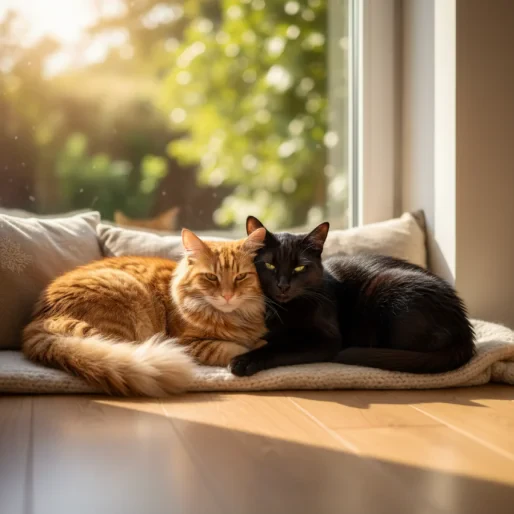
A bonded pair refers to two cats who have developed a mutual social attachment characterised by specific behaviours: allogrooming (mutual grooming), allorubbing (body rubbing), co sleeping in physical contact, and synchronised activity patterns. These behaviours are not merely habitual; they reflect an underlying affiliative relationship mediated by oxytocin pathways similar to those documented in other social mammals.
Shelter staff and behaviour assessors identify bonded pairs through structured observation. Cats who consistently seek proximity, display visible distress (vocalisation, reduced appetite, hiding) when separated, and show rapid reunion behaviours meet the threshold for a bonded pair designation. This is not a casual label; it carries real behavioural and welfare implications.
Is Feline Social Bonding Normal? When Does Separation Become a Problem?
Social bonding between cats is a normal expression of affiliative behaviour, particularly when cats have been raised together from kittenhood or have cohabited for extended periods. The FAS (Fear, Anxiety, and Stress) scale, widely used in Fear Free certified practices, provides a framework for evaluating the impact of separation on bonded individuals.
When bonded cats are separated, the following responses commonly emerge:
- Acute stress indicators: excessive vocalisation, pacing, anorexia or reduced food intake, and increased hiding behaviour.
- Chronic stress indicators: over grooming (psychogenic alopecia), litter box avoidance, withdrawal from human interaction, and disrupted sleep wake cycles.
- Trigger stacking: separation compounded with a novel environment (the new home), novel humans, and unfamiliar scents can push a cat well beyond its coping threshold.
Professional consensus from organisations such as the ASPCA and the RSPCA supports keeping bonded pairs together. Separation of a genuinely bonded pair is considered a welfare compromise, not merely a preference.
Environmental and Social Triggers: Why the Shelter to Home Transition Is Critical
The transition from shelter to home is one of the most behaviourally demanding events in a companion cat's life. Novel stimuli are everywhere: unfamiliar spatial layouts, different acoustic environments, new human scent profiles, and the absence of familiar conspecifics (other cats).
For a single cat, coping with this transition relies entirely on individual resilience and the quality of the adopter's environmental setup. For a bonded pair, something powerful occurs: social buffering. This is an ethologically well documented phenomenon in which the presence of a familiar social partner reduces physiological and behavioural stress responses.
In practical terms, adopters of bonded pairs commonly report:
- Shorter hiding periods after arrival in the new home.
- Earlier resumption of normal eating, grooming, and play behaviours.
- Reduced night time vocalisation (a frequent complaint from adopters of single adult cats).
- More confident exploration of the new environment.
This social buffering effect means the adopter spends less time managing a frightened, withdrawn cat and more time enjoying the relationship from the outset.
Behavioural Benefits: How Two Cats Can Be Less Work Than One
Mutual Enrichment and Play
One of the most significant behavioural benefits of a bonded pair is mutual enrichment. Cats are crepuscular predators with a strong drive for play that mimics hunting sequences: stalk, chase, pounce, and grab. A single indoor cat relies entirely on the owner for this stimulation. When enrichment falls short, behaviour problems emerge: furniture scratching, nocturnal hyperactivity (the "midnight zoomies"), attention seeking behaviours, and redirected aggression.
Bonded pairs engage in reciprocal play that satisfies these predatory motor patterns naturally. The result is a pair of cats who are more behaviourally balanced and less demanding of the owner's time for interactive play, though regular human interaction remains important for socialisation.
Reduced Separation Related Behaviours
Cats living alone in households where owners work full time can develop separation related distress. While feline separation anxiety was historically underrecognised, the veterinary behaviour literature (including guidelines from the American College of Veterinary Behaviorists) now acknowledges it as a legitimate clinical concern. Signs include destructive behaviour, inappropriate elimination, and excessive vocalisation during owner absence.
A bonded companion provides consistent social contact during these periods, significantly reducing the likelihood and severity of separation related behaviours. This is particularly relevant for adopters with demanding work schedules.
Litter Box Behaviour
Litter box avoidance is the single most commonly reported behaviour problem in cats and a leading reason for relinquishment. Stress is a primary trigger. Because bonded pairs experience lower baseline stress, they are typically more consistent with litter box use, provided the setup follows established guidelines: one box per cat plus one extra, placed in quiet and accessible locations. For more on this topic, see Litter Box Mistakes First Time Cat Owners Make.
Grooming and Coat Health
Allogrooming serves both a social bonding and a practical hygiene function. Bonded cats groom each other in areas that are difficult for a single cat to reach (the top of the head, behind the ears, the back of the neck). This mutual care contributes to coat health and can reduce the incidence of matting, particularly relevant in medium and long haired breeds. For seasonal considerations, see Autumn Coat Changes in Dogs and Cats (Southern Hemisphere).
Shelter Policies on Bonded Pairs: What Adopters Should Know
Most reputable shelters and rescue organisations have formal or informal policies regarding bonded pairs. These typically include:
- Mandatory paired adoption: the pair must be adopted together. This is the most common policy for strongly bonded cats.
- Reduced adoption fees: many shelters offer a discounted or waived fee for the second cat in a bonded pair, making adoption more financially accessible.
- Behavioural disclosure: ethical shelters provide information about each cat's temperament, known triggers, and any history of FAS related behaviours.
- Post adoption support: some organisations offer follow up consultations or access to behaviour helplines.
Adopters should ask shelter staff about the specific behavioural assessment methods used to determine the bonded pair status. A robust assessment includes structured separation trials and observation of reunion behaviour, not just the fact that two cats shared a kennel.
Behaviour Modification and Management: Setting Up for Success
The First 72 Hours
Professional guidelines recommend a gradual introduction protocol even for bonded pairs entering a new home. The cats know each other, but they do not know the environment. Best practice includes:
- Confining the pair to a single, quiet room with all resources (food, water, litter, hiding spots, vertical perches) for the first 24 to 72 hours.
- Using synthetic feline pheromone diffusers (such as products containing feline facial fraction analogues) in the confinement room to support environmental familiarity.
- Allowing the cats to set the pace for exploration. Do not force interaction; let approach behaviour occur voluntarily.
- Keeping ambient noise low and limiting the number of humans interacting with the cats during this period.
Resource Setup for Two Cats
The incremental resource cost of a second cat is often overestimated. The practical additions include:
- One additional litter box (following the n+1 rule).
- Separate feeding stations to prevent resource guarding, even in bonded pairs.
- Vertical space: cat trees, shelves, or window perches. Vertical territory is critical for feline welfare and is often more important than floor space.
- Multiple resting spots in different microclimates (warm, cool, elevated, enclosed).
Counter Conditioning and Desensitisation for Specific Fears
If one or both cats in the pair arrive with specific fear triggers (common examples: carrier fear, noise sensitivity, fear of handling), classical counter conditioning paired with systematic desensitisation remains the gold standard approach. This involves pairing the feared stimulus at sub threshold intensity with a high value reinforcer (food, play) to change the emotional response.
The presence of a calm bonded partner during these sessions can accelerate progress, as the relaxed cat provides a model of non fearful behaviour. This is sometimes referred to as social facilitation and is a well recognised phenomenon in animal learning.
What Not to Do
Punishment based approaches (spray bottles, loud noises, physical correction) are contraindicated for any fear or anxiety based behaviour. These methods increase FAS, damage the human animal bond, and can trigger defensive aggression. Flooding, which involves forced exposure to a feared stimulus at full intensity, is equally harmful. Professional organisations including the IAABC, the American Veterinary Society of Animal Behavior (AVSAB), and Fear Free Pets unanimously oppose these techniques.
Special Considerations: Senior Bonded Pairs
Senior bonded pairs (typically aged ten years and older) are among the most overlooked cats in shelters. They wait significantly longer for adoption than kittens or young adults. However, they offer distinct advantages:
- Established, predictable temperaments with lower risk of behavioural surprises.
- Reduced play intensity, making them suitable for quieter households.
- Deep social bonds that have been reinforced over years, resulting in exceptionally stable pair dynamics.
Senior cats do require more attentive health monitoring. For practical guidance on caring for older felines, see Caring for Senior Cats: A Pet Sitter's Full Guide.
When to Consult a Certified Animal Behaviourist
While bonded pairs generally transition well, certain situations require professional assessment:
- Inter cat aggression within the pair: if the pair's relationship deteriorates after adoption (which can occur due to redirected aggression, pain related irritability, or environmental stress), a CAAB or veterinary behaviourist should evaluate the situation.
- Severe anxiety in one or both cats: persistent anorexia lasting more than 48 hours, self injurious over grooming, or complete social withdrawal beyond the initial adjustment period.
- Litter box avoidance that persists despite correct environmental setup, as this may indicate an underlying medical condition requiring veterinary diagnosis before behavioural intervention.
- Aggression toward humans: any biting or scratching that goes beyond normal play behaviour warrants professional evaluation, particularly in households with children.
Qualified professionals can be located through the Animal Behavior Society (ABS) directory for CAABs, the American College of Veterinary Behaviorists (ACVB) for veterinary behaviourists, or the IAABC consultant directory.
The Financial Perspective: Busting the "Double Cost" Myth
Prospective adopters often assume two cats cost exactly twice as much as one. The reality is more nuanced:
- Food costs increase, but not proportionally if purchasing in larger quantities.
- Many veterinary clinics offer multi pet discounts on wellness plans.
- The most significant potential savings are behavioural: a well adjusted bonded pair is less likely to require costly behavioural consultations, psychopharmaceutical interventions, or emergency veterinary visits related to stress induced conditions such as feline idiopathic cystitis.
- Reduced property damage from stress related destructive behaviours (furniture scratching, inappropriate elimination) represents an often unrecognised financial benefit.
Conclusion: Two Cats, One Decision, Better Welfare
Adopting a bonded pair is not a charitable compromise; it is a behaviourally sound decision supported by feline social science. The social buffering, mutual enrichment, and emotional stability that bonded pairs provide each other translate directly into a smoother adoption experience and a calmer household. Shelters benefit from freed kennel space. The cats benefit from preserved social bonds. And adopters benefit from companions who are, in many measurable ways, less work than a single anxious cat navigating the world alone.
For those considering international relocation with newly adopted cats, resources such as Flying With a Cat in the EU: A 2026 Checklist and EU Pet Relocation After April 2026: The Full Checklist provide relevant logistical guidance.
Frequently Asked Questions
Content Disclosure
This article was created using state-of-the-art AI models with human editorial oversight. It is intended for informational and entertainment purposes only and does not constitute veterinary medical advice. Always consult a licensed veterinarian for your pet's specific health needs. Learn more about our process.