
In this article
- Key Takeaways
- A Unique Moment for Greyhound Adoption in Aotearoa
- Legal Requirements: The Dog Control Act and the Green Collar
- The Three-Three-Three Transition Timeline
- Prey Drive and Native Wildlife: A Critical NZ Concern
- Sleep, Nesting, and Bedding Needs
- Climate Considerations Across Aotearoa
- When to Seek Professional Help
- Practical First-Week Checklist for NZ Greyhound Owners
- Why Greyhounds Suit New Zealand Lifestyles
Key Takeaways
- New Zealand's greyhound racing industry closes on 31 July 2026, creating an unprecedented wave of greyhounds needing homes across the country.
- The Green Collar programme provides a legal muzzle exemption under the Dog Control Act 1996 for greyhounds that pass temperament testing.
- Prey drive management is especially critical in Aotearoa, where native ground-nesting birds such as kiwi, weka, and penguins are vulnerable to dog predation.
- Retired greyhounds sleep 16 to 18 hours daily and need supportive, padded bedding to prevent pressure sores on their thin skin and low body fat frames.
- The New Zealand Veterinary Association (NZVA) can help connect owners with qualified veterinary behaviourists if anxiety or predatory behaviour escalates.
A Unique Moment for Greyhound Adoption in Aotearoa
New Zealand is experiencing a pivotal moment for greyhound welfare. The Racing Industry (Closure of Greyhound Racing Industry) Amendment Bill has passed into law, ending commercial greyhound racing from 31 July 2026. With approximately 2,900 racing greyhounds in the country at the time of the announcement, rehoming efforts are scaling up rapidly through organisations such as Greyhounds as Pets (GAP), which operates kennels in Cambridge, Levin, and Rangiora, as well as through SPCA centres and independent foster networks.
For prospective adopters, this means more greyhounds are available than ever before, but it also means understanding the specific behavioural and legal requirements of owning an ex-racing greyhound in New Zealand is essential.
Legal Requirements: The Dog Control Act and the Green Collar
Under the Dog Control Act 1996, all dogs in New Zealand must be registered with their local council and microchipped. For greyhound owners, there is an additional layer of regulation that sets these dogs apart from most other breeds.
Muzzling and the Green Collar Exemption
Historically, racing greyhounds in New Zealand have been required to wear a muzzle in public places. The Green Collar programme offers a formal exemption: greyhounds that pass a structured temperament assessment, which evaluates their reactions to sudden noises, unfamiliar objects, small dogs, and handling by strangers, earn a green collar that legally permits them to be unmuzzled in public.
Until a greyhound has earned its Green Collar, it must be muzzled when outside the home. This is not a reflection of the individual dog's temperament; it is a legal requirement. Basket muzzles, which allow panting, drinking, and treat-taking, are the standard. Maintaining positive muzzle associations through pairing muzzle-wearing with high-value treats is strongly recommended by behavioural professionals.
Council Registration and Microchipping
All greyhound owners must register their dog with the relevant territorial authority. Registration fees vary by council but typically range from $50 to $150 NZD annually, with discounts commonly available for desexed dogs. Microchipping is mandatory under the Act, and most greyhounds adopted through GAP or SPCA will already be chipped, desexed, vaccinated, and wormed prior to placement.
The Three-Three-Three Transition Timeline
Rescue organisations worldwide reference a general adjustment framework for newly adopted dogs: three days, three weeks, three months. This is not a rigid scientific model, but it provides a useful structure for managing expectations.
The First Three Days: Sensory Overload
Many racing greyhounds have never lived inside a house. Glass doors, mirrors, stairs, slippery tile or timber floors, and household appliances such as dishwashers and televisions are entirely novel. During this phase, a greyhound may refuse food, startle easily, freeze on unfamiliar surfaces, or appear unusually withdrawn. This is not disobedience; it is genuine sensory overload.
Practical steps during this window include keeping the home quiet, limiting introductions to new people or animals, feeding in a low-traffic area, and providing a clearly defined resting space. Non-slip mats or rugs placed on polished timber or tile floors create safe pathways and reduce anxiety around slippery surfaces, which are common in New Zealand homes.
Three Weeks: True Personality Emerges
Around three weeks, the dog's underlying temperament surfaces. Owners may notice growing confidence or, conversely, the emergence of behaviours previously suppressed by stress: resource guarding, noise sensitivity, or separation distress. Having spent their lives in group kennel environments, some greyhounds struggle with being left alone.
Establishing predictable routines around feeding, walks, and rest is particularly effective with greyhounds, as their racing lives were highly structured. Consistency is deeply reinforcing for these dogs.
Three Months: Settling In
By roughly three months, most greyhounds have integrated into household rhythms. However, full decompression can take six months or longer, particularly for dogs with limited socialisation or those that experienced aversive training methods during their racing careers.
Prey Drive and Native Wildlife: A Critical NZ Concern
Prey drive in greyhounds is not aggression. It is a genetically influenced predatory motor sequence (orient, eye, stalk, chase, grab, bite) that has been further reinforced through racing training. In sighthounds, the chase phase is disproportionately strong.
In New Zealand, this trait carries particular weight. Aotearoa's native fauna evolved without mammalian predators, making ground-dwelling and ground-nesting species, including kiwi, weka, blue penguins (kororā), and dotterels, extremely vulnerable to dog attacks. Under the Dog Control Act 1996, dogs that attack protected wildlife can be seized and destroyed, and owners may face significant fines. The Department of Conservation (DOC) maintains designated controlled dog areas and prohibited dog areas throughout the conservation estate.
Management Strategies for NZ Conditions
- Secure fencing: A minimum fence height of 1.5 metres is recommended, with no gaps at ground level. Greyhounds are athletic jumpers when motivated by prey. Council bylaws may specify additional fencing requirements.
- Lead management: Greyhounds should not be off lead in unfenced areas. In areas near native bird habitats, on-lead requirements are often legally mandated. A long line of 5 to 10 metres in secure, open spaces offers a compromise between exercise and safety.
- Muzzle use: Even after earning a Green Collar, some owners choose to continue muzzling in areas where wildlife is present. This is a responsible, precautionary approach.
- Physical separation in multi-pet homes: Baby gates, closed doors, and separate zones are essential if the household includes cats, rabbits, or small dogs. Management is not failure; it is responsible ownership.
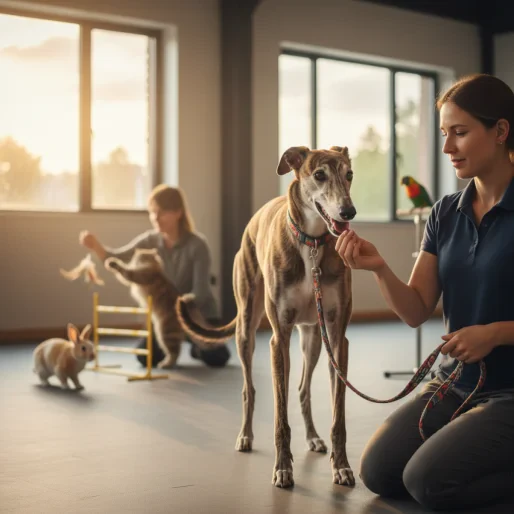
- Controlled introductions: For greyhounds assessed as suitable for living with cats or small dogs, introductions should follow a systematic desensitisation protocol: scent exchange first, then visual exposure at a distance below the dog's reactivity threshold, reinforcing calm behaviour with treats.
- Enrichment alternatives: Flirt poles (supervised, with clear start and stop cues), snuffle mats, and food puzzle toys channel predatory motor patterns into safe outlets.
What Not to Do
Punishment-based approaches, including leash corrections, shock collars, or verbal reprimands for chasing behaviour, are contraindicated. Position statements from the NZVA and the International Association of Animal Behavior Consultants (IAABC) consistently indicate that aversive methods increase fear and anxiety without reliably suppressing predatory behaviour. Punishment may suppress visible arousal while leaving the underlying motivation intact, creating a dog that is harder to read and potentially more dangerous.
Sleep, Nesting, and Bedding Needs
Greyhounds typically rest or sleep for 16 to 18 hours per day. This is normal breed behaviour and not a sign of illness, provided the dog is alert and responsive during waking hours.
Greyhounds exhibit pronounced nesting behaviour: circling, pawing at bedding, dragging blankets into piles, and "roaching" (lying on their backs with legs in the air). Roaching is a strong indicator of comfort and relaxation.
Because greyhounds have very low body fat and thin skin, they are prone to pressure sores on bony prominences such as elbows, hocks, and hips. Orthopaedic or memory foam beds are strongly recommended. During cooler months, particularly in the South Island and central North Island where overnight temperatures can drop below 5°C, greyhounds benefit from fleece-lined coats indoors and insulated jackets outdoors. Their thin coats provide minimal insulation.
Conversely, New Zealand's strong UV environment, particularly during summer, means greyhounds with light or thin coats may be vulnerable to sunburn on exposed skin areas such as the nose and belly. Limiting midday sun exposure and using pet-safe sunscreen on vulnerable areas is advisable.
Climate Considerations Across Aotearoa
New Zealand's varied climate means greyhound care differs by region. In the warmer, more humid conditions of Northland and Auckland, heat management is a priority: walks are best scheduled for early morning or evening, and fresh water must always be accessible. In the cooler, alpine-influenced climates of Canterbury, Otago, and Southland, cold weather protection through coats and warm bedding becomes more important. Greyhounds lack the double coat that many breeds rely on for insulation, making them genuinely susceptible to hypothermia in cold, wet conditions.
When to Seek Professional Help
Seek assessment from a qualified veterinary behaviourist or an IAABC-certified consultant if:
- Fear responses escalate despite consistent modification efforts over two to four weeks.
- The dog displays aggression (growling, snapping, biting) in any context.
- Self-injurious behaviour occurs, such as excessive licking, tail chewing, or escape attempts causing physical harm.
- Separation distress is severe (vocalisation lasting more than 30 minutes, destructive behaviour, house soiling).
The NZVA website provides resources for locating veterinary professionals with behavioural expertise. A veterinary behaviourist may also recommend pharmacological support, such as selective serotonin reuptake inhibitors or situational anxiolytics, to lower baseline anxiety enough for behaviour modification to take effect.
After Hours Veterinary Clinics
Contact your regular vet's after-hours service or your nearest emergency veterinary clinic.
Major centres (Auckland, Wellington, Christchurch) have dedicated 24-hour emergency vet hospitals.
Practical First-Week Checklist for NZ Greyhound Owners
- Orthopaedic bed with washable cover, plus two or more soft blankets for nesting.
- Correctly fitted martingale collar (standard buckle collars slip over a greyhound's narrow head).
- Basket muzzle with positive conditioning treats (required until Green Collar is obtained).
- Non-slip mats or rugs for timber or tile flooring.
- Baby gates for room separation, particularly in multi-pet households.
- Fleece-lined coat for cooler regions or winter months.
- High-value training treats for counter-conditioning work.
- Council registration completed and microchip details updated to your name and address.
- A predictable daily schedule written out and shared with all household members.
- Contact details for your nearest NZVA-registered veterinary clinic.
Why Greyhounds Suit New Zealand Lifestyles
Despite their size, retired greyhounds are among the calmest indoor companions. After a moderate walk of 20 to 30 minutes, most are content to sleep for hours. They are generally quiet, rarely excessive barkers, and tend toward gentle, conflict-avoidant social styles. They adapt well to smaller homes, townhouses, and apartments provided they receive daily outdoor exercise.
With the racing industry closing, New Zealand has both an opportunity and a responsibility. Thousands of gentle, affectionate dogs need homes. With the right preparation, an understanding of the legal framework, and patience through the decompression period, a retired greyhound can become one of the most rewarding companions an owner will ever have.
Frequently Asked Questions
Content Disclosure
This article was created using state-of-the-art AI models with human editorial oversight. It is intended for informational and entertainment purposes only and does not constitute veterinary medical advice. Always consult a licensed veterinarian for your pet's specific health needs. Learn more about our process.