
In this article
Key Takeaways
- Automatic Feeders excel at routine maintenance and precise timing, making them ideal for owners with unpredictable schedules or pets who require strict feeding intervals.
- Smart Bowls (weighing bowls) require manual filling but offer the highest precision for calorie counting, wet food diets, and multi-pet households where food guarding is a risk.
- For weight loss, smart bowls often provide better engagement, whereas automatic feeders prevent begging behaviour by dissociating the owner from the food source.
- Technology is not a substitute for supervision; mechanical failures can occur, and battery backups are essential for safety.
In modern pet care, the transition from standard ceramic crocks to technology-driven feeding solutions is driven by a critical need: health management. With veterinary associations reporting rising obesity rates in companion animals, precise portion control has moved from a suggestion to a medical necessity. Adoption counsellors and breed advisors frequently discuss feeding strategies with new owners, as establishing healthy eating habits early is far easier than correcting established begging behaviours or weight gain later.
Two primary technologies have emerged to assist owners: Automatic Feeders and Smart Bowls. While both aim to regulate intake, they serve different psychological and logistical needs. This guide compares the utility, safety, and suitability of each system based on professional shelter and behavioural standards.
Defining the Technology
1. Automatic Feeders
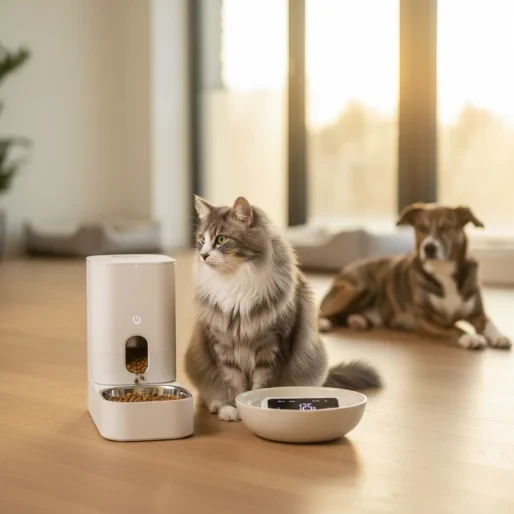
Automatic feeders are programmable devices that dispense a pre-set amount of dry food (kibble) at specific times. They typically feature a hopper for storage and a conveyor or gravity-fed mechanism. Advanced models may include Wi-Fi connectivity, cameras, and app-based logs.
2. Smart Bowls
Smart bowls (or weighing bowls) appear similar to standard bowls but contain integrated digital scales. They display the weight of the food as it is poured, often connecting to a smartphone app to track calorie intake against the pet's breed, age, and activity level. They require the owner to be physically present to serve the meal.
Side-by-Side Comparison
| Feature | Automatic Feeder | Smart Bowl |
|---|---|---|
| Portion Precision | Moderate (volume-based) | High (weight-based) |
| Food Type | Mostly Dry/Kibble only | Dry, Wet, Raw, Fresh |
| Owner Presence | Not required | Required |
| Routine Building | Excellent (fixed times) | Variable (owner dependent) |
| Cost Entry Point | Higher investment | Lower investment |
| Multi-Pet Safety | Low (guarding risk) | High (supervised) |
Deep Dive: Automatic Feeders
The Case for Consistency
For dogs prone to bilious vomiting syndrome (vomiting yellow bile on an empty stomach) or cats who wake owners at 4:00 AM, automatic feeders provide a medical and behavioural advantage: absolute consistency. By breaking the association between the human and the food, these devices can reduce begging behaviour. The dog learns that the machine, not the owner, controls the resources.
This dissociation is particularly useful during routine shifts or return-to-office transitions, helping to prevent separation anxiety by normalising feeding times regardless of the owner's location.
Limitations and Risks
- Kibble Jamming: Irregularly shaped kibble can jam mechanisms. Owners must test the reliability of the unit extensively before relying on it.
- Resource Guarding: In multi-pet households, a dominant dog may camp by the feeder, creating anxiety for a shyer pet. Microchip-activated feeders mitigate this but are significantly more expensive.
- Lack of Inspection: When feeding is automated, owners may miss subtle signs of illness, such as a lack of appetite or dental pain, which are usually noticed during manual feeding.
Deep Dive: Smart Bowls
The Case for Precision
Smart bowls bring the accuracy of a kitchen scale to the feeding station. For breeds prone to obesity (such as Labradors, Beagles, and Pugs) or senior dogs managing arthritis where weight load is critical, the difference between "a cup" and "100 grams" can be significant. Volume measurements (cups) are notoriously inaccurate; settling contents can vary calorie counts by up to 20%.
Smart bowls are diet-agnostic. Whether an owner feeds commercial raw, home-cooked, or wet food, the bowl tracks the exact intake. This is crucial for adhering to nutritional labels that specify grams per kilogram of body weight.
Limitations and Risks
- Battery Dependency: Unlike passive bowls, a dead battery means a loss of tracking data, though the bowl still functions physically.
- Hygiene: Electronics and water do not mix well. While many smart bowls have removable stainless steel inserts, the base unit cannot be submerged, making thorough sanitisation slightly more complex than standard bowls.
Behavioural Considerations for Adoption Candidates
When counselling potential adopters, understanding the dog's history is vital before selecting gear. Rescue dogs with a history of food insecurity may find automatic feeders stressful. The mechanical noise and the inability to "negotiate" with the device can trigger frustration or destructive behaviour directed at the machine.
Conversely, dogs with separation anxiety may benefit from puzzle feeders or slow-feeder inserts often compatible with smart bowl systems, rather than the instant gratification of a gravity feeder. For those considering adoption, refer to our checklist for rescue dogs to assess if food guarding is a known issue.
Lifestyle Match: Which System Fits You?
Scenario A: The Multi-Pet Household
Verdict: Smart Bowls.
Unless investing in microchip-gated feeders, automatic feeders can cause chaos in multi-pet homes. One animal often eats both portions. Smart bowls require supervision, ensuring each pet eats their specific prescription or portion without theft.
Scenario B: The 12-Hour Shift Worker
Verdict: Automatic Feeder (with Camera).
For cats or dogs with access to a secure area, an automatic feeder ensures meals are not delayed by traffic or overtime. Models with cameras allow the owner to verify that the pet has actually eaten, providing peace of mind.
Scenario C: The Weight-Loss Protocol
Verdict: Smart Bowl.
Weight loss requires 100% accuracy. Automatic feeders can fluctuate in dispensing amounts by 5-10 grams per serving. A smart bowl ensures the deficit is maintained exactly as prescribed by the veterinarian.
Financial and Maintenance Considerations
The cost of ownership extends beyond the initial purchase. Automatic feeders require desiccant packs to keep food fresh and regular disassembly for cleaning to prevent oil build-up and rancidity. Smart bowls generally have lower ongoing costs but may require frequent battery changes.
Decision Checklist
Before purchasing, owners should ask the following questions:
- Diet Type: Do I feed wet or raw food? (If yes, Auto Feeders are generally disqualified).
- Patience: Does my dog scratch or chew at food containers? (Plastic hoppers are vulnerable to destruction).
- Power: Do I have a reliable power source or battery backup for an automatic unit?
- Goals: Is the primary goal convenience (Auto) or medical weight management (Smart Bowl)?
Ultimately, the best tool is the one that supports the animal's health while reducing stress for the owner. Neither device replaces the bond formed during feeding time, but both can serve as valuable assistants in maintaining a happy, healthy pet.
Frequently Asked Questions
Content Disclosure
This article was created using state-of-the-art AI models with human editorial oversight. It is intended for informational and entertainment purposes only and does not constitute veterinary medical advice. Always consult a licensed veterinarian for your pet's specific health needs. Learn more about our process.