Arthritis changes everything about a dog's grooming routine, from the way they stand at the tub to how long they can tolerate a brush stroke near an inflamed hip. This guide covers professional-grade positioning strategies, adaptive equipment, and coat-type-specific techniques that keep senior dogs comfortable and clean without aggravating their joints.
Key Takeaways
- Short, frequent sessions of 5 to 10 minutes are safer than one long grooming appointment for arthritic dogs.
- Non-slip surfaces under all four paws reduce the postural anxiety that causes muscle guarding and resistance.
- Warm water (around 37 to 39 degrees Celsius) eases joint stiffness before and during bathing.
- Adaptive tools such as long-handled brushes, grooming slings, and orthopaedic bath mats lower the physical demand on both dog and owner.
- Mats forming near the axilla (armpit), groin, or behind the ears are a grooming priority, as they pull on skin over joints already under stress.
- Sudden behavioural changes during grooming, including snapping, vocalising, or refusing weight-bearing, warrant a veterinary consultation before the next session.
- Professional groomers certified through bodies such as the International Professional Groomers (IPG) or the National Dog Groomers Association of America (NDGAA) can adapt table and tub setups for mobility-limited dogs.
Why Grooming Matters More, Not Less, When a Dog Has Arthritis
A common misconception among owners of arthritic dogs is that grooming becomes less important once mobility declines. In practice, the opposite is true. Dogs with osteoarthritis or degenerative joint disease tend to move less, which means the natural coat-maintenance that comes from activity, rolling, and self-grooming is significantly reduced. Mats accumulate faster, particularly in pressure areas such as the elbow, hip, and sternum, where the dog rests for extended periods. These mats tighten against skin that may already be sensitised by reduced circulation and muscle atrophy, creating a painful feedback loop.
Beyond coat condition, regular grooming appointments, even brief ones at home, serve as low-stress health assessments. Owners who groom consistently are more likely to notice early changes in skin condition, limb swelling, weight distribution, and sensitivity to touch, all of which are clinically relevant for managing a dog with joint disease. Veterinary guidelines consistently emphasise that owner observation is a front-line tool in chronic pain management, and a grooming routine creates structured opportunities for that observation. If you use an indoor camera to observe your dog between sessions, our guide on how indoor pet cameras help you monitor behaviour while away explains what footage to document and share with your vet.
Setting Up a Safe Grooming Environment
Non-Slip Surfaces Are Non-Negotiable
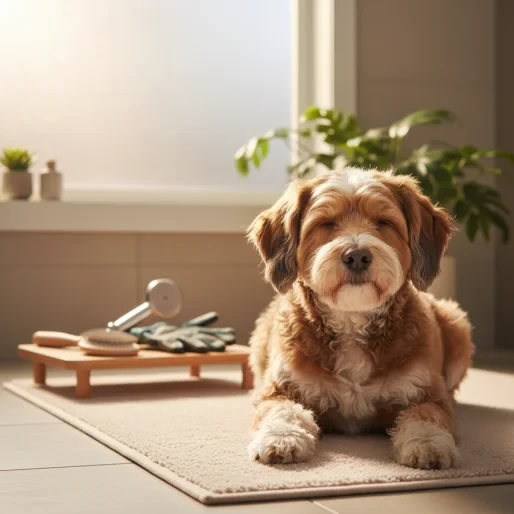
Arthritic dogs experience a significant amount of postural anxiety on slippery surfaces. When paws cannot grip, dogs recruit compensatory muscle groups to stabilise themselves, and this increases tension through already-compromised joints. Professional grooming tables use rubberised surfaces specifically to prevent this. At home, placing a thick rubber bath mat or an orthopaedic foam mat in the grooming area eliminates most of that stress before a brush even touches the coat. For bathing, a purpose-made non-slip bath insert or a folded rubber mat on the tub floor provides the same stability.
Height and Access
Asking an arthritic dog to jump onto a table or step into a raised tub is one of the most common causes of grooming-related pain flares. Ramps with a gentle gradient (professional consensus suggests no steeper than around 20 to 25 degrees for dogs with moderate hip or elbow arthritis) allow dogs to walk in rather than leap. Portable grooming ramps and foldable steps with rubber treads are widely available and represent a worthwhile investment for owners managing long-term conditions.
For floor-level grooming, the owner should work from a low stool or kneel on a cushioned mat rather than bending awkwardly, which also helps maintain a calm, controlled pace throughout the session.
Temperature and Lighting
Cool environments cause joints to stiffen. Grooming in a warm room, ideally after the dog has had light movement such as a short walk, allows muscles and connective tissue around affected joints to be more pliable. Good lighting is equally important: it allows owners to see skin changes, early mat formation, and any redness around pressure points that might otherwise be missed beneath a dense coat.
Adaptive Tools for Arthritic Dogs
Brushes and Combs
- Long-handled slicker brushes: Extend reach without requiring the owner to press down on the dog's back or lean over them, which can cause the dog to shift weight and stress a sore joint. The longer handle also allows lighter, more controlled strokes.
- Flexible-pin brushes: For dogs with single coats or fine double coats, flexible-pin brushes conform to the body contour without rigid pressure over bony prominences such as hip points or shoulder blades.
- Wide-tooth combs with rotating teeth: Rotating-tooth combs glide through tangles with less drag force, reducing the tugging sensation that causes arthritic dogs to flinch, brace, or pull away.
- Rubber curry brushes: For short-coated breeds with arthritis (Staffordshire Bull Terriers, Boxers, Labrador Retrievers), rubber curry brushes provide effective dead-coat removal with broad, flat contact that distributes pressure across a larger skin area.
Grooming Slings and Support Harnesses
Grooming slings, which loop under the abdomen and attach to a grooming arm or a hook fixed at appropriate height, are a professional tool now increasingly available to home owners. They do not suspend the dog but provide gentle counter-pressure that reduces the muscular effort required to hold a standing position. Professional bodies including the IPG note that sling support is particularly beneficial during rear-end grooming of dogs with lumbosacral arthritis, where the simple act of lifting a tail can cause acute discomfort if the dog has no external support.
Detangling Sprays and Conditioning Rinses
Coat preparation products are not cosmetic luxuries in this context. A properly applied detangling spray reduces the mechanical force needed to work through a mat by lowering the coefficient of friction between hair shafts. This translates directly into fewer tugging sensations and less repositioning by the dog. Owners should look for products formulated without alcohol (which dries the skin, an existing risk in older dogs) and ideally with a conditioning agent to maintain coat elasticity. Always allow a spray product to penetrate for at least one to two minutes before beginning to brush.
Step-by-Step Grooming Routine for an Arthritic Dog
Step 1: Pre-Session Assessment (2 Minutes)
Before picking up any tool, observe the dog walking to the grooming area. Note any new favouring of a limb, hesitation on the ramp, or reluctance to stand. Gently palpate (with flat-palmed pressure, not fingertip pressure) along the spine, over the hips, and down each foreleg. A dog that stiffens, pulls away, or vocalises in response to areas that were previously comfortable may be experiencing an acute flare and the session should be shortened or postponed. Professional standards recommended by the NDGAA suggest documenting these observations, even informally, to track patterns over time.
Step 2: Positioning the Dog
For standing work (brushing the back, sides, and tail region), encourage the dog to stand on the non-slip mat. Do not hold the dog in an uncomfortable position to complete a section faster. If they shift to a three-legged stance, allow it and adjust the grooming angle rather than correcting the dog's position. For sensitive areas such as the underbelly, chest, and inner thighs, having the dog lie on a well-padded surface is preferable to crouching or stretching. A grooming bolster or rolled towel placed under the dog's side prevents them from rolling fully and helps maintain a relaxed lateral position.
Step 3: Brushing (Working From Distal to Proximal)
Begin brushing at the extremities (lower legs and paws) and work toward the body. This approach familiarises the dog with the sensation and allows the groomer to identify tender areas before reaching the highest-sensitivity zones around the hips, elbows, and spine. Use short, directional strokes following the natural coat growth, and work in layers for double-coated breeds. Lifting the outer coat with one hand while brushing the undercoat with the other (known as line brushing) prevents the brush from dragging across the full coat depth in one pass, which is the single most common cause of unnecessary pulling force.
For dogs with dense double coats (Golden Retrievers, German Shepherd Dogs, Siberian Huskies), carding (using a fine-toothed tool or specialised carding blade to remove dead undercoat close to the skin) is periodically necessary. In arthritic dogs, carding sessions should be kept brief and focused on areas of highest matting risk rather than attempting a full carding in a single session.
Step 4: Mat Removal
Mats near the ears, under the collar, in the axilla, and at the groin are the highest priority because they sit over joints or in areas of maximum movement. Never attempt to brush out a tight mat from the surface: this generates the most drag force. Instead, work a detangling spray into the mat, then use fingers or a wide-tooth comb to tease the mat from its outermost edge inward, working in small increments. A mat splitter can be used to divide dense mats into smaller sections, each of which can then be combed out with significantly less force. If a mat is tightly adhered to skin over a joint, professional groomer removal or clipping by a veterinary nurse is the safer option.
Step 5: Bathing
Warm water (around 37 to 39 degrees Celsius) is recommended: it relaxes periarticular muscle tension and makes the bathing experience genuinely therapeutic for many arthritic dogs. Avoid high-pressure spray settings, which startle dogs and cause them to brace and shift weight suddenly. A handheld shower head at low pressure, directed away from the face initially, is the standard professional approach. Wet the coat thoroughly before applying shampoo, as this reduces the amount of product needed and prevents the drag of applying shampoo to a dry coat.
Support the dog's weight throughout by keeping one hand gently under the chest or abdomen. For rear-end bathing in a dog with hip arthritis, a grooming sling or a second person providing gentle abdominal support reduces the risk of the dog sitting or collapsing suddenly under warm water. This is especially relevant for larger breeds. It is worth noting that the physiological benefits of warm water immersion for joints are well documented in hydrotherapy literature; for more on how water-based therapies support canine orthopaedic health, see our detailed article on what hydrotherapy actually does for dogs recovering from orthopaedic surgery.
Step 6: Drying
Vigorous towel rubbing is a significant source of joint stress during drying: it rotates limbs, pulls skin over joints, and creates the kind of unpredictable movement that arthritic dogs find difficult to stabilise against. Instead, use a pressing and blotting technique with a highly absorbent microfibre towel, or a low-heat, low-velocity pet dryer held at a distance. Never direct forced air at joints or the lower back for prolonged periods. Ensure the dog is fully dry before returning to a cool environment, as residual moisture combined with cold temperatures can trigger muscle stiffness.
Frequency Guide by Coat and Breed Type
- Short, smooth single coats (Beagle, Whippet, Dachshund): Brushing once weekly with a rubber curry brush is generally sufficient. Bathing every four to six weeks, or as needed for odour or soiling.
- Double coats with moderate density (Labrador Retriever, Golden Retriever): Brushing two to three times per week, increasing to daily during seasonal shedding periods. Bathing every four to eight weeks. Line brushing recommended to manage undercoat without surface drag.
- Dense double coats (Siberian Husky, Alaskan Malamute, Chow Chow): Brushing three to five times per week. Bathing every six to eight weeks. Carding sessions divided across multiple short appointments rather than a single long session.
- Long, flowing single coats (Afghan Hound, Yorkshire Terrier, Maltese): Daily brushing to prevent mat formation, particularly around the ears, collar, and axilla. Bathing every two to three weeks with a conditioning rinse to maintain coat slip.
- Curly or wavy coats (Poodle, Lagotto, Bichon Frise): Brushing three to five times per week. Professional clipping every six to eight weeks is typically required to keep the coat at a manageable length, as these coat types do not shed and will mat if overgrown. For arthritic dogs of these breeds, more frequent professional appointments at shorter coat lengths reduce the home grooming burden.
- Wire coats (Border Terrier, Airedale Terrier, Wire Fox Terrier): Weekly brushing. Stripping or tipping (removing the dead outer coat by hand or with a stripping knife to maintain breed-standard texture) is part of the breed-specific maintenance cycle, but in arthritic dogs, stripping sessions should be kept short and targeted.
For comprehensive guidance on seasonal coat-specific checks relevant to senior dogs, the article on autumn grooming for senior dogs covers coat assessment, skin condition review, and parasite screening across the seasonal transition period.
Warning Signs to Watch For During Grooming
Grooming sessions provide an invaluable window into a dog's health status. The following observations should prompt a pause in the session and, where indicated, a veterinary consultation:
- New or increased vocalisation when specific areas are touched, particularly over the spine, hips, elbows, or carpal (wrist) joints.
- Sudden snapping or growling from a previously tolerant dog. Pain-related aggression during grooming is a recognised clinical sign that the dog's pain management may need reassessment.
- Skin thickening, scaling, or hyperpigmentation over pressure points such as elbows and hocks. These can indicate callus formation, pressure sores, or early skin infection secondary to reduced mobility.
- Redness, warmth, or swelling over or near a joint. These signs suggest active inflammation and should be reported to a veterinarian before grooming continues over that area.
- Unusual odour emanating from skin folds or between toes, which may indicate a secondary bacterial or yeast infection, particularly common in dogs with reduced mobility and compromised self-grooming.
- Refusal to bear weight on a limb during the session that was not present before. This warrants veterinary assessment, not continuation of grooming.
- Significant coat thinning or patchy loss not attributable to seasonal shedding. This may indicate a systemic condition, including thyroid dysfunction, which is more common in older dogs, or a reaction to medication used to manage arthritis pain.
Any skin condition that falls outside normal coat and skin variation should be referred to a veterinary dermatologist or the treating veterinarian. Grooming professionals, regardless of certification level, are not qualified to diagnose or treat dermatological conditions.
Professional Groomer vs Home Grooming: A Decision Guide
The decision to groom at home or delegate to a professional should be made based on the dog's condition, coat complexity, and the owner's ability to maintain a safe, low-stress environment. The following framework, informed by standards recognised by the IPG and NDGAA, provides a starting point.
Home Grooming Is Appropriate When:
- The dog has a short or low-maintenance coat that requires brushing and occasional bathing but no clipping or stripping.
- The dog is familiar with the home environment and tolerates handling from the owner without stress-related behaviours.
- Arthritis is mild to moderate and the dog can stand with support for short periods.
- The owner has appropriate tools, a non-slip surface, and the physical ability to manage the dog safely.
Professional Grooming Is Recommended When:
- The coat requires clipping, scissoring, hand-stripping, or tipping, tasks that require professional-grade equipment and technique to complete safely on a mobile-limited dog.
- Mats are dense, close to the skin, or located over joints where the risk of nicking or pulling skin is elevated.
- The dog shows stress responses (panting, trembling, vocalising) that are beyond the owner's ability to manage safely.
- The dog has severe arthritis, is non-ambulatory, or requires specialised positioning equipment not available in a domestic setting.
When selecting a professional groomer for an arthritic dog, owners should ask specifically about the groomer's experience with senior and mobility-limited dogs, their approach to positioning and support, and whether they hold certification from a recognised body. Our overview of pet groomer licensing requirements across the US, UK, Australia, Canada, and the EU explains what qualifications are legally required and what is voluntary, helping owners make an informed choice.
Communicating With Your Veterinary Team
Grooming is a healthcare activity for arthritic dogs, not a cosmetic one, and it benefits from being included in veterinary conversations. Owners are encouraged to inform the treating veterinarian of any changes observed during grooming, including new areas of sensitivity, changes in coat quality, and the dog's overall tolerance of handling. In return, the veterinary team can advise on whether a pain management review is warranted before grooming sessions, and whether specific areas (such as over a recently injected joint) should be avoided temporarily.
Some veterinary practices now work in coordination with certified groomers to provide combined appointments for senior dogs, an approach that professional organisations including the British Dog Groomers' Association have advocated as part of a more integrated model of senior pet care.
Frequently Asked Questions
How long should a grooming session be for an arthritic dog? ↓
What is the best brush for an arthritic dog? ↓
Can bathing help an arthritic dog? ↓
When should I stop grooming and call a vet? ↓
How do I remove mats from an arthritic dog without causing pain? ↓
Sophie Bianchi
Certified Master Pet Groomer
Certified master pet groomer — breed-standard techniques, skin health awareness, and at-home grooming guidance.
Content Disclosure
This article was created using state-of-the-art AI models with human editorial oversight. It is intended for informational and entertainment purposes only and does not constitute veterinary medical advice. Always consult a licensed veterinarian for your pet's specific health needs. Learn more about our process.