Singapore's year-round tropical heat and high humidity make aquarium cooling a daily necessity, not a seasonal concern. This guide compares fans, chillers, and DIY methods with local pricing, energy costs, and HDB-friendly advice.
Key Takeaways for Singapore Aquarists
- Singapore's ambient temperature of 30 to 33 °C and average humidity above 83% make aquarium cooling a year-round requirement, not a seasonal task as in temperate countries.
- Clip-on cooling fans offer affordable relief for small freshwater tanks, but Singapore's persistent humidity significantly limits evaporative cooling performance.
- Aquarium chillers are widely considered essential in Singapore for reef tanks, shrimp breeding setups, axolotl tanks, and any livestock sensitive to temperatures above 26 to 28 °C.
- DIY methods such as frozen bottles or partial water changes are unreliable stopgaps and should not be treated as a permanent strategy in a climate where heat stress is constant.
- At current SP Group electricity tariffs of approximately $0.30 per kWh (inclusive of GST, Q2 2026), running costs for chillers are a meaningful ongoing expense that should be factored in before acquiring heat-sensitive species.
Why Singapore's Climate Is Uniquely Challenging for Aquariums
Unlike temperate countries where aquarium overheating is a summer problem lasting weeks, Singapore's tropical climate poses a continuous threat. Daytime temperatures regularly reach 31 to 33 °C, while nighttime lows rarely drop below 24 to 26 °C. Indoor temperatures in HDB flats, condominiums, and landed properties without air conditioning commonly sit at 29 to 32 °C throughout the day.
More critically, Singapore's relative humidity averages 83 to 87% year-round according to the Meteorological Service Singapore. This severely reduces the effectiveness of evaporative cooling methods, including aquarium fans. In practical terms, a fan that might lower water temperature by 3 to 4 °C in a dry climate may achieve only 1 to 2 °C of cooling in a typical Singapore room.
Elevated water temperatures reduce dissolved oxygen, accelerate bacterial growth, and cause physiological stress in fish and invertebrates. Crystal red shrimp, axolotls, and coldwater species can suffer organ damage or death within hours at temperatures that feel only mildly warm to a person. Planning cooling equipment before acquiring livestock is essential, not optional.
Side-by-Side Comparison for Singapore Conditions
| Factor | Clip-On / Aquarium Fans | Aquarium Chillers | DIY and Household Methods |
|---|---|---|---|
| Best tank size | Nano to small (up to roughly 100 L) | Medium to large (75 L and above) | Any size as a temporary fix |
| Typical purchase cost (SGD) | Around $20 to $70 | Around $200 to $1,100+ depending on capacity | Near zero to minimal |
| Realistic cooling in Singapore | 1 to 2 °C below ambient (limited by humidity) | Holds a precise set point regardless of ambient conditions | Unpredictable, typically 1 to 2 °C temporarily |
| Energy use | Very low (typically 2 to 10 watts per fan) | Moderate to high (50 to 500+ watts depending on unit) | Negligible to low |
| Monthly electricity cost (est.) | Under $1.50 | $10 to $30+ depending on cycling frequency | Negligible (unless running household AC) |
| Noise level | Low to moderate hum | Moderate; compressor vibration noticeable in small HDB rooms | Variable |
| Effectiveness in SG humidity | Significantly reduced above 80% relative humidity | Unaffected by humidity | Poor |
| Maintenance | Low; top off evaporated water regularly | Moderate; clean condenser, ensure ventilation | High; constant manual effort |
Option 1: Aquarium Cooling Fans
How they work
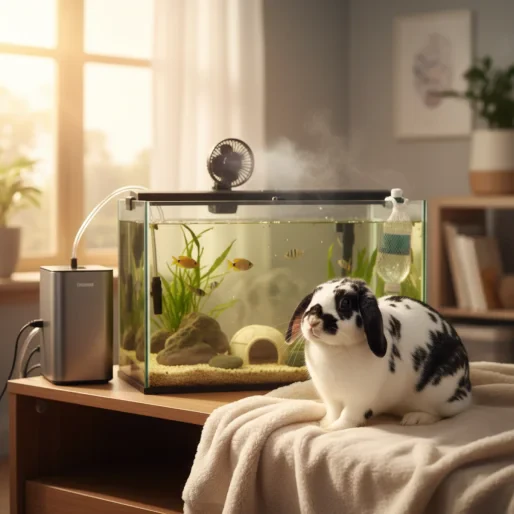
Clip-on aquarium fans sit on the tank rim and blow air across the water surface, accelerating evaporation. Because evaporation is endothermic, it draws heat from the water. Many models include a built-in thermostat that triggers the fan when a set temperature is exceeded.
Singapore-specific performance
In Singapore's high humidity, evaporative cooling is substantially less efficient than manufacturers' specifications suggest. Specifications are typically measured at 40 to 60% relative humidity. At Singapore's typical 80 to 87%, expect roughly half the advertised temperature drop. A fan rated for 3 to 4 °C of cooling may realistically achieve 1 to 2 °C in a non-air-conditioned HDB room.
That said, even a modest 1 to 2 °C reduction can mean the difference between 31 °C and 29 °C, which is meaningful for hardy tropical species such as neon tetras, guppies, and common bettas.
Pricing in SGD
Single-fan clip-on units typically cost $20 to $35 at local aquarium retailers or on platforms such as Shopee and Lazada. Dual or quad-fan arrays with thermostat control range from $40 to $70.
Best suited for
Small freshwater tanks (under 100 L) keeping hardy tropical species in rooms with some air conditioning, or as a supplementary measure alongside a chiller to reduce compressor workload.
Option 2: Aquarium Chillers
How they work
Aquarium chillers use a refrigeration compressor to actively remove heat from water pumped through the unit. An internal thermostat maintains the set temperature precisely, cycling the compressor on and off as needed. Inline models connect between a canister filter outlet and the return line; drop-in coil models sit inside a sump.
Why chillers are the default recommendation in Singapore
Because Singapore's heat and humidity are constant rather than seasonal, professional aquarist consensus in the region strongly favours chillers for any setup housing temperature-sensitive livestock. Reef corals, caridina shrimp species, axolotls, and discus all require stable temperatures that fans alone cannot reliably maintain in local conditions.
Chillers are unaffected by ambient humidity, making them the only cooling method that performs consistently in Singapore without household air conditioning.
Pricing and running costs in SGD
Entry-level chillers rated for 100 to 200 L tanks (typically 1/10 HP) cost approximately $200 to $400. Mid-range units for 200 to 500 L setups range from $400 to $700. Larger reef-grade chillers can exceed $1,100.
A 1/10 HP chiller drawing around 120 watts with approximately 50% cycling in Singapore's climate would consume roughly 43 kWh per month. At SP Group's current tariff of approximately $0.30 per kWh, that translates to around $13 per month. Larger units or those in poorly ventilated spaces will cost proportionally more.
HDB and condo considerations
Compressor-based chillers produce moderate noise and vibration. In smaller HDB bedrooms or study rooms, this may be noticeable, particularly at night. Placement on a vibration-dampening mat and ensuring adequate clearance (typically 15 to 20 cm on all sides) for heat exhaust helps with both noise and efficiency.
Critically, chillers expel warm air into the room. In a small, enclosed HDB room without ventilation or air conditioning, this creates a feedback loop where the chiller heats the room, causing it to work harder. Positioning the chiller near an open window or in a ventilated cabinet is strongly advisable.
Best suited for
Medium to large tanks (75 L and above), all saltwater and reef setups, shrimp breeding tanks, axolotl enclosures, and any aquarium in a non-air-conditioned Singapore home. Widely considered a necessary investment rather than an optional upgrade in this climate.
Option 3: DIY and Household Methods
Common approaches
- Frozen water bottles: Sealed bottles of ice floated in the tank or sump. They provide 1 to 2 °C of temporary cooling but melt within two to three hours in Singapore's heat and can cause rapid temperature swings.
- Room air conditioning: Running household AC to 24 to 25 °C effectively keeps aquarium temperatures in range. However, continuous AC use adds significantly to electricity bills and is not feasible in all households.
- Partial water changes with cooler water: Replacing 10 to 15% of tank water with slightly cooler, dechlorinated water can offer brief relief. Avoid sudden temperature drops exceeding 2 °C, as thermal shock is itself harmful.
- Removing the tank lid: Allows some surface gas exchange and marginal evaporative cooling, but increases the risk of fish jumping, especially with active species.
Limitations in Singapore
DIY methods are fundamentally unreliable in a climate where heat stress is a daily, year-round concern. Frozen bottles require replacement every few hours around the clock. Manual water changes are time-consuming and impractical over weeks and months. These methods should be reserved for genuine emergencies, such as a chiller malfunction while a replacement is sourced.
Choosing by Tank Type and Livestock
Nano planted tanks and basic community tanks (under 60 L)
A clip-on fan may be adequate if the room has air conditioning set to 25 °C or below for most of the day. Without AC, even nano tanks benefit from a small chiller, especially when housing caridina shrimp species popular in Singapore's aquascaping community.
Medium freshwater or planted tanks (60 to 200 L)
A 1/10 to 1/5 HP chiller is the standard local recommendation. Fans can be used as a supplement to reduce chiller cycling frequency and extend compressor lifespan.
Reef and marine tanks (any size)
A properly sized chiller is considered non-negotiable for reef keeping in Singapore. Corals can bleach at sustained temperatures just 1 to 2 °C above their comfort zone. The investment in a chiller is small compared to the cost of replacing coral livestock.
Axolotl tanks
Axolotls require water below approximately 20 °C, which is 10 to 13 °C below typical Singapore room temperature. A chiller is the only viable option. Prospective axolotl owners in Singapore should budget for a chiller from the outset.
Responsible Ownership and Sourcing
The National Parks Board (NParks), through its Animal and Veterinary Service (AVS), oversees animal welfare in Singapore. While aquatic species are not subject to the same licensing and microchipping requirements as dogs, the Animals and Birds Act provides broad welfare protections. Keeping animals in conditions likely to cause suffering, including preventable heat stress due to inadequate equipment, falls within the scope of animal welfare obligations.
Before purchasing temperature-sensitive aquatic species, owners should ensure their cooling setup is installed, tested, and verified to hold the required temperature for at least 48 hours. Reputable aquatic retailers in Singapore routinely ask buyers about their tank setup, including temperature management, before selling sensitive livestock such as axolotls or high-grade caridina shrimp.
Call the Animal Recovery Centre (ARC) or your nearest 24-hour veterinary clinic.
Several clinics in Singapore offer 24-hour emergency services. The AVS (Animal & Veterinary Service) website lists all licensed clinics.
Practical Tips for Singapore Aquarists
- Monitor continuously: A digital thermometer with a high-temperature alarm is an inexpensive safeguard. Units with smartphone alerts are available from local retailers for under $30.
- Reduce heat inputs: Switch to LED lighting, which runs significantly cooler than older T5 or metal halide fixtures. Avoid placing tanks near windows that receive direct afternoon sun.
- Increase surface agitation: Higher oxygen exchange at the surface helps fish cope in warmer water. An airstone or adjusted filter outlet can assist.
- Plan for power outages: Singapore's grid is highly reliable, but outages do occur. Having battery-operated air pumps and frozen water bottles on standby provides a critical buffer.
- Pair fans with chillers: Using a fan alongside a chiller can reduce how frequently the compressor cycles, lowering energy consumption and extending the chiller's lifespan.
- Budget cooling into total cost of care: A chiller, its electricity consumption, and periodic maintenance should be factored into the monthly cost of fishkeeping before acquiring livestock, not after.
Decision Checklist
- What is your tank volume? Under 60 L with hardy tropicals may suit fans (with AC). Over 75 L or sensitive species: plan for a chiller.
- What species do you keep? Research the upper temperature tolerance of every species. The most sensitive species dictates the cooling requirement.
- Is your room air-conditioned? If yes, fans may suffice for hardy species. If no, a chiller is strongly recommended in Singapore.
- What is your monthly electricity budget? A chiller adds approximately $10 to $30+ per month. Factor this in before purchase.
- Do you have adequate ventilation for a chiller? Ensure 15 to 20 cm clearance around the unit and avoid enclosed cabinets without airflow.
- Can you commit to daily monitoring? DIY methods demand constant attention. Fans and chillers with thermostats operate autonomously.
Responsible cooling preparation protects aquatic animals from preventable suffering. In Singapore's tropical climate, matching the cooling method to the tank size, species requirements, and home environment is not a luxury: it is a fundamental part of responsible fishkeeping.
Frequently Asked Questions
Do aquarium cooling fans work well in Singapore? ↓
How much does it cost to run an aquarium chiller in Singapore? ↓
Do I need a chiller for a reef tank in Singapore? ↓
Can I keep axolotls without a chiller in Singapore? ↓
Where should I place an aquarium chiller in my HDB flat? ↓

Priya Nair
Dog Breed Advisor & Adoption Counsellor
Dog breed advisor and adoption counsellor — honest breed comparisons and lifestyle matching for prospective owners.
Content Disclosure
This article was created using state-of-the-art AI models with human editorial oversight. It is intended for informational and entertainment purposes only and does not constitute veterinary medical advice. Always consult a licensed veterinarian for your pet's specific health needs. Learn more about our process.