
In this article
The Economics of Enrichment
In the current veterinary economic climate, pet owners are increasingly scrutinizing the recurring costs of ownership. While food and preventative care are non-negotiable fixed costs, enrichment budgets often fluctuate. Commercial puzzle toys and durable tugs typically range from $15 to $50 per item, and for power chewers, the lifespan of these investments can be measured in minutes.
As a veterinary practice manager, I frequently review client files where owners have spent hundreds of dollars annually on toys that are destroyed almost immediately. Upcycling household linens into snuffle mats and braided tugs offers a financially sustainable alternative. However, this 'free' enrichment comes with a caveat: the potential for costly medical emergencies if materials are not selected and managed with clinical precision. This guide explores the financial and safety realities of DIY upcycling.
The Hidden Cost: Linear Foreign Bodies
Before cutting into old bedsheets, it is critical to understand the veterinary concept of a 'linear foreign body.' This occurs when a pet swallows a long item, such as a thread, ribbon, or strip of fabric. Unlike a solid ball that might pass or cause a simple blockage, a linear object can anchor itself (often under the tongue or in the stomach) while the rest travels into the intestines, causing the bowel to bunch up or plicate. This can slice through the intestinal wall, leading to life-threatening peritonitis.
Surgical intervention for linear foreign bodies is complex and expensive. Veterinary invoices for these procedures, including diagnostics, anaesthesia, surgery, and post-operative hospitalization, commonly range between $2,000 and $5,000 depending on geographic location and severity. Therefore, the primary goal of DIY upcycling is not just saving $20 on a toy, but preventing a $4,000 emergency bill.
Material Selection: Fleece vs. Woven Cotton
Professional consensus favors polar fleece over woven cotton (like bedsheets or denim) for DIY toys. The structural difference is financial risk management:
- Woven Fabrics (Sheets/Towels): When chewed, these fray into long, strong threads. These threads are high-risk for linear obstructions.
- Knits and Fleece: Polyester fleece creates a 'break-away' structure. It tends to tear into small chunks rather than unraveling into long strings. Small chunks are generally less likely to cause the catastrophic plication associated with linear bodies.
For the projects below, retired fleece blankets or pajama pants are the safest currency. If using t-shirts, ensure they are jersey knit (which rolls) rather than woven.
Project 1: The High-Value Snuffle Mat
A commercial snuffle mat costs between $30 and $60. A DIY version costs the price of a rubber sink mat (approx. $5) and utilizes waste fabric. Snuffle mats utilize a dog's foraging instinct, providing mental stimulation that can reduce destructive boredom behaviors—protecting your furniture and baseboards from damage.
The Construction Protocol
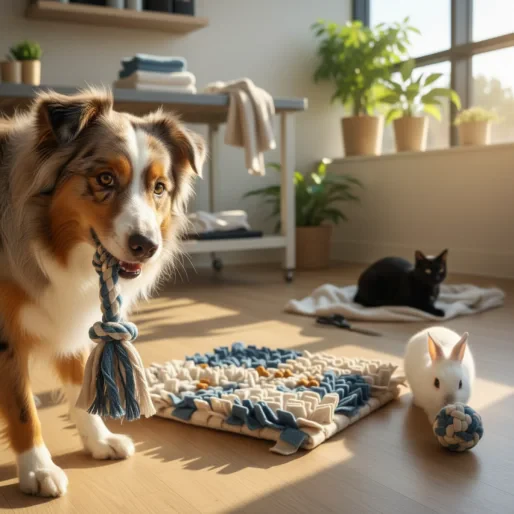
- Base Material: Acquire a heavy-duty rubber sink mat with holes. Avoid lightweight mesh that a dog could easily chew through and ingest.
- Fabric Preparation: Cut fleece into strips approximately 1 inch wide and 6 to 8 inches long. Precision is not required, but consistency helps density.
- Assembly: Thread a strip through two adjacent holes in the mat and tie a single overhand knot. Repeat until every pair of holes is occupied.
- Density Check: The goal is a dense 'shag carpet' effect. If the mat is sparse, kibble falls through too easily, reducing the enrichment duration.
Financial Impact: By using old fleece throws, you save 100% of the material cost. The primary investment is labor (approx. 1 hour). Compared to purchasing a new $40 mat every time one gets dirty or worn, the ROI on DIY mats is substantial.
Project 2: The Braided Jersey Tug
Heavy-duty tug toys are expensive consumables. Creating a durable tug from old t-shirts allows for frequent replacement at zero marginal cost.
The Braiding Technique
- Material Prep: Cut the body of old cotton jersey t-shirts into three long, continuous strips. T-shirt yarn is excellent because the cut edges roll inward, hiding fraying threads.
- The Anchor: Knot the three strips firmly together at one end.
- The Braid: Perform a tight box braid (square knot braid) or a very tight standard plait. Tightness is the safety factor here; loose braids allow dogs to access and rip individual strands.
- The Seal: Knot the end firmly. Inspect for any loose threads and trim them flush.
Safety Note: This toy is for interactive play (tug between owner and dog) only. It is not a pacifier toy to be left with the dog alone. The risk of ingestion rises significantly during solitary chewing.
The Protocol for Supervision and Retirement
The most effective cost-saving strategy in pet ownership is preventative management. Even the safest DIY toy can become a hazard if monitored poorly.
- The 'Check-In' Rule: Inspect DIY toys after every session. If a snuffle mat strip is loose, retie it. If a tug is fraying, trim it.
- Retirement Criteria: When a braided tug loses its structural integrity or a snuffle mat's rubber base begins to crack, discard it immediately. The replacement cost is zero (using more waste fabric), so there is no financial incentive to push a toy beyond its safe lifespan.
- Ingestion Monitoring: If you notice fabric missing from a toy, monitor your pet for vomiting, lethargy, or lack of appetite. Early veterinary intervention is always less expensive than delayed emergency surgery.
For more on managing pet costs, review our breakdown of The Real Cost of Dog Ownership in 2026. If you are preparing for a new addition, consider the hidden costs of puppy budgeting to ensure your emergency fund is adequate.
Key Takeaways
- Material Matters: Use fleece or jersey knit. Avoid woven sheets or towels that fray into dangerous threads.
- The Linear Risk: Understand that thread ingestion is a major financial and medical risk ($2,000+ surgery).
- Supervision is Savings: Interactive play prevents ingestion. Never leave DIY fabric toys with an unsupervised chewer.
- Zero-Cost Replacement: Because materials are free, retire and replace damaged toys aggressively to maintain safety standards.
Balancing a pet's mental health with a household budget requires creativity. By upcycling safely, you divert waste from landfills and provide high-quality enrichment, all while protecting your bank account from preventable veterinary emergencies. For further reading on sustainable practices, see our guide on Eco-Friendly Cat Litter and Eco-Friendly Spring Cleaning.
Frequently Asked Questions
Content Disclosure
This article was created using state-of-the-art AI models with human editorial oversight. It is intended for informational and entertainment purposes only and does not constitute veterinary medical advice. Always consult a licensed veterinarian for your pet's specific health needs. Learn more about our process.