
In this article
- Key Takeaways
- Singapore's Climate: Why Every Day Requires the Same Heat Management as a Heatwave Elsewhere
- AVS Licensing and What It Means for Singapore Dog Daycare
- Climate-Controlled Dog Daycare in Singapore: What to Look For
- Outdoor Dog Daycare in Singapore's Tropical Climate
- Breed Considerations Specific to Singapore
- Cost Considerations in SGD
- Practical Decision Guide for Singapore Dog Owners
Key Takeaways
- Singapore's heat is a year-round condition, not a seasonal one: Temperatures consistently range between 27°C and 34°C, with relative humidity commonly between 70% and 90%, creating thermoregulatory conditions more demanding than what temperate-climate guidelines describe for a summer heatwave.
- Humidity amplifies heat risk far beyond what temperature alone indicates: High ambient humidity reduces the efficiency of panting as a cooling mechanism, meaning dogs in Singapore face greater physiological stress at any given temperature than in drier climates at the same reading.
- Climate-controlled facilities are the recommended standard for high-risk dogs in Singapore, including brachycephalic breeds such as French Bulldogs, Pugs, and Shih Tzus, which rank among the most popular companion breeds in the country.
- AVS licensing is the regulatory baseline: The Animal and Veterinary Service (AVS) under Singapore's National Parks Board (NParks) licenses commercial pet daycare operators. A valid licence is necessary but not sufficient as a quality indicator.
- HDB breed restrictions shape daycare planning: Many HDB-approved breeds, including several brachycephalic and small companion breeds, carry elevated heat risk that must factor into facility selection for flat-dwelling owners.
Singapore's Climate: Why Every Day Requires the Same Heat Management as a Heatwave Elsewhere
Global veterinary guidance on dog heat safety typically frames temperatures above 30°C as a threshold requiring special precautions during summer months. In Singapore, those conditions describe a typical Tuesday in March as accurately as they do any other month of the year. The island's equatorial position means daytime temperatures consistently sit between 27°C and 34°C throughout the year, with night-time lows rarely falling below 23°C. For dog owners evaluating daycare facilities, this removes the concept of a safe season entirely: every operating day requires the same level of heat management that a temperate-climate facility might apply only during a heatwave.
The additional factor that distinguishes Singapore's climate from other hot regions is humidity. Relative humidity in Singapore routinely ranges between 70% and 90%, with values exceeding 80% common during the Northeast Monsoon season (November to January) and during afternoon periods throughout the year. High ambient humidity does not simply make conditions feel warmer to human observers; it directly impairs the physiological mechanism by which dogs cool themselves. Panting works by evaporating moisture from the respiratory tract, and in air that is already heavily saturated with water vapour, that evaporation becomes substantially less efficient. A dog panting in 31°C air at 85% humidity is working considerably harder to regulate its temperature than the same dog in 31°C air at 40% humidity. Professional veterinary guidance and animal welfare literature consistently identify the heat-humidity combination, rather than temperature alone, as the clinically meaningful measure of thermal risk for dogs.
For daycare operators in Singapore, this means the heat management standards described in global guidelines represent a minimum rather than an adequate benchmark. Facilities that perform adequately during a European summer may be materially under-resourced for Singapore's daily operating conditions.
AVS Licensing and What It Means for Singapore Dog Daycare
Commercial pet boarding and daycare businesses in Singapore are required to hold a valid licence from the Animal and Veterinary Service (AVS), a cluster within Singapore's National Parks Board (NParks). AVS licensing sets baseline requirements for animal welfare, facility standards, and operator competencies, and facilities must comply with the AVS Code of Animal Welfare. Confirming that a daycare provider holds a current AVS licence is a straightforward and reasonable first step before any facility visit.
Licensing is, however, a regulatory floor rather than a quality endorsement. The AVS framework establishes minimum welfare standards, and the gap between a facility that meets those minimums and one that meaningfully exceeds them can be significant in Singapore's climate. Owners should treat AVS licensing as necessary but not sufficient, and apply the full set of operational questions outlined in this article regardless of licensing status.
Climate-Controlled Dog Daycare in Singapore: What to Look For
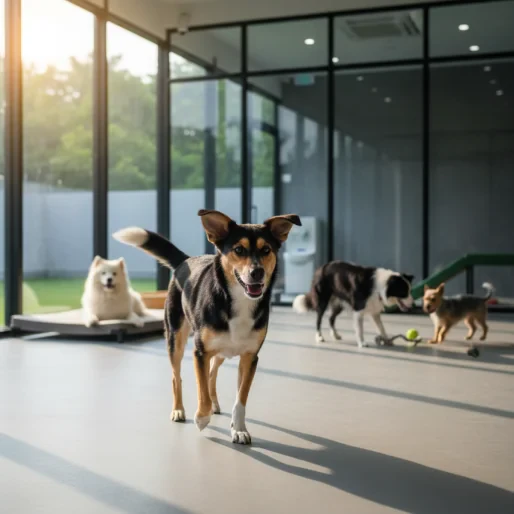
A climate-controlled daycare in Singapore should maintain active play areas below 24°C throughout the full operating day, not just during cooler morning hours. Given that Singapore's outdoor temperatures peak in the early to mid-afternoon and ambient humidity remains high even overnight, air conditioning systems in quality facilities run continuously and are designed to manage the thermal load generated by active dogs, not simply to cool an empty room.
Ventilation quality matters alongside temperature control. Closed, cooled spaces with inadequate air exchange accumulate ammonia from urine, which causes respiratory irritation at concentrations below a perceptible odour threshold. This is particularly relevant for Singapore's popular brachycephalic breeds, which are already managing structural airway resistance as a baseline condition. Quality facilities combine active cooling with mechanical ventilation, maintaining both temperature and air quality simultaneously rather than treating them as separate concerns.
When visiting a climate-controlled facility in Singapore, the most useful practical test is to request access to the main play area during midday operating hours rather than during an early-morning promotional tour. The difference between a facility that genuinely maintains 22°C to 24°C during a Singapore afternoon and one that struggles to hold 27°C becomes immediately apparent. Ask staff whether temperature is monitored by fixed sensors and whether logs are maintained across the operating day.
Key Questions to Ask a Climate-Controlled Facility in Singapore
- What temperature is the active play area maintained at between 11am and 4pm on a typical weekday, and is this measured and logged by equipment rather than estimated?
- Are rest areas kept cooler than active play zones, and are dogs monitored individually during rest periods?
- What is the staff-to-dog ratio during peak play hours? Professional daycare guidance suggests a working benchmark of one staff member per 10 to 15 dogs during active group play, with lower ratios enabling closer observation.
- Are staff trained in canine first aid, specifically including recognition of early heat stress indicators: laboured panting, profuse drooling, bright red gums, reluctance to move, and episodes of vomiting?
- Is there a written emergency protocol for heat-related illness, and which veterinary clinic is on call or within close access distance?
Call the Animal Recovery Centre (ARC) or your nearest 24-hour veterinary clinic.
Several clinics in Singapore offer 24-hour emergency services. The AVS (Animal & Veterinary Service) website lists all licensed clinics.
- Does the facility hold a current AVS licence, and can the licence number be provided for verification?
Outdoor Dog Daycare in Singapore's Tropical Climate
Outdoor daycare is not categorically inappropriate in Singapore, but the operational requirements for responsible outdoor management in a tropical climate substantially exceed what is adequate in cooler or less humid regions. Because there is no cool season, outdoor facilities must operate at a consistently high standard every day of the year rather than intensifying protocols only during identifiable heat periods.
Shade coverage requirements are more demanding in Singapore than in temperate climates. Because the sun tracks across relatively steep angles throughout the year, fixed shade structures that provide adequate coverage in the morning may leave significant ground area exposed in the afternoon. Quality outdoor operators in Singapore use a combination of permanent roofed structures and adjustable sail cloth systems to ensure coverage that tracks with the sun's position across the full operating day. Grass or rubber matting surfaces under shade structures are preferable to exposed concrete or paving, which can reach surface temperatures well above 45°C under direct Singapore sunlight, causing paw pad burns even during brief contact.
Activity scheduling at Singapore's outdoor facilities should concentrate any active group play before 9am and after 5pm. The period from approximately 11am to 4pm carries the highest combined heat and humidity load and is not appropriate for active social play for most dogs in Singapore's conditions. When assessing an outdoor facility, ask specifically what supervised activity looks like between noon and 3pm on a typical day. A credible answer describes structured rest in shaded, well-ventilated areas with continuous water access, not free play with shade available on request.
Misting systems, shallow wading areas, and cooling mats placed in shaded zones represent meaningful welfare upgrades in Singapore's outdoor context. These allow dogs to engage in behavioural thermoregulation, choosing cooling contact as needed, rather than depending entirely on shade and passive water provision. Given Singapore's ambient humidity, misting is most effective in ventilated outdoor spaces; in enclosed areas with limited air movement it can raise ambient moisture without delivering adequate cooling benefit.
Breed Considerations Specific to Singapore
Singapore's companion dog population skews heavily toward breeds that carry elevated heat risk. French Bulldogs, Pugs, Shih Tzus, Maltese, Cavalier King Charles Spaniels, and Poodle varieties consistently rank among the most commonly kept companion breeds in the country. Several of these, including Shih Tzus and Maltese, appear on Singapore's HDB-approved breed list, meaning a significant proportion of dog-owning households in public housing keep precisely the breeds most vulnerable to heat-related illness in tropical conditions.
Brachycephalic breeds, including French Bulldogs, Pugs, and Cavalier King Charles Spaniels, have structurally compressed upper airways that reduce the efficiency of panting as a thermoregulatory mechanism. Veterinary guidance consistently identifies these breeds as at elevated risk in temperatures above 24°C to 26°C, well below Singapore's daily baseline outdoor temperature. For any brachycephalic dog in Singapore, climate-controlled daycare should be regarded as the appropriate standard of care rather than an optional premium. Outdoor daycare above 28°C for these breeds carries meaningful clinical risk regardless of the quality of shade and water provision in place.
For dogs of breeds less commonly associated with heat risk in temperate contexts, including Golden Retrievers, Labrador Retrievers, and Shetland Sheepdogs, Singapore's year-round heat and humidity still represent a material thermal challenge. These breeds are not brachycephalic, but their body mass and coat density generate significant metabolic heat during active group play. Climate-controlled daycare remains the preferable option in Singapore for these dogs, with outdoor facilities appropriate only where rigorous rest scheduling, cooling infrastructure, and written emergency protocols are demonstrably in place and have been verified by the owner in person.
Senior dogs over eight years of age, dogs with diagnosed cardiac or respiratory conditions, and clinically overweight dogs share elevated heat risk profiles for different physiological reasons and warrant the same degree of caution, regardless of breed, when evaluating any Singapore daycare environment operating above 25°C.
Cost Considerations in SGD
Climate-controlled daycare in Singapore typically commands a premium over basic outdoor alternatives, reflecting the capital cost of air conditioning infrastructure and the ongoing energy expenditure required for near-continuous cooling in a tropical climate. Daily rates at quality climate-controlled facilities in Singapore generally range from around SGD $60 to SGD $100 or above, depending on location, group size, and service inclusions.
Outdoor facilities with lower infrastructure overheads may offer lower daily rates, but quality outdoor operators investing in shade structures, misting systems, and adequate staffing charge accordingly, and a lower price at an outdoor facility is frequently a reliable indicator of lower operational standards in Singapore's conditions rather than simple efficiency.
The relevant comparison for Singapore owners is not the daily rate differential but the potential cost of a heat-related illness event. Veterinary treatment for heat exhaustion or heatstroke in Singapore can range from several hundred to several thousand SGD depending on the severity, the speed of intervention, and the treatments required, including intravenous fluid therapy, intensive monitoring, and extended hospitalisation in severe cases. The additional monthly expenditure on a quality climate-controlled facility is modest relative to those contingent costs, particularly for brachycephalic, senior, or health-compromised dogs.
Practical Decision Guide for Singapore Dog Owners
Climate-Controlled Daycare Is the Appropriate Choice If:
- The dog is a brachycephalic or flat-faced breed, including French Bulldogs, Pugs, Shih Tzus, Cavalier King Charles Spaniels, or Boston Terriers, all of which are common in Singapore.
- The dog is over eight years of age, clinically overweight, or has a diagnosed cardiac, respiratory, or metabolic condition.
- The dog has previously shown signs of heat sensitivity: prolonged panting at rest, reluctance to move in warm conditions, or persistent shade-seeking during outdoor walks in Singapore.
- The owner is unable to confirm from personal observation what midday conditions at the facility look like during full operating hours.
- Year-round service reliability is a practical requirement, without risk of disruption during National Environment Agency (NEA) high heat advisory periods.
Outdoor Daycare May Be Appropriate If:
- The dog is a healthy adult of a breed with documented heat tolerance, lean body mass, and a short single coat, and does not fall into any high-risk category listed above.
- The owner has personally visited the facility during midday operating hours and verified adequate shade coverage, continuous water access, misting or wading infrastructure, enforced rest scheduling between 11am and 4pm, and a written emergency protocol for heat-related illness.
- The facility holds a current AVS licence and can confirm staff hold first aid certification relevant to canine heat emergencies.
- The dog has demonstrated consistent heat tolerance during outdoor activity in Singapore conditions, with no behavioural indicators of heat discomfort during walks or outdoor exercise at comparable temperatures and humidity levels.
Singapore's climate removes the seasonal buffer that allows lower-grade daycare facilities to perform adequately for parts of the year in temperate regions. The questions that matter during a facility assessment are not hypothetical preparations for an exceptional heatwave; they are operational realities that every compliant facility in Singapore must be addressing every single day. Owners who inspect facilities at peak operating hours, verify current AVS licensing, and match facility type to their dog's specific physiological profile are making the decision that best protects their animal's welfare in one of the world's most thermally demanding everyday environments for companion dogs.
Frequently Asked Questions
Content Disclosure
This article was created using state-of-the-art AI models with human editorial oversight. It is intended for informational and entertainment purposes only and does not constitute veterinary medical advice. Always consult a licensed veterinarian for your pet's specific health needs. Learn more about our process.