
In this article
- The Two Modalities: Underwater Treadmill vs. Pool Swimming
- The Physiology Behind the Water: Four Key Mechanisms
- What Happens Inside the Body During a Session
- Which Orthopaedic Conditions Benefit Most
- What the Research Suggests
- The Timeline: When Can Hydrotherapy Begin?
- Monitoring Your Dog at Home Between Sessions
- When to Pause or Seek Veterinary Advice
- Questions to Ask Your Veterinary Team
- The Bottom Line
Key Takeaways
- Hydrotherapy exploits four physical properties of water: buoyancy, hydrostatic pressure, viscous resistance, and thermal conductivity, each targeting a distinct aspect of orthopaedic recovery.
- The underwater treadmill (UWTM) is the preferred modality for gait re-education and controlled progressive weight-bearing. Pool swimming is better suited to cardiovascular conditioning and range-of-motion work without compressive joint loading.
- Water level in a UWTM directly determines how much body weight is offloaded, enabling safe weight-bearing exercise weeks before full loading is appropriate on land.
- Hydrotherapy should only begin after full surgical incision healing and with explicit veterinary clearance, typically two to four weeks post-operatively depending on the procedure.
- Sessions must be supervised by a qualified canine hydrotherapist or veterinary physiotherapist, and progress should be communicated back to the treating surgeon at every recheck.
- Owners are a critical part of the rehabilitation team and should monitor limb use, swelling, and post-session recovery between appointments.
For many dogs, the road back from orthopaedic surgery is longer than the operation itself. Tibial plateau levelling osteotomy (TPLO), tibial tuberosity advancement (TTA), femoral head and neck ostectomy (FHNE), total hip replacement, and fracture repairs all produce the same fundamental challenge: the dog must rebuild muscle, restore joint range of motion, and relearn how to move, but doing so on land means loading healing tissue with full body weight before the repair is ready to tolerate it. Hydrotherapy resolves this problem by changing the physical environment entirely.
This guide explains the science behind water-based rehabilitation, why each physical property of water targets a specific aspect of recovery, and what owners should understand before, during, and after their dog's first hydrotherapy session.
The Two Modalities: Underwater Treadmill vs. Pool Swimming
Canine hydrotherapy is not a single treatment. Two distinct modalities are used in veterinary rehabilitation practice, and the distinction matters because their physiological effects differ significantly.
The Underwater Treadmill (UWTM)
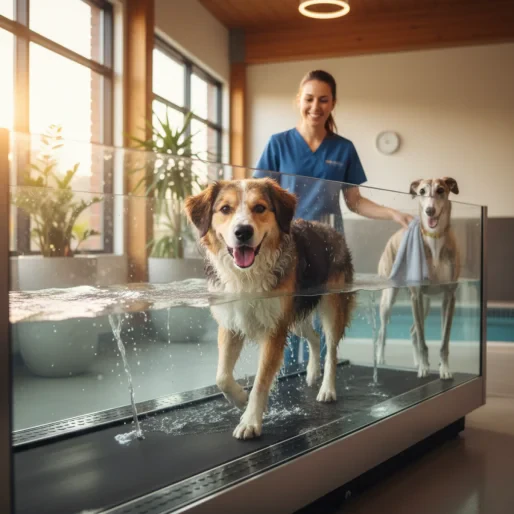
An underwater treadmill consists of a watertight chamber housing a motorised belt. The dog stands on the belt while water is filled to a controlled and adjustable depth. Because the water level can be set precisely, the therapist controls how much buoyancy is offloading the dog's weight, and which level of loading is introduced at each stage of recovery.
The key clinical advantage of the UWTM is that it preserves a normal, forward-walking gait. The dog places its feet in sequence against a moving surface, engaging postural muscles and receiving ground contact feedback through the paw pads. This is important for neurological re-education: the proprioceptive signals generated by rhythmic, weight-bearing foot placement are essential for re-establishing the motor patterns disrupted by surgery and the preceding period of lameness.
Pool Hydrotherapy (Swimming)
In pool sessions, the dog swims in a heated pool, either independently or supported by a flotation harness. Because the dog is fully buoyant, limb loading is effectively eliminated. This makes pool hydrotherapy appropriate for dogs that cannot tolerate any weight-bearing, or for sessions focused on cardiovascular fitness, thoracic limb strength, or range-of-motion work without compressive joint force.
The trade-off is that swimming does not replicate a normal gait pattern. The paddle motion used in water differs substantially from terrestrial locomotion, and professional consensus among veterinary physiotherapists holds that pool work alone is insufficient for full orthopaedic recovery. Most structured rehabilitation programmes combine both modalities, sequencing them according to the individual dog's healing stage and functional goals.
How Clinicians Choose Between Them
The choice of modality at each stage of recovery is guided by surgical protocol, the dog's size and body condition, the specific joint involved, and the degree of muscle atrophy present. Veterinary rehabilitation guidelines generally support introducing the UWTM earlier in the post-operative period for procedures such as TPLO and TTA, while pool work may precede UWTM use in dogs with severe muscle wastage or those recovering from spinal procedures. A certified canine rehabilitation practitioner should make this determination based on individual clinical assessment and in direct communication with the treating surgeon.
The Physiology Behind the Water: Four Key Mechanisms
Hydrotherapy works because water has physical properties that land-based exercise cannot replicate. Understanding these properties helps owners appreciate why a session in a heated pool or treadmill tank achieves outcomes that rest, medication, or gentle lead walking on land simply cannot deliver alone.
1. Buoyancy and Reduced Weight-Bearing
Buoyancy is governed by Archimedes' principle: a body submerged in fluid experiences an upward force equal to the weight of the fluid it displaces. In practical terms, the deeper a dog is submerged, the greater the proportion of its body weight supported by the water rather than by its limbs.
In an underwater treadmill, therapists use this principle deliberately. When water is filled to approximately hip level, canine rehabilitation research suggests effective body weight can be reduced by roughly 38 to 62 percent compared to dry-land walking, depending on body composition and water density. When the water level rises to the shoulder, loading drops further still. This allows the dog to walk with correct gait mechanics at a fraction of the compressive force that would otherwise pass through the healing surgical site.
This graduated loading is central to controlled progressive rehabilitation. As the post-operative weeks advance and bone or soft-tissue repair matures, water levels are incrementally lowered, progressively reintroducing the mechanical loading stimulus that drives bone remodelling and connective tissue strengthening. This principle reflects Wolff's Law and the broader concept of mechanotransduction: healing tissue requires appropriate mechanical stimulus to organise correctly, but that stimulus must be introduced at the right level at the right time.
2. Hydrostatic Pressure and Oedema Reduction
Hydrostatic pressure is the force exerted by water on any submerged surface, increasing proportionally with depth. For post-surgical limbs, this pressure produces a clinically useful circumferential compressive effect on soft tissue, assisting venous and lymphatic return from the distal limbs.
Post-operative swelling (oedema) is nearly universal following orthopaedic surgery. It impairs tissue oxygenation, increases joint stiffness, and contributes to pain. The hydrostatic pressure experienced during a water session provides consistent, graduated compression across the entire submerged limb. This effect is difficult to replicate with static bandaging and impossible to achieve with conventional physiotherapy exercises. Owners commonly report that limbs appear less swollen immediately following hydrotherapy sessions, an observation consistent with the known effects of hydrostatic pressure on lymphatic and venous circulation.
Hydrostatic pressure also stimulates peripheral mechanoreceptors in the skin and deeper tissues, feeding proprioceptive and sensory information to the central nervous system. This sensory input contributes to the neurological re-education that underpins functional recovery after joint surgery.
3. Viscous Resistance and Muscle Rehabilitation
Water is approximately 800 times denser than air, and moving a limb through it demands proportionally greater muscular effort than the equivalent movement in air. This hydrodynamic drag provides a form of variable resistance exercise that scales automatically with the speed and force of the dog's limb movement: the faster or more forceful the stroke, the greater the resistance encountered.
For a dog recovering from TPLO surgery, significant quadriceps and hamstring atrophy is expected even after a relatively short period of post-operative reduced weight-bearing. Walking through water requires these muscles to contract against resistance with every stride, accelerating the hypertrophic stimulus while buoyancy simultaneously limits compressive joint load. The result is that muscle mass can be rebuilt before the joint is ready to tolerate full weight-bearing exercise on land.
The resistance also applies to the core musculature. Dogs must engage their epaxial and abdominal muscles to maintain postural stability against turbulence and drag, contributing to trunk conditioning that is frequently overlooked in standard post-operative care and that has direct relevance to long-term spinal and pelvic health.
4. Thermodynamics: Warm Water and Tissue Perfusion
Hydrotherapy pools and UWTM units are typically maintained at temperatures between approximately 28 and 34 degrees Celsius. Warm water induces vasodilation in superficial and deep tissues, increasing blood flow to recovering muscles and periarticular structures. Improved perfusion accelerates the clearance of metabolic waste products, delivers oxygen and nutrients to healing tissue, and reduces post-exercise soreness.
Warmth also reduces the viscosity of synovial fluid, improving joint lubrication and facilitating greater range of motion with less discomfort. For dogs with concurrent degenerative joint disease (common in animals that have experienced cruciate disease or hip dysplasia), this effect meaningfully improves comfort and exercise compliance during sessions. The hydrotherapy environment essentially combines active rehabilitation with the tissue-warming benefits normally provided by therapeutic heat in a conventional physiotherapy setting.
What Happens Inside the Body During a Session
The Gait Cycle Underwater
High-speed underwater camera systems fitted to modern UWTM units allow therapists to observe gait kinematics in real time. Veterinary rehabilitation research has demonstrated that dogs walking in an underwater treadmill exhibit measurably different joint angle profiles compared to dry-land walking, with variations in hip and stifle flexion depending on the water depth selected. Therapists use this knowledge to choose water depths that promote the joint range-of-motion outcomes most relevant to each patient.
For TPLO and TTA patients, restoring full stifle flexion and extension is a primary goal. The UWTM environment allows the therapist to encourage movement through a range that would be painful or biomechanically unsupported on land during early recovery. Early restoration of normal movement patterns also prevents the development of compensatory gait adaptations (such as overloading the contralateral limb or shortening the stride) that can lead to secondary orthopaedic problems over time.
Muscle Fibre Recruitment and Re-education
Disuse atrophy following orthopaedic surgery predominantly involves type II (fast-twitch) muscle fibre loss, though type I (slow-twitch, endurance) fibres are also affected over time. Controlled, rhythmic walking in the UWTM at moderate speeds primarily recruits type I fibres, rebuilding the postural and endurance musculature essential for sustained, normal locomotion. As recovery advances and belt speed is increased, progressively greater type II recruitment is stimulated, restoring the full spectrum of muscular function needed for more demanding activities.
Proprioception and Neurological Recovery
One of the less visible but clinically important benefits of hydrotherapy is its effect on the nervous system's capacity to sense and map limb position. After orthopaedic surgery, proprioceptive function in the affected limb is frequently impaired, both by the original injury and by the surgery itself. This results in subtle but significant deficits in foot placement accuracy during walking, increasing the risk of stumbles and secondary injury.
The combination of hydrostatic pressure stimulating skin mechanoreceptors and rhythmic ground contact through treadmill walking creates a rich proprioceptive input to the spinal cord and cerebellum. This drives neuroplasticity, prompting the nervous system to re-map the limb and re-establish the reflexive motor programmes that underpin normal gait. This neurological dimension is why hydrotherapy is considered superior to passive range-of-motion exercises alone when the goal is full functional recovery rather than simple wound healing.
Which Orthopaedic Conditions Benefit Most
Cruciate Ligament Repair (TPLO and TTA)
Cranial cruciate ligament (CCL) disease and its surgical management via TPLO or TTA is the most common indication for post-operative canine hydrotherapy. The stifle joint undergoes significant periarticular muscle atrophy during the weeks before and after surgery, and restoring quadriceps mass and stifle stability is the primary rehabilitation goal. The underwater treadmill is well suited to this, enabling progressive weight-bearing and targeted stifle muscle recruitment from the early post-operative period. For further context on the broader mechanics of this recovery, the related guide Hydrotherapy for Post-Operative Dogs: The Mechanics of Recovery provides a useful companion resource.
Femoral Head and Neck Ostectomy (FHNE)
FHNE is a salvage procedure in which the femoral head is removed entirely, relying on scar tissue formation to create a functional pseudarthrosis. The long-term functional outcome of this procedure is uniquely dependent on periarticular muscle mass and strength: the more robust the surrounding musculature, the better the pseudarthrosis functions as a joint. Hydrotherapy is considered a cornerstone of FHNE rehabilitation, with pool swimming often used early to maintain hip range of motion before transitioning to UWTM-based muscle strengthening.
Hip and Elbow Dysplasia Surgeries
Procedures for hip dysplasia (including triple pelvic osteotomy and total hip replacement) and elbow dysplasia interventions (such as fragmented coronoid process removal) benefit from the same physiological principles. Hydrotherapy is particularly valuable in younger, larger-breed dogs, where the combination of active growth, periarticular inflammation, and the demands of an active lifestyle creates a challenging rehabilitation context. Owners of senior dogs also managing degenerative joint changes alongside surgical recovery may find the article Managing Arthritis in Senior Dogs During Cold Snaps useful for home-based management strategies between sessions.
Fracture Repair and Spinal Procedures
Post-fracture hydrotherapy follows similar principles but introduces an additional consideration: the integrity of internal fixation hardware must be sufficient to tolerate the demands of water exercise before sessions begin, as confirmed by radiographic assessment. Spinal procedures, including decompressive surgery for intervertebral disc disease (IVDD), represent another major indication. In neurological recovery cases, pool swimming with full body support may be introduced early to maintain cardiovascular fitness and limb mobility while voluntary movement is being restored. For dogs returning to hiking or trail activity after full recovery, the article Conditioning Your Dog for Spring Hiking: A Physiotherapy Approach addresses the graduated return to more demanding exercise.
What the Research Suggests
The evidence base for canine hydrotherapy has grown substantially over the past two decades, shifting it from an empirically applied therapy to one with documented physiological rationale. Peer-reviewed research published in journals including the Veterinary Journal and the American Journal of Veterinary Research has examined gait kinematics, muscle mass retention, and owner-reported outcome measures in post-operative dogs receiving structured hydrotherapy compared to those managed with rest or land-based physiotherapy alone.
Studies suggest dogs receiving structured aquatic rehabilitation after TPLO surgery demonstrate better limb use scores and more favourable recovery trajectories compared to dogs managed with rest alone, though the heterogeneity of study designs makes direct comparison across trials difficult. Professional bodies including the American Association of Rehabilitation Veterinarians (AARV) and the International Association of Veterinary Rehabilitation and Physical Therapy (IAVRPT) recognise hydrotherapy as a component of evidence-supported multimodal rehabilitation protocols.
Current professional consensus also supports integrating hydrotherapy with other physiotherapy modalities (therapeutic laser, therapeutic ultrasound, and manual therapy) rather than using it as a standalone treatment. The most effective programmes are those developed by a veterinary rehabilitation specialist who can adjust modality, duration, and intensity to the individual patient's progress at each stage of healing.
The Timeline: When Can Hydrotherapy Begin?
Timing is one of the most common questions owners raise following orthopaedic surgery, and the answer depends on the surgical type, incision healing, and the treating veterinarian's clinical assessment. General guidance in veterinary rehabilitation suggests hydrotherapy should not begin until the surgical incision is fully closed and there is no evidence of infection or dehiscence, which typically means a minimum of two to three weeks post-operatively for most procedures.
Earlier introduction may occasionally be appropriate using pool work with a fully waterproof wound seal, but only on explicit veterinary instruction. Premature water exposure to a healing incision carries a meaningful infection risk that could jeopardise the entire surgical outcome.
Once cleared, a typical structured programme might begin with two to three sessions per week of short duration (often 10 to 20 minutes initially) and progress in length and intensity over a period of weeks to months. Full recovery from a TPLO, for example, typically requires four to six months of structured rehabilitation, with hydrotherapy playing a progressively evolving role throughout that period.
Monitoring Your Dog at Home Between Sessions
Owners are an essential part of the rehabilitation team. Consistent home observation provides the therapist with critical data between appointments and allows early detection of complications. Key indicators to track include:
- Limb use: Is the dog consistently weight-bearing on the operated limb during standing, walking, and transitions from sitting to standing?
- Post-session fatigue: Some tiredness after sessions is normal. Marked lethargy, reluctance to move, or vocalisation after sessions may indicate that session intensity was too high.
- Swelling around the surgical site: A brief, mild increase followed by reduction in the 24 hours after a session is common. Persistent or worsening swelling warrants veterinary contact.
- Gait quality: Short video clips taken on flat ground at regular intervals are extremely useful for tracking progress and identifying subtle changes that may be missed during the session itself.
- Behavioural indicators of pain: Changes in appetite, reluctance to engage with normal activities, altered sleep patterns, or uncharacteristic resistance when touched near the surgical site can indicate inadequately controlled pain.
Dogs returning to activity after orthopaedic procedures must also be protected from excessive uncontrolled land exercise between sessions. The controlled loading of the water environment can create a misleading impression that the dog is ready for unrestricted activity on land. Structured lead walking and rest periods remain essential components of the protocol throughout the rehabilitation period.
When to Pause or Seek Veterinary Advice
Hydrotherapy is generally well tolerated, but there are specific circumstances in which sessions should be suspended and veterinary guidance sought promptly:
- Any open wound, skin breakdown, or discharge at or near the surgical incision
- A sudden increase in lameness following a session that does not resolve within 24 to 48 hours
- Signs of systemic illness including fever, vomiting, or significant appetite loss
- Behavioural evidence of significant pain during or immediately after sessions
- Any palpable change around the surgical site suggesting possible implant shift or structural concern
Regular veterinary rechecks (typically at six and twelve weeks post-operatively for major procedures) provide the opportunity to confirm healing via physical examination and radiography, and to ensure the rehabilitation programme remains appropriate for the current stage of repair. The treating surgeon and the rehabilitation practitioner should communicate directly at these intervals wherever possible.
Questions to Ask Your Veterinary Team
Before beginning hydrotherapy, owners are encouraged to raise the following questions to ensure the programme is appropriately tailored and safely managed:
- Which modality (UWTM or pool) is recommended for my dog's specific procedure and why?
- At what point post-operatively can sessions safely begin, and what incision healing criteria must be met first?
- What qualifications should the hydrotherapist hold, and will the rehabilitation team communicate directly with you?
- What signs of overexertion between sessions should prompt me to contact you directly?
- How long is the full rehabilitation programme expected to last, and at what point would return to normal exercise be considered?
- Is hydrotherapy covered under my pet insurance policy, and what documentation will the insurer require?
Understanding the financial dimension of a full rehabilitation course is also important for long-term planning. For a broader overview of the costs involved in managing chronic and post-surgical conditions, the article The Real Cost of Aging: Budgeting for Chronic Conditions in Senior Pets offers practical context. Owners should also review their current policy coverage with the guidance available in Rising Vet Costs in 2026: Is Your Insurance Coverage Still Adequate?
The Bottom Line
Hydrotherapy is not a passive soak. It is a precisely applied clinical intervention that exploits the fundamental physical properties of water to achieve rehabilitation outcomes that cannot be replicated on land during the critical early and middle phases of orthopaedic recovery. Buoyancy reduces harmful joint loading while preserving the weight-bearing stimulus necessary for normal gait re-education. Hydrostatic pressure actively manages post-surgical oedema and stimulates neurological recovery. Viscous resistance rebuilds atrophied muscle without compressive risk, and warm water enhances tissue perfusion throughout every session.
When delivered by qualified practitioners as part of a structured, veterinarian-supervised protocol, hydrotherapy represents one of the most physiologically comprehensive tools available in post-operative canine rehabilitation. For owners navigating their dog's recovery, understanding what is actually happening inside that warm water tank transforms hydrotherapy from a mysterious add-on into a logical, science-backed pillar of the journey back to full function.
Frequently Asked Questions
Content Disclosure
This article was created using state-of-the-art AI models with human editorial oversight. It is intended for informational and entertainment purposes only and does not constitute veterinary medical advice. Always consult a licensed veterinarian for your pet's specific health needs. Learn more about our process.