
In this article
- Key Takeaways
- What Is Proprioception and Why Does It Matter for Dogs?
- The Neuroscience Behind Proprioceptive Training
- Wobble Boards: Building Core Stability and Joint Awareness
- Cavaletti Poles: Precision Foot Placement and Stride Awareness
- Body Awareness Drills: Expanding the Training Toolkit
- Which Dogs Benefit Most from Proprioceptive Training?
- What the Research Says About Injury Prevention
- Recognising Proprioceptive Deficits in Your Dog
- When to See Your Vet and What to Ask
- Building a Weekly Proprioceptive Programme
- Equipment Considerations
- Safety Precautions
Key Takeaways
- Proprioception is a dog's ability to sense the position and movement of its own body, and it can be trained and improved at any age.
- Wobble boards, cavaletti poles, and targeted body awareness drills strengthen the neuromuscular feedback loops that prevent falls and injuries.
- Proprioceptive training is especially valuable for senior dogs, post-surgical rehabilitation patients, and active sporting breeds.
- A veterinary assessment is recommended before starting any proprioceptive programme, particularly for dogs with joint disease or neurological conditions.
- Consistency matters more than intensity: short daily sessions of 5 to 10 minutes typically produce measurable improvements within weeks.
What Is Proprioception and Why Does It Matter for Dogs?
Proprioception, sometimes called the "sixth sense," refers to the body's ability to perceive its own position in space without relying on vision. In dogs, proprioceptive information flows from specialised sensory receptors located in muscles, tendons, joints, and the inner ear. These receptors, known as mechanoreceptors, constantly send signals through the spinal cord to the brain, creating a real-time map of where every limb is and how fast it is moving.
This system is what allows a dog to walk across uneven terrain without looking at its paws, shift weight mid-stride to avoid a pothole, or land safely after jumping off a log. When proprioception is impaired, whether from ageing, surgery, injury, or neurological disease, dogs may stumble, drag their paws, or develop compensatory movement patterns that place excessive stress on healthy joints.
Veterinary rehabilitation specialists describe proprioception as the foundation of all coordinated movement. Without accurate proprioceptive feedback, even a structurally sound musculoskeletal system cannot function efficiently. This is why proprioceptive exercises have become a cornerstone of canine physical therapy programmes worldwide.
The Neuroscience Behind Proprioceptive Training
Mechanoreceptors: The Body's Position Sensors
Four main types of mechanoreceptors contribute to canine proprioception. Muscle spindles detect changes in muscle length and the rate of that change. Golgi tendon organs monitor tension in tendons. Ruffini endings in joint capsules respond to sustained pressure and joint angle. Pacinian corpuscles, found in deeper tissues, detect rapid vibration and pressure changes.
When a dog steps onto an unstable surface like a wobble board, all four receptor types fire simultaneously, sending a surge of information to the central nervous system. The brain and spinal cord must then coordinate a rapid motor response, activating the correct muscles at the right intensity to maintain balance. This process is sometimes called the "sensorimotor loop."
Neuroplasticity and the Training Effect
Repeated proprioceptive challenges stimulate neuroplasticity, the nervous system's ability to form new neural connections and strengthen existing ones. Research in veterinary rehabilitation science suggests that targeted balance exercises can improve the speed and accuracy of sensorimotor responses over time. In practical terms, a dog that regularly practises balance work develops faster reflexes, more precise foot placement, and greater joint stability.
This principle is well established in human sports medicine, and veterinary professionals have increasingly adopted similar protocols. The American Association of Rehabilitation Veterinarians (AARV) includes proprioceptive retraining as a key component in post-operative and age-related rehabilitation guidelines.
Wobble Boards: Building Core Stability and Joint Awareness
How Wobble Boards Work
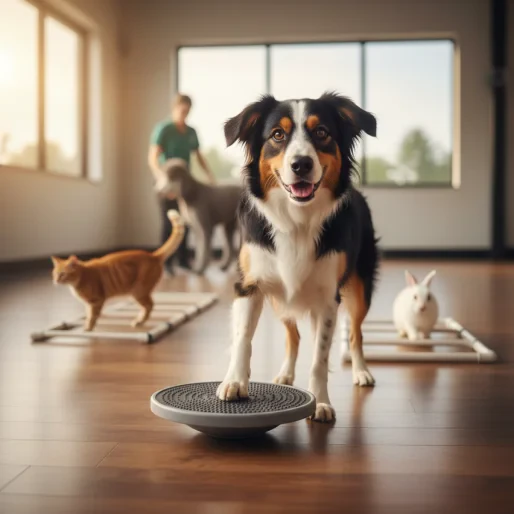
A wobble board is a flat platform mounted on a rounded or hemispherical base, creating an inherently unstable surface. When a dog stands on one, the board tilts unpredictably, forcing the dog to make constant micro-adjustments through its core, shoulders, hips, and all four limbs.
This continuous adjustment engages the deep stabiliser muscles, particularly the multifidus along the spine and the smaller muscles surrounding the stifle (knee) and hock joints, that are difficult to target through regular exercise like walking or running.
Getting Started Safely
Professional consensus suggests a gradual introduction. The following progression is commonly recommended by canine rehabilitation therapists:
- Phase 1 (Days 1 to 3): Place the wobble board on a carpet or mat so it barely moves. Lure the dog onto the board with treats. Reward any paw placement on the surface. Sessions should last no more than 2 to 3 minutes.
- Phase 2 (Days 4 to 7): Allow slight movement of the board. Encourage the dog to stand with all four paws on the board for 5 to 10 seconds. Gradually extend the duration.
- Phase 3 (Weeks 2 to 4): Remove the stabilising mat. Allow the board to tilt freely. Ask for head turns, gentle weight shifts, and brief three-legged stands (lifting one paw with a treat lure).
- Phase 4 (Ongoing): Introduce more dynamic challenges such as treat tosses that require the dog to shift weight while maintaining balance, or combine with sit-to-stand transitions on the board.
Dogs should never be forced onto wobble boards. If a dog shows signs of stress, such as lip licking, whale eye, or attempting to jump off repeatedly, the difficulty should be reduced or the session ended. Positive reinforcement is essential throughout.
Cavaletti Poles: Precision Foot Placement and Stride Awareness
The Science of Ground Pole Work
Cavaletti poles (low horizontal bars set at regular intervals on the ground) require dogs to consciously lift each limb higher than normal and place it precisely between poles. This engages proprioceptive pathways intensely because the dog must judge distance, height, and timing with each stride.
Studies in equine and canine rehabilitation have shown that ground pole exercises increase joint range of motion, particularly in the hip and shoulder, while also improving awareness of hind limb placement. Many dogs naturally have weaker proprioceptive awareness in their hind legs compared to their front legs, and cavaletti work directly addresses this imbalance.
Setting Up Cavaletti Exercises
Pole spacing depends on the dog's size and stride length. A common guideline is to start with poles spaced roughly one body length apart (measured from shoulder to base of tail) for a walking pace, then adjust based on the individual dog's comfort.
- Walking pace: Poles at one body length apart, set flat on the ground or raised 2 to 5 centimetres. This teaches deliberate foot placement.
- Trotting pace: Poles spaced at approximately 1.5 body lengths. The trot naturally demands greater proprioceptive engagement because diagonal limb pairs must coordinate precisely.
- Elevated cavaletti: Raising poles to fetlock height (the equivalent of ankle height for dogs) increases the demand on hip flexors and core stabilisers. This level should only be introduced after several weeks of ground-level work.
Three to five passes over a set of four to six poles constitutes a reasonable session. Owners commonly report that dogs appear more focused and mentally tired after cavaletti work than after a similar duration of free walking, reflecting the cognitive demand of proprioceptive processing.
Body Awareness Drills: Expanding the Training Toolkit
Weight Shifting Exercises
Weight shifting can be practised on stable ground by gently guiding a dog's balance point forward, backward, and side to side using treat lures. The goal is to bring the dog to the edge of its balance without causing it to step. This builds the stabiliser muscles and trains rapid corrective responses.
Backing Up on Command
Walking backward is an underappreciated proprioceptive exercise. Dogs rarely move in reverse during daily life, so backing up forces heightened awareness of hind limb position. Practising this in a narrow corridor (such as between a wall and a piece of furniture) increases precision. Start with one or two steps and gradually build to longer distances.
Surface Variety Training
Walking across different textures and surfaces, such as grass, gravel, sand, rubber mats, and foam pads, provides varied sensory input to the mechanoreceptors. Veterinary rehabilitation guidelines often recommend "sensory trails" that combine multiple surfaces in sequence. This type of training is particularly beneficial for urban dogs who primarily walk on pavement and may have limited proprioceptive adaptability.
Targeted Limb Lifts
Asking a dog to hold a paw in a "shake" or "high five" position while standing engages the proprioceptive system of the three supporting limbs. This is a simple but effective exercise that can be integrated into daily training routines. Duration should be kept short (3 to 5 seconds per lift) and built up gradually.
Which Dogs Benefit Most from Proprioceptive Training?
While all dogs can benefit from proprioceptive work, certain populations gain the most:
- Senior dogs: Age-related proprioceptive decline is well documented in veterinary literature. Dogs over seven years often show subtle changes in foot placement and balance. Regular proprioceptive exercises may slow this decline and help maintain mobility and confidence. Complementary approaches such as canine massage therapy can further support ageing joints.
- Post-surgical patients: Dogs recovering from cruciate ligament repair, spinal surgery, or fracture fixation typically undergo proprioceptive retraining as part of formal rehabilitation. After a period of disuse or immobilisation, the neural pathways controlling the affected limb require targeted stimulation to regain normal function.
- Sporting and working dogs: Dogs involved in agility, flyball, herding, or search and rescue face high proprioceptive demands. Proactive balance training can reduce the risk of soft tissue injuries and improve competitive performance. Owners of high-energy working breeds should consider proprioceptive exercises as part of a comprehensive fitness programme.
- Puppies (with caution): Gentle proprioceptive exposure during the socialisation period (roughly 3 to 16 weeks) can build a foundation of body awareness. However, exercises must be age-appropriate. Wobble boards and cavaletti poles should be very low, sessions extremely brief, and the emphasis always on positive experiences rather than physical challenge. For guidance on recognising when a puppy needs veterinary attention during any training programme, see this guide on puppy emergencies.
- Overweight dogs: Excess weight places additional strain on joints and can impair proprioceptive accuracy. Low-impact balance exercises offer a way to build strength and coordination without the joint stress of running or jumping. Nutritional considerations, particularly during warmer months, are also important; this nutrition guide provides practical advice.
What the Research Says About Injury Prevention
While large-scale randomised controlled trials specific to canine proprioception are still limited, the available evidence is encouraging. Veterinary rehabilitation literature consistently reports that proprioceptive training reduces re-injury rates in post-surgical patients and improves functional outcomes in dogs with degenerative joint disease.
A growing body of case series and clinical reports from veterinary teaching hospitals suggests that dogs undergoing structured proprioceptive rehabilitation after cranial cruciate ligament surgery return to full weight-bearing faster and demonstrate more symmetrical gait patterns compared to dogs receiving exercise restriction alone.
In the sporting dog population, trainers and veterinary sports medicine practitioners widely report that dogs with regular proprioceptive conditioning experience fewer soft tissue injuries over competitive seasons. While controlled studies are needed to quantify this effect precisely, the mechanistic rationale is strong: improved neuromuscular response times logically reduce the likelihood of awkward landings, missteps, and joint hyperextension.
Recognising Proprioceptive Deficits in Your Dog
Owners can watch for several signs that may indicate reduced proprioceptive function:
- Knuckling: The dog folds its paw under and walks on the top of the foot, even briefly. This is one of the earliest and most reliable signs of proprioceptive impairment.
- Stumbling or tripping: Especially on uneven ground or when transitioning between surfaces.
- Scuffing nails: Excessive nail wear on the top of the toes can indicate that a dog is dragging its feet.
- Difficulty with stairs: Hesitation, misjudging steps, or placing both hind feet on the same step.
- Slow correction of paw placement: A simple test used in veterinary neurological examinations involves gently turning the dog's paw so it rests on its knuckles. A dog with normal proprioception will immediately flip it back. Delayed correction (more than one to two seconds) may suggest a deficit.
- Crossing legs or wide stance: Unusual limb positioning during standing or walking.
It is important to note that proprioceptive deficits can be caused by a range of conditions, from mild age-related degeneration to serious spinal cord disease. Any sudden onset or rapid worsening of these signs warrants prompt veterinary evaluation.
When to See Your Vet and What to Ask
Veterinary consultation is recommended before beginning proprioceptive exercises if a dog has any of the following: known joint disease (such as hip dysplasia or elbow dysplasia), a history of spinal problems (including intervertebral disc disease), recent surgery, neurological symptoms, or significant obesity.
During the consultation, helpful questions include:
- "Has my dog's neurological examination revealed any proprioceptive deficits?"
- "Are there specific exercises that would be most beneficial, or any that should be avoided, given my dog's condition?"
- "Would my dog benefit from a formal rehabilitation programme with a certified canine rehabilitation therapist?"
- "How frequently should we reassess progress?"
Dogs showing sudden knuckling, dragging of limbs, loss of coordination, or incontinence should be seen by a veterinarian urgently, as these may indicate spinal cord compression or other neurological emergencies.
Building a Weekly Proprioceptive Programme
For a healthy adult dog cleared by a veterinarian, a balanced weekly programme might include:
- Monday, Wednesday, Friday: Wobble board sessions (5 to 8 minutes each), focusing on static balance holds progressing to dynamic weight shifts.
- Tuesday, Thursday: Cavaletti pole work (5 to 10 minutes each), alternating between walking and trotting pace.
- Daily: Brief body awareness drills incorporated into regular training sessions, such as backing up, targeted limb lifts, or surface variety walks.
- Rest days: At least one to two days per week should be free of structured proprioceptive work to allow neuromuscular recovery.
Professional consensus emphasises that proprioceptive exercises should always be performed when the dog is fresh, not fatigued. A tired dog has slower reaction times and diminished motor control, which increases injury risk and reduces the training benefit.
For dogs attending daycare programmes, it is worth discussing with the facility whether proprioceptive enrichment activities are incorporated into the daily routine.
Equipment Considerations
Proprioceptive training does not require expensive equipment. Many exercises can be performed with household items:
- A firm couch cushion placed on the floor serves as a basic unstable surface.
- Broomsticks or PVC pipes laid on the ground work as cavaletti poles.
- Rolled towels taped to the floor create low obstacles for stepping practice.
- Different textured mats (rubber, carpet, foam) provide surface variety.
Purpose-built canine balance equipment, including wobble boards, inflatable balance discs, and adjustable cavaletti sets, is available from veterinary rehabilitation suppliers. When purchasing equipment, look for non-slip surfaces, appropriate weight ratings for the dog's size, and durable construction.
Safety Precautions
- Always supervise proprioceptive exercises. Never leave a dog unattended on unstable equipment.
- Work on non-slip flooring. Hardwood or tile floors increase the risk of slipping and can cause injury or erode the dog's confidence.
- Stop immediately if the dog shows signs of pain, such as vocalising, limping, or refusing to continue.
- Progress gradually. Advancing too quickly is the most common mistake and can lead to muscle strain or joint stress.
- Keep sessions short and positive. Quality of engagement matters far more than duration.
Frequently Asked Questions
Content Disclosure
This article was created using state-of-the-art AI models with human editorial oversight. It is intended for informational and entertainment purposes only and does not constitute veterinary medical advice. Always consult a licensed veterinarian for your pet's specific health needs. Learn more about our process.