
In this article
- Key Takeaways
- Why Home Physiotherapy Matters for Arthritic Cats
- Before You Start: Essential Preparation
- Warm Compress Techniques: Step by Step
- Gentle Range of Motion Stretches: Step by Step
- What to Watch for During and After Sessions
- Environmental Modifications That Reduce Joint Strain
- Building a Weekly Routine
- When to Call Your Vet Immediately
- Managing the Ongoing Costs
- Final Thoughts
Key Takeaways
- Always get a veterinary diagnosis before beginning any home physiotherapy routine.
- Warm compresses applied for 5 to 10 minutes before stretching help relax stiff joints and reduce discomfort.
- Gentle range of motion (ROM) exercises should last only 2 to 5 minutes per session, once or twice daily.
- Stop immediately if the cat vocalises, hisses, tries to bite, or pulls away sharply.
- Environmental modifications (ramps, raised bowls, low litter trays) often deliver as much relief as hands on therapy.
- Home physiotherapy supports veterinary treatment; it does not replace it.
Why Home Physiotherapy Matters for Arthritic Cats
Osteoarthritis (often shortened to OA) is a progressive condition in which the cartilage cushioning a joint gradually breaks down. According to veterinary literature, a significant proportion of cats over the age of 12 show radiographic signs of degenerative joint disease, even when outward symptoms seem mild. Because cats are experts at hiding pain, many owners only notice something is wrong when their cat stops jumping onto a favourite windowsill or begins avoiding the litter tray.
Veterinary treatment typically includes pain management, weight control, and sometimes nutraceutical supplements. Home physiotherapy sits alongside those strategies. Professional consensus suggests that regular, gentle movement helps maintain joint flexibility, supports muscle tone around affected joints, and can improve a cat's overall quality of life. The goal is never to push through pain; it is to preserve comfortable movement for as long as possible.
Before You Start: Essential Preparation
Step 1: Get Veterinary Clearance
This cannot be overstated. A veterinarian needs to confirm the arthritis diagnosis, rule out fractures, tumours, or other conditions, and advise on appropriate pain relief. Some joints may be too inflamed for passive stretching, and certain medications affect how a cat responds to handling. Never begin a physiotherapy routine without professional guidance first.
Step 2: Gather Your Supplies
Keeping everything within arm's reach makes sessions calmer for both parties. A typical home kit includes:
- A clean, soft towel or small blanket to create a non slip, padded surface.
- A warm compress: a microwaveable wheat bag, a damp flannel heated in the microwave, or a hot water bottle wrapped in a towel. The surface temperature should feel comfortably warm on the inside of your wrist, never hot.
- High value treats that the cat enjoys, ideally small and soft so they can be eaten quickly.
- A timer or phone to track compress and stretching durations.
- A simple notebook to log session dates, duration, the cat's response, and any changes you notice over time.
Step 3: Choose the Right Moment
Most owners find sessions work best when the cat is already relaxed but awake, often after a nap or a light meal. Trying to stretch a cat that is anxious, playful, or hungry rarely goes well. Mornings can be a good choice because joint stiffness tends to be most noticeable after a long rest period, and gentle therapy can ease the cat into the day.
Warm Compress Techniques: Step by Step
Applying warmth to stiff joints before any stretching is a cornerstone of physiotherapy practice. Heat increases blood flow to the area, relaxes surrounding muscles, and can reduce the sensation of stiffness. Veterinary physiotherapy guidelines recommend moist heat over dry heat wherever possible, as it penetrates tissue more effectively.
How to Apply a Warm Compress
- Prepare the compress. If using a damp flannel, wet it with warm water, wring it out, and heat it in the microwave for 15 to 30 seconds. If using a wheat bag, follow the manufacturer's instructions. Always test the temperature on the inside of your wrist first.
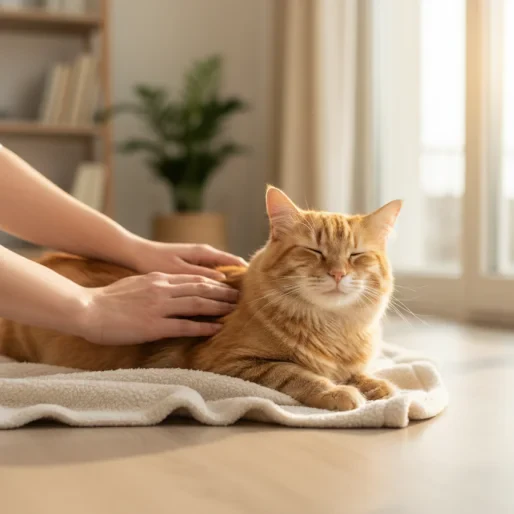
- Settle the cat. Place the cat on the padded towel in a quiet room. Spend a minute or two stroking gently so the cat feels at ease.
- Apply the compress. Lay it gently over the target joint (commonly the hips, knees or stifles, elbows, or lower spine). Do not press down. The weight of the compress itself is usually sufficient.
- Hold for 5 to 10 minutes. If the cat shifts away, reposition the compress without forcing. If the cat consistently moves away, try a lighter, smaller compress or simply use your warm hands cupped over the joint.
- Check the skin underneath every 2 to 3 minutes. The skin should feel warm and pink, not red or hot. Remove the compress immediately if you see redness or if the cat shows discomfort.
- Reward the cat. Offer a small treat and some calm praise once the compress session ends.
Important safety note: Never apply a compress directly from the microwave without testing it. Hot spots can develop unevenly in microwaved materials. Owners commonly report that their cat tolerates warmth better when the compress is wrapped in an extra layer of thin fabric.
Gentle Range of Motion Stretches: Step by Step
Range of motion exercises involve slowly moving a joint through its natural arc of movement. The purpose is to maintain flexibility and lubricate the joint with synovial fluid (the body's natural joint lubricant). These are passive exercises, meaning the owner moves the limb while the cat stays relaxed.
General Principles
- Work on one limb at a time.
- Keep sessions short: 2 to 5 minutes total, especially in the first week.
- Move slowly and smoothly. Jerky movements cause pain and erode trust.
- Never force a joint past the point where you feel resistance.
- If the cat tenses, pauses, vocalises, or tries to pull away, stop that stretch and move on or end the session.
Hind Limb Flexion and Extension (Hips and Stifles)
Hind limb arthritis is among the most common presentations in senior cats. This exercise targets the hip and stifle (knee) joints.
- With the cat lying on its side on the padded surface, support the upper hind leg by placing one hand gently under the thigh and the other around the lower leg just above the hock (ankle).
- Slowly and gently flex the leg, bringing the knee toward the cat's body. Move only as far as the joint travels without resistance.
- Hold for 2 to 3 seconds at the end of the comfortable range.
- Slowly extend the leg back out to a relaxed, natural position.
- Repeat 3 to 5 times per leg, then switch sides.
Forelimb Flexion and Extension (Elbows and Shoulders)
- With the cat in the same side lying position, support the forelimb by cradling the elbow with one hand and holding the paw gently with the other.
- Slowly flex the elbow, bringing the paw toward the shoulder.
- Hold for 2 to 3 seconds at the comfortable end range.
- Slowly extend the leg forward again.
- Repeat 3 to 5 times per leg.
Gentle Spinal Mobilisation
Many arthritic cats develop stiffness along the lumbar spine (lower back). A very gentle technique involves:
- With the cat in a relaxed standing or sternal (chest down) position, place your palm flat along the cat's lower back.
- Using minimal pressure, make slow, small circular motions with your fingertips along the muscles either side of the spine. This is more of a massage than a stretch.
- Continue for 30 to 60 seconds, watching the cat's body language closely.
Never press directly on the spine itself. Work on the muscles alongside it. If the cat flinches, dips away from your hand, or the skin twitches repeatedly, reduce pressure or stop.
Paw and Toe Flexion
Arthritic cats sometimes develop stiffness in the small joints of the toes, which can affect their grip on surfaces. Gently flexing and extending each toe for a second or two during a session can help maintain mobility. This is also a useful time to check claw length, as senior cats often lose the ability to retract claws fully, and overgrown claws can curl into paw pads.
What to Watch for During and After Sessions
Positive Signs
- The cat relaxes, purrs, or falls asleep during the session.
- The cat appears more mobile or willing to move in the hours following therapy.
- Over several weeks, the cat's willingness to be handled during sessions increases.
Warning Signs: Stop and Reassess
- Vocalising (meowing, growling, hissing) during stretches.
- Sudden muscle tension or guarding (the cat stiffens the limb to prevent movement).
- Attempting to bite or scratch.
- Swelling, heat, or redness around a joint that was not present before the session.
- Limping that worsens after sessions rather than improving over time.
It is normal for a cat to be slightly uncertain during the first few sessions. Most owners struggle with positioning the first time, and that is completely expected. Building trust takes patience, and keeping sessions very short at the beginning (even just 1 to 2 minutes) helps the cat associate the routine with treats and gentle attention rather than discomfort.
Environmental Modifications That Reduce Joint Strain
Adjusting the home environment is one of the most impactful and often overlooked strategies for managing feline arthritis. These changes require no special skill and can make an immediate difference.
Access and Mobility
- Ramps and pet steps: Place them beside beds, sofas, and favourite window perches. Carpeted ramps provide better traction than smooth surfaces.
- Low sided litter trays: A tray with an entry point no higher than about 5 cm (roughly 2 inches) eliminates the need to climb over a high wall. Some owners repurpose shallow baking trays or storage container lids.
- Non slip surfaces: Scatter rugs or yoga mats on slippery floors (tile, hardwood, laminate) along the cat's regular routes. Arthritic cats lose confidence on slick surfaces and may stop moving altogether.
Comfort and Warmth
- Heated beds or pads: Low wattage pet heating pads placed inside a favourite bed can soothe aching joints. Always ensure the cat can move away from the heat source.
- Raised food and water bowls: Elevating bowls to chest height reduces the need to bend the neck and flex sore forelimbs or spine. Bowls raised roughly 5 to 10 cm work well for most cats.
- Padded bedding in multiple locations: Arthritic cats benefit from having comfortable resting spots in every room they frequent, so they do not have to travel far to lie down.
Enrichment Without Strain
Arthritis does not eliminate a cat's need for mental stimulation. Puzzle feeders placed at ground level, gentle interactive play with a feather wand (keeping movements low and slow), and window perches with easy ramp access all keep a senior cat engaged without stressing fragile joints. For owners who travel, automated enrichment options can help maintain routine; the guide on smart cat feeders for weekend trips covers timed feeding solutions in more detail. When selecting any daycare or boarding facility for an arthritic cat, it is also worth reviewing whether they offer genuine enrichment suited to seniors, as discussed in the article on choosing a cat daycare with real enrichment.
Building a Weekly Routine
Consistency matters more than intensity. A practical weekly plan might look like this:
- Daily: Warm compress for 5 to 10 minutes on the most affected joints, followed by 2 to 5 minutes of gentle ROM stretches.
- Every other day: Gentle spinal massage for 1 to 2 minutes.
- Weekly: Check claw length, assess mobility (can the cat still reach the litter tray, food bowls, and resting spots comfortably?), and note any changes in your log.
Veterinary physiotherapy professionals generally recommend reassessing the programme with a veterinarian every 4 to 8 weeks, or sooner if the cat's condition changes.
When to Call Your Vet Immediately
Home physiotherapy is a supportive measure, not a cure. Contact a veterinarian promptly if any of the following occur:
- Sudden inability to bear weight on one or more legs.
- Noticeable swelling, heat, or redness in any joint.
- The cat stops eating, drinking, or using the litter tray.
- Behavioural changes such as hiding, aggression when touched, or vocalising when moving.
- Any new lameness or a significant worsening of existing symptoms.
- Loss of bladder or bowel control, which may indicate a neurological issue rather than simple arthritis.
These signs may indicate a flare up, a secondary injury, or a condition that requires diagnostic imaging and adjusted medication. Prompt veterinary assessment is always the safest course of action.
Managing the Ongoing Costs
Caring for a senior cat with arthritis involves ongoing expenses: veterinary check ups, potential medications, supplements, and environmental modifications. Owners planning their budget may find it helpful to review the breakdown in the true monthly cost of owning a cat in 2026, which includes a section on senior cat healthcare spending.
Final Thoughts
Helping an arthritic senior cat stay comfortable and mobile does not require expensive equipment or advanced training. Warm compresses, gentle stretches performed with patience and consistency, and thoughtful changes to the home environment can meaningfully improve a cat's daily comfort. The most important ingredients are observation, gentleness, and a willingness to follow the cat's lead. When the cat says stop, the session is over. When progress stalls or symptoms worsen, the veterinarian steps back in. With that balance, home physiotherapy becomes a powerful complement to professional care.
Frequently Asked Questions
Content Disclosure
This article was created using state-of-the-art AI models with human editorial oversight. It is intended for informational and entertainment purposes only and does not constitute veterinary medical advice. Always consult a licensed veterinarian for your pet's specific health needs. Learn more about our process.