A science-based framework for structuring rotating activity stations, breed-appropriate play groups, and rest periods at dog daycare during spring. This guide helps staff prevent overstimulation through scent work integration and behavioural monitoring.
Key Takeaways
- Overstimulation in daycare settings results from trigger stacking: accumulated arousal that exceeds a dog's ability to self-regulate.
- A well-designed spring schedule rotates activity stations every 20 to 30 minutes with mandatory rest intervals at a ratio of roughly 1:1 (active to rest).
- Breed-appropriate play groups reduce conflict by matching arousal styles rather than size alone.
- Scent work stations provide cognitive enrichment that lowers cortisol without raising physical arousal.
- Staff trained to read early behavioural stress cues can intervene before escalation occurs.
Why Overstimulation Is the Root Problem in Dog Daycare
Overstimulation in a daycare context is not simply excitement taken too far. It represents a neurobiological state in which the sympathetic nervous system remains activated beyond a dog's capacity to return to baseline. The Fear, Anxiety, and Stress (FAS) scale used by Fear Free certified professionals describes escalating arousal from mild alertness (FAS 1) through moderate stress (FAS 3) to full panic or aggression (FAS 5). In a poorly structured daycare, dogs can progress through these stages without any single dramatic event because of trigger stacking: the cumulative effect of multiple low-level stressors occurring in sequence without recovery time.
Spring introduces specific challenges. Warmer weather brings more enrolments, higher energy levels after sedentary winters, increased environmental stimuli (pollen, insects, birdsong), and longer daylight hours that shift circadian arousal patterns. A schedule designed for winter attendance simply cannot accommodate the sensory load of a spring day without modification.
Is Arousal Normal? When Does It Become a Problem?
Play arousal is entirely normal and beneficial. Appropriate play promotes social learning, cardiovascular health, and emotional resilience. The distinction between healthy arousal and overstimulation lies in the dog's ability to de-escalate. A well-regulated dog can interrupt play voluntarily, respond to social signals from other dogs, and return to a calm state within seconds of disengagement.
Overstimulation becomes problematic when dogs exhibit:
- Inability to disengage from play despite fatigue cues (heavy panting, glazed eyes)
- Escalating roughness, body-slamming, or persistent mounting
- Hyper-vigilance and scanning rather than fluid movement
- Redirected nipping at staff or inanimate objects
- Vocalisation that shifts from play barks to high-pitched, repetitive alarm barking
Research referenced by the International Association of Animal Behavior Consultants (IAABC) suggests that cortisol levels remain elevated for 48 to 72 hours after a significantly stressful event. A dog sent home in a hyper-aroused state may display reactivity, sleep disruption, or gastrointestinal upset for days afterward.
Environmental and Social Triggers in Spring
Increased Enrolment Density
More dogs per square metre directly increases competition for resources (water bowls, shade, staff attention) and raises ambient noise. Professional guidelines from Fear Free Pets recommend a minimum of 70 to 100 square feet of indoor space per dog, with outdoor areas offering significantly more.
Seasonal Sensory Load
Fresh-cut grass, flowering plants, increased insect activity, and open windows all add olfactory and visual stimulation that does not exist in winter. While many dogs find these enriching in moderation, the compounding effect alongside social stimulation can push sensitive individuals past threshold.
Returning Dogs with Reduced Fitness
Dogs that attended less frequently during winter may have reduced physical stamina and weakened social skills. They fatigue faster but may also be more socially uncertain, a combination that increases conflict risk. Facilities may wish to review each dog's spring fitness readiness before resuming full-day attendance.
The Rotating Activity Station Model
A rotation-based schedule prevents the monotony that leads to self-created (often inappropriate) stimulation and also limits the duration of any single arousal source. The following framework is structured around a standard eight-hour daycare day (7:30 AM to 3:30 PM).
Station Types
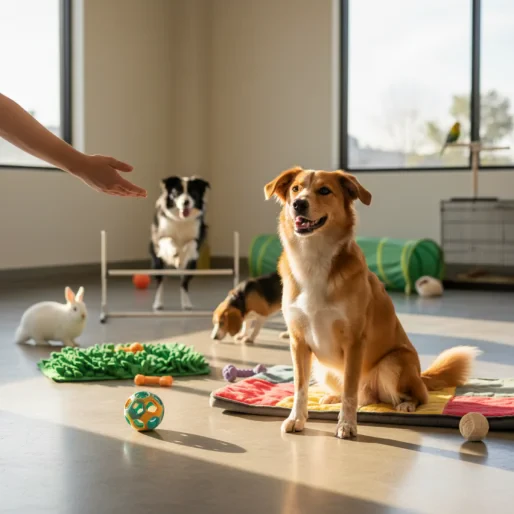
- Free play station: Supervised off-leash social play in appropriately matched groups.
- Structured movement station: Staff-led activities such as obstacle courses, recall games, or spring-themed agility (low jumps, tunnels).
- Scent work station: Nose-based enrichment including treat-finding puzzles, snuffle mats, and scent trails.
- Calm enrichment station: Food-dispensing toys (frozen stuffed Kongs, lick mats), gentle handling practice, or quiet background music (classical or reggae, as referenced in canine auditory enrichment literature).
- Rest station: Individual crates or partitioned resting areas with visual barriers.
Sample Rotation Schedule
Each group rotates through stations in 25-minute blocks with 5-minute transition periods (leashing, short decompression walk between areas):
- 7:30 to 8:00: Arrival, individual greeting, calm enrichment (settling period)
- 8:00 to 8:30: Free play (Group A) / Scent work (Group B) / Rest (Group C)
- 8:30 to 9:00: Rotate positions
- 9:00 to 9:30: Rotate again so each group has visited all three stations
- 9:30 to 10:00: Universal rest period (all groups)
- 10:00 to 10:30: Structured movement (Group A) / Calm enrichment (Group B) / Free play (Group C)
- 10:30 to 11:00: Rotate
- 11:00 to 11:30: Rotate
- 11:30 to 12:30: Extended midday rest (all groups, minimum 45 minutes quiet)
- 12:30 to 1:00: Scent work (all groups, low-arousal re-entry)
- 1:00 to 2:30: Afternoon rotation block (same structure as morning)
- 2:30 to 3:00: Universal wind-down (calm enrichment, individual settling)
- 3:00 to 3:30: Pickup period
This structure provides approximately 3.5 hours of active engagement and 3.5 hours of rest or low-arousal activity across the day, achieving the recommended 1:1 ratio.
Breed-Appropriate Play Groups
Grouping dogs solely by size is a common but inadequate approach. Behavioural research supports grouping by arousal style and play type:
Group Profiles
- Chase and wrestle group: Herding breeds, terriers, and sporting breeds that favour high-speed, body-contact play. These dogs typically match well when similarly sized and conditioned.
- Parallel play group: Breeds or individuals that prefer proximity without sustained direct interaction (many guardian breeds, older dogs, brachycephalic breeds with reduced exercise tolerance).
- Gentle social group: Toy breeds, senior dogs, dogs in post-surgical recovery (those cleared for light socialisation), and dogs with lower confidence. Related: dogs recovering from joint surgery may benefit from this lower-intensity group.
- Solo enrichment track: Dogs that thrive on cognitive challenges but find group play stressful. These individuals rotate through scent work and calm enrichment stations with minimal group exposure.
Assessment Protocol
Every dog entering the spring schedule should undergo a brief behavioural assessment noting: play style preference, arousal recovery speed, resource guarding triggers, and known sensitivities. Dogs new to the facility, particularly recently adopted shelter dogs in their adjustment period, warrant a graduated introduction over several half-days before full scheduling.
Rest Period Ratios: The Science Behind Downtime
Rest is not wasted daycare time; it is essential neurobiological recovery. During sleep and quiet rest, the canine brain consolidates social learning, cortisol levels normalise, and muscles repair from physical exertion. Studies in canine welfare science consistently associate insufficient rest in group housing with increased aggression, stereotypic behaviour, and immune suppression.
Professional consensus suggests:
- Minimum 1:1 ratio of active time to rest time for adult dogs
- Minimum 2:1 rest-to-active ratio for puppies under 12 months
- Minimum 2:1 rest-to-active ratio for senior dogs (typically 7 years and older, breed-dependent)
- At least one extended rest block of 45 to 60 minutes midday
- Individual resting spaces with visual barriers to prevent social vigilance during rest
Dogs that cannot settle during rest periods may need assessment for separation distress, generalised anxiety, or insufficient physical exercise outside daycare. Facilities should communicate with owners about senior dogs showing cognitive changes that affect their ability to rest in group settings.
Scent Work Integration: Lowering Arousal Through the Nose
Scent work is arguably the most valuable enrichment tool for preventing overstimulation because it engages the parasympathetic nervous system. When a dog shifts from visual/auditory scanning to deliberate olfactory investigation, heart rate and respiratory rate typically decrease. This makes scent work ideal as a transitional activity between high-arousal stations and rest.
Spring-Specific Scent Enrichment Ideas
- Scatter feeding in fresh grass (utilising natural spring growth)
- Herb garden stations with dog-safe plants (lavender, chamomile, mint) for exploratory sniffing
- Hidden treat trails along outdoor perimeters
- Snuffle mats with varied textures to increase search duration
- Scent discrimination games for advanced dogs (finding a specific target odour)
Implementation Guidelines
- Allow 15 to 25 minutes per scent session
- Limit group size to 3 to 4 dogs per scent station to prevent resource competition
- Supervise to ensure dogs are searching independently rather than guarding found resources
- Vary difficulty: simpler tasks early in the day when dogs are fresh, more complex tasks after physical activity when cognitive engagement helps decelerate arousal
Behavioural Cues Staff Should Monitor
The difference between a well-run daycare and a problematic one often comes down to staff observation skills. The following framework, aligned with the FAS scale and IAABC professional standards, provides a monitoring checklist.
Green Zone (FAS 0 to 1): Normal, Continue
- Loose, wiggly body posture
- Play bows and role reversals during interaction
- Voluntary disengagement and re-engagement
- Soft facial muscles, relaxed ears
- Comfortable eating, drinking, and eliminating
Yellow Zone (FAS 2 to 3): Caution, Prepare to Intervene
- Increased body tension, stilted movement
- Displacement behaviours: yawning, lip-licking, shaking off when dry
- Avoidance of previously enjoyed activities
- Hyper-vigilance, head on a swivel
- Play that becomes one-sided (one dog always on bottom or always chasing)
- Mounting that persists despite redirection
- Resource hovering near water bowls, shade, or staff
Red Zone (FAS 4 to 5): Immediate Intervention Required
- Hard stares, whale eye (visible sclera), closed mouth with tension
- Growling, snapping, or air-snapping
- Piloerection along spine or shoulders
- Trembling, cowering, or attempts to escape the enclosure
- Sudden stillness (freeze response) before lunging
- Redirected aggression toward staff
Staff Response Protocol
When yellow-zone behaviours are observed:
- Calmly redirect the dog to a lower-arousal station or initiate a brief leash walk
- Offer a food-dispensing toy or lick mat to activate parasympathetic calming
- Note the trigger context (which dogs were present, what preceded the behaviour)
- Consider whether the dog has exceeded appropriate active time and needs early rest rotation
When red-zone behaviours are observed:
- Separate dogs using physical barriers (baby gates, body blocking) rather than grabbing collars
- Move the affected dog to an isolated calm space with a food reward for settling
- Document the incident in detail for the behaviour log
- Contact the owner and, if patterns emerge, recommend consultation with a certified applied animal behaviourist or veterinary behaviourist
When to Consult a Certified Animal Behaviourist
Daycare staff are not behaviour therapists, and certain presentations exceed management-level intervention. A referral to a certified applied animal behaviourist (CAAB), board-certified veterinary behaviourist (DACVB), or IAABC-certified consultant is appropriate when:
- A dog shows escalating aggression across multiple sessions despite group adjustments
- Severe anxiety prevents a dog from eating, resting, or engaging in any enrichment
- Self-injurious behaviour (excessive licking, spinning, barrier frustration causing injury) is observed
- A dog's behaviour deteriorates significantly after daycare attendance, suggesting the environment is not appropriate for that individual
Facilities that maintain relationships with certified professionals demonstrate a commitment to welfare that owners should look for when evaluating daycare quality. Similarly, owners should verify that staff have appropriate training, much as one would check credentials for pet groomers. Facilities with proper insurance and bonding also signal professional accountability.
Putting It All Together: A Spring-Ready Facility
A daycare that prevents overstimulation does not eliminate stimulation. It structures stimulation deliberately, provides recovery opportunities proportional to arousal demands, matches dogs by behavioural compatibility rather than superficial traits, and empowers staff with the observational skills to intervene early. Spring, with its increased energy and sensory load, simply demands that these principles be applied with greater precision than quieter seasons require.
The core formula is straightforward: rotate, rest, observe, adjust. When every dog leaves daycare with a soft body, easy breathing, and the ability to settle at home within 30 minutes, the schedule is working. When dogs arrive home wired, restless, or reactive for hours afterward, the arousal load has exceeded their capacity, and the schedule needs recalibration.
Frequently Asked Questions
How long should dogs rest between activity stations at daycare? ↓
Why is grouping dogs by size alone insufficient for daycare play groups? ↓
What are early signs that a dog is becoming overstimulated at daycare? ↓
How does scent work help prevent overstimulation in daycare dogs? ↓

David Okafor
Certified Animal Behaviourist
Certified animal behaviourist — science-based strategies for fear, anxiety, reactivity, and behavioural challenges.
Content Disclosure
This article was created using state-of-the-art AI models with human editorial oversight. It is intended for informational and entertainment purposes only and does not constitute veterinary medical advice. Always consult a licensed veterinarian for your pet's specific health needs. Learn more about our process.