Cats in the UAE face extreme heat stroke risk from April through October, when temperatures regularly exceed 45°C. Learn how to spot the hidden signs, cool your cat safely, and reach emergency veterinary care across Dubai, Abu Dhabi, and Sharjah.
Key Takeaways for UAE Cat Owners
- UAE summers are life-threatening for cats. With outdoor temperatures regularly hitting 45°C to 50°C and coastal humidity exceeding 80%, heat stroke can develop in minutes, even indoors if air conditioning fails.
- Cats hide their distress. By the time a cat is panting or collapsed, internal temperatures may already exceed 40.5°C and organ damage can be underway.
- Cool slowly with tepid water, never ice. Apply room-temperature water to paw pads, ears, and groin. Stop active cooling at 39.4°C.
- Heat stroke always requires emergency veterinary care. Even a cat that appears recovered needs bloodwork to rule out kidney, liver, and clotting damage.
- AC failure is a leading cause. Power cuts and AC breakdowns during peak summer are a well-documented trigger for feline heat emergencies in the Gulf region.
Why UAE Cats Face Elevated Heat Stroke Risk
The United Arab Emirates presents one of the most extreme thermal environments on earth for companion animals. From April through October, daytime temperatures in Dubai, Abu Dhabi, and Sharjah routinely exceed 40°C, with July and August peaks approaching 50°C in inland areas. Coastal humidity compounds the danger: when relative humidity exceeds 70 to 80%, evaporative cooling (the primary mechanism cats rely on through saliva spreading and paw pad moisture) becomes drastically less effective.
Indoor cats are not exempt. A common and dangerous misconception is that cats kept inside UAE apartments or villas are safe from heat stroke. However, air conditioning failures, whether from power outages, mechanical breakdown, or thermostat malfunction, can cause indoor temperatures to climb above 35°C within an hour in a sealed, sun-facing apartment. During Ramadan or holiday periods, empty apartments with switched-off AC pose a particularly serious risk to cats left at home.
Cats popular in the UAE and wider Gulf region include Persians, Himalayans, and Exotic Shorthairs, all brachycephalic (flat-faced) breeds with compromised airways that make thermoregulation significantly harder. These breeds are at especially high risk during UAE summers.
Recognising Heat Stroke: Signs Cats Try to Hide
Early Signs (Often Missed)
- Restlessness followed by sudden lethargy or hiding in cool spots such as bathroom tiles, sinks, or under furniture
- Excessive grooming (saliva spreading is a feline cooling mechanism)
- Warm or hot ear tips and paw pads to the touch
- Seeking out tiled floors, bathtubs, or air conditioning vents
- Mild, intermittent open-mouth breathing
Moderate to Severe Signs (Emergency Stage)
- Sustained open-mouth panting (this is abnormal for cats at rest and always warrants concern)
- Brick-red or pale gums; capillary refill time greater than 2 seconds or under 1 second
- Drooling with thick or ropy saliva
- Staggering, disorientation, or inability to stand
- Vomiting or diarrhoea (may contain blood)
- Muscle tremors or seizures
- Collapse or unresponsiveness
Critical temperature thresholds: A rectal temperature above 40°C is concerning. Above 40.5°C, heat stroke is probable. Above 41.7°C, multi-organ damage becomes likely.
Immediate First Aid: What to Do in the Next 10 Minutes
Step 1: Move to a Cool Environment
Get the cat into an air-conditioned room immediately. In the UAE, most homes, offices, and vehicles have AC; use it at the coldest setting available. If the AC has failed, move the cat to the most shaded, ventilated room and use any available fans. If you are outdoors (for example, on a villa terrace or balcony), bring the cat inside without delay.
Step 2: Measure Core Temperature
Rectal temperature is the only reliable field measurement. Digital rectal thermometers designed for pets are available at veterinary clinics and pet supply stores across Dubai, Abu Dhabi, and Sharjah. Ear and forehead infrared devices are not accurate enough in emergencies to guide treatment.
- Lubricate the thermometer tip with water-based lubricant or petroleum jelly.
- Gently insert approximately 2 to 3 centimetres into the rectum.
- Hold the cat securely, using a towel wrap if needed. A second person helps.
- Record the temperature and the time. This information is critical for the emergency veterinary team.
Step 3: Begin Active Cooling (Tepid Water Method)
Apply room-temperature or slightly cool water (not cold, not from the refrigerator) to:
- Paw pads (high concentration of blood vessels near the surface)
- Inner ear flaps
- Groin and armpit areas
- Abdomen
Use soaked cloths, replacing them every 2 to 3 minutes. A cloth left in place acts as insulation and stops working. A fan directed at the dampened cat accelerates evaporative cooling. Important UAE note: tap water in summer months can run warm (above 35°C in some areas). If your tap water feels warm, use bottled water at room temperature from inside the home, not water stored in a hot garage or vehicle.
Step 4: Stop Active Cooling at 39.4°C
This step is critical. Stop all active cooling when the rectal temperature reaches 39.4°C. The body continues to cool after external efforts stop. Cooling past this point risks rebound hypothermia (core temperature dropping below 37.5°C), which creates cardiac arrhythmia and clotting risks.
Step 5: Offer Water, Never Force It
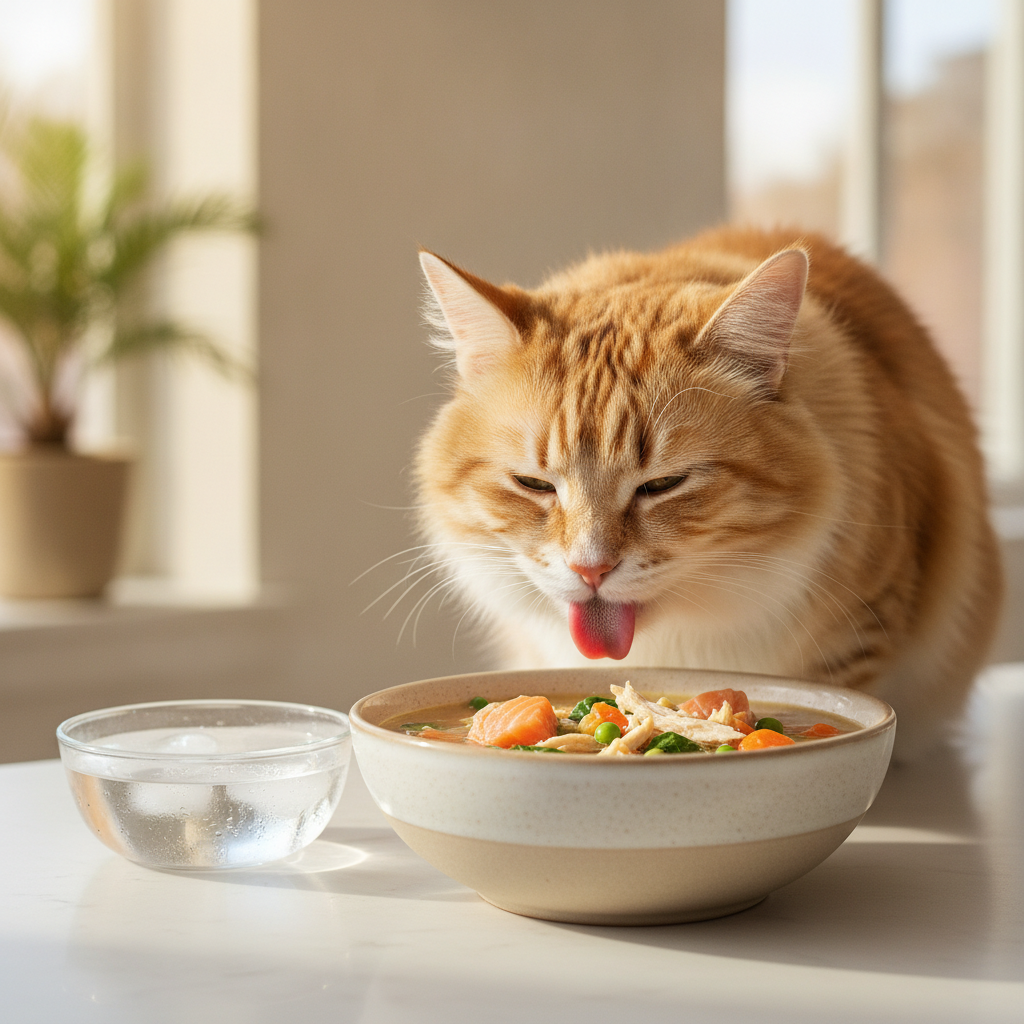
Place a small bowl of room-temperature water near the cat. Never pour water into the mouth of a disoriented or semiconscious animal due to aspiration risk.
Step 6: Transport to Emergency Veterinary Care
Even if the cat appears to improve, emergency veterinary evaluation is essential. Contact your nearest emergency veterinary clinic while en route.
Dubai Municipality Veterinary Services
Contact Dubai Municipality Veterinary Services or your nearest 24-hour emergency vet clinic.
In Abu Dhabi, contact ADAFSA. Several private clinics across the UAE offer 24-hour emergency services.
During transport, keep the vehicle AC on maximum. Place the cat in a well-ventilated carrier (avoid sealed plastic carriers with poor airflow). A damp towel under the cat provides continued mild evaporative cooling. If possible, have a passenger monitor the cat during the drive.
What NOT to Do
- Do not use ice, ice water, or frozen gel packs on the cat. Extreme cold triggers peripheral vasoconstriction, trapping heat in the core and paradoxically raising internal temperature.
- Do not submerge the cat in a cold bath. Rapid immersion can induce shock and cardiac arrhythmias.
- Do not leave wet towels in place. They warm quickly and become insulating layers. Replace or remove them frequently.
- Do not give paracetamol, aspirin, or any human medication. Paracetamol is lethal to cats even in small doses. Heat stroke is not a fever; antipyretics do not address it.
- Do not assume recovery means safety. Organ damage including acute kidney injury, liver necrosis, and disseminated intravascular coagulation (DIC) can progress silently for 24 to 72 hours after the initial event.
- Do not delay transport. Delayed presentation is one of the strongest negative prognostic indicators in veterinary heat stroke cases.
UAE-Specific Prevention: Year-Round Vigilance
Unlike temperate climates where heat stroke is a seasonal concern for a few weeks, UAE cat owners need to maintain heat awareness for roughly seven months of the year. The following precautions reflect the realities of life in the Emirates:
- AC maintenance is pet safety. Schedule AC servicing before summer begins (March or April). Consider a backup portable AC unit or at minimum a battery-operated fan in case of power failure.
- Never leave a cat in a parked vehicle. Interior car temperatures in the UAE can exceed 70°C within 30 minutes. This applies to short errands as well.
- Ensure multiple fresh water stations. Place water bowls in several rooms. Some cats prefer running water; a pet water fountain (available at pet stores across Dubai, Abu Dhabi, and Sharjah, typically 50 to 150 AED) can encourage hydration.
- Close blinds during peak sun hours. South and west-facing windows in UAE apartments can create localised hot zones even with AC running.
- Villa cats with outdoor access: Restrict outdoor time to early morning (before 7 AM) and late evening (after 7 PM) from May through September. Sand and concrete surfaces can cause paw pad burns in addition to heat stroke risk.
- Monitor cats during holiday travel. If leaving your cat with a pet sitter or boarding facility, confirm that AC will be running continuously. UAE animal welfare regulations under the Ministry of Climate Change and Environment (MOCCAE) support the protection of animal welfare, and boarding facilities should maintain appropriate thermal environments.
- Brachycephalic breeds need extra care. Persians, Himalayans, and Exotic Shorthairs, among the most popular breeds in the region, should be kept in the coolest room during extreme heat days.
What to Tell the Vet on Arrival
Emergency veterinary teams follow structured triage protocols. Provide the following clearly and quickly:
- Estimated duration of heat exposure
- Highest rectal temperature recorded and the time it was taken
- All cooling measures performed and their duration
- Most recent temperature reading
- Any vomiting, diarrhoea, seizures, or loss of consciousness observed
- The cat's age, breed, weight (in kg), and any pre-existing conditions
- Current medications and supplements
- MOCCAE-registered microchip number if available (helps the vet access medical history)
Recovery at Home After Veterinary Discharge
- Keep the home at 20 to 22°C for at least one to two weeks post-discharge.
- Limit activity: no outdoor access, no jumping to high surfaces, and no vigorous play until veterinary clearance.
- Monitor appetite, water intake, litter box output, and behaviour. Any decline warrants an immediate recheck.
- Administer prescribed medications exactly as directed. Do not skip follow-up appointments; delayed organ failure is a documented risk.
- A cat that has experienced one heat stroke episode may have permanently impaired thermoregulation, increasing future risk at lower temperatures.
Understanding Organ Damage After Heat Stroke
Heat stroke is a systemic inflammatory event. When core temperature exceeds approximately 41°C for a sustained period, a cascade of damage begins affecting the kidneys (acute tubular necrosis), liver (hepatocellular damage peaking 24 to 48 hours later), gastrointestinal tract (bacterial translocation potentially triggering sepsis), coagulation system (DIC), and brain (cerebral oedema). The veterinary team will typically perform a complete blood count, serum biochemistry, coagulation panel, and urinalysis, with repeated monitoring over 48 to 72 hours.
FELINE HEAT STROKE: EMERGENCY ACTION CARD
IF YOUR CAT IS PANTING AT REST, STAGGERING, OR COLLAPSED IN HEAT: ACT NOW
- MOVE the cat to an air-conditioned room immediately.
- TEMPERATURE: Take rectal temperature. Above 40°C = emergency.
- COOL with tepid water on paw pads, ears, groin, and armpits. Use a fan. Replace wet cloths every 2 to 3 minutes.
- NO ICE. NO cold water. NO human medications (paracetamol is lethal to cats).
- STOP cooling at 39.4°C. Temperature will keep dropping on its own.
- OFFER water but never force it into the mouth.
- CALL your emergency vet and transport immediately with AC on maximum.
- TELL THE VET: Highest temperature recorded, time of onset, cooling steps taken, any vomiting or seizures, cat's medical history and microchip number.
Emergency Vet Clinic: ___________________
Phone: ___________________
Dubai Municipality Veterinary Services
Contact Dubai Municipality Veterinary Services or your nearest 24-hour emergency vet clinic.
In Abu Dhabi, contact ADAFSA. Several private clinics across the UAE offer 24-hour emergency services.
MOCCAE Animal Welfare: ___________________
Disclaimer: This guide is produced by an AI-generated veterinary content specialist and is for educational purposes only. It does not replace consultation with a licensed emergency veterinarian. If your cat shows any signs of heat stroke, contact an emergency veterinary clinic immediately.
Frequently Asked Questions
How quickly can a cat develop heat stroke in UAE summer conditions? ↓
Is tap water in the UAE too warm to cool a cat with heat stroke? ↓
Are Persian cats more prone to heat stroke in the UAE? ↓
What should I do if my AC breaks during summer and I have cats at home? ↓
Do I still need to take my cat to the vet if they seem fine after cooling down? ↓

Dr. Ana Reyes
Emergency & Critical Care Veterinarian
Emergency and critical care veterinarian — life-saving first-aid guidance and emergency recognition for pet owners.
Content Disclosure
This article was created using state-of-the-art AI models with human editorial oversight. It is intended for informational and entertainment purposes only and does not constitute veterinary medical advice. Always consult a licensed veterinarian for your pet's specific health needs. Learn more about our process.