Systematic desensitisation can transform a terrified rescue cat into a relaxed companion. This eight week guide covers stress signals, safe base rooms, gradual exposure stages, and progress signs most owners overlook.
Key Takeaways
- Fear in rescue cats stems from inadequate early socialisation, traumatic experiences, or genetic predisposition, not spite or stubbornness.
- A correctly set up safe base room is the foundation of every successful desensitisation programme.
- Systematic desensitisation proceeds through four graduated stages over approximately eight weeks, though timelines vary per individual.
- Counter-conditioning stalls are normal and usually signal threshold miscalculation, trigger stacking, or unresolved pain.
- Subtle progress signs (slow blinks, mid-room resting, voluntary approach) often precede obvious behavioural breakthroughs by weeks.
Root Cause Analysis: Why Rescue Cats Are Fearful
Fear in domestic cats is a survival adaptation, not a character flaw. The feline sensitive socialisation window closes between approximately two and seven weeks of age (according to AAFP and ISFM guidelines). Kittens who miss positive human contact during this period often develop persistent neophobia and social wariness. In rescue populations, additional contributors include:
- Classical conditioning of aversive stimuli: repeated pairing of humans, handling, or environments with pain, confinement, or loud noise.
- Learned helplessness: prolonged exposure to inescapable stressors in hoarding or neglect situations.
- Genetic temperament: paternal boldness or timidity is heritable in cats, meaning some individuals arrive with a lower baseline threshold for arousal.
- Trigger stacking: the cumulative effect of transport, rehoming, veterinary procedures, and novel environments occurring in rapid succession.
When Fear Becomes a Welfare Problem
Fear responses (freeze, flee, fidget, fight) are normal in novel contexts. The behaviour becomes a welfare concern when the cat remains in a chronic state of fear, anxiety, or stress (FAS) that prevents eating, eliminative behaviour, grooming, sleep, or exploratory activity for more than 48 to 72 hours. A cat spending over 90 percent of waking hours hiding, or one who cannot eat unless completely alone in a darkened room after multiple days, warrants structured intervention.
Reading Feline Stress Signals: The FAS Scale in Practice
The Fear Free Pets framework grades FAS on a scale from 0 (relaxed) to 5 (severe panic or aggression). Owners benefit from learning to read the early, moderate, and severe indicators:
Early (FAS 1 to 2)
- Ears rotated laterally (airplane ears)
- Dilated pupils in normal lighting
- Tight commissure of the mouth (lips pulled back slightly)
- Tail wrapped tightly around the body or tucked
- Averted gaze or prolonged stillness (freeze)
- Reduced or absent slow blink responses
Moderate (FAS 3)
- Crouched posture with weight shifted rearward for flight
- Piloerection along the dorsal stripe
- Low growling, hissing with mouth partly open
- Rapid scanning head movements
- Refusal of high value food
Severe (FAS 4 to 5)
- Defensive aggression: swatting, biting, lunging
- Involuntary elimination (urination or defecation)
- Complete tonic immobility (shutdown)
- Salivation, trembling, or displacement grooming to the point of alopecia
If a cat is consistently exhibiting FAS 4 to 5 responses, consultation with a certified applied animal behaviourist (CAAB) or veterinary behaviourist (Dip ACVB) is strongly recommended, as pharmacological support may be necessary to bring arousal below threshold before behavioural work can proceed.
Creating the Safe Base Room
The safe base room concept draws on attachment theory adapted for feline husbandry. The goal is a predictable, low-stimulus environment where the cat can regain homeostasis before any exposure work begins. Professional consensus from the IAABC and AAFP suggests the following setup:
Room Selection
- Quiet, low-traffic room (spare bedroom, study) away from appliances or external noise sources.
- Single entry point the owner controls. Avoid rooms with multiple doors or large windows facing busy streets.
- Ambient temperature between 20 and 24 degrees Celsius, as cats prefer thermal comfort and stress increases in cool environments.
Essential Resources (Five Pillars Model, AAFP/ISFM)
- Safe hiding spot: covered bed, cardboard box with entry and exit holes, or igloo bed elevated off the floor. Provide at least two options at different heights.
- Litter tray: large, uncovered, placed as far from food and water as possible. Unscented, fine-grain clumping litter is typically best tolerated.
- Food and water: placed near hiding spots initially so the cat does not need to cross open space. Separate food and water stations.
- Scratching surface: vertical and horizontal options to allow scent marking (a confidence building behaviour).
- Elevated perch: even a shelf or sturdy box allows vertical escape and visual control of the room.
Scent and Sound Management
Synthetic feline facial pheromone diffusers (the F3 fraction) can be placed in the room. While research results are mixed, several studies published in the Journal of Feline Medicine and Surgery suggest modest anxiolytic effects in multi-cat and novel environments. White noise or species-appropriate music (slow tempo, simple harmonic structures) can buffer unpredictable household sounds.
The Eight Week Systematic Desensitisation Programme
Systematic desensitisation pairs controlled, sub-threshold exposure to a feared stimulus with a relaxation-incompatible state. In cats, this often combines with counter-conditioning (pairing the trigger with a positive unconditioned stimulus such as food). The programme below is a general framework; individual cats may progress faster or slower.
Stage 1: Weeks 1 to 2, Establishing Safety
- No direct approach attempts. The owner enters only for resource maintenance (food, water, litter).
- Sit quietly in the room for 10 to 15 minutes, two to three times daily, without making eye contact or reaching toward the cat.
- Toss high-value treats (small pieces of cooked chicken, commercial lick treats) toward the cat's hiding spot without requiring the cat to emerge.
- Success criterion: cat begins eating in the owner's presence, even from hiding.
Stage 2: Weeks 3 to 4, Reducing Distance
- Gradually decrease the distance between the owner's seated position and the cat's chosen resting area, by roughly 30 centimetres per session, guided by the cat's FAS level remaining at 0 to 1.
- Introduce an extended hand (closed fist, low, with averted gaze) at the threshold distance where the cat remains relaxed.
- Begin offering food from a long spoon or lick mat placed incrementally closer to the owner's body.
- Success criterion: cat voluntarily moves toward the owner to investigate or accept food within one metre.
Stage 3: Weeks 5 to 6, Voluntary Contact and Room Expansion
- Allow the cat to initiate contact. Hold a hand low and still; let the cat bump, sniff, or rub. Never reach over the cat's head.
- Begin opening the base room door for short periods (15 to 30 minutes) while the cat chooses whether to explore. Ensure the wider area has additional hiding spots and resources.
- Pair novel stimuli (new person standing quietly in the doorway, gentle household sounds) at sub-threshold intensity.
- Success criterion: cat explores one additional room voluntarily, returns to base room to rest without prolonged hiding.
Stage 4: Weeks 7 to 8, Generalisation and Maintenance
- Introduce varied contexts: different people (one at a time, following the same protocol), gentle handling for husbandry tasks (brief chin touch, then release), and normal household noise levels.
- Fade food lures to intermittent reinforcement schedules to maintain resilience.
- Continue providing base room access indefinitely as a retreat option.
- Success criterion: cat spends voluntary time in communal living areas, tolerates brief handling, and recovers from mild startle within minutes rather than hours.
When Counter-Conditioning Stalls
Plateaus are common. Research and professional guidelines highlight several reasons progress may halt:
Threshold Miscalculation
The most frequent error is progressing too quickly. If the cat is over threshold (FAS 2 or above), learning cannot occur because the sympathetic nervous system overrides appetitive motivation. The solution is to increase distance from the trigger, reduce stimulus intensity, or shorten session duration.
Trigger Stacking
Multiple sub-threshold stressors occurring in close succession (delivery person ringing doorbell, followed by vacuum cleaner, followed by owner approach) sum to push the cat over threshold. An environmental audit, noting all potential triggers across 24 hours, often reveals hidden contributors.
Pain or Illness
Unresolved pain (dental disease, musculoskeletal issues common in older rescues) lowers the stress threshold dramatically. A thorough veterinary examination, including oral assessment, is recommended before attributing all behaviour to psychological fear. For senior cats, gentle mouth care protocols are an important parallel consideration.
Insufficient Reinforcement Value
Standard kibble rarely competes with fear. High value reinforcers (meat-based baby food without onion or garlic, commercial squeeze treats, warm broth) may be necessary. Some cats are more responsive to play (feather wand at a distance) than food.
Need for Pharmacological Support
When behaviour modification alone is insufficient after four to six weeks of consistent, correctly implemented protocol, veterinary behaviourists may recommend anxiolytic medication as an adjunct. This is not a failure; it is an evidence-based strategy to bring cortisol levels down enough for learning to occur. Common classes include SSRIs and gabapentin for situational use, prescribed and monitored by a veterinarian.
Signs of Progress Most Owners Miss
Many owners expect dramatic transformation and overlook the micro-behaviours that indicate genuine neurological and emotional shift:
- Slow blinks directed at the owner: this affiliative signal indicates relaxation and social willingness.
- Mid-room resting: a cat who moves from a corner hide to an open area of the floor, even briefly, is demonstrating significant trust.
- Sleeping with belly partially exposed: ventral exposure is incompatible with high vigilance states.
- Scent marking (bunting) on furniture or doorframes: this indicates the cat is investing in territorial familiarity, a confidence behaviour.
- Voluntary approach followed by retreat: approach-retreat cycles are healthy exploration, not regression.
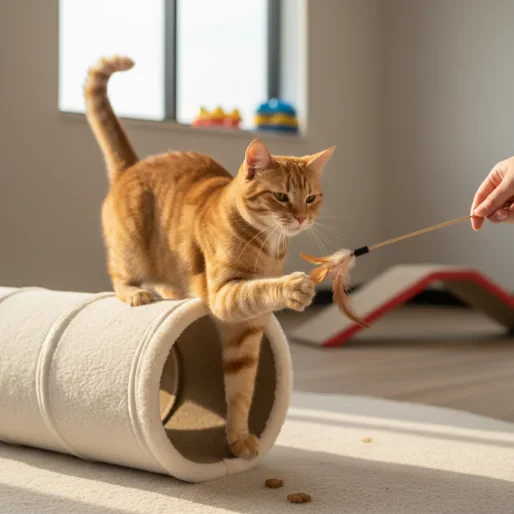
- Play behaviour: even brief batting at a toy indicates a shift from sympathetic (fight/flight) to parasympathetic (rest/digest/play) dominance.
- Vocalisation changes: a silent cat beginning to trill, chirp, or offer short meows during feeding time is socially engaging.
- Grooming in the owner's presence: self-grooming requires a sense of safety; it is rarely performed at FAS 2 or above.
Management Strategies While Training
Behaviour modification does not happen in isolation. The following management strategies protect progress between active sessions:
- Maintain strict routine: feed, clean, and visit at consistent times to build temporal predictability.
- Minimise forced interactions. Advise all household members and visitors not to pursue, stare at, or corner the cat.
- Use vertical space and visual barriers (shelving, cardboard partitions) to give the cat control over visual exposure.
- Avoid punishment of any kind. Punishment increases cortisol and erodes trust, directly undermining the desensitisation process.
- Keep a simple behaviour diary: note daily FAS level, eating latency, time spent hiding versus exploring, and any new behaviours. Patterns become visible over weeks that are invisible day-to-day.
For owners who also have dogs in the home, managing multi-species stress is essential. Ensuring canine housemates are calm and well-exercised (a structured fitness plan can help) reduces interspecies tension that may stall the cat's progress.
When to Consult a Certified Animal Behaviourist
Professional referral is indicated when:
- The cat shows no measurable improvement after six weeks of consistent, correctly applied protocol.
- Fear-based aggression escalates or is directed at humans with contact (bites breaking skin).
- Self-injurious behaviour develops (overgrooming to skin lesions, tail chasing with self-mutilation).
- The cat stops eating for more than 48 hours or loses significant body weight.
- The owner suspects pain or illness may be contributing.
Seek professionals credentialed through the Animal Behavior Society (CAAB/ACAAB), the American College of Veterinary Behaviorists (Dip ACVB), or International Association of Animal Behavior Consultants (IAABC). Avoid practitioners who recommend flooding, alpha rolls, or aversive tools for cats.
For those navigating the adoption process itself, understanding the adjustment period is equally important. The widely referenced 3-3-3 rule for shelter animals provides a useful timeline framework that, while developed for dogs, offers analogous insight into feline decompression periods.
Summary
Helping a fearful rescue cat build confidence is a patient, structured process rooted in classical conditioning principles. By accurately reading stress signals, providing an optimised safe base, progressing through graduated exposure stages, troubleshooting stalls with scientific reasoning, and recognising subtle progress markers, owners can facilitate genuine emotional recovery. The cat sets the pace. The owner provides the conditions for safety. Time, consistency, and compassion do the rest.
Frequently Asked Questions
How long does it take for a fearful rescue cat to become confident? ↓
Should I force a fearful rescue cat out of hiding to socialise? ↓
Can medication help a fearful rescue cat during behaviour modification? ↓
What are the most common mistakes owners make with fearful rescue cats? ↓

David Okafor
Certified Animal Behaviourist
Certified animal behaviourist — science-based strategies for fear, anxiety, reactivity, and behavioural challenges.
Content Disclosure
This article was created using state-of-the-art AI models with human editorial oversight. It is intended for informational and entertainment purposes only and does not constitute veterinary medical advice. Always consult a licensed veterinarian for your pet's specific health needs. Learn more about our process.