Australian spring brings snakes, nesting magpies, and curious possums into your dog's world. Learn force-free techniques to manage prey drive and protect both your dog and native fauna.
Key Takeaways
- Australian spring (September to November) triggers increased prey drive as snakes, nesting birds, possums, and lizards become more active in suburban and bushland environments.
- Chasing native wildlife is not only a training problem: it can result in snakebite, paralysis tick exposure, or council fines under state and territory companion animal legislation.
- Positive reinforcement techniques such as the "Look at That" (LAT) game and pattern games build impulse control without suppressing natural instinct.
- Training should begin below threshold, meaning the dog can still respond to cues despite noticing wildlife nearby.
- The Australian Veterinary Association (AVA) and the Association of Pet Dog Trainers Australia (APDTA) both advocate force-free, evidence-based behaviour modification methods.
Why Australian Spring Is a High-Risk Season for Prey Drive
As daytime temperatures climb past 20°C and daylight hours lengthen, Australian wildlife enters a period of intense activity. Eastern brown snakes and red-bellied black snakes emerge from brumation. Magpies begin nesting and swooping. Brushtail and ringtail possums become more visible at dusk. Masked lapwings (plovers) nest on open ground in parks and sports fields, and blue-tongue lizards bask on warm paths. For dogs with any degree of prey drive, this seasonal shift creates a daily obstacle course of triggers.
The predatory motor sequence in dogs follows a predictable chain: orient, eye, stalk, chase, grab, bite. Selective breeding has amplified different links in this chain. Kelpies and Border Collies often show strong eye and stalk behaviours, while Jack Russell Terriers and Bull Terriers may escalate rapidly to chase and grab. Greyhounds and Whippets, both popular breeds in Australia, carry intense chase drive from their coursing heritage. Understanding where a particular dog's drive peaks is essential for choosing the right training approach.
Critically, prey drive is self-reinforcing. Every successful chase triggers a dopamine release, making future impulse control harder. In the Australian context, this carries additional dangers. A dog chasing an eastern brown snake risks envenomation, which is a veterinary emergency requiring immediate antivenom treatment. A dog disturbing a nesting plover in a council park may result in fines under companion animal legislation, which varies by state and territory but commonly includes penalties for dogs off leash in prohibited areas.
Animal Emergency Service (AES)
Call the Animal Emergency Service or find your nearest 24-hour emergency vet clinic.
AES operates in QLD, NSW, and VIC. For other states, search for your nearest after-hours veterinary hospital.
Australian Regulations: What Dog Owners Need to Know
Each Australian state and territory has its own companion animal legislation governing leash requirements, and most national parks either prohibit dogs entirely or require them to be on leash at all times. Key legislation includes the Companion Animals Act 1998 (NSW), the Domestic Animals Act 1994 (Victoria), and similar frameworks in Queensland, South Australia, Western Australia, Tasmania, the ACT, and the Northern Territory.
Common rules that affect prey drive training include:
- On-leash requirements: Most council areas mandate dogs be on leash in public spaces unless within a designated off-leash area. Fines for off-leash dogs in on-leash zones typically range from $200 to $500 AUD depending on the jurisdiction.
- Wildlife protection: Under the Environment Protection and Biodiversity Conservation Act 1999 (federal) and corresponding state legislation, harassing or injuring native wildlife can attract significant penalties. Dogs that chase or injure protected species may be declared "dangerous" or "menacing" by local councils.
- Declared dangerous dogs: If a dog injures wildlife or a person while off leash, councils can impose control orders that include mandatory muzzling, enclosure requirements, and desexing.
These regulations are not bureaucratic inconveniences; they exist to protect native fauna and community safety. Responsible prey drive management aligns directly with legal compliance.
Equipment for Australian Conditions
- A well-fitted front-clip harness or flat collar: The APDTA and the AVA both discourage the use of prong collars, choke chains, and electronic shock collars. In some jurisdictions, electronic collars are banned outright (for example, in the ACT under the Animal Welfare Act 1992).
- A 5 to 6 metre long line: This allows the dog to make choices while maintaining safety. Avoid retractable leads, as the inconsistent tension encourages pulling. Lightweight biothane long lines are practical in Australian conditions because they resist moisture, dry quickly, and do not harbour ticks.
- High-value treats in a treat pouch: Cooked kangaroo, chicken, or cheese cut into small pieces work well. The reward must genuinely compete with the value of chasing a lizard, which is a high bar. Freeze-dried liver treats, available at most Australian pet retailers, are another reliable option.
- A clicker or verbal marker: Consistency and precision in marking desired behaviour are essential for effective counter-conditioning.
Step-by-Step: Building Impulse Control
Step 1: Foundation Work Indoors
Before introducing wildlife triggers, build three core behaviours in a low-distraction indoor environment:
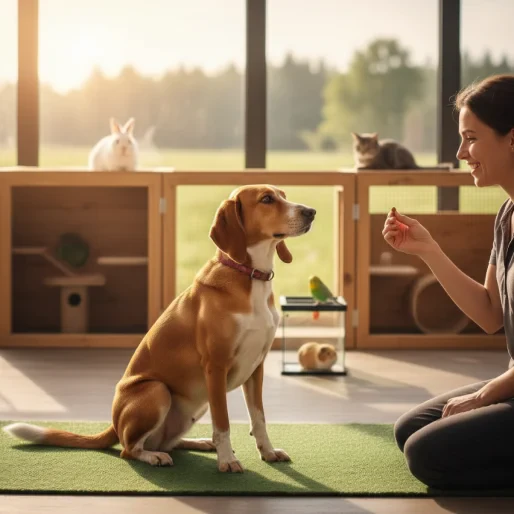
- "Watch me" or eye contact cue: Reward the dog for voluntarily looking at the handler. Mark the moment with a click or verbal marker and deliver a treat. Start in a quiet room with no distractions.
- "Leave it" with escalating difficulty: Begin with a treat under the hand, then progress to uncovered treats, dropped treats, and finally rolling or moving objects. The dog is never physically corrected for failing; simply reset and try again.
- A reliable recall cue: This is the emergency brake. Practise indoors first, then in a fenced yard, then on a long line. The recall should predict the best possible outcome: a jackpot of treats, excited praise, or a favourite toy.
Step 2: The "Look at That" (LAT) Game
Developed by trainer Leslie McDevitt as part of the Control Unleashed programme, the LAT game is highly effective for managing prey drive:
- Position the dog at a distance where wildlife (or a wildlife-rich area) is visible but the dog is not over threshold.
- The moment the dog orients toward the trigger, mark with a click or "yes."
- Deliver a high-value treat immediately.
- Repeat. Over multiple sessions, the dog begins to notice the wildlife and then look back at the handler, anticipating the reward.
This works through classical counter-conditioning: the presence of wildlife becomes a predictor of treats rather than a trigger for chase behaviour. It also provides an acceptable outlet for the "orient" stage of the predatory sequence without escalation.
Step 3: Reduce Distance Gradually
Once the "look and dismiss" pattern is reliable at a comfortable distance, decrease the distance by roughly 10 to 20 percent per session. Only reduce distance if the dog remains under threshold (able to respond to cues, not lunging, fixating, or trembling). In Australian suburban parks, this often means starting 30 to 50 metres from areas where magpies forage or possums are known to shelter.
Step 4: Add Movement Triggers
A stationary blue-tongue lizard is a very different stimulus from a skink darting across a footpath. Movement is the most potent trigger in the predatory sequence. Visit areas where wildlife is naturally active (waterbird habitats near dams or creeks, for example) but maintain a safe working distance. Mark and reward the dog for noticing movement without escalating.
Step 5: Generalise Across Environments
Dogs do not generalise well. A dog that calmly observes a magpie at the local oval may lose composure entirely when a plover flushes from ground cover on a bushland trail. Practise in multiple locations, with different species, and at different times of day. Consistent daily practice of even 5 minutes produces better results than occasional long sessions.
Common Mistakes to Avoid
- Starting too close to the trigger: If the dog is lunging, vocalising, or fixated with a hard stare, no learning can occur. Increase distance first.
- Using low-value treats: Standard kibble rarely competes with the thrill of chasing a possum. Use high-value food rewards such as cooked meat or cheese.
- Punishing the alert: Jerking the leash when the dog looks at wildlife teaches the dog that wildlife predicts unpleasant experiences, which can increase anxiety and arousal rather than reducing it.
- Allowing rehearsal: Every uncontrolled chase powerfully reinforces the behaviour. Until impulse control is reliable, use a long line in wildlife-active areas.
- Expecting breed drive to vanish: A Greyhound's chase instinct will not be eliminated. The goal is management and redirection, not suppression. Realistic expectations prevent frustration for both handler and dog.
Australian-Specific Hazards During Training
Training around Australian wildlife carries risks that do not exist in many other countries:
- Snakes: Eastern brown snakes, tiger snakes, and red-bellied black snakes are active in spring and summer across much of southern and eastern Australia. Dogs that chase snakes are at serious risk of envenomation. Snake avoidance training, offered by various providers using scent-based aversion protocols, is a complementary measure but does not replace impulse control training.
- Paralysis ticks: In coastal eastern Australia from northern Queensland to eastern Victoria, paralysis ticks (Ixodes holocyclus) are a significant seasonal threat. Dogs working on long lines in bushland or tall grass during spring should be on tick prevention and checked thoroughly after each session.
- Heat: Spring days can exceed 35°C in many parts of Australia, particularly from October onward. Schedule training sessions for early morning or late afternoon. Watch for signs of heat stress: excessive panting, drooling, lethargy, or unsteady gait. Always carry water for both handler and dog.
- Magpie swooping: Australian magpies defend nests aggressively from August to October. A dog reacting to a swooping magpie can bolt into traffic or injure the handler. Be aware of known swooping hotspots in your area and avoid them during nesting season.
When to Seek Professional Help
Certain situations warrant professional guidance from a qualified behaviour consultant:
- The dog has caught, injured, or killed wildlife.
- The dog redirects frustration onto the handler, other dogs, or bystanders when prevented from chasing.
- Prey drive co-occurs with other behavioural issues such as anxiety, leash reactivity, or inter-dog aggression.
- The dog fixates on household pets (cats, rabbits, birds).
- The handler feels physically unsafe managing the dog around triggers.
When selecting a professional in Australia, look for membership in the APDTA or credentials such as CPDT-KA (Certified Professional Dog Trainer, Knowledge Assessed) or IAABC certification. Veterinary behaviourists registered with the Australian and New Zealand College of Veterinary Scientists (ANZCVS) hold the highest level of qualification for complex behaviour cases. Verify that any trainer uses force-free, evidence-based methods aligned with the AVA's policy on humane training.
A Sample Two-Week Training Plan
- Days 1 to 3: Foundation work indoors. Practise "watch me," "leave it," and recall in short sessions of 5 to 10 minutes, three to four times daily.
- Days 4 to 5: Move foundation exercises to a fenced backyard or quiet courtyard with no wildlife present.
- Days 6 to 7: Introduce the LAT game at maximum comfortable distance from a known wildlife area, such as a park with foraging magpies. Limit sessions to 5 minutes.
- Days 8 to 10: Continue LAT at the same distance. Begin introducing mild movement triggers if naturally available.
- Days 11 to 14: If the dog reliably offers "look and dismiss," reduce distance by a small increment. If progress is not yet consistent, maintain current distance and continue building reinforcement history.
Progress is rarely linear. Expect plateaus, minor setbacks, and variable performance depending on the dog's arousal level, the species involved, and environmental factors such as wind carrying animal scent.
Protecting Native Wildlife
Responsible prey drive management is not only about dog safety; it is about protecting Australia's unique native fauna during a vulnerable season. Practical steps include keeping dogs on leash or long line near known nesting sites, avoiding walks through long grass during nesting season (typically August to December in temperate regions), respecting council leash laws, and leaving any disturbed nesting area immediately. Australia's native wildlife faces significant pressure from habitat loss and introduced predators. Responsible dog ownership is part of the broader conservation effort.
Frequently Asked Questions
Is it legal to use electronic shock collars for dog training in Australia? ↓
What should I do if my dog is bitten by a snake during a walk? ↓
Which Australian dog breeds have the highest prey drive? ↓
Can snake avoidance training replace impulse control training? ↓
How much do professional dog behaviour consultations cost in Australia? ↓

Mark Sullivan
Certified Professional Dog Trainer
Certified professional dog trainer — positive-reinforcement methods for every breed and behavioural challenge.
Content Disclosure
This article was created using state-of-the-art AI models with human editorial oversight. It is intended for informational and entertainment purposes only and does not constitute veterinary medical advice. Always consult a licensed veterinarian for your pet's specific health needs. Learn more about our process.