Australian spring brings warming waterways and eager dogs, but unique hazards demand local knowledge. This guide covers blue-green algae risks, water temperature thresholds, life jacket fitting, and post-swim care for Australian conditions.
Key Takeaways
- Australian spring (September to November) creates deceptive water conditions: Warming shallows fuel algal blooms while deeper water remains cold from winter.
- Blue-green algae (cyanobacteria) kills dogs in Australian waterways every year: State water authorities issue alerts, but not all affected waterways are monitored.
- Unique Australian hazards include tidal estuaries, bull sharks in river systems, and venomous marine life: Site selection matters more here than in many other countries.
- A properly fitted canine life jacket is essential in any open water with currents, drop-offs, or tidal movement.
- Post-swim ear drying and full-body rinsing prevent infections and remove contaminants common in Australian inland and coastal waterways.
Why Spring Water Safety Is Different in Australia
As temperatures climb through September and October, Australian waterways become magnets for dogs and their owners. After the cooler winter months, the urge to get back into rivers, lakes, dams, and coastal rock pools is understandable. However, Australian spring waterways carry a distinctive combination of risks that differ markedly from those in the Northern Hemisphere.
Spring rainfall across much of southeastern and eastern Australia increases river flows, stirs up sediment, and washes agricultural runoff into dams and lakes. This nutrient loading, combined with warming surface temperatures, creates ideal conditions for cyanobacterial (blue-green algae) blooms. At the same time, water temperatures in inland waterways can vary enormously: a sunny afternoon may warm shallows to 18 °C or above while water at depth remains below 12 °C.
In northern Australia (Queensland, the Northern Territory, and northern Western Australia), the late dry season and early wet season overlap with spring, bringing additional risks including saltwater crocodiles in coastal and estuarine waterways. Dogs should never enter waterways in known crocodile habitat.
For owners who also enjoy spring bushwalking with their dogs, the water safety principles here complement trail-side water encounters covered in Off Leash Spring Hiking With Your Dog: Full Guide.
Pre-Swim Site Assessment: Every Visit, Every Time
Conditions at any open water site can shift dramatically between visits. A structured check before every session takes under five minutes and can prevent a veterinary emergency:
- Visual scan of the water surface: Look for green, brown, or reddish discolouration, surface scum, foam accumulation, or a paint-like sheen. These may indicate a cyanobacterial bloom.
- Smell test: Blooms often produce a musty, earthy, or sewage-like odour detectable from the bank.
- Current and tidal check: For rivers, toss a leaf or stick and observe its speed. If it travels faster than a brisk walking pace, the current is likely unsafe for most dogs. For estuarine or tidal waterways, check tide times; outgoing tides create strong seaward currents.
- Entry and exit points: Ensure gradual, non-slippery banks or beach areas where a fatigued dog can climb out easily. Rocky platforms common along Australian coastlines can be slippery with algae growth.
- Check state water quality alerts: In New South Wales, WaterNSW and local councils publish algal alerts. In Victoria, the state government's water quality portal provides similar information. Queensland Health and the relevant water authorities in South Australia, Western Australia, and Tasmania also issue public notifications. Bookmark the relevant site for your area.
Blue-Green Algae in Australian Waterways
A Persistent and Lethal Threat
Cyanobacterial blooms are a well-documented hazard across Australian inland waterways, particularly in the Murray-Darling Basin, farm dams, and urban lakes. The Australian Veterinary Association (AVA) has highlighted the risk to companion animals, and state health departments regularly issue public warnings during bloom events.
Unlike many overseas contexts, Australian conditions can sustain blooms across a longer season. Spring blooms may begin as early as September in warmer inland regions and persist into late autumn. Farm dams, which many rural dog owners use for swimming, are often unmonitored and particularly high-risk due to nutrient runoff from surrounding agricultural land.
Identifying a Potential Bloom
- Surface appearance: Thick green, blue-green, or brownish scum resembling spilled paint or pea soup.
- Texture: Scooping water into a clear container may reveal clumpy, granular, or stringy particles distinct from harmless filamentous algae.
- Shoreline residue: Dried, crusty, or paint-like deposits along the waterline indicate recent bloom activity even if the water currently appears clear.
Toxicity: Why Every Minute Counts
Cyanotoxins include hepatotoxins (such as microcystins, which attack the liver) and neurotoxins (such as anatoxin-a, which can cause respiratory paralysis). Dogs face particularly high risk because they drink water while swimming and lick contaminated fur afterwards. Clinical signs can appear within 15 to 60 minutes:
- Vomiting and diarrhoea (sometimes bloody)
- Excessive drooling and disorientation
- Seizures and muscle tremors
- Difficulty breathing
- Collapse
If any of these signs appear after water exposure, this is a veterinary emergency. Rinse the dog immediately with clean water to remove residue and transport to the nearest emergency veterinary hospital without delay.
Animal Emergency Service (AES)
Call the Animal Emergency Service or find your nearest 24-hour emergency vet clinic.
AES operates in QLD, NSW, and VIC. For other states, search for your nearest after-hours veterinary hospital.
Owners concerned about toxic environmental exposures should also review Toxic Garden Products for Dogs: Aussie Spring Audit for related hazards at home.
Australian-Specific Water Hazards Beyond Algae
Australia's unique wildlife introduces hazards not encountered in most other countries:
- Bull sharks: Present in river systems and estuaries along the eastern and northern coastline, including surprisingly far upstream in some Queensland and NSW rivers. Avoid allowing dogs to swim in known bull shark habitat, particularly in murky or brackish water.
- Blue-ringed octopus: Found in rock pools and shallow coastal waters across southern and eastern Australia. Dogs investigating rock pools can be envenomated through a bite that is often painless initially but rapidly causes paralysis. This is a critical emergency requiring immediate veterinary attention.
- Jellyfish: Box jellyfish (Chironex fleckeri) in tropical northern waters from October onwards, and bluebottle (Physalia) stings in southern coastal waters, can cause significant pain and systemic reactions in dogs.
- Saltwater crocodiles: Present in waterways across northern Australia. Dogs must never enter waterways in crocodile habitat, including river banks and boat ramps.
- Snakes near waterways: Eastern brown snakes, tiger snakes, and red-bellied black snakes are commonly encountered near Australian waterways during spring as they emerge from winter brumation. Maintain awareness and keep dogs under close control near riverbanks and lake edges.
Water Temperature Thresholds for Australian Conditions
Australian spring water temperatures vary enormously by region. Inland NSW and Victorian waterways may sit between 12 and 18 °C in September and October, while tropical Queensland waterways may already exceed 25 °C. General veterinary guidance on temperature thresholds:
- Small breeds and lean-bodied dogs (under roughly 10 kg): Water below approximately 15 °C presents meaningful hypothermia risk. Keep sessions very short or avoid altogether.
- Medium breeds (10 to 25 kg) with moderate coat: Water between 12 and 15 °C may be tolerated for brief, supervised swims of around 5 to 10 minutes.
- Large, double-coated breeds (e.g., Labrador Retrievers, Australian Shepherds, Kelpies): Generally tolerate water down to roughly 10 °C for short sessions, though individual variation is significant.
- Senior dogs and those with arthritis or chronic conditions: Regardless of size, these dogs are more vulnerable to cold stress. Warmer water and shorter durations are advisable. For guidance on managing arthritic dogs during spring, see Senior Dog Arthritis: Spring Walk Guide.
Signs of Cold Stress
Watch for shivering, reluctance to re-enter the water, tucked tail, stiff movement, or whining. End the swim immediately, dry the dog with an absorbent towel, and move to a warm, sheltered area. Lethargy, uncoordination, or unresponsiveness after cold water exposure warrants veterinary assessment.
Life Jacket Fitting for Australian Conditions
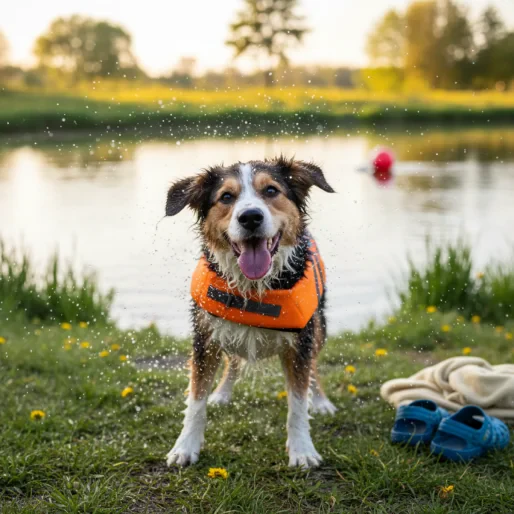
Canine life jackets are widely available from Australian pet retailers, typically ranging from around $40 to $120 AUD depending on size and quality. Key fitting steps:
- Measure accurately: Use the manufacturer's sizing chart. Measure girth (widest part of the ribcage) and length (base of neck to base of tail).
- Secure all straps: Neck, chest, and belly straps should be snug enough to prevent the jacket sliding forward over the head, but loose enough to fit two fingers between strap and body.
- Test the dorsal handle: Lift the dog gently by the handle on dry land. The jacket should hold the dog evenly without riding up or compressing the throat.
- Check leg freedom: The dog should walk, trot, and paddle normally. Watch for chafing behind the front legs.
- Shallow water test first: Let the dog wear the jacket in a controlled shallow setting before any open water outing.
Life jackets are particularly important in Australian tidal waterways and coastal areas where conditions can change rapidly.
Post-Swim Care: Ears, Coat, and Parasites
Ear Drying Protocol
Popular Australian breeds prone to ear infections after swimming include Cocker Spaniels, Golden Retrievers, Cavalier King Charles Spaniels, and Groodles (Goldendoodles). The warm, humid Australian climate accelerates bacterial and yeast overgrowth in damp ear canals.
- Immediately after the swim, gently lift each ear flap and blot visible moisture with a soft cloth or cotton ball. Do not insert anything deep into the canal.
- If recommended by your veterinarian, apply a veterinary-approved ear drying solution.
- Allow air circulation by letting ear flaps remain open for a few minutes.
- Monitor over the following 24 to 48 hours for head shaking, scratching, redness, odour, or discharge.
Full-Body Rinse
Australian waterways may contain agricultural chemicals, fertiliser runoff, or naturally occurring irritants. A thorough freshwater rinse after every swim helps prevent contact dermatitis and removes potential toxins from the coat before the dog grooms itself.
Paralysis Tick Checks
In coastal and bushland areas of eastern Australia (from far north Queensland to eastern Victoria), paralysis ticks (Ixodes holocyclus) are active during spring and summer. After any outdoor water activity in tick-prone regions, conduct a thorough tick search. Veterinary guidance recommends running fingers through the entire coat, paying particular attention to the head, ears, neck, and between the toes. Maintain current tick prevention as recommended by your veterinarian.
Vaccination Considerations for Swimming Dogs
Leptospirosis, a bacterial disease transmitted through contaminated water (often from wildlife urine), is present in parts of Australia, particularly in tropical and subtropical regions and areas with significant rodent or wildlife populations near waterways. The Australian Veterinary Association recognises leptospirosis vaccination as a consideration for at-risk dogs. Discuss with your veterinarian whether your dog's swimming habits and location warrant leptospirosis vaccination as part of their preventive health plan.
Local Regulations: Where Dogs Can Swim
Dog access to beaches, rivers, and lakes varies by local council across Australia. Many councils designate off-leash dog beaches with specific time restrictions (often before 9 am and after 4 pm during daylight saving months). Some waterways in national parks and water catchment areas prohibit dogs entirely. Before visiting a new swimming spot:
- Check your local council website for designated dog-friendly water access areas
- Look for signage at the site regarding leash requirements, prohibited zones, and water quality warnings
- Be aware that fines for dogs in prohibited areas can range from $200 to over $1,000 AUD depending on the jurisdiction
Warning Signs That Require Veterinary Attention
Seek veterinary care promptly if a dog displays any of the following after open water exposure:
- Vomiting, diarrhoea, or loss of appetite within hours of swimming (possible cyanotoxin exposure or waterborne infection)
- Persistent shivering, lethargy, or weakness after adequate drying and warming (possible hypothermia or limber tail syndrome)
- Head shaking, ear scratching, redness, or foul odour from ears within 24 to 72 hours (possible otitis externa)
- Coughing, laboured breathing, or nasal discharge (possible water aspiration)
- Skin irritation, hot spots, or rashes (possible contact dermatitis from contaminants)
- Lameness or reluctance to move (possible musculoskeletal strain or injury from underwater obstacles)
- Any sign of tick paralysis: change in bark, wobbliness in hind legs, vomiting, or difficulty breathing
Never attempt to wait and see with suspected algae toxin exposure or tick paralysis. Both are emergencies.
Animal Emergency Service (AES)
Call the Animal Emergency Service or find your nearest 24-hour emergency vet clinic.
AES operates in QLD, NSW, and VIC. For other states, search for your nearest after-hours veterinary hospital.
Building a Safe Spring Swimming Routine
Consistent pre-swim assessment takes under five minutes. Combined with proper life jacket use, water temperature awareness, a simple post-swim ear drying and rinsing protocol, and thorough tick checks in endemic areas, the most common and most serious risks become manageable. Swimming remains one of the best forms of canine exercise available: low impact on joints, excellent for cardiovascular conditioning, and deeply enjoyable for water-loving breeds. The goal is not to limit the fun but to make every session as safe as it is rewarding.
On non-swim days, balance and proprioceptive exercises support the core stability that makes swimming more efficient and enjoyable. The Dog Balance Exercises at Home: A Progressive Guide offers a progressive programme suitable for dogs at any fitness level.
Frequently Asked Questions
When is blue-green algae most dangerous for dogs in Australia? ↓
What water temperature is too cold for dogs to swim in during Australian spring? ↓
Do dogs need a life jacket for swimming in Australian rivers and beaches? ↓
Should I check my dog for paralysis ticks after swimming? ↓
Is leptospirosis vaccination recommended for dogs that swim in Australia? ↓

Lena Voss
Pet Wellness & Lifestyle Coach
Pet wellness and lifestyle coach — proactive fitness, weight management, and preventive care for healthier, happier pets.
Content Disclosure
This article was created using state-of-the-art AI models with human editorial oversight. It is intended for informational and entertainment purposes only and does not constitute veterinary medical advice. Always consult a licensed veterinarian for your pet's specific health needs. Learn more about our process.