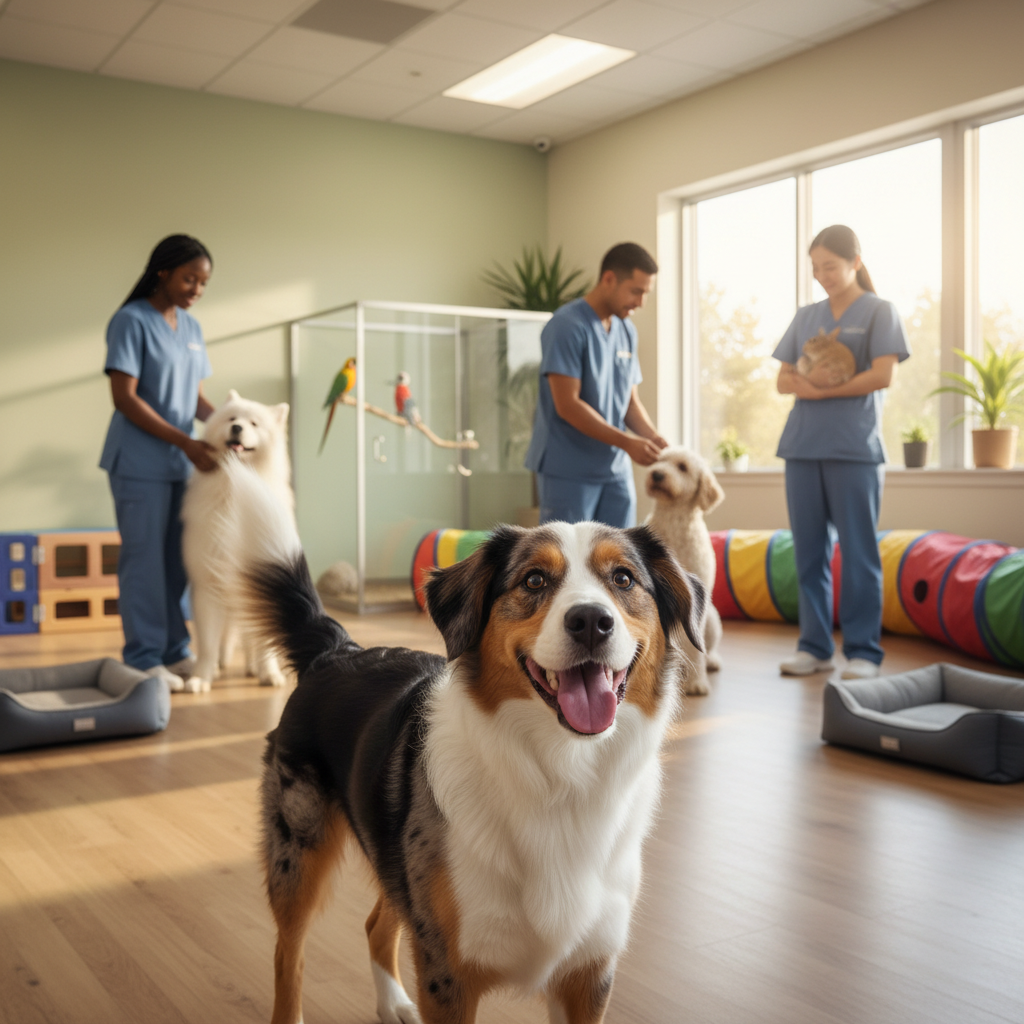
Canadian dog daycare facilities must meet province-specific licensing requirements and staff training benchmarks. Learn what certifications, ratios, and protocols to expect from a quality facility in Canada.
Key Takeaways
- Canadian daycare staff should hold current certifications in canine first aid, CPR, and behaviour assessment from recognized providers.
- Provincial licensing requirements vary significantly across Canada, with some provinces mandating specific staff credentials.
- Reading canine body language remains the single most critical skill for preventing incidents in group play settings.
- Canadian climate extremes, from winter conditions reaching -30°C to summer humidity, create unique safety challenges that trained staff must manage.
- Owners should verify facility compliance with municipal bylaws, provincial animal welfare legislation, and industry standards from bodies like IBPSA Canada or PIJAC Canada.
Why Professional Training Standards Matter for Canadian Dog Daycares
Canada's dog daycare industry has expanded rapidly, driven by high pet ownership rates and growing demand for quality care while owners work or travel. The Canadian Veterinary Medical Association (CVMA) has emphasized the importance of professional animal handling across all care settings, and this principle extends directly to daycare environments.
Unlike veterinary clinics, dog daycares in Canada are primarily regulated at the provincial and municipal level. British Columbia, Ontario, and Alberta each have distinct frameworks governing animal care businesses. Some municipalities require kennel licences for any facility housing more than a set number of dogs, while others impose zoning restrictions and inspection schedules. This patchwork of regulation makes it essential for owners to understand what training standards they should expect, regardless of what their local bylaws minimally require.
Professional organizations such as the International Boarding and Pet Services Association (IBPSA), which maintains an active Canadian chapter, and the Pet Industry Joint Advisory Council of Canada (PIJAC Canada) have established voluntary accreditation programmes that signal a facility's commitment to staff development and operational excellence.
Canine Body Language Reading: The Foundation of Safe Group Play
Why This Skill Is Non-Negotiable
The ability to accurately read canine body language is widely considered the most critical competency for any daycare attendant. Dogs communicate almost entirely through posture, facial expression, tail position, ear set, and subtle shifts in movement. A trained staff member can identify early warning signs of stress, fear, or arousal before a situation escalates.
Core Signals Every Staff Member Should Recognize
Professional training programmes in Canada typically cover these signals in depth:
- Stress signals: lip licking, yawning out of context, whale eye (showing the whites of the eyes), panting when not warm, tucked tail, and avoidance behaviours such as turning away or hiding.
- Arousal signals: stiff body posture, forward-leaning stance, raised hackles (piloerection), intense fixed stare, and rapid tail wagging with a high, rigid tail set.
- Calming signals: slow blinking, play bows, curved body approaches, sniffing the ground, and soft loose body movement.
- Escalation ladder: well trained staff understand that aggression rarely appears without warning. The typical progression moves from subtle displacement behaviours through freeze responses, hard stares, growling, snapping, and finally biting.
Practical Application in a Canadian Daycare Setting
Staff should actively scan the play floor at all times, identifying dogs becoming overwhelmed or overstimulated and intervening with redirection or separation before conflict occurs. Canadian facilities managing popular high-energy breeds such as Labrador Retrievers, Golden Retrievers, Bernese Mountain Dogs, and Australian Shepherds must be particularly skilled at reading arousal levels during active play. Best practice facilities conduct brief body language check-ins every few minutes, rotating attention across the group systematically.
First Aid and CPR Requirements for Canadian Daycare Staff
Recommended Certifications
Professional guidelines recommend that every staff member who handles dogs directly should hold a current certification in pet first aid and CPR. In Canada, recognized providers include Walks 'N' Wags Pet First Aid, the Canadian Red Cross (which offers pet-inclusive modules), and ProPetHero. These courses typically cover:
- Cardiopulmonary resuscitation (CPR) techniques specific to dogs of various sizes
- Choking response and obstruction removal
- Wound management, including bite wounds, lacerations, and punctures
- Heat stroke recognition and emergency cooling protocols
- Hypothermia recognition and warming procedures (critical for Canadian winters)
- Seizure response and safe restraint
- Poisoning and toxin exposure first response
- Frostbite assessment on paw pads and ear tips
Certifications should be renewed annually or biannually depending on the issuing body. A well run facility will maintain a visible log of staff certifications and their expiry dates.
Emergency Protocols and Veterinary Partnerships
Professional standards call for facilities to maintain a written emergency action plan that includes a relationship with a nearby veterinary clinic or emergency hospital. Staff should know the fastest route to that clinic, have the contact information posted prominently, and have authorization forms on file for every dog permitting emergency treatment if the owner cannot be reached.
ASPCA Animal Poison Control / Local Emergency Vet
Call the ASPCA Poison Control hotline (also serves Canada) or contact your nearest emergency veterinary hospital.
The ASPCA hotline charges a consultation fee. For non-poison emergencies, search for a 24-hour veterinary hospital in your city.
Canadian Climate Considerations for Daycare Staff Training
Winter Safety Protocols
Canada's harsh winters create unique challenges that daycare staff must be specifically trained to manage. When temperatures drop below -15°C, outdoor play periods must be shortened significantly. Staff need training in:
- Recognizing signs of hypothermia (shivering, lethargy, slow breathing)
- Assessing paw pad condition after exposure to road salt and de-icing chemicals
- Understanding breed-specific cold tolerance (a Siberian Husky at -20°C differs vastly from a Greyhound at -5°C)
- Managing indoor ventilation and humidity when dogs cannot exercise outdoors
- Applying and checking dog boots for proper fit during winter outings
Summer Heat and Humidity
Eastern Canada, particularly Ontario and Quebec, experiences high humidity in summer that raises heat stroke risk substantially. Staff should be trained to limit outdoor play when the humidex exceeds 30°C, ensure fresh water is available within 5 metres of any play area, and recognize early signs of heat distress including excessive drooling, glazed eyes, and uncoordinated movement. Brachycephalic breeds (Bulldogs, Pugs, Boston Terriers) require extra vigilance in warm conditions.
Provincial Licensing and Staff-to-Dog Ratios
The Canadian Regulatory Landscape
There is no single federal standard governing dog daycare operations in Canada. Regulation falls to provinces and municipalities. Some key points:
- Ontario: The Provincial Animal Welfare Services Act (PAWS Act) establishes baseline care standards. Many municipalities require kennel licences.
- British Columbia: The BC SPCA's AnimalKind accreditation programme sets voluntary but influential standards for dog training and care businesses.
- Alberta: Municipal business licences and the Animal Protection Act govern operations. Calgary, for example, has specific bylaws for animal care facilities.
Recommended Staff-to-Dog Ratios
| Facility Type | Recommended Ratio | Notes |
|---|---|---|
| Small group, indoor only | 1:6 to 1:8 | Common in urban centres like Toronto, Vancouver, and Montreal where space is limited. |
| Mixed indoor/outdoor facility | 1:8 to 1:10 | Outdoor space reduces density, but supervision must cover both areas. |
| Large outdoor play yard | 1:10 to 1:15 | More common in suburban and rural settings with ample acreage. |
| Puppy or small dog groups | 1:6 to 1:8 | Puppies and small breeds require closer supervision. |
| Special needs or senior groups | 1:4 to 1:6 | Dogs with medical conditions or mobility limitations need individualized attention. |
Canadian Factors That Should Tighten Ratios
- Winter conditions requiring indoor-only operation (increased arousal from confinement)
- New dogs in the group who have not yet established social relationships
- Mixed energy levels or significant size differences within the same play group
- Extreme heat or cold requiring rapid transitions between environments
- Inexperienced or newly hired staff still developing observational skills
Health, Vaccination, and Documentation Requirements
Canadian daycare facilities should require up-to-date vaccination records in compliance with CVMA guidelines, typically including:
- Rabies: legally mandated in most Canadian provinces
- DHPP: distemper, hepatitis, parvovirus, and parainfluenza
- Bordetella: kennel cough vaccine, often required every 6 to 12 months
- Canine influenza: increasingly recommended in group settings
- Leptospirosis: particularly relevant in areas with wildlife and standing water
Many facilities also require proof of flea and tick prevention and a recent negative fecal test. Given Canada's expanding tick populations (particularly in Ontario, Quebec, Nova Scotia, and Manitoba), Lyme disease prevention is an increasingly important discussion point between owners and daycare operators.
What Canadian Owners Should Ask Before Enrolling
A professional daycare should willingly answer detailed questions about operations. Canadian owners should specifically ask:
- What formal training or certifications do your staff hold?
- Are you licensed under municipal bylaws and compliant with provincial animal welfare legislation?
- What is your staff-to-dog ratio during peak hours?
- How do you manage outdoor play in extreme cold (below -20°C) or extreme heat (humidex above 35°C)?
- What is your protocol if a dog is injured or becomes ill?
- Do you carry commercial liability insurance?
- What is your policy on breed-specific municipal bylaws?
When to Seek Professional Help
If a dog returns from daycare showing signs of persistent stress, such as excessive panting, loss of appetite, new fearfulness, or unexplained injuries, owners should consult a veterinarian promptly. Behavioural changes after daycare attendance can warrant a consultation with a certified animal behaviourist. In Canada, look for credentials such as CAAB (Certified Applied Animal Behaviourist), ACVB diplomate, or IAABC certification.
Daycare is not suitable for every dog. Dogs with severe anxiety, a history of aggression, or significant medical conditions may be better served by individualized pet sitting or structured one-on-one care. A responsible facility will be honest about whether their environment is the right fit, and a good Canadian facility will provide referrals to qualified alternatives when needed.
Frequently Asked Questions
What certifications should Canadian dog daycare staff hold? ↓
Are dog daycares regulated in Canada? ↓
What is a safe staff-to-dog ratio at a Canadian daycare? ↓
How should Canadian daycares handle extreme winter cold? ↓
What vaccinations do Canadian dog daycares require? ↓

TrustMyPets Editorial Team
Global Pet Care Experts
Multi-disciplinary editorial team — evidence-based pet care guidance across health, behaviour, and welfare.
Content Disclosure
This article was created using state-of-the-art AI models with human editorial oversight. It is intended for informational and entertainment purposes only and does not constitute veterinary medical advice. Always consult a licensed veterinarian for your pet's specific health needs. Learn more about our process.