Underwater treadmill therapy helps Canadian dogs manage hip dysplasia, but costs vary widely by province and facility type. This guide breaks down typical CAD pricing, insurance options, and seasonal considerations for Canadian pet owners.
Key Takeaways
- A single underwater treadmill session in Canada typically costs $50 to $150 CAD, depending on province, facility credentials, and session length.
- Most rehabilitation protocols call for one to three sessions per week over six to twelve weeks, with total programme costs ranging from roughly $700 to $4,000 CAD before insurance reimbursement.
- Canadian pet insurers such as Trupanion and Petsecure increasingly cover rehabilitation therapies, though pre-existing condition exclusions and optional add-on requirements apply.
- Canada's cold winters create additional challenges for dogs with hip dysplasia, making indoor hydrotherapy a particularly valuable year-round option.
- Provincial veterinary regulatory bodies govern who may perform rehabilitation therapies, so credentials vary by province.
Why Hydrotherapy Matters for Canadian Dogs With Hip Dysplasia
Hip dysplasia is among the most common orthopaedic conditions in dogs, particularly in medium to large breeds popular across Canada: Labrador Retrievers, Golden Retrievers, German Shepherds, Bernese Mountain Dogs, and Rottweilers. The condition involves abnormal hip joint development that leads to cartilage degradation, chronic inflammation, and progressive osteoarthritis.
While surgical options such as total hip replacement or femoral head ostectomy exist, many dogs benefit from conservative management centred on pain control, weight management, and structured physical rehabilitation. Underwater treadmill therapy has become a cornerstone of canine rehabilitation programmes because the buoyancy of water reduces joint loading by roughly 40% to 60% of body weight (depending on water depth), while water resistance strengthens the muscles that support the affected hip.
For Canadian dogs, winter conditions add a layer of complexity. Icy sidewalks, deep snow, and subzero temperatures (reaching as low as minus 30°C in parts of the Prairies and northern Ontario) limit safe outdoor exercise for months at a time. Dogs with hip dysplasia are especially vulnerable to slipping on ice, which can worsen joint instability. Indoor hydrotherapy provides a controlled, warm environment for consistent rehabilitation regardless of season.
How Underwater Treadmill Sessions Work
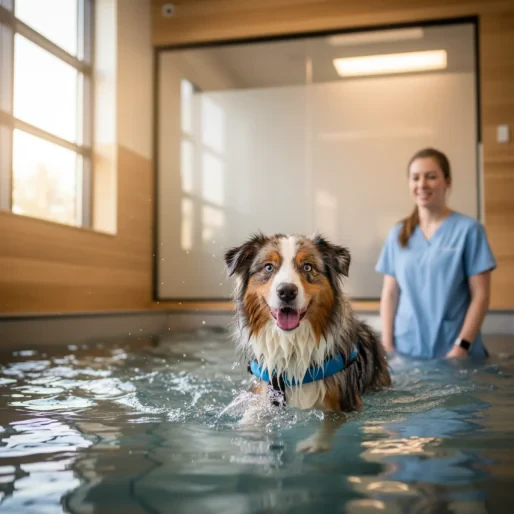
An underwater treadmill unit consists of an enclosed chamber with a motorised belt at the base. The chamber fills with temperature-controlled water, typically warmed to 26°C to 30°C, to a depth set by the therapist. Key variables include:
- Water depth: Higher levels provide greater buoyancy and reduced joint loading; lower levels increase the weight-bearing challenge.
- Treadmill speed: Usually set between 0.5 and 3.0 km/h, calibrated to the dog's comfort and gait pattern.
- Session duration: Initial sessions may involve only 5 to 10 minutes of active walking, gradually building to 20 to 30 minutes as conditioning improves.
- Water jets: Some units include adjustable jets that add resistance, further engaging core and limb muscles.
A certified canine rehabilitation therapist monitors the dog throughout, observing gait quality, compensatory movements, fatigue, and pain indicators. In Canada, practitioners typically hold CCRT (Certified Canine Rehabilitation Therapist) or CCRP (Certified Canine Rehabilitation Practitioner) credentials. The Canadian Veterinary Medical Association (CVMA) holds that diagnosis and prescribing of rehabilitation treatment must rest with the patient's veterinarian, while allied health professionals such as physiotherapists and veterinary technicians may apply treatment modalities under appropriate supervision. Provincial regulatory bodies determine the specific scope of practice.
Cost Breakdown in Canadian Dollars
Hydrotherapy pricing in Canada reflects regional cost-of-living differences, facility type, and therapist credentials. The following table provides realistic CAD ranges based on current Canadian market pricing.
| Item | Typical Cost Range (CAD) |
|---|---|
| Initial rehabilitation assessment | $150 to $350 |
| Single underwater treadmill session (20 to 30 min) | $50 to $150 |
| Package of 6 to 10 sessions (if offered) | $400 to $1,200 |
| Maintenance phase (1 to 2 sessions per month, ongoing) | $50 to $300 per month |
| Total for a 6 to 12 week initial programme (1 to 3x per week) | $700 to $4,000+ |
What Drives Pricing Differences Across Canada
Province and city size: Sessions at facilities in Toronto, Vancouver, Calgary, and Ottawa tend to sit at the higher end of the spectrum ($100 to $150 per session), while clinics in smaller centres or Atlantic Canada may charge $50 to $80. British Columbia and Ontario generally have the highest veterinary costs in the country.
Facility type and credentials: Board-certified veterinary rehabilitation specialists (such as Diplomates of the American College of Veterinary Sports Medicine and Rehabilitation) charge premium rates, often $120 to $200 per session. Certified rehabilitation therapists working within a veterinary practice typically charge $60 to $120. Independent hydrotherapy centres staffed by trained therapists tend to be the most affordable at $50 to $90 per session, though veterinary oversight may be limited.
Dog size: Larger dogs require more water, longer warm-up periods, and sometimes additional staff. Some facilities apply a surcharge of $15 to $30 CAD for giant breeds such as Great Danes, Newfoundlands, and Saint Bernards. Since breeds predisposed to hip dysplasia tend to be medium to large (typically 25 kg and above), most owners should budget toward the mid to upper range.
Severity and bundled services: Dogs with severe dysplasia, post-surgical patients, or those with concurrent conditions (obesity, cruciate ligament disease, spinal issues) may need longer sessions, more frequent visits, and additional therapies such as laser therapy or manual mobilisation. Bundled add-on services can increase per-visit costs by $25 to $75 CAD.
Seasonal Considerations for Canadian Owners
Canada's climate makes year-round rehabilitation planning essential. During winter months, dogs with hip dysplasia face increased risk from slippery surfaces, reduced muscle warm-up in cold temperatures, and limited opportunities for controlled outdoor exercise. Practical strategies include:
- Maintaining consistent hydrotherapy schedules through winter: Rather than reducing sessions when outdoor walks become difficult, winter is often when hydrotherapy is most valuable.
- Using booties and harnesses on ice: For the walk from the car to the clinic, non-slip booties and a supportive body harness can prevent falls that aggravate dysplastic hips.
- Spring transition caution: When warmer weather returns, owners sometimes increase outdoor activity too quickly. A gradual transition, guided by the rehabilitation therapist, helps prevent setbacks.
- Summer swimming as a supplement: In warmer months, supervised swimming in lakes or calm rivers can supplement (but not replace) structured treadmill therapy. Water temperature in Canadian lakes varies widely, and very cold water can cause muscle tensing that is counterproductive.
Call the ASPCA Poison Control hotline (also serves Canada) or contact your nearest emergency veterinary hospital.
The ASPCA hotline charges a consultation fee. For non-poison emergencies, search for a 24-hour veterinary hospital in your city.
Pet Insurance Coverage for Hydrotherapy in Canada
Pet insurance is one of the most effective tools for managing rehabilitation costs. Several Canadian insurers offer relevant coverage:
- Trupanion: Headquartered in Vancouver, Trupanion offers a "Recovery and Complementary Care" add-on that covers hydrotherapy, physical therapy, and acupuncture. This is an optional rider added to the base policy for an additional monthly fee. All treatments must be given by or under the supervision of a licensed veterinarian.
- Petsecure: A Canadian-owned insurer operating for over 30 years, Petsecure includes alternative and rehabilitative treatments in their plans, with up to 80% reimbursement depending on the coverage level selected.
- Other providers: Fetch, Pets Plus Us, and several other insurers active in Canada offer varying levels of rehabilitation coverage. Policy details change frequently, so comparing current plan documents is essential.
Critical considerations for Canadian pet owners:
- Pre-existing condition exclusions: If hip dysplasia was diagnosed before the policy start date or during the waiting period, hydrotherapy costs are almost universally excluded.
- Waiting periods: Most policies impose 14 to 30 day illness waiting periods, and some impose 6 to 12 month waits specifically for orthopaedic or hereditary conditions.
- Annual or per-condition limits: Sub-limits for complementary therapies (for example, $1,500 to $3,000 CAD per year) are common.
- Veterinary referral requirements: Most insurers require that hydrotherapy be prescribed by a licensed veterinarian and performed at an approved facility.
Insuring puppies of predisposed breeds early, ideally before any clinical signs appear, offers the best chance of receiving coverage should hip dysplasia develop later. For a detailed explanation of how waiting periods affect claims, see Pet Insurance Waiting Periods in Canada Explained.
Financial Assistance Beyond Insurance
For owners without insurance or facing exclusions, several Canadian options may help:
- Veterinary financing: Petcard and Scratchpay are widely accepted at Canadian veterinary clinics, offering payment plans from $200 to $10,000 with terms of 12 to 36 months. Scratchpay uses a soft credit inquiry that does not affect credit scores.
- Veterinary teaching hospitals: The Ontario Veterinary College (University of Guelph) and the Western College of Veterinary Medicine (University of Saskatchewan) both offer rehabilitation services, often at reduced rates compared to private specialty clinics.
- Charitable funds: Breed-specific rescue organisations and some provincial SPCA branches may offer financial assistance for rehabilitation in qualifying cases.
- Clinic package discounts: Many Canadian rehabilitation facilities offer 10% to 20% discounts when sessions are purchased in blocks of six or more.
Finding a Qualified Rehabilitation Provider
The Canadian Animal Physiotherapy Association and the Canine Rehabilitation Institute both maintain directories of certified practitioners. When evaluating a facility, owners should ask:
- What credentials does the therapist hold (CCRT, CCRP, or equivalent)?
- Is a veterinarian on site or available for consultation during sessions?
- What does the initial assessment include, and is it billed separately?
- Will the facility provide documentation suitable for insurance reimbursement claims?
- How will progress be measured (gait scoring, range of motion, thigh circumference)?
Provincial veterinary regulatory bodies (such as the College of Veterinarians of Ontario, the College of Veterinarians of British Columbia, and their counterparts in other provinces) set the rules governing who may provide rehabilitation services. Confirming that a facility meets provincial requirements protects both the dog and the owner.
When Hydrotherapy May Not Be Appropriate
Hydrotherapy is not suitable for every dog. Contraindications include open wounds or skin infections, uncontrolled cardiac or respiratory disease, severe water anxiety, certain infectious conditions, and cases where orthopaedic instability requires surgical correction before rehabilitation can safely begin. A thorough veterinary assessment should always precede the first session. For monitoring symptoms between appointments, see How AI Pet Health Apps Analyse Your Pet's Symptoms.
Budgeting Realistically
The figure that often surprises owners is not the cost of a single session (which is comparable to a standard veterinary consultation) but the cumulative total over weeks and months of consistent treatment. Budgeting $1,500 to $3,000 CAD for an initial programme is a reasonable starting estimate for most Canadian owners, with ongoing maintenance adding $50 to $300 CAD per month. Combined with appropriate medical management, weight control, and home exercise prescribed by the rehabilitation team, hydrotherapy offers one of the most effective non-surgical strategies for managing canine hip dysplasia across all seasons.
Frequently Asked Questions
How much does dog hydrotherapy cost in Canada? ↓
Does pet insurance in Canada cover hydrotherapy for hip dysplasia? ↓
Can my dog do hydrotherapy in winter in Canada? ↓
What credentials should a canine hydrotherapist have in Canada? ↓
Are there lower cost options for dog hydrotherapy in Canada? ↓

Rachel Simmons
Pet Ownership Cost Advisor
Pet ownership cost advisor — transparent vet fee breakdowns, insurance guidance, and financial planning for owners.
Content Disclosure
This article was created using state-of-the-art AI models with human editorial oversight. It is intended for informational and entertainment purposes only and does not constitute veterinary medical advice. Always consult a licensed veterinarian for your pet's specific health needs. Learn more about our process.