
In this article
- Key Takeaways
- Why Post-Holiday Grooming Matters for Health, Not Just Appearance
- Tools and Products Needed for Recovery Grooming
- Step-by-Step Recovery Grooming Routine
- Ticks and Grass Awns After Countryside Stays
- Managing the Autumn Coat Change That Starts in September
- Frequency Guide by Coat Type
- Warning Signs to Watch For During Grooming
- Professional Groomer or Home Grooming: A Decision Guide
- A Realistic Late August to September Recovery Schedule
Key Takeaways
- Salt and sand are abrasive: dried sea salt stiffens the coat and sand acts like grit inside mats, so rinsing thoroughly with plain lukewarm water before any brushing is the single most important step.
- Never brush a dry, salty mat: professional grooming standards favour sectioning, conditioning and dematting from the tips inward, or clipping out when the mat is tight to skin.
- September triggers the autumn coat change: shortening daylight (photoperiod) drives shedding of the summer coat and growth of denser undercoat, so undercoat work should increase from early September.
- Grass awns (forasacchi) are a genuine emergency risk: check paws, ears, armpits, groin and between toes after every countryside stay.
- Ticks come home too: a systematic tick check should be part of the first post-holiday groom, with removal by a proper tick tool only.
- Pelted coats are a welfare issue, not a cosmetic one: if a comb cannot pass to skin over more than a small area, book a professional groomer rather than persisting at home.
- Any smell, heat, redness, ooze or pain found under a mat is a veterinary matter, not a grooming one.
Why Post-Holiday Grooming Matters for Health, Not Just Appearance
The Italian rhythm of Ferragosto sends families (and increasingly their pets) to the coast, the lakes or the countryside for two to four weeks around mid-August. Long-haired dogs and cats return with a coat that has been through repeated cycles no groomer would ever choose: salt water, then evaporation, then sand, then heat, then a hasty towel-dry, repeated daily for weeks. Coats that were fully combed through in July can arrive back in Milan or Rome in September carrying dense felting behind the ears, in the armpits, along the tail base and in the trouser feathering.
This matters medically. A mat is not simply tangled hair. Once hair felts, it forms a rigid, air-impermeable pad that traps moisture and skin oils against the skin surface. The skin underneath cannot breathe, dries into scale, and in humid late-summer conditions can develop moist dermatitis (hot spots) or secondary bacterial and yeast overgrowth. Tight mats also exert constant traction on the skin, which is painful and can restrict movement at the elbows, hocks and groin. Veterinary dermatology consensus consistently links severe matting to skin inflammation, pain and delayed detection of lumps, wounds and parasites.
Equally important, matted coat is where ticks and grass awns hide. A tick attached under a mat may go unnoticed for the full duration of attachment, which is precisely when tick-borne disease risk rises. A grass awn (in Italy, the forasacco or foxtail-type seed head of Hordeum murinum and related grasses) is barbed and migrates in one direction only: inward. Coat that cannot be combed is coat that cannot be inspected, and inspection is the point of grooming.
Cats deserve specific mention. Long-haired cats groom themselves fastidiously, which is exactly why owners assume they are fine. A cat that has swallowed sea salt and sand while self-grooming often over-grooms in response to irritation, then produces more mats, then stops grooming the painful areas altogether. Elderly cats and overweight cats cannot reach the lumbar region and tail base, which is where post-holiday pelting typically begins.
Tools and Products Needed for Recovery Grooming
The tool list below reflects standard professional kit as taught within International Professional Groomers (IPG), National Dog Groomers Association of America (NDGAA) and British Dog Groomers Association curricula. Nothing exotic is required, but the right tool used in the right order prevents most home-grooming injuries.
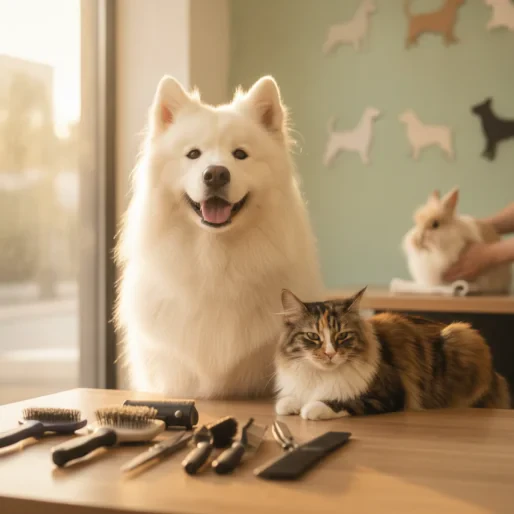
Essential Tools
- Greyhound-style metal comb (coarse and fine ends): the diagnostic tool. If this comb passes to skin easily, the area is groomed. If it stops, it is not.
- Slicker brush with flexible pad: for line brushing. A rigid pad pressed hard causes slicker burn (superficial abrasion) on thin-skinned areas.
- Pin brush: gentler for long, silky single coats and for finishing.
- Undercoat rake or moulting comb: essential from September for double coats.
- Dematting tool or seam ripper style splitter: used to split mats, not to saw through skin. Use sparingly and never flat against skin.
- Blunt-tipped, curved scissors: for feet and sanitary areas only.
- Clipper with a suitable blade: for removing pelted areas safely. In practice this is where most owners should hand over to a professional.
- Fine-toothed flea comb: for face, ears and tick detection.
- Tick removal hook or fine-tipped tick tweezers: not fingers, not standard tweezers.
- High-velocity dryer (professional) or a cool-setting stand dryer: drying is where sand and loose undercoat actually leave the coat.
Products
- A gentle, pH-appropriate pet shampoo. Canine and feline skin is more neutral to slightly alkaline than human skin, so human shampoo is inappropriate. Avoid heavy clarifying products on already dry, sun-exposed coat.
- A silicone-free or lightly conditioning rinse-out conditioner to restore cuticle smoothness after weeks of salt exposure.
- A detangling or dematting spray to lubricate hair shafts before mechanical work. Slip is what protects the skin.
- A soothing, fragrance-free leave-in or oatmeal-type rinse if the skin is dry and flaking. Avoid alcohol-based sprays on irritated skin.
- Veterinary-prescribed parasite prevention, discussed with your vet rather than chosen from a shelf, particularly in tick-heavy central and southern Italian countryside.
Do not use human hair oils, cooking oils or home remedies on mats. They add weight, attract sand and make professional dematting harder rather than easier.
Step-by-Step Recovery Grooming Routine
Step 1: Dry Assessment Before Anything Else (10 to 15 minutes)
Work in good light, on a non-slip surface, with the animal calm. Run your hands over the whole body first, then use the metal comb systematically: neck, behind ears, throat, chest, front legs and armpits, back, flanks, belly and groin, hind legs and trousers, tail base and tail, feet and between toes.
Map what you find. Note the location and size of every mat, whether it is loose (moves freely, comb passes at the edges) or tight to skin (does not lift, skin tents when pulled). Note any lumps, scabs, hot areas, or places the animal flinches. This map decides everything that follows, and it is also what a professional groomer will want to hear when you call.
Critical rule: never bathe a matted coat before addressing the mats. Water shrinks and tightens felted hair, converting a workable mat into a pelt.
Step 2: Remove Loose Sand and Salt Crust Dry
Before water, take the coat outdoors or into a bathroom and work loose grit out mechanically. A high-velocity dryer on a cool setting, held at an angle and moved constantly, blasts an impressive quantity of sand out of a double coat. Without one, a rubber curry on short areas and gentle pin brushing on long areas will shift the surface layer. Removing dry grit first means less abrasive material dragged through hair shafts later.
Step 3: Dematting With Lubrication and Patience
Spray the mat and the surrounding coat with detangling product and let it soak in for a minute. Then:
- Isolate the mat with your fingers and support the skin at its base with your other hand so no traction reaches the skin.
- Split the mat vertically into strips with a splitter or the tip of a comb, working with the direction of hair growth.
- Pick apart each strip from the outer tips inward, never from the skin outward.
- Comb through after each section to confirm progress, then move on.
- Work in short sessions. Ten to fifteen minutes per session for a cat, twenty to thirty for a tolerant dog, with breaks and reward.
Stop and clip instead if: the mat is flat against skin, covers a large area, sits over a joint, or the animal is showing pain or escalating stress. Professional grooming guidance is unambiguous here: a short clip is kinder than prolonged dematting. A pelted coat should be removed under a clipper by someone trained to keep the blade flat and to feel for skin folds and nipples beneath.
Step 4: The Salt-Removal Bath
Once the coat combs through, bathe. Sequence matters:
- Pre-rinse with lukewarm plain water for longer than feels necessary, at least three to five minutes on a large double coat. This alone removes most residual salt and fine sand.
- Shampoo once, working to the skin in sections rather than piling coat on top of itself. Piling creates new tangles.
- Rinse until the water runs completely clear and the coat squeaks slightly. Residual shampoo is a leading cause of post-bath itching and flaking.
- Condition, leave for the stated time, rinse thoroughly.
- Rinse ears and face last with a damp cloth rather than direct spray, and check ear canals for sand.
Step 5: Drying, Which Is Where the Groom Actually Happens
Air-drying a dense double coat is how mats reform. Towel-blot (do not rub, rubbing felts hair), then dry with forced air while brushing the coat away from the skin, section by section, from the bottom of the body upward. This is called fluff drying and it is what separates a professional finish from a home wash. Keep the dryer on cool or low warm; heat is unnecessary and risks burns, particularly on brachycephalic and elderly animals.
Step 6: Line Brushing and Carding
Line brushing is the professional standard for long coats: hold the coat up with one hand, drop a thin horizontal line of hair at a time, brush that line to the skin, then drop the next. It is slow and it is the only way to be certain the whole coat is done.
Carding (using a stripping knife or fine blade to pull dead undercoat from the base) is particularly useful in September on double-coated breeds and on short-coated dogs with dense undercoat. Tipping and hand-stripping remain the correct maintenance for wire-coated breeds such as the Lagotto Romagnolo's relatives and terriers, and should not be replaced with clipping if coat texture is to be preserved.
Step 7: Full Parasite and Foreign Body Sweep
With the coat clean and combed, this check finally becomes possible. Details in the next section.
Ticks and Grass Awns After Countryside Stays
Systematic Tick Checking
Ticks favour thin-skinned, sheltered sites. Check in this order, using fingertips and a flea comb: inside and around the ear flaps and ear base, eyelids and lips, under the collar, throat, armpits, between and under the toes and in the webbing, groin and inner thighs, under the tail and around the anus, and along the belly. On long-haired cats, the ruff and the base of the ears are the classic sites.
Remove any attached tick with a tick hook or fine-tipped tick tweezers: grasp as close to the skin as possible, then lift or twist steadily according to the tool's design without crushing the body. Do not apply oil, alcohol, petroleum jelly or a lit match, which encourage regurgitation. Clean the site afterwards and note the date. If the animal later develops lethargy, lameness, fever, pale gums or reduced appetite, tell your vet that a tick was removed and when. Tick-borne diseases including babesiosis, ehrlichiosis and Lyme borreliosis are recognised in various parts of Italy, and leishmaniasis (sandfly-borne rather than tick-borne) is endemic in coastal and southern regions, which is a separate reason to discuss preventatives with your vet before, not after, the holiday.
Grass Awns (Forasacchi)
Dry summer grasses shed barbed seed heads throughout August and September. They lodge in coat, then migrate through skin, into ear canals, up nostrils, under eyelids and into interdigital spaces. Once beneath the skin they can travel considerable distances and require veterinary retrieval.
Signs that should prompt a same-day veterinary call include sudden violent head shaking or one-sided ear scratching, persistent explosive sneezing, a painful swelling between the toes (often with a small draining hole), squinting or a weeping eye, or repeated licking at one spot. Preventively, keep the hair between the pads and toes trimmed short during awn season, comb the ear feathering and armpits after every walk, and check the tail and trousers of setters, spaniels, retrievers and long-coated shepherds especially carefully. Our detailed guide to grass seed and foxtail injuries in dogs covers presentation and treatment in depth.
Managing the Autumn Coat Change That Starts in September
Coat cycling in dogs and cats is driven substantially by photoperiod rather than temperature. As daylight shortens from late August, hair follicles in telogen (resting phase) release the summer coat and a denser winter undercoat begins to grow. In Italy's Mediterranean climate the change is often less dramatic than in northern Europe, but it is real, and it typically becomes obvious through September and October.
Practically, this means the exact moment your pet's coat is most compromised by salt, sand and holiday neglect is also the moment it begins to shed heavily. Dead undercoat that is not removed becomes the scaffolding for new mats.
Adjusting the Routine for the Shed
- Increase undercoat work from early September: rake or card double coats two to three times weekly during peak shed rather than weekly.
- Bathe and force-dry once at the start of the shed. A proper bath and blow-out releases far more dead coat than brushing alone.
- Do not shave double coats to "help" with shedding. Professional and veterinary consensus is that clipping a double coat removes the guard hairs that provide sun and insulation protection, and can lead to patchy, woolly regrowth. Our double-coated dog grooming guide explains the coat structure in detail.
- For long-haired cats, comb daily during the change. Increased shedding means increased ingestion and more hairballs; combing is the most effective intervention.
- Support skin from the inside: discuss diet and essential fatty acid adequacy with your vet, especially for animals that ate irregularly on holiday.
Frequency Guide by Coat Type
Long Single Coats (Maltese, Shih Tzu, Havanese, Yorkshire Terrier, Afghan Hound)
Hair grows continuously and mats readily. Line brush and comb daily during recovery, then every one to two days. Professional groom every four to six weeks. After a coastal holiday, many owners reasonably opt for a shorter, practical trim through September.
Double Coats (German Shepherd, Border Collie, Golden Retriever, Bernese Mountain Dog, Australian Shepherd, Spitz breeds)
Rake and line brush two to three times weekly year-round, daily during the September shed. Professional bath and blow-out every six to twelve weeks, ideally once at the start of the coat change.
Curly and Wavy Coats (Poodle, Lagotto Romagnolo, Bichon, Poodle crosses)
The highest-risk group for post-holiday pelting because the curl hides matting until it is total. Comb to skin daily. Professional groom every four to six weeks without exception.
Wire Coats (Terriers, Schnauzer, Spinone Italiano)
Comb weekly, hand-strip or card on the breed-appropriate cycle (typically every eight to twelve weeks for a rolled coat). Clipping softens texture and increases matting over time.
Long-Haired Cats (Persian, Maine Coon, Norwegian Forest, Ragdoll, Siberian)
Comb daily with a metal comb, focusing on the ruff, armpits, groin, trousers and tail base. Persians and other flat-faced breeds also need daily eye and facial fold care. Professional feline grooming every eight to twelve weeks, or more often for seniors and overweight cats.
Warning Signs to Watch For During Grooming
Grooming is the most thorough physical examination most pets receive. Treat every session as a health check.
Stop Grooming and Contact Your Vet If You Find
- Red, moist, weeping or foul-smelling skin under a removed mat (likely pyotraumatic dermatitis or infection).
- Any warm, painful swelling, particularly between toes or on the face.
- Skin that appears bruised, thickened, blackened or bloodstained.
- Small draining tracts or pinhole wounds (classic for migrating grass awns).
- Sudden head shaking, head tilt, or discharge or odour from an ear.
- New lumps, or existing lumps that have changed size, shape or texture.
- Widespread scale, dandruff, greasiness, or hair that pulls out easily in clumps with no obvious cause.
- Fleas, flea dirt, or crusted lesions along the spine and tail base.
- Pain, growling, hissing or flinching in an animal that previously tolerated handling: pain, not naughtiness, is the usual explanation.
- Sunburn or crusting on white-coated or thinly coated areas after weeks outdoors.
Post-swimming ear inflammation is especially common after a coastal holiday. Persistent scratching, odour or discharge needs veterinary assessment, not home cleaning products. Our guide to summer coat care, ticks, swims and hot spots covers post-water skin problems in more detail.
Professional Groomer or Home Grooming: A Decision Guide
Safe to Handle at Home
- Isolated, loose mats smaller than roughly the size of a coin that lift away from the skin.
- Routine bathing, combing, line brushing and undercoat raking.
- Nail trimming, if you are confident about the quick and the animal is cooperative.
- Trimming hair between the pads with blunt-tipped scissors.
- Daily tick and awn checks.
Book a Professional Groomer
- Any pelting: comb will not pass to skin over a broad area, or coat moves as a single sheet.
- Mats in high-risk locations: armpits, groin, between toes, around the anus, or close to the eyes.
- Long-haired cats requiring more than superficial dematting. Feline grooming is a specialist skill and stress management matters enormously.
- Any need for clippers over matted skin. Matted skin is thin, tented and easily lacerated.
- Coated breeds needing structural work: hand-stripping, breed trims, or restoring a coat after weeks of neglect.
- Senior, arthritic, cardiac or anxious animals who cannot tolerate long sessions.
Groomer and Vet Together
Severely pelted animals, animals with skin disease under the coat, and animals too painful or fearful to be groomed conscious may need sedation under veterinary supervision so the coat can be removed safely and humanely in a single session. Professional groomers working to IPG and comparable standards will decline to force a distressed or painful animal through a groom and will refer instead. That referral is a mark of competence, not a failure.
When booking after Ferragosto, be aware that mid-September is one of the busiest periods in the Italian grooming calendar. Book before you leave for the coast, not after you return, and tell the salon honestly what condition the coat is in so they can allocate enough time.
A Realistic Late August to September Recovery Schedule
Week 1 (return home): full dry assessment and mapping, sand removal, tick and awn sweep, staged dematting in short sessions, veterinary appointment if any warning sign appeared. Do not attempt everything on day one.
Week 2: once the coat combs through, full bath, condition, force-dry and line brush. Professional appointment if pelting was found. Re-check paws and ears daily.
Weeks 3 and 4 (early September): introduce increased undercoat work as the shed begins. Establish the routine that will carry through autumn: daily comb for long single coats and cats, two to three sessions weekly for double coats.
Ongoing through September: weekly skin check, continued parasite prevention, and a maintained professional grooming cycle. A pet that finishes September fully combed, parasite-free and shedding cleanly is a pet that will go into winter with a functional, insulating coat.
The goal of recovery grooming is not a show finish. It is a coat that can be combed to the skin without pain, skin that can be seen and inspected, and an animal that still enjoys being handled at the end of it.
This article is for educational purposes and does not replace consultation with a licensed veterinarian or a qualified professional groomer. If you are uncertain about your pet's skin or coat, seek professional assessment.
Frequently Asked Questions
Content Disclosure
This article was created using state-of-the-art AI models with human editorial oversight. It is intended for informational and entertainment purposes only and does not constitute veterinary medical advice. Always consult a licensed veterinarian for your pet's specific health needs. Learn more about our process.