New bearded dragon owners often repeat the same preventable husbandry errors each spring. This guide covers UVB bulb replacement timing, basking temperature accuracy, insect overfeeding risks, and safe outdoor sun exposure setups.
Key Takeaways
- UVB bulbs lose effective output well before they visibly burn out; replacement every six months is the widely accepted guideline for most linear fluorescent tubes.
- Basking surface temperature matters more than ambient air temperature, and inaccurate thermometers are a leading cause of thermal stress behaviours.
- Overfeeding insects to adult bearded dragons in spring triggers obesity, fatty liver changes, and stress related behavioural shifts such as lethargy and glass surfing.
- Outdoor sun exposure is highly beneficial but requires a secure, shaded, escape proof enclosure to prevent predator stress, overheating, and escape.
- Many behavioural signs owners misread as "happiness" or "laziness" are actually indicators of suboptimal husbandry.
Why Spring Is a Critical Window for Bearded Dragon Husbandry
Spring presents a unique convergence of challenges for new bearded dragon owners. Dragons emerging from brumation (the reptilian equivalent of a dormancy period) undergo hormonal shifts, appetite changes, and increased activity levels. Their metabolic demands rise sharply, yet many owners are still operating on winter routines. The result is a cluster of preventable mistakes that manifest as stress behaviours: glass surfing (repetitive scratching at enclosure walls), colour darkening of the beard and body, appetite refusal, and abnormal basking patterns.
Understanding these behaviours through an ethological lens is essential. A bearded dragon flattening its body on a basking spot is performing a thermoregulatory behaviour. A dragon with a persistently black beard in the absence of social stimuli may be experiencing chronic stress. Recognising the difference between species typical behaviour and distress signals allows owners to intervene before veterinary emergencies develop.
Mistake 1: Ignoring UVB Bulb Replacement Schedules
The Root Cause
UVB bulbs degrade in spectral output long before they stop producing visible light. Most linear fluorescent UVB tubes (T5 and T8 formats) lose a clinically significant portion of their UVB output within approximately six to twelve months of use, depending on the brand and technology. T5 high output bulbs generally maintain effective output longer than T8 bulbs, but no bulb lasts indefinitely. New owners frequently assume that a bulb still producing visible light is still producing adequate UVB radiation. This assumption is incorrect and potentially dangerous.
Behavioural and Health Consequences
Insufficient UVB exposure impairs vitamin D3 synthesis, which in turn disrupts calcium metabolism. The early behavioural signs are subtle: reduced activity, reluctance to climb, mild tremors during movement, and an increase in time spent directly under the UVB source (a compensatory behaviour). As metabolic bone disease (MBD) progresses, owners may observe jaw softening, limb deformities, and inability to support body weight. These are welfare emergencies requiring immediate veterinary intervention.
The Correct Approach
- Record the installation date of every UVB bulb and set a reminder for replacement. For most T5 HO linear tubes, the professional consensus suggests replacement every twelve months. For T8 tubes, every six months is more appropriate.
- Use a UVB meter (such as a Solarmeter 6.5R) if possible to measure actual output at the basking distance. This removes guesswork entirely.
- Ensure the UVB tube spans at least two thirds of the enclosure length, positioned so the dragon receives exposure during normal basking behaviour.
- Replace any mesh or glass lids between the bulb and the animal with UVB transmitting mesh where possible. Standard glass and fine mesh can block a substantial percentage of UVB radiation.
For owners using smart habitat monitors, pairing a digital UVB sensor with automated alerts can help ensure consistent replacement schedules.
Mistake 2: Basking Temperature Errors
Why This Happens
Temperature regulation is the foundation of reptilian physiology. Bearded dragons are obligate ectotherms; they depend entirely on external heat sources to reach metabolic operating temperature. The most common spring error is measuring ambient air temperature with an analogue stick on thermometer instead of measuring the actual basking surface temperature with an infrared thermometer or a reliable digital probe.
What the Science Says
The generally recommended basking surface temperature for adult bearded dragons (Pogona vitticeps) is approximately 40 to 43 degrees Celsius (104 to 110 degrees Fahrenheit). Juvenile dragons may benefit from slightly warmer basking spots, around 43 to 46 degrees Celsius (110 to 115 degrees Fahrenheit), to support higher metabolic rates and growth. The cool end of the enclosure should remain around 26 to 29 degrees Celsius (78 to 85 degrees Fahrenheit) to allow effective thermoregulation through shuttling behaviour.
Behavioural Red Flags
- Basking spot too cool: The dragon spends excessive time on the basking spot without achieving full activity, displays dark body colouration (maximising heat absorption), and may show reduced appetite because digestion is temperature dependent.
- Basking spot too hot: The dragon gapes persistently (a thermoregulatory behaviour to dissipate heat), avoids the warm end entirely, or retreats to the cool side and becomes lethargic.
- No thermal gradient: If the entire enclosure is uniformly warm or uniformly cool, the dragon cannot perform shuttling behaviour. This is a form of environmental deprivation that creates chronic physiological stress.
Corrective Steps
- Invest in a quality infrared temperature gun and measure the basking surface directly, not the air two inches above it.
- Use a dimming thermostat connected to the basking lamp for precise, automated temperature control.
- In spring, ambient room temperatures rise. This can push enclosure temperatures above safe limits. Monitor daily and adjust lamp wattage or height accordingly.
- Verify that the basking platform is a solid surface (stone, ceramic tile, or textured resin) that holds heat effectively.
Mistake 3: Overfeeding Insects
Understanding the Dietary Shift
Juvenile bearded dragons require a diet heavily weighted toward live insects (typically around 70 to 80 percent insects and 20 to 30 percent plant matter). However, as dragons mature past 12 to 18 months, this ratio should gradually invert. Adult bearded dragons thrive on a diet comprising roughly 70 to 80 percent leafy greens and vegetables, with insects offered in moderation, perhaps a few times per week rather than daily.
New owners who acquired their dragon as a juvenile often fail to adjust this ratio as the animal matures. Spring compounds the problem because post brumation appetite surges can lead owners to offer excessive quantities of high fat feeder insects such as waxworms and superworms.
Behavioural and Health Consequences
- Obesity: Fat deposits become visible behind the skull, along the limbs, and at the tail base. Obese dragons show reduced mobility and diminished species typical exploratory behaviour.
- Hepatic lipidosis: Fatty liver disease is a documented concern in overfed captive reptiles. Lethargy, anorexia, and colour changes may indicate hepatic compromise.
- Selective feeding behaviour: Dragons offered unlimited high reward insects (such as waxworms) frequently refuse nutritionally superior staple greens. This is an example of conditioned food preference, not "pickiness" in the colloquial sense. The animal has learned to hold out for the higher value reinforcer.
- Glass surfing after meals: Paradoxically, overfeeding can increase restlessness. Gastrointestinal discomfort from excessive insect chitin or volume can trigger increased locomotor activity and repetitive behaviours along enclosure walls.
Practical Feeding Guidelines
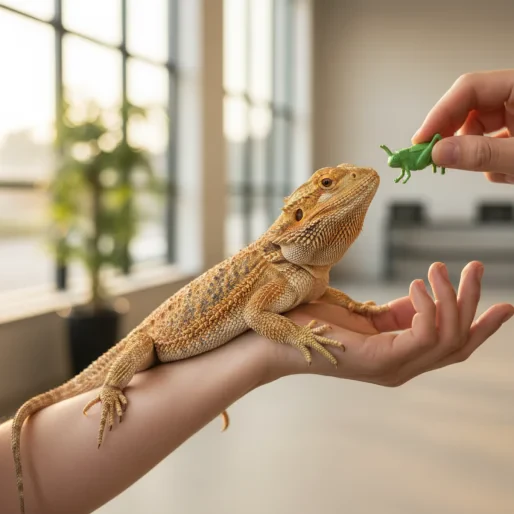
- Offer staple insects (appropriately sized crickets, dubia roaches, black soldier fly larvae) two to three times per week for adults, with portion sizes roughly equivalent to what the dragon can consume in a 10 to 15 minute window.
- High fat insects (waxworms, butterworms) should be reserved as occasional enrichment, not dietary staples.
- Provide a daily salad of chopped leafy greens (collard greens, mustard greens, dandelion greens) as the dietary foundation.
- Dust insects with calcium powder (without D3 if UVB lighting is adequate) at most feedings, and with a calcium plus D3 supplement once or twice weekly as a safeguard. A multivitamin supplement once weekly is also commonly recommended.
Mistake 4: Unsafe Outdoor Sun Exposure
Why Natural Sunlight Matters
No artificial UVB source perfectly replicates the full spectrum of natural sunlight. Brief periods of outdoor exposure during warm spring days can be tremendously beneficial for vitamin D3 synthesis, behavioural enrichment, and overall welfare. However, many new owners make the critical error of simply placing their dragon outside in an open area, on a leash, or in an unsuitable container. This introduces serious risks.
The Behaviour Problem: Acute Stress Response
Bearded dragons placed in unfamiliar outdoor environments without adequate cover frequently display acute fear responses: frantic running, colour darkening, beard puffing, and attempted escape behaviour. Overhead shadows from birds trigger a hardwired anti predator response (bearded dragons are prey animals for raptorial birds in their native Australian habitat). This is not a response the animal "gets used to" through repeated exposure in the way casual flooding might suggest. Repeated uncontrolled outdoor exposure without security features constitutes a form of sensitisation, progressively worsening the fear response rather than habituating the animal.
Specific Setup Requirements
- Enclosure type: Use a fully enclosed, escape proof outdoor enclosure with mesh sides that allow unfiltered UVB transmission. The mesh must be fine enough to prevent the dragon from pushing through or catching toes. Many owners repurpose small animal playpens or build custom timber and mesh enclosures. Similar principles apply to those discussed for outdoor grazing runs for rabbits and guinea pigs.
- Shade provision: At least one third of the enclosure must be shaded at all times. Overheating is a genuine emergency risk. Unlike indoor basking, the dragon cannot escape solar radiation by shuttling to a cool end unless shade is provided.
- Predator protection: The enclosure must have a secure top. Hawks, crows, cats, and dogs are all potential threats. A solid mesh top reduces both physical danger and the stress of overhead predator silhouettes.
- Substrate and furniture: Provide a familiar hide and a basking surface inside the outdoor enclosure. Familiar items reduce novelty stress. This is a basic application of environmental management: reducing trigger intensity while the animal acclimates.
- Supervision: Never leave a bearded dragon outdoors unattended. Temperature shifts, unexpected weather, and predator intrusion can occur rapidly.
- Duration: Start with short sessions of 15 to 20 minutes, gradually increasing if the dragon displays relaxed body language (normal colouration, alert but calm posture, voluntary basking). If the animal shows persistent stress signs, end the session immediately.
Owners planning to travel with their bearded dragon during warmer months should also consider the specific risks associated with heat and animal transport.
Reading Your Bearded Dragon's Stress Signals
Many of the mistakes above produce overlapping behavioural indicators. Learning to read bearded dragon body language is the single most valuable skill a new owner can develop. The following is not exhaustive but covers the most commonly misinterpreted signals.
- Glass surfing: Repetitive scratching or running along the glass walls of an enclosure. This is not playfulness. It typically indicates environmental dissatisfaction: incorrect temperatures, insufficient space, hunger, or visual stressors (such as seeing their own reflection or another animal).
- Beard darkening: A transiently dark beard during social interaction or feeding can be normal. A persistently black beard, especially combined with body flattening or gaping, indicates stress or illness.
- Head bobbing: In males, this is often a territorial or courtship display. In novel environments, rapid head bobbing may indicate agitation.
- Arm waving: Often described as "cute," arm waving is typically a submissive or appeasement signal. Frequent arm waving in a solitary dragon may suggest the animal perceives a threat (reflection, overhead movement, nearby pets).
- Lethargy beyond brumation: Post brumation lethargy lasting more than a week or two, especially with appetite loss, warrants veterinary evaluation for parasites, infection, or husbandry related illness.
Management Strategies While Correcting Husbandry
Behavioural improvement in reptiles follows environmental correction. Unlike mammals, where behaviour modification protocols may involve complex training plans, bearded dragon welfare improvements are overwhelmingly driven by getting the habitat right. The following management priorities should be addressed simultaneously, not sequentially.
- Audit the entire lighting setup: UVB output, photoperiod (typically 12 to 14 hours of light in spring), and basking lamp wattage.
- Calibrate temperatures with reliable instruments and verify both the basking surface and the cool zone.
- Restructure the diet according to the animal's age and body condition.
- Eliminate visual stressors: cover reflective glass sides from the outside if glass surfing is persistent, remove line of sight to other pets, and ensure the enclosure is positioned in a low traffic area at or above the owner's waist height (below eye level placement can trigger defensive behaviours).
- Record behavioural observations daily for two weeks after making changes. Note basking duration, appetite, faecal quality, and stress signal frequency. This data is invaluable if a veterinary consultation becomes necessary.
Owners concerned about veterinary costs for diagnostics should explore budget alternatives and financial planning options as well as understanding pet insurance waiting periods.
When to Consult a Reptile Veterinarian or Certified Behaviourist
While most spring care errors can be corrected through improved husbandry, certain situations require professional assessment.
- Any signs of metabolic bone disease: tremors, jaw softening, limb swelling, inability to support body weight.
- Persistent anorexia lasting beyond two weeks post brumation with weight loss.
- Prolapse (tissue protruding from the cloaca), which can be associated with straining from dietary imbalances.
- Behavioural changes that do not resolve within two to three weeks of husbandry corrections.
- Signs consistent with respiratory infection: mucus around the nostrils, open mouth breathing unrelated to thermoregulation, wheezing.
A consultation with a veterinarian experienced in reptile medicine is the appropriate first step. For complex or persistent behavioural concerns that do not have an identifiable medical cause, referral to a professional with expertise in reptile behaviour may be warranted. Organisations such as the International Association of Animal Behavior Consultants (IAABC) maintain directories that can help locate qualified professionals.
Frequently Asked Questions
How often should you replace a bearded dragon UVB bulb? ↓
What is the correct basking surface temperature for an adult bearded dragon? ↓
Why is my bearded dragon glass surfing after eating? ↓
Can you take a bearded dragon outside for natural sunlight? ↓
How many insects should an adult bearded dragon eat per week? ↓

David Okafor
Certified Animal Behaviourist
Certified animal behaviourist — science-based strategies for fear, anxiety, reactivity, and behavioural challenges.
Content Disclosure
This article was created using state-of-the-art AI models with human editorial oversight. It is intended for informational and entertainment purposes only and does not constitute veterinary medical advice. Always consult a licensed veterinarian for your pet's specific health needs. Learn more about our process.