Spring triggers a surge in territorial barking driven by increased foot traffic, wildlife activity, and open windows. This guide explains the behavioural science behind the spike and offers humane modification strategies owners can start today.
Key Takeaways
- Spring barking spikes are rooted in normal canine territorial and alert behaviour, amplified by seasonal changes in stimuli.
- Open windows, longer daylight, more pedestrians, and returning wildlife all act as compounding triggers (a concept behaviourists call trigger stacking).
- Punishment and flooding make reactivity worse. Counter-conditioning and management are the humane, evidence-based path forward.
- If barking is accompanied by lunging, snapping, self-injury, or inability to settle for prolonged periods, consult a certified applied animal behaviourist or veterinary behaviourist.
Root Cause Analysis: Why Spring Changes Everything
Territorial barking is a normal part of the domestic dog's behavioural repertoire. Dogs evolved alongside humans partly because of their willingness to alert to novel stimuli. In ethological terms, barking in this context serves as a distance-increasing signal: the dog perceives something approaching the home territory and vocalises to discourage further approach.
What makes spring unique is the sheer volume of new or returning stimuli that arrive within a short window. Three categories dominate:
- Increased human foot traffic. Warmer weather brings more pedestrians, joggers, children on bicycles, and delivery drivers. For a dog stationed at a front window or behind a garden fence, each passerby can become a rehearsal of the bark-and-retreat cycle: the person walks past, the dog barks, the person continues walking, and the dog interprets the departure as a successful repulsion. This self-reinforcing loop is one of the most well-documented maintenance patterns for territorial barking in applied behaviour literature.
- Wildlife resurgence. Squirrels, birds, rabbits, and other small animals become significantly more active in spring. Movement at ground level and in trees activates predatory motor patterns and alert responses. For breeds with strong chase or watchdog tendencies, this can be intensely arousing.
- Open windows and doors. Perhaps the single biggest seasonal change is acoustic. Homes that were sealed against winter cold suddenly admit a full soundscape of neighbourhood activity: car doors, voices, lawnmowers, birdsong. A dog that seemed calm all winter may simply have been under-stimulated. The behaviour was latent, not absent.
Is It Normal? When Does Barking Become a Problem?
A few alert barks when someone approaches the front door generally fall within typical canine communication. The behaviour becomes a welfare and practical concern when:
- The dog cannot disengage from the trigger and continues barking for minutes after the stimulus has gone.
- Arousal escalates into lunging, growling, or redirected aggression toward household members or other pets.
- The dog shows signs of sustained stress: panting when at rest, pacing, inability to sleep, digestive upset, or loss of appetite.
- Bark intensity and frequency increase over weeks, indicating sensitisation rather than habituation.
- Neighbours, landlords, or local authorities raise noise complaints.
The Fear, Anxiety, and Stress (FAS) scale, widely referenced in Fear Free veterinary practice, provides a useful framework. A dog at FAS level 1 (mild) may bark briefly and return to rest. At FAS levels 3 to 5, the dog may exhibit whale eye, tucked tail, rigid posture, excessive drooling, or inability to take treats, all signs that the emotional state has shifted well beyond simple alerting into genuine distress.
Understanding Trigger Stacking
One concept that transforms how owners understand spring reactivity is trigger stacking. Each individual stimulus (a jogger, a squirrel, a slammed car door) may be tolerable alone. But when several occur in quick succession, the dog's cortisol and adrenaline levels accumulate faster than they can recover. Research on canine stress physiology suggests that cortisol can remain elevated for hours or even days after an acute stressor, meaning a dog that had a reactive morning may have a lower threshold for the rest of the day.
Spring is essentially a season of chronic trigger stacking. Owners who say "he was fine five minutes ago" are often witnessing the moment the cumulative load exceeded the dog's coping capacity.
Behaviour Modification Techniques
1. Classical Counter-Conditioning
The gold standard for changing a dog's emotional response to a trigger is classical counter-conditioning. The goal is not to suppress the bark but to change the underlying emotional association from "threat, repel" to "that predicts something I enjoy."
The process:
- Identify the dog's threshold distance or stimulus intensity at which it notices the trigger but has not yet reacted. This is the sub-threshold zone.
- The moment the dog perceives the trigger (ears prick, head turns), deliver a high-value food reward. Timing matters: the trigger must predict the food, not the other way around.
- Repeat across many short sessions. Over time, the dog should begin to orient toward the owner upon noticing the trigger, a response behaviourists call a conditioned emotional response (CER).
If the dog is too aroused to eat, the stimulus is too close or too intense. Move further away or reduce exposure. Forcing proximity is flooding, and professional guidelines from the IAABC (International Association of Animal Behavior Consultants) and the American Veterinary Society of Animal Behavior (AVSAB) explicitly advise against it.
2. Differential Reinforcement of an Incompatible Behaviour (DRI)
Once the emotional response is shifting, owners can layer in an operant component. A common DRI approach for window barking:
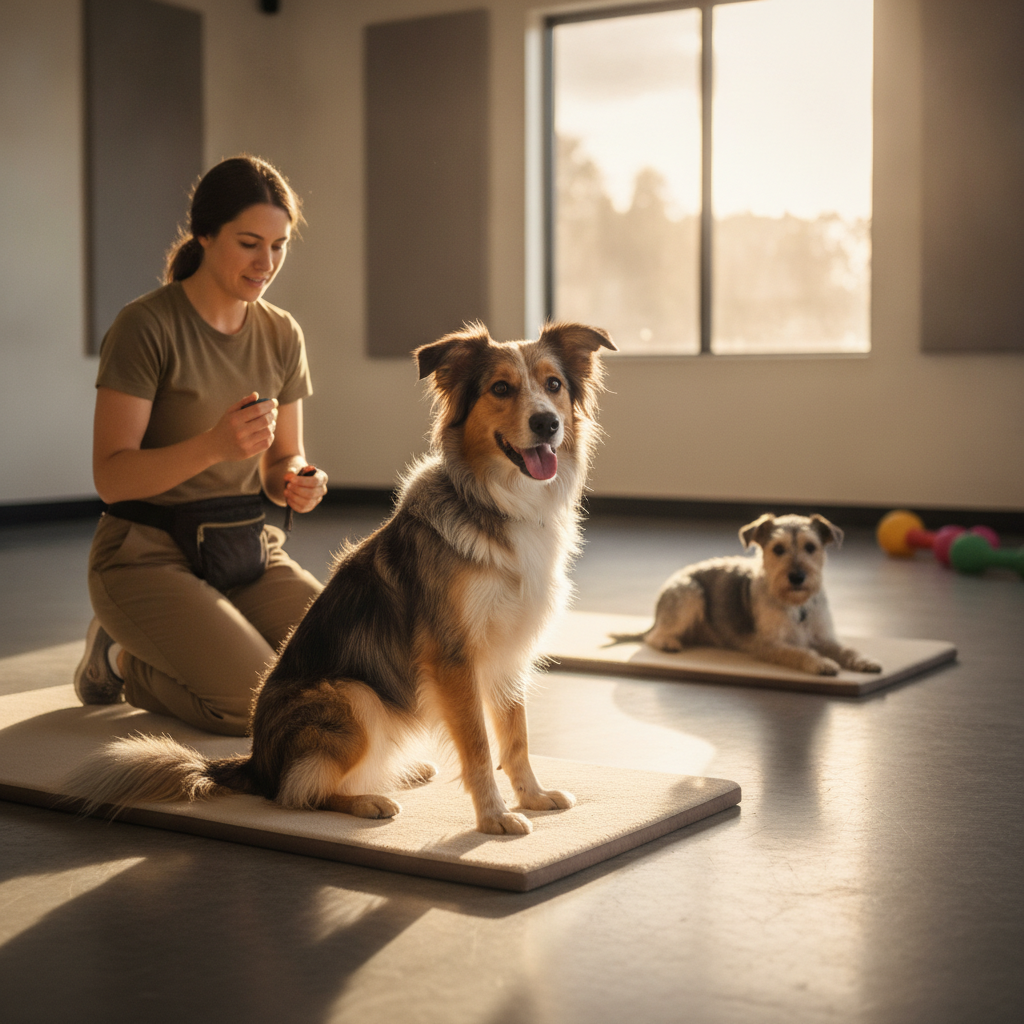
- Teach a reliable "place" or "mat" cue in a low-distraction environment first.
- Gradually add mild versions of the trigger (e.g., a family member walking past the window).
- Reinforce the dog for remaining on the mat. Lying down and barking simultaneously is biomechanically possible but far less likely when the dog has been reinforced for relaxed postures.
3. Desensitisation
Systematic desensitisation involves presenting the trigger at such a low intensity that it does not provoke a reaction, then gradually increasing intensity. For sound-based triggers (voices outside, wildlife calls), recorded audio played at low volume through a speaker can be a useful training tool. Increase volume incrementally across sessions, pairing each level with counter-conditioning.
4. Capturing Calmness
A technique popularised in evidence-informed training circles involves reinforcing the dog any time it is voluntarily calm: lying on a hip, sighing, resting its chin on paws. Over weeks, this builds a stronger default "do nothing" behaviour that competes with reactivity. No cue is given; the owner simply marks and rewards the calm state.
Management Strategies While Training
Behaviour modification takes weeks to months. In the interim, management prevents the dog from rehearsing the unwanted behaviour, which would undermine training progress.
Visual Barriers
- Apply frosted window film to lower panes the dog can see through.
- Rearrange furniture so the dog cannot station itself at the front window unsupervised.
- Use baby gates to restrict access to high-stimulus rooms when no one is home to train.
Acoustic Buffering
- Close windows on the street-facing side of the home during peak foot traffic hours.
- Use white noise machines, fans, or calm music playlists designed for dogs (studies have explored the calming effects of classical music and reggae on shelter dogs, with some evidence of reduced vocalisation and increased resting behaviour).
- If the home must be ventilated, open windows on the quieter side of the property.
Environmental Enrichment
A dog with unmet cognitive and physical needs is more likely to fixate on external stimuli. Spring is an ideal time to increase enrichment: scatter feeding in the garden, snuffle mats, frozen food-stuffed toys, and novel scent trails. For more ideas, see DIY Dog Enrichment Rotation From Recycled Materials. Additionally, dogs that are carrying extra weight from a sedentary winter may benefit from a gradual return to exercise, as outlined in Spring Fitness Restart Plan for Overweight Dogs.
Leash Walks and Outdoor Reactivity
Spring barking often extends beyond the home. On walks, owners may notice increased lunging and barking at other dogs, people, or wildlife. Key management tips:
- Walk during lower-traffic times (early morning or later evening).
- Use a well-fitted harness rather than a collar to reduce neck pressure during unexpected lunges.
- Carry high-value treats and practise emergency U-turns when a trigger appears suddenly.
- Avoid retractable leads, which provide inconsistent feedback and limited control near triggers.
If your dog will be spending time in a boarding facility this summer, reactivity history is important information to share with staff. Guidance on evaluating facilities can be found in How to Choose a Dog Boarding Facility This Summer.
The Role of Nutrition and Physical Health
Chronic stress can affect gut health, and emerging research in the field of the gut-brain axis in dogs suggests that nutritional factors may play a supporting role in behavioural wellness. While diet alone will not resolve territorial reactivity, ensuring the dog receives balanced, high-quality nutrition is part of a holistic approach. Owners exploring novel protein sources can review Insect Protein Dog Food: The Science Explained or Raw vs Cooked vs Freeze-Dried Dog Food Compared for evidence-based comparisons.
Underlying pain conditions can also lower a dog's tolerance threshold. A dog with undiagnosed orthopaedic discomfort, for example, may react more intensely because its baseline stress is already elevated. Regular veterinary health checks are essential, particularly for older dogs or breeds predisposed to joint issues. Owners managing conditions such as hip dysplasia may find Hydrotherapy for Dogs With Hip Dysplasia: Cost Guide useful.
What About Medication?
For dogs whose anxiety is severe enough that they cannot engage with behaviour modification (unable to take food, panting and pacing continuously, showing signs of panic), psychopharmacological support may be appropriate. This is a veterinary decision, ideally made in collaboration with a veterinary behaviourist. Common categories of medications used in canine anxiety cases include selective serotonin reuptake inhibitors and short-acting anxiolytics, but dosing and selection must be tailored to the individual dog. Medication is not a replacement for behaviour modification; it is a tool that can lower arousal enough for learning to occur.
When to Consult a Certified Animal Behaviourist
Owners should seek professional help when:
- The dog has bitten or attempted to bite a person or animal.
- Barking is accompanied by signs of severe distress (self-harm, destruction of barriers, prolonged inability to settle).
- The behaviour is worsening despite consistent management and training efforts over several weeks.
- Multiple triggers are involved and the owner feels overwhelmed.
- The dog's quality of life is noticeably diminished.
Look for credentials such as CAAB (Certified Applied Animal Behaviourist), DACVB (Diplomate of the American College of Veterinary Behaviorists), or IAABC-certified consultants. These professionals adhere to ethical standards that prohibit the use of aversive tools and techniques. Reputable directories include the IAABC consultant locator and the ACVB directory.
If veterinary costs are a concern, it is worth understanding how insurance may cover behavioural consultations. Some policies include coverage for conditions diagnosed by a veterinary behaviourist. For more detail, see Pet Insurance Waiting Periods: Your Questions Answered.
A Note on What Not to Do
Several common owner responses can inadvertently worsen spring reactivity:
- Yelling at the dog to be quiet. From the dog's perspective, the owner is joining in the alarm. This often increases arousal.
- Shock collars, spray collars, or rattle cans. The AVSAB's position statement on the use of punishment in animal training notes that aversive interventions risk increasing fear, anxiety, and aggression. They may suppress the visible behaviour temporarily while worsening the underlying emotional state.
- Ignoring the behaviour entirely. While not harmful in the way punishment is, simple extinction (ignoring) is often insufficient for territorial barking because the reinforcer (the trigger leaving) is environmental, not owner-delivered. The owner cannot control when a pedestrian walks away.
- Flooding. Deliberately exposing the dog to intense stimuli to "get used to it" risks profound sensitisation and learned helplessness.
Putting It All Together: A Sample Weekly Plan
Below is a realistic framework for the first two weeks. Adjust based on your dog's individual progress.
- Days 1 to 3: Implement all management strategies (window film, white noise, restricted access). Begin capturing calmness indoors with no triggers present.
- Days 4 to 7: Introduce counter-conditioning at sub-threshold levels. If using recorded sounds, start at barely audible volume. Keep sessions to 3 to 5 minutes, two to three times daily.
- Days 8 to 14: If the dog is consistently offering a CER (looking at the owner when the trigger appears), begin very slight increases in trigger intensity. Add "place" training in a quiet room. Continue capturing calmness throughout the day.
Progress is rarely linear. Expect setbacks on days with high trigger stacking (weekends, holidays, garbage collection days). The goal is a general trend toward calmer responses over weeks, not perfection within days.
Final Thoughts
Spring reactivity is not a sign that a dog is "bad" or "dominant." It is a predictable behavioural response to a genuine increase in environmental stimulation, layered onto the dog's individual temperament, learning history, and current welfare state. With thoughtful management, humane counter-conditioning, and professional support when needed, most dogs can learn to navigate the busier season with significantly less distress. The investment in patient, science-based training pays dividends not only in quieter homes but in stronger, more trusting relationships between dogs and their families.
Frequently Asked Questions
Why does my dog bark more when the windows are open in spring? ↓
Is it okay to let my dog bark a few times and then call them away? ↓
Will punishment such as a spray collar stop territorial barking? ↓
How long does behaviour modification for territorial barking take? ↓
When should I see a professional instead of handling this at home? ↓

David Okafor
Certified Animal Behaviourist
Certified animal behaviourist — science-based strategies for fear, anxiety, reactivity, and behavioural challenges.
Content Disclosure
This article was created using state-of-the-art AI models with human editorial oversight. It is intended for informational and entertainment purposes only and does not constitute veterinary medical advice. Always consult a licensed veterinarian for your pet's specific health needs. Learn more about our process.