
In this article
- Key Takeaways
- Why Enrichment Rotation Matters
- Preparation: What You Need
- Safety Screening: Do This Before Every Build
- Build 1: The Snuffle Mat
- Build 2: Cardboard Puzzles (Three Variations)
- Build 3: The Bottle Spinner
- Setting Up a Weekly Rotation Schedule
- What to Watch for During and After Sessions
- When to Call Your Vet Immediately
- Sustainability and Cost Benefits
- Final Checklist Before You Start
Key Takeaways
- A rotating enrichment schedule using three to five homemade toys prevents boredom and reduces destructive behaviour more effectively than leaving the same toys out every day.
- Snuffle mats, cardboard puzzles, and bottle spinners can all be built for little or no cost from items already in your recycling bin or fabric scrap pile.
- Safety screening every material before use is non negotiable: remove staples, labels, small caps, and any item your dog could swallow.
- Always supervise your dog during enrichment sessions, especially the first few times with a new puzzle.
- If your dog swallows a piece of cardboard, fabric, or plastic, contact your veterinarian immediately.
Why Enrichment Rotation Matters
Mental stimulation is widely recognised by veterinary behaviour specialists as essential to canine welfare. The RSPCA and ASPCA both list environmental enrichment as a core component of responsible dog ownership. Dogs that lack mental outlets commonly develop repetitive behaviours such as excessive licking, barking, or destructive chewing.
Rotation is the key concept here. Presenting the same toy every day leads to habituation, meaning the dog loses interest. A simple weekly rotation of three to five different enrichment items keeps the novelty factor high without requiring a large budget. Professional dog daycare facilities use this principle daily, and it works just as well at home. If you are preparing a dog for new social environments, enrichment confidence also supports smoother transitions (see Prepare Your Dog for Its First Day at Daycare).
Preparation: What You Need
Recycled and Household Materials
- Fleece or old T shirts: Cut into strips for snuffle mats. Fleece is ideal because it does not fray into threads that could be swallowed.
- Cardboard boxes and tubes: Cereal boxes, toilet roll tubes, egg cartons, and shoe boxes. Remove all tape, staples, and plastic windows first.
- Plastic bottles (500 ml to 1.5 litre): Clean, dry, with the cap and label ring removed.
- Old towels or tea towels: For wrapping treats inside simple roll up puzzles.
- Muffin tins: A standard 6 or 12 cup tin works as a puzzle base when paired with tennis balls.
Tools
- Sharp scissors or a rotary cutter
- A rubber sink mat or piece of non slip shelf liner (as a snuffle mat base)
- A wooden dowel, chopstick, or sturdy stick (for the bottle spinner frame)
- A hole punch or craft knife
- Cable ties or strong string
Treats and Food
Small, soft training treats or pieces of your dog's regular kibble work best. Avoid anything sticky, as it will gum up fabric and cardboard quickly. For dogs on restricted diets, consult your vet or check our guide on Feeding Dogs in Extreme Heat: A Nutrition Guide for tips on adjusting treat calories.
Safety Screening: Do This Before Every Build
Before assembling any enrichment toy, run through this checklist:
- Remove all staples, tape, glue residue, and plastic windows from cardboard items.
- Remove bottle caps and the small plastic ring beneath them. These are common choking hazards.
- Check fabric for loose buttons, zips, or elastic that could be chewed off and swallowed.
- Avoid glossy or heavily printed cardboard (such as magazine covers) where inks may contain solvents. Plain brown corrugated cardboard is safest.
- Size the toy to your dog. A toilet roll tube is fine for a Labrador but could be swallowed whole by a Great Dane. Scale up or down accordingly.
- Discard and replace any enrichment item as soon as it shows significant damage. These are single session or short lifespan toys by design.
Build 1: The Snuffle Mat
What It Is
A snuffle mat is a fabric based foraging toy. Strips of fleece are tied through a grid base, creating a dense, grass like surface where kibble or treats are hidden. Dogs use their nose to push through the fabric and find the food, which engages natural scavenging instincts and can tire a dog out surprisingly quickly.
Step by Step Instructions
- Prepare the base: Take a rubber sink mat or a piece of non slip shelf liner with a grid of holes. A piece roughly 30 cm by 40 cm works well for medium sized dogs. Trim it to size if needed.
- Cut fabric strips: Cut fleece or old T shirt material into strips approximately 2.5 cm wide and 15 cm long. You will need around 150 to 250 strips depending on the grid size. This is the most time consuming part, and most owners find it easier to cut in batches while watching television.
- Tie the strips: Push one strip through a hole from the top, then bring both ends up through the adjacent hole. Tie a simple overhand knot on top, pulling it snug against the mat. Repeat for every hole across the grid.
- Fill densely: The mat works best when it is full and fluffy. Sparse mats are too easy for most dogs to solve in seconds.
- Test it: Sprinkle a small handful of kibble into the mat, push it down between the strips, and let your dog investigate.
Tips for Success
- Start with high value treats scattered on top of the mat so your dog understands the concept before you bury food deeper.
- Wash the mat regularly. Most fleece snuffle mats can go in the washing machine on a cool cycle inside a pillowcase or mesh laundry bag.
- For dogs that tend to pick up and shake the whole mat, place it on a non slip surface or inside a shallow cardboard box to anchor it.
Build 2: Cardboard Puzzles (Three Variations)
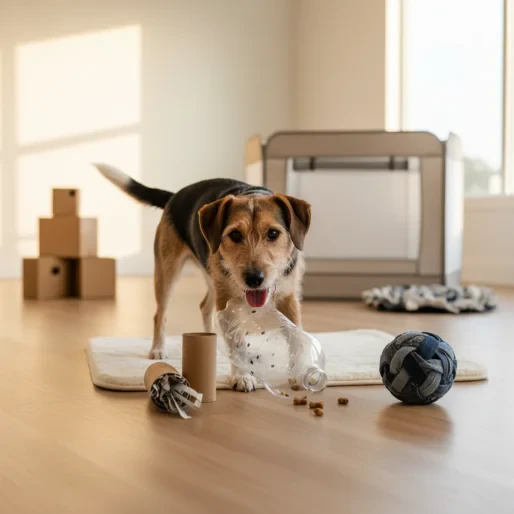
Variation A: Toilet Roll Treat Tubes
- Take a toilet roll tube and fold one end flat, creasing it closed.
- Drop a few pieces of kibble inside.
- Fold the other end closed in the opposite direction, creating a sealed parcel.
- Offer it to your dog and let them tear it open.
This is the simplest enrichment build and a great starting point for puppies or dogs new to puzzle toys.
Variation B: Egg Carton Puzzle
- Place a treat in each cup of a cardboard egg carton.
- Close the lid and let your dog figure out how to open or tear through it.
- To increase difficulty, place tennis balls or scrunched up paper over the treats inside the cups before closing the lid.
Variation C: Box in a Box
- Take a small box (such as a tea box) and place treats inside. Close it loosely.
- Place that box inside a medium box with some crumpled newspaper as packing.
- Place the medium box inside a larger box (a shoe box works well).
- Let your dog unpack the layers to find the reward.
This multi layer approach is excellent for dogs that need a longer challenge. It also supports the kind of gentle problem solving that benefits rescue dogs building confidence (see Teaching a Rescue Dog to Accept Handling and Grooming for more on building trust through positive experiences).
Cleanup Note
Cardboard puzzles create mess. That is part of the fun. Have a bag ready to collect shredded pieces immediately after the session. Supervise the entire time to ensure your dog is shredding but not eating large quantities of cardboard.
Build 3: The Bottle Spinner
What It Is
A bottle spinner is a plastic bottle mounted horizontally on a rod or frame so it can rotate freely. Holes are cut in the bottle, and when the dog paws or noses it, kibble falls out. It combines physical coordination with problem solving.
Step by Step Instructions
- Prepare the bottle: Take a clean, dry plastic bottle (a 500 ml water bottle for small dogs, a 1.5 litre bottle for larger dogs). Remove the cap, label, and cap ring entirely.
- Cut treat holes: Using scissors or a craft knife, cut two to three small holes in the sides of the bottle. Each hole should be just large enough for a piece of kibble to fall through, roughly 1 to 1.5 cm in diameter. Smooth any sharp edges by briefly running a lighter flame along the cut edge or covering them with a small piece of duct tape on the inside.
- Create the axle holes: Pierce a hole through the centre of the bottle on each side, near the midpoint of its length. The holes should be directly opposite each other and just wide enough for your dowel or stick to pass through.
- Build the frame: You have two options.
- Option A (simple): Thread the dowel through both holes. Hold each end of the dowel in your hands or rest them on the edges of a box, letting the bottle spin freely in the middle.
- Option B (freestanding): Take two identical plastic bottles or two pieces of sturdy cardboard and create upright supports on each side. Cut a notch in the top of each support to cradle the dowel ends. Secure the supports to a flat base (a piece of plywood or a thick cutting board) with cable ties, tape, or by weighing them down.
- Load and test: Drop kibble into the bottle through the mouth or one of the holes. Set the spinner in place and let the bottle hang so it can rotate freely. Give it a nudge to confirm treats fall out.
Tips for Success
- If your dog is intimidated by the bottle's noise or movement, start by placing the loaded bottle on the ground without the frame, letting them roll it with their nose first.
- Adjust difficulty by making the holes slightly larger (easier) or smaller (harder).
- Replace the bottle as soon as it shows bite marks or cracks. A crushed bottle with exposed sharp edges is a laceration risk.
Setting Up a Weekly Rotation Schedule
Rotation does not need to be complicated. A practical approach for most owners is to divide enrichment activities across the week:
- Day 1 and Day 4: Snuffle mat session (5 to 15 minutes).
- Day 2 and Day 5: Cardboard puzzle, alternating between the three variations.
- Day 3 and Day 6: Bottle spinner session (5 to 10 minutes).
- Day 7: Rest day or a simple scatter feed in the garden (tossing kibble across the grass for the dog to forage).
Store unused enrichment items out of sight. When a toy reappears after a few days' absence, it feels new again. This principle is well supported in animal behaviour literature and is routinely applied in shelter enrichment programmes.
Adjusting for Your Dog
- Puppies (under 12 months): Use the simplest versions of each toy and keep sessions to five minutes. Puppies tire quickly but also lose focus fast, so short, positive sessions are more effective.
- Senior dogs: Snuffle mats are typically the best option because they do not require much physical coordination. Avoid bottle spinners for dogs with arthritis in their forelimbs or shoulders.
- High energy breeds: Combine enrichment with physical exercise. A 20 minute walk followed by a cardboard puzzle can be more settling than a 40 minute walk alone. Dogs that pull excessively on walks may also benefit from mental outlets at home (see Why Dogs Pull More in Spring and How to Fix It).
- Dogs with mobility issues: For dogs doing rehabilitation or proprioception work, a snuffle mat placed on a slightly raised platform can encourage gentle weight shifting. For more on balance exercises, visit Canine Proprioception Exercises for Balance and Safety.
What to Watch for During and After Sessions
- Frustration signals: Whining, barking at the toy, or walking away repeatedly may indicate the puzzle is too difficult. Dial it back by making the solution more obvious (larger holes, thinner cardboard, treats placed closer to the surface).
- Resource guarding: Some dogs become possessive over high value puzzle toys. If growling, stiffening, or snapping occurs when you approach during a session, stop the activity and consult a qualified canine behaviourist.
- Ingestion of materials: Monitor for any signs that your dog is eating (not just tearing) cardboard, fabric, or plastic. Small amounts of plain cardboard typically pass without issue, but larger quantities or non cardboard materials can cause gastrointestinal obstruction.
- Overexcitement: If your dog becomes frantic rather than calmly engaged, end the session and try again with a lower difficulty puzzle. Enrichment should produce calm focus, not escalating arousal.
When to Call Your Vet Immediately
Contact your veterinary practice without delay if you observe any of the following after an enrichment session:
- Repeated vomiting or unproductive retching
- Refusal to eat or drink for more than 12 hours
- Abdominal swelling, pain on touch, or a hunched posture
- Lethargy or signs of distress
- Visible pieces of plastic, fabric, or large amounts of cardboard in vomit or stool
- Choking, gagging, or difficulty breathing during a session (this is an emergency: seek help immediately)
Gastrointestinal foreign body obstruction is a serious and potentially life threatening condition. Veterinary guidelines from organisations such as the BSAVA emphasise that early intervention significantly improves outcomes. When in doubt, call your vet rather than waiting.
Sustainability and Cost Benefits
All three enrichment builds in this guide use materials that would otherwise go to landfill. Over the course of a year, a rotation schedule like this can replace dozens of purchased puzzle toys, saving a significant amount of money while reducing household waste. This aligns with the broader sustainable pet care philosophy (for more ideas, see Eco Friendly Cat Litter Compared: 5 Options Ranked).
The fleece snuffle mat is the most durable item in this rotation and, with regular washing, can last several months. Cardboard puzzles are intentionally disposable, and each one costs nothing to replace. Bottle spinners typically last one to four weeks depending on your dog's chewing intensity.
Final Checklist Before You Start
- All materials screened for choking hazards, sharp edges, and toxic residues
- Treats portioned and counted (deducted from your dog's daily food allowance to prevent weight gain)
- Session area clear of items you do not want shredded
- Supervision plan in place: never leave your dog alone with a DIY enrichment toy
- Vet contact details accessible in case of an emergency
Frequently Asked Questions
Content Disclosure
This article was created using state-of-the-art AI models with human editorial oversight. It is intended for informational and entertainment purposes only and does not constitute veterinary medical advice. Always consult a licensed veterinarian for your pet's specific health needs. Learn more about our process.