Hydrotherapy sessions for dogs with hip dysplasia in the UK typically cost between £30 and £80, with full treatment courses ranging from £400 to £2,000 or more. This guide breaks down pricing, insurance options, and what to look for in an accredited UK hydrotherapy centre.
Key Takeaways
- A single underwater treadmill session for a dog with hip dysplasia in the UK typically costs between £30 and £80, depending on location, facility credentials, and session length.
- Most rehabilitation protocols involve one to three sessions per week over an initial period of six to twelve weeks.
- Total cost for a standard course of hydrotherapy in the UK can range from roughly £400 to £2,000 or more before any insurance reimbursement.
- The Canine Hydrotherapy Association (CHA) and the National Association of Veterinary Physiotherapists (NAVP) both maintain registers of accredited practitioners and centres across the UK.
- UK pet insurance policies from providers such as Petplan, Animal Friends, and Bought By Many increasingly cover rehabilitation therapies, though sub-limits, waiting periods, and pre-existing condition exclusions apply.
Hip Dysplasia in UK Dog Populations
Hip dysplasia remains one of the most prevalent orthopaedic conditions seen in UK veterinary practice, particularly among medium to large breeds. Labrador Retrievers, German Shepherds, Golden Retrievers, and Rottweilers are well represented, but the condition also appears frequently in breeds popular across British households such as English Springer Spaniels, Border Collies, and Staffordshire Bull Terriers. The British Veterinary Association (BVA) and The Kennel Club jointly operate the Hip Dysplasia Scheme, which scores breeding dogs via standardised radiographic assessment to reduce the prevalence of the condition in future generations.
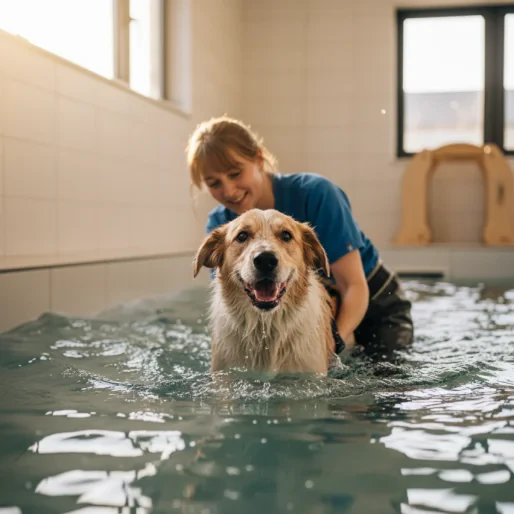
While surgical options including total hip replacement and femoral head ostectomy exist, many dogs are managed conservatively through a combination of pain control, weight management, and structured physical rehabilitation. Hydrotherapy, particularly underwater treadmill therapy, has become a widely recommended component of this approach across UK veterinary rehabilitation centres.
How Underwater Treadmill Therapy Works
An underwater treadmill unit consists of an enclosed chamber fitted with a motorised belt at its base. The chamber fills with temperature-controlled water, usually warmed to around 26°C to 30°C, to a depth selected by the therapist. Key variables adjusted during each session include:
- Water depth: Higher water levels provide greater buoyancy and reduced joint loading (typically offloading 40% to 60% of body weight); lower levels increase the weight-bearing challenge.
- Treadmill speed: Typically set between 0.5 and 3.0 kilometres per hour, calibrated to the dog's gait and comfort level.
- Session duration: Initial sessions may involve only 5 to 10 minutes of active walking, building gradually to 20 to 30 minutes as the dog's conditioning improves.
- Water jets: Some units include adjustable jets that add resistance, further engaging core and limb muscles.
Underwater Treadmill vs. Swimming Pool Sessions
Many UK hydrotherapy centres offer both underwater treadmill and purpose-built swimming pool facilities. Both use the properties of water to aid rehabilitation, but they differ in ways that affect both cost and clinical outcomes. Underwater treadmills encourage a controlled walking or trotting gait, which is particularly valuable for retraining movement patterns in dogs with hip dysplasia. Swimming involves a paddling motion that may not target hip extension as effectively. Treadmill sessions generally cost more because the equipment represents a significant capital investment (units typically cost £25,000 to £60,000 or more). Pool sessions are often slightly cheaper, ranging from £25 to £50 per swim.
UK Cost Breakdown for Canine Hydrotherapy
Geographic Variation
Location significantly influences pricing across the UK. Centres in London and the South East tend to charge at the higher end of the spectrum, with sessions commonly priced between £60 and £80. Facilities in the Midlands, the North of England, Scotland, and Wales typically charge £30 to £55 per session. Rural areas may offer slightly lower rates, though fewer facilities may be available, potentially adding travel costs.
Facility Type and Qualifications
Under the Veterinary Surgeons Act 1966, hydrotherapy for animals is not classified as an act of veterinary surgery, meaning non-veterinary professionals can deliver it. However, responsible practice requires veterinary referral, and accreditation through bodies such as the Canine Hydrotherapy Association (CHA) provides quality assurance. Pricing varies by facility type:
- Veterinary practices with in-house rehabilitation suites: Often staffed by veterinary physiotherapists or nurses with additional rehabilitation qualifications. Sessions typically cost £50 to £80, reflecting the integrated veterinary oversight.
- CHA-accredited independent hydrotherapy centres: These centres operate under veterinary referral and maintain standards set by the CHA, including water quality testing, staff training, and health and safety protocols. Sessions typically cost £30 to £60.
- Non-accredited centres: Some facilities operate without formal accreditation. While potentially cheaper (£25 to £45), the level of training and clinical oversight may be variable. Veterinary professionals generally recommend choosing an accredited centre.
Initial Assessment
Most centres require an initial consultation before hydrotherapy begins. This typically includes a gait assessment, body condition evaluation, range-of-motion measurement, and treatment planning. In the UK, this assessment usually costs between £50 and £150. Some centres include the first hydrotherapy session within this fee; others charge separately.
Average UK Cost Table
| Item | Typical UK Cost Range |
|---|---|
| Initial rehabilitation assessment | £50 to £150 |
| Single underwater treadmill session (20 to 30 min) | £30 to £80 |
| Single swimming pool session | £25 to £50 |
| Package of 6 to 10 treadmill sessions | £200 to £650 |
| Maintenance phase (1 to 2 sessions per month) | £30 to £160 per month |
| Total for a 6 to 12 week initial programme (1 to 3x per week) | £400 to £2,000+ |
Many UK centres offer package discounts of 10% to 20% when sessions are purchased in blocks. It is always worth asking about bundled pricing at the initial consultation.
Pet Insurance Coverage in the UK
The UK has one of the highest rates of pet insurance uptake in the world, and this can significantly offset hydrotherapy costs. However, coverage varies considerably between providers and policy tiers. Key points for UK dog owners:
- Lifetime policies: These are generally the most comprehensive option and are more likely to cover ongoing rehabilitation therapies. Major UK providers including Petplan, Bought By Many (now ManyPets), and Animal Friends offer policies that may include complementary therapies such as hydrotherapy, often with an annual sub-limit (commonly £1,000 to £2,500 per condition per year).
- Pre-existing condition exclusions: If hip dysplasia was diagnosed before the policy started, or during the waiting period, hydrotherapy costs will almost certainly be excluded. This is standard across UK insurers.
- Waiting periods: Most UK policies impose a waiting period of 14 days for illness-related claims. Some insurers apply longer waiting periods (up to 12 months) specifically for orthopaedic or hereditary conditions, which directly affects hip dysplasia claims.
- Veterinary referral requirement: UK insurers typically require that hydrotherapy be prescribed by a veterinary surgeon and carried out at an approved or accredited centre. Keeping referral documentation is essential for successful claims.
- Excess and co-pay: Most policies include a fixed excess (commonly £75 to £150) and may apply a percentage co-pay, particularly for older dogs. Some policies increase the co-pay to 20% or more once a dog reaches a certain age (often 8 to 10 years).
Insuring puppies of predisposed breeds early, ideally before any clinical signs appear, is the most reliable strategy for securing coverage should hip dysplasia develop later. For a deeper understanding of how waiting periods affect claims, TrustMyPets offers a guide on Pet Insurance Waiting Periods: A UK Owner's Guide.
Financial Support Beyond Insurance
For owners without insurance or facing exclusions, several UK-specific options may help:
- Veterinary payment plans: Many UK practices offer interest-free payment plans or work with third-party credit providers to spread costs over several months.
- Charitable assistance: Organisations such as the PDSA, Blue Cross, and Dogs Trust provide subsidised or free veterinary care for owners on low incomes or certain qualifying benefits. Breed-specific rescue charities may also offer financial support for rehabilitation costs.
- Veterinary teaching hospitals: University-affiliated veterinary hospitals (such as those at the Royal Veterinary College, the University of Edinburgh, and the University of Bristol) sometimes offer rehabilitation services at reduced rates as part of clinical training programmes.
Contact your registered vet's out-of-hours service or find your nearest Vets Now emergency clinic.
All UK vet practices must provide 24/7 emergency cover. Your vet's answerphone will direct you to the on-call service.
Choosing an Accredited UK Hydrotherapy Centre
The Canine Hydrotherapy Association (CHA) maintains a directory of accredited centres across the UK. Accreditation requires centres to meet standards covering water quality and testing, pool and treadmill hygiene, staff qualifications, emergency protocols, and veterinary referral procedures. The National Association of Veterinary Physiotherapists (NAVP) also maintains a register of qualified animal physiotherapists, many of whom incorporate hydrotherapy into their practice.
Before committing to a programme, owners should ask:
- Is the centre CHA-accredited or does the therapist hold a recognised qualification?
- Is veterinary referral required, and will the centre liaise directly with the referring vet?
- What does the initial assessment include, and is it charged separately?
- Are package discounts available, and what is the cancellation policy?
- Will the centre provide invoices and clinical notes that an insurer would accept for reimbursement?
- How will progress be measured, and how often will formal reassessments take place?
Session Frequency and Treatment Phases
Rehabilitation professionals in the UK generally follow a phased approach, though exact protocols vary by individual case:
- Acute or post-surgical phase (weeks 1 to 4): Two to three sessions per week, with short active intervals of 5 to 15 minutes and gradual progression. The focus is pain reduction and early muscle activation.
- Strengthening phase (weeks 5 to 12): One to two sessions per week, with longer active intervals of 15 to 25 minutes and increased treadmill speed or reduced water depth to build strength.
- Maintenance phase (ongoing): One to two sessions per month. Many UK owners find that ongoing maintenance hydrotherapy, combined with weight management and joint supplements, helps manage chronic hip dysplasia effectively over the longer term.
The UK's temperate but often wet and cold climate can make outdoor exercise challenging during autumn and winter months. Hydrotherapy provides a controlled, weather-independent environment that allows dogs to maintain their rehabilitation programme year-round, which is a practical advantage in British conditions.
Home Exercise and Complementary Approaches
Home-based exercises prescribed by a rehabilitation therapist, such as controlled lead walks, sit-to-stand repetitions, and gentle range-of-motion stretches, are a valuable supplement to clinic-based hydrotherapy. These exercises cost nothing beyond the initial instruction and can reduce the number of clinic visits needed each month. However, they do not replicate the controlled gait retraining that an underwater treadmill provides.
Some owners consider using garden paddling pools or natural bodies of water for informal aquatic exercise. While gentle wading can offer low-impact activity, there are important limitations: no controlled gait pattern, potential safety risks (particularly for brachycephalic or overweight dogs), and no professional monitoring. For broader fitness and enrichment ideas, TrustMyPets has a guide to Spring Fitness Restart Plans for Overweight Dogs that complements rehabilitation goals.
When Hydrotherapy May Not Be Suitable
Hydrotherapy is not appropriate for every dog. Contraindications may include open wounds or skin infections, uncontrolled cardiac or respiratory disease, severe anxiety around water, certain infectious conditions, and cases where orthopaedic instability requires surgical correction before rehabilitation can safely begin. A thorough veterinary assessment should always precede the first session. Under the Animal Welfare Act 2006, owners have a duty of care to ensure their dog's needs are met, which includes seeking appropriate veterinary advice before starting any rehabilitation programme.
Budgeting for Hydrotherapy in the UK
The figure that often catches UK owners off guard is not the cost of a single session, which is broadly comparable to a standard veterinary consultation, but the cumulative total over weeks and months of consistent treatment. Budgeting £600 to £1,500 for an initial course is a reasonable starting estimate for most UK owners, with ongoing maintenance adding £30 to £160 per month.
Hydrotherapy represents an investment in a dog's long-term comfort and mobility. When combined with appropriate veterinary management, weight control, and home exercise, it offers one of the most effective non-surgical strategies available for managing hip dysplasia. Owners are encouraged to explore insurance coverage early, ask about package pricing, and maintain open communication with their rehabilitation team about goals, timelines, and financial constraints.
Frequently Asked Questions
How much does dog hydrotherapy cost in the UK? ↓
Does UK pet insurance cover hydrotherapy for hip dysplasia? ↓
How do I find an accredited hydrotherapy centre for my dog in the UK? ↓
How many hydrotherapy sessions will my dog need for hip dysplasia? ↓
Can I do hydrotherapy for my dog at home instead of using a professional centre? ↓

Rachel Simmons
Pet Ownership Cost Advisor
Pet ownership cost advisor — transparent vet fee breakdowns, insurance guidance, and financial planning for owners.
Content Disclosure
This article was created using state-of-the-art AI models with human editorial oversight. It is intended for informational and entertainment purposes only and does not constitute veterinary medical advice. Always consult a licensed veterinarian for your pet's specific health needs. Learn more about our process.