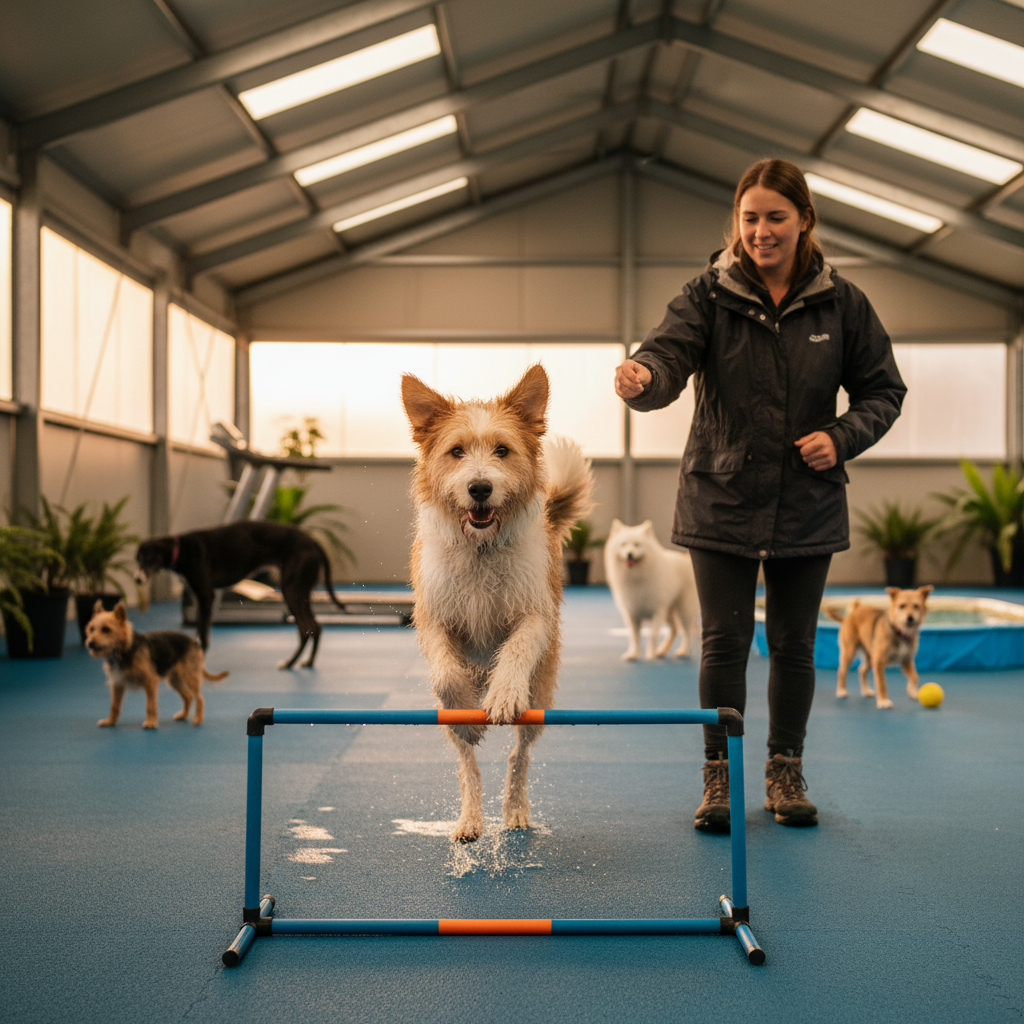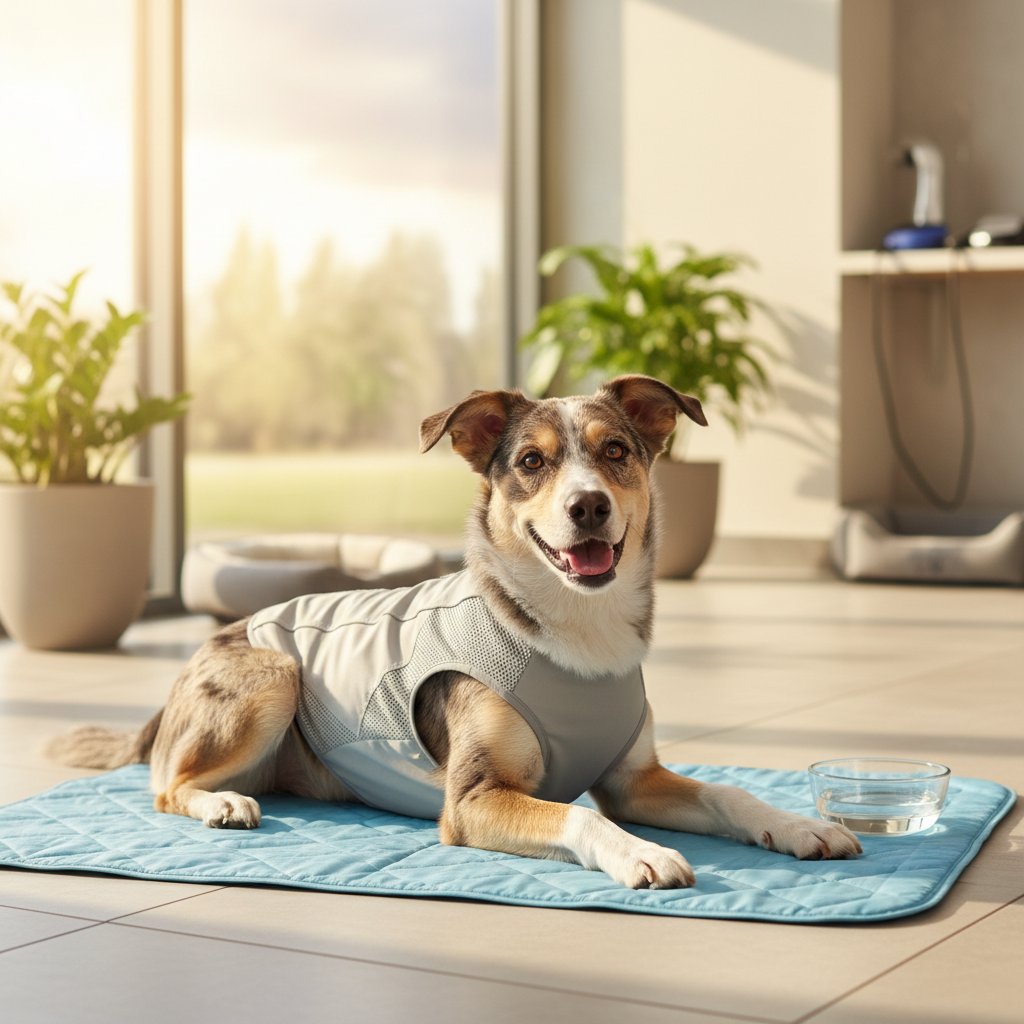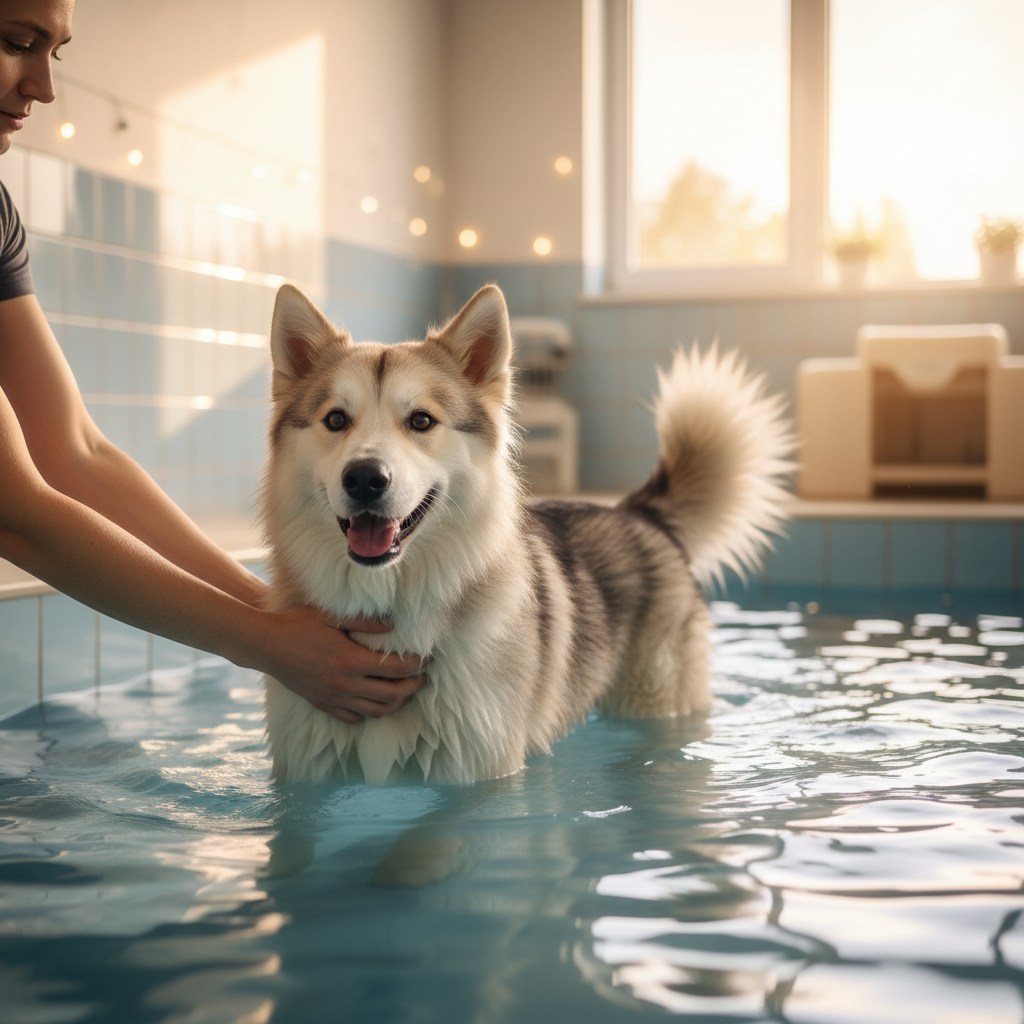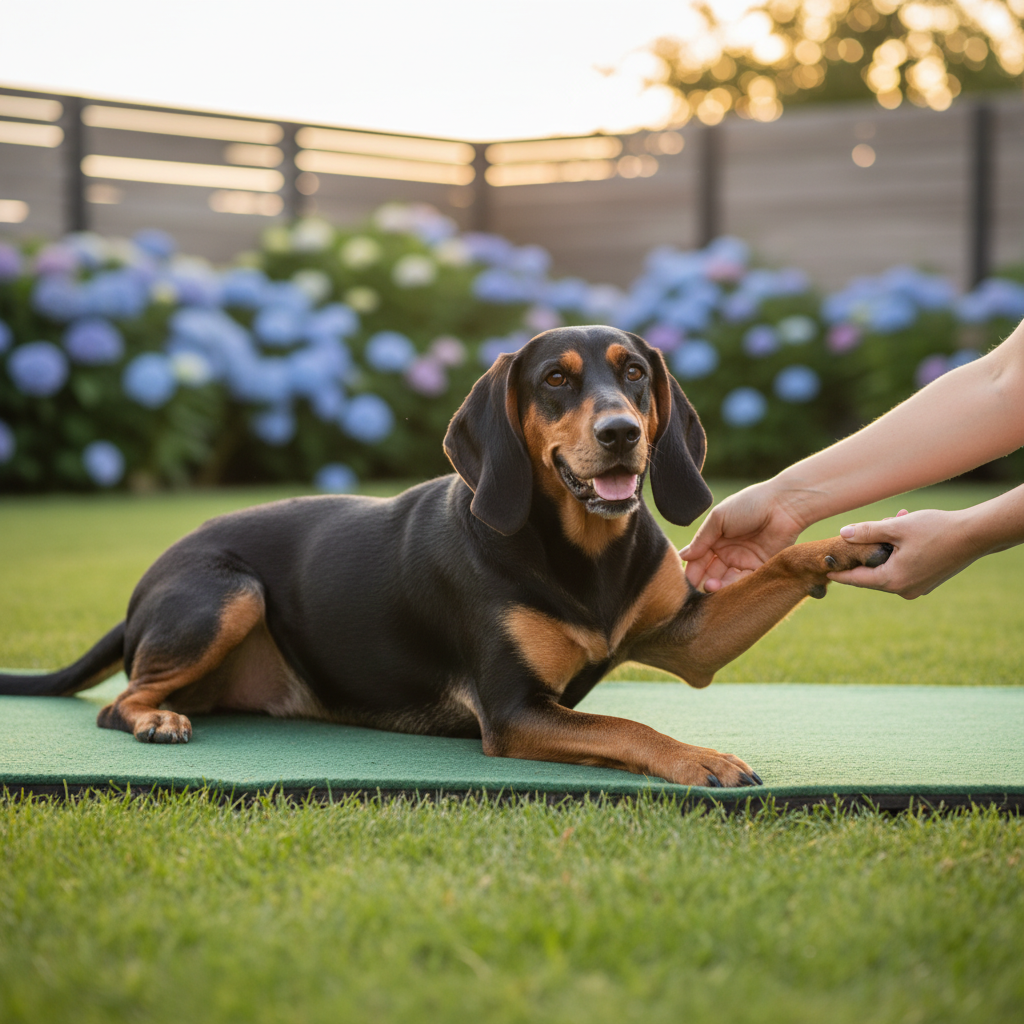
A practical UK guide to building a safe garden conditioning circuit for healthy adult dogs during long British summer evenings. Includes BVA aligned safety guidance, ACPAT therapist references, and Animal Welfare Act 2006 considerations.
Key Takeaways for UK Dog Owners
- Cavaletti pole height and spacing should be matched to your dog's height at the withers and natural stride, not to Kennel Club breed name alone.
- Wobble cushions build core strength gradually; begin with two front paws on a lightly inflated disc before progressing.
- Cone weaves develop lateral flexibility; spacing must allow a comfortable bend, not a sharp twist.
- Session length for healthy adult dogs is typically 10 to 20 minutes, two to three times per week, with at least 48 hours between strength sessions.
- British summer humidity can make 22 to 24 °C feel significantly warmer; check pavement and decking temperature with the back of your hand for seven seconds before starting.
- Always consult an RCVS registered vet or an ACPAT chartered physiotherapist if you notice lameness, stiffness, or reluctance to move.
Why a Garden Circuit Suits the British Summer
Long British summer evenings, particularly from late May through to early September, offer a useful window for low impact canine fitness. With the Met Office issuing heat health alerts more frequently in recent years, and surface temperatures on tarmac and patios rising sharply between late morning and mid afternoon, many UK owners are shifting structured exercise to the cooler hours after 7 pm. A garden conditioning circuit gives dogs a controlled outlet for energy, supports core stability, and helps reduce the kind of injuries seen when sedentary weekday dogs suddenly chase a ball flat out on a Saturday.
The principles below align with general veterinary physiotherapy guidance promoted by the British Veterinary Association (BVA) and reflect the kind of progressive loading work used by chartered physiotherapists registered with the Association of Chartered Physiotherapists in Animal Therapy (ACPAT). The circuit is suitable for healthy adult dogs already cleared for exercise by a vet. Puppies whose growth plates have not yet closed, senior dogs with osteoarthritis, and any dog recovering from injury should follow a tailored programme delivered by a qualified canine rehabilitation professional, ideally one listed on the Register of Animal Musculoskeletal Practitioners (RAMP).
Preparation: What You Need
Equipment Checklist
- 4 to 6 cavaletti poles: lightweight PVC sets are widely available from UK pet retailers, typically £25 to £60 for a beginner set with adjustable supports.
- 1 wobble cushion or balance disc rated for your dog's body weight in kg, with a non slip mat underneath. Expect to pay around £15 to £35.
- 6 to 8 cones: tall enough that your dog must weave around them, not hop over. Standard football training cones work well.
- A non slip surface: short, dry lawn, artificial turf, or rubber matting. Avoid wet decking, ceramic patio tiles, or loose gravel, which are common features in British gardens and become slick after rain.
- High value treats cut into pea sized pieces, plus fresh water in a shaded spot.
- A well fitted flat collar or Y shaped harness and a 1.5 to 2 metre lead for guidance, never a slip lead for conditioning work.
Environmental Setup for UK Conditions
Plan sessions when ambient temperatures drop below 24 °C and the ground feels comfortable to the back of your hand for at least seven seconds. During the warmer spells the UK now experiences, including the record breaking days when temperatures exceeded 40 °C in some parts of England, training should be postponed entirely. Brachycephalic breeds such as French Bulldogs, Pugs, and English Bulldogs, all extremely popular in the UK, are at heightened risk of heat related illness even at mid range summer temperatures.
Pollen counts are also worth checking. Dogs with seasonal allergies, particularly Westies, Labradors, and Cocker Spaniels, may benefit from a quick paw rinse after sessions during the high grass pollen weeks in June and July.
Cavaletti Spacing for Common UK Breeds
Cavaletti work, walking or trotting over a series of low poles, is one of the most evidence supported tools in canine conditioning. It encourages active joint flexion, even weight distribution, and engagement of the deep core musculature. The single biggest mistake owners make is setting poles too close together, which forces the dog to hop rather than stride.
General Rules
- Pole height for foundation work: roughly the height of your dog's carpus (wrist) for small and medium dogs, and the height of the hock for larger dogs.
- Pole spacing: approximately the same distance as the dog's height at the withers for a walking pace, slightly longer for a trotting pace.
Suggested Starting Points by Popular UK Breeds
- Toy and small breeds (Cavalier King Charles Spaniel, Yorkshire Terrier, Miniature Dachshund): poles 5 to 10 cm high, spaced 20 to 30 cm apart. Take particular care with long backed breeds and keep the pace slow.
- Medium breeds (Cocker Spaniel, Border Collie, Staffordshire Bull Terrier, Whippet): poles 10 to 15 cm high, spaced 40 to 50 cm apart.
- Large breeds (Labrador Retriever, Golden Retriever, German Shepherd, Springer Spaniel): poles 15 to 20 cm high, spaced 55 to 70 cm apart. These are routinely the most popular Kennel Club registered breeds in the UK and respond well to structured work.
- Giant breeds (Great Dane, Bernese Mountain Dog, Newfoundland): poles 20 to 25 cm high, spaced 75 to 90 cm apart, keeping sessions short to protect joints.
Adjust to your dog's natural stride. If the dog clips poles, lengthen the spacing slightly. If the dog hops over multiple poles at once, shorten it.
A Note on Restricted Breeds
Owners of dogs covered by the Dangerous Dogs Act 1991, including XL Bully type dogs following the 2024 restrictions in England, Wales and Scotland, must keep their dog muzzled and on lead in public places. Conditioning work in a securely fenced private garden is permitted, but a well fitted basket muzzle should be retained during any session that involves visitors, gardeners, or open access points. Owners should also ensure their Certificate of Exemption is current and that microchip details, mandatory for dogs and cats under UK law, remain up to date.
Wobble Cushion Progressions
Balance discs challenge the small stabiliser muscles that hold joints aligned. Veterinary physiotherapy consensus suggests these tools are most effective when introduced in stages, with each stage held until the dog is calm and confident.
Stage 1: Familiarisation (Week 1)
Place the cushion flat and only lightly inflated on a non slip mat. Lure your dog to step two front paws on, hold for three to five seconds, then step off. Repeat 5 to 8 times per session.
Stage 2: Rear Paw Awareness (Week 2)
Reverse the position: encourage two back paws on the cushion. This is harder and often produces the classic puzzled head tilt. Reward steady weight distribution rather than duration.
Stage 3: All Four Paws (Weeks 3 to 4)
Use a slightly larger disc or two cushions side by side. Lure the dog into a square stand with all four paws on. Aim for 10 to 15 seconds of calm balance.
Stage 4: Dynamic Work (Weeks 5 to 6)
Introduce gentle weight shifts: ask for a nose touch to the left, then right, encouraging core engagement. Never push, pull, or rock the cushion forcefully.
Cone Weave Drills
Cone weaves develop spinal flexibility, hindlimb awareness, and controlled turning. They differ from competition agility weave poles in that the focus is on slow, deliberate movement rather than speed.
Setting Up
- Arrange 6 cones in a straight line.
- Spacing: roughly 1.5 times your dog's body length apart for foundation work.
The Drill
Lead your dog at a walk in a serpentine pattern around the cones. Focus on smooth, continuous motion and equal bending in both directions. Most dogs are noticeably stiffer on one side; that side needs extra repetitions, not fewer. Begin with three passes in each direction and add one pass per week up to a maximum of six passes per direction.
Session Length and Recovery
Conditioning is not the same as cardio. The aim is quality of movement, not exhaustion. General veterinary physiotherapy standards used in the UK recommend:
- Total session length: 10 to 20 minutes for healthy adult dogs, including warm up and cool down.
- Frequency: two to three sessions per week, with at least 48 hours between strength focused sessions.
- Warm up: 5 minutes of loose lead walking, plus a few play bows or sit to stand transitions. A gentle quarter mile garden walk works well.
- Cool down: 5 minutes of slow walking and, if your dog tolerates it, gentle passive range of motion on each limb.
Owners commonly underestimate how tiring proprioceptive work is. A dog may seem energetic during the session and then sleep deeply for hours afterwards, which is normal. Soreness lasting more than 24 hours, stiffness on rising, or any change in gait warrants a rest day and a veterinary review if it persists.
Six Week Plan to Build Core Strength
Week 1: Foundation
- Session A: Cavaletti walk over 4 poles, 3 passes. Wobble cushion Stage 1.
- Session B: Cone weave at walk, 3 passes each direction.
Week 2: Adding Repetitions
- Session A: Cavaletti 5 poles, 4 passes. Wobble cushion Stage 2.
- Session B: Cone weave 4 passes each direction. Sit to stand x 5.
Week 3: Combining Stations
- Session A: Cavaletti 6 poles, 4 passes. Wobble cushion Stage 3.
- Session B: Cone weave 5 passes each direction. Add a figure of eight around two widely spaced cones.
Week 4: Building Endurance
- Session A: Cavaletti at slow trot if the dog is balanced, 5 passes. Wobble cushion Stage 3 with nose touches.
- Session B: Cone weave 6 passes. Sit to stand x 8 with controlled tempo.
Week 5: Dynamic Balance
- Session A: Cavaletti combined with a wobble cushion stand at the end of the lane.
- Session B: Cone weave plus down to stand x 5.
Week 6: Integration and Assessment
- Session A: Full circuit, two rounds with rest between.
- Session B: Reassess pole spacing and weave smoothness. Note any side preference and adjust the next cycle accordingly.
What to Watch For
During the Session
- Excessive panting that does not settle within a minute of pausing.
- Refusal or freezing at a station the dog previously enjoyed.
- Repeatedly knocking poles, which suggests fatigue or spacing issues.
- Slipping on the surface; stop immediately and adjust.
After the Session
- Mild tiredness and a long nap are expected.
- Stiffness on rising the next morning is a sign you progressed too quickly.
- Drinking heavily and then resting comfortably is normal in warm weather.
For dogs with double coats common in the UK, including Border Collies, Huskies, and Golden Retrievers, conditioning generates body heat that the undercoat traps. Never clip a double coated dog to cope with summer training.
When to Call a UK Vet Immediately
- Any sudden lameness or non weight bearing on a limb during or after a session.
- Collapse, disorientation, or vomiting, which may indicate heat stress.
- Rapid, distressed breathing that does not normalise with rest, shade, and water.
- Yelping on movement, hunched posture, or reluctance to lie down comfortably.
- Swelling around joints in the 24 to 48 hours after exercise.
If your usual practice is closed in the evening, most UK regions are covered by dedicated out of hours services such as Vets Now or hospital based emergency teams operated by larger group practices. Keep your nearest service saved in your phone before the first session.
Contact your registered vet's out-of-hours service or find your nearest Vets Now emergency clinic.
All UK vet practices must provide 24/7 emergency cover. Your vet's answerphone will direct you to the on-call service.
The Animal Welfare Act 2006 places a clear legal duty of care on owners to protect dogs from pain, suffering, injury, and disease. Pushing a dog through a conditioning session when it is showing signs of distress could be considered a failure of that duty. Conditioning should be a quiet, structured, slightly boring activity rather than an exciting workout, and progress should be measured in weeks rather than days.
Final Thoughts
A well designed garden conditioning circuit is one of the most rewarding ways to spend long British summer evenings with a dog. The goal is not to create a canine athlete in six weeks but to build steady, lifelong physical literacy: balanced movement, calm focus, and resilient joints. With consistency, most owners notice a more confident gait, easier transitions on stairs, and a happier, more settled dog around the house.
Frequently Asked Questions
Is a garden conditioning circuit suitable for an XL Bully under the 2024 UK restrictions? ↓
How warm is too warm for a conditioning session in the UK? ↓
Should I see a chartered physiotherapist before starting? ↓
What does a basic UK kit cost? ↓
How many miles of walking should I keep alongside this programme? ↓

Emma Lawson
Practical Pet Care Educator
Practical pet home care specialist — clear, step-by-step guidance grounded in veterinary nursing standards.
Content Disclosure
This article was created using state-of-the-art AI models with human editorial oversight. It is intended for informational and entertainment purposes only and does not constitute veterinary medical advice. Always consult a licensed veterinarian for your pet's specific health needs. Learn more about our process.