
In this article
- Key Takeaways
- Why Spring Water Safety Deserves Special Attention in Britain
- Pre-Swim Site Assessment: A Five Minute Routine for Every Visit
- UK River and Lake Hazards in Spring
- Blue-Green Algae in the UK: A Recurring Lethal Threat
- Water Temperature and Hypothermia Risk in the UK
- Canine Life Jackets: Selection and Fitting
- Leptospirosis Vaccination: Especially Important for UK Swimmers
- Post-Swim Ear Care
- What to Pack for a UK Spring Swim Outing
- When to Seek Veterinary Help
- Building a Safe Spring Routine
Key Takeaways
- Check before every swim: River flow, water clarity, and shoreline stability shift rapidly in UK spring conditions, even at familiar spots in the Lake District or local canal towpaths.
- Blue-green algae (cyanobacteria) kills dogs in the UK every year: The Environment Agency and local councils issue alerts you can check before visiting any water body.
- UK spring water temperatures remain dangerously cold: Inland waters typically sit between 6 °C and 12 °C from March to May, well below safe thresholds for most breeds.
- A properly fitted canine life jacket is essential in any open water with currents, drop-offs, or limited visibility.
- Post-swim ear drying is a straightforward habit that substantially reduces the risk of otitis externa, particularly in floppy-eared breeds popular in the UK such as Cocker Spaniels and Golden Retrievers.
Why Spring Water Safety Deserves Special Attention in Britain
The UK's temperate maritime climate means spring arrives with a particular combination of hazards for water-loving dogs. Rainfall is typically high from March through May, swelling rivers and streams well beyond their summer baselines. Reservoirs managed by water companies release overflow, and lowland canals often carry increased flow from feeder streams. Meanwhile, warming shallows in lakes, ponds, and Norfolk Broads waterways begin to fuel early cyanobacterial blooms, sometimes weeks before official summer.
The British Veterinary Association (BVA) and the RSPCA both highlight spring as a period requiring heightened vigilance near water. Under the Animal Welfare Act 2006, dog owners in England and Wales have a legal duty of care to protect their animals from suffering, which includes foreseeable environmental risks. Allowing a dog to swim in visibly contaminated water or dangerously fast currents could fall short of that duty.
Prevention is always preferable. A dog that ingests cyanotoxins may develop acute liver failure within hours, and veterinary prognosis can be poor even with aggressive treatment. If your dog shows any signs of illness after water contact, seek emergency veterinary care without delay.
Contact your registered vet's out-of-hours service or find your nearest Vets Now emergency clinic.
All UK vet practices must provide 24/7 emergency cover. Your vet's answerphone will direct you to the on-call service.
Pre-Swim Site Assessment: A Five Minute Routine for Every Visit
Conditions at UK water bodies change quickly, particularly after overnight rainfall. Professional canine hydrotherapy and fitness guidelines emphasise conducting a brief, structured check before every session:
- Visual scan: Look for green or brown discolouration, surface scum, foam lines, and floating debris. After storms, UK rivers frequently carry agricultural runoff that can irritate skin and eyes.
- Smell test: Cyanobacterial blooms produce a distinctive musty, earthy, or sewage-like odour. If the water smells off, keep your dog away entirely.
- Current speed: Drop a stick or leaf into the water and watch how quickly it travels. If it moves faster than a brisk walking pace, the flow is likely too strong for most dogs.
- Entry and exit points: Ensure there are gradual, non-slippery banks. Many UK riverbanks are reinforced with stone or concrete that becomes treacherously slippery when wet. Canal sides are often sheer, making exit extremely difficult for a dog in the water.
- Check local alerts: The Environment Agency publishes bathing water quality data for England, and Natural Resources Wales and SEPA (Scottish Environment Protection Agency) provide equivalent services. Many councils also post signage at known algae hotspots. A quick online check before leaving home takes moments.
UK River and Lake Hazards in Spring
Rivers
British rivers in spring carry several risks that are easy to underestimate:
- Elevated flow: Rainfall in upland catchments (the Pennines, Snowdonia, the Scottish Highlands) rapidly increases downstream flow. A gentle stretch of the River Wye or Severn in August can become swift and turbulent in April.
- Underwater obstacles: Fallen branches, discarded rubbish, and submerged shopping trolleys (a persistent urban waterway hazard) create entrapment risks invisible beneath murky spring water.
- Weirs and low-head dams: The UK has hundreds of weirs on navigable and non-navigable rivers. The recirculating hydraulic below a weir can trap and submerge even strong swimmers, including dogs and humans.
- Bank erosion: Saturated clay and peat soils along UK riverbanks erode rapidly in spring. A solid-looking bank may collapse under a dog's weight.
Lakes, Reservoirs, and Canals
- Thermoclines: UK lake surface temperatures in spring can feel deceptively tolerable while water just a metre below remains near freezing. Dogs that dive or swim to depth risk sudden cold shock.
- Reservoir rules: Many UK reservoirs are owned by water companies and prohibit or restrict dog swimming. Ignoring these rules can result in fines and, more importantly, poses genuine safety risks from steep banks, intake pipes, and deep cold water.
- Canal hazards: While canal water is often slow-moving, it can contain submerged metalwork, shopping trolleys, and sharp debris. Weil's disease (leptospirosis) is a particular concern in canal and slow-moving water environments; see the vaccination section below.
Blue-Green Algae in the UK: A Recurring Lethal Threat
Why the UK Climate Encourages Blooms
The UK's combination of nutrient-rich agricultural runoff and warming spring temperatures creates ideal conditions for cyanobacterial blooms. Bodies like Windermere, Loch Lomond, and the Norfolk Broads experience recurring issues. The UK Centre for Ecology and Hydrology monitors bloom activity, and local authorities issue warnings when toxin levels are elevated.
Identification
- Appearance: Often resembles spilled green paint, pea soup, or a thick floating scum. Some species produce brown or blue-tinged mats.
- Texture: Scoop a small sample in a clear jar: clumpy, granular particles (as opposed to smooth green strands) suggest cyanobacteria rather than harmless filamentous algae.
- Shoreline residue: Dried, crusty, paint-like deposits along the waterline indicate recent bloom activity, even if the water currently looks clear.
Toxicity and Emergency Response
Cyanotoxins include hepatotoxins (such as microcystins, which cause liver damage) and neurotoxins (such as anatoxin-a, which can cause respiratory paralysis). Dogs are especially vulnerable because they readily drink water while swimming and lick contaminated fur afterwards. Signs may appear within 15 to 60 minutes:
- Vomiting and diarrhoea (sometimes bloody)
- Excessive drooling and disorientation
- Seizures and muscle tremors
- Breathing difficulty
- Collapse
This is always a veterinary emergency. Do not wait. Rinse the dog thoroughly with clean water, avoid letting them lick their coat, and transport immediately to the nearest veterinary practice.
Contact your registered vet's out-of-hours service or find your nearest Vets Now emergency clinic.
All UK vet practices must provide 24/7 emergency cover. Your vet's answerphone will direct you to the on-call service.
For related environmental toxin risks at home, Toxic Garden Products for Dogs: UK Spring Safety Audit covers common UK garden chemicals hazardous to pets.
Water Temperature and Hypothermia Risk in the UK
UK inland water temperatures are slow to warm in spring. Data from the Environment Agency and research bodies typically show:
- March: 5 °C to 8 °C in most lowland rivers and lakes
- April: 8 °C to 11 °C
- May: 10 °C to 14 °C
- June: 13 °C to 17 °C
These figures mean that for much of spring, UK waters are below safe thresholds for many dogs. Veterinary sports medicine and canine hydrotherapy guidelines suggest the following general thresholds:
- Small breeds and lean dogs (under roughly 10 kg): Meaningful hypothermia risk below approximately 15 °C. For most of UK spring, open water swimming should be very brief or avoided for these dogs.
- Medium breeds (10 to 25 kg) with moderate coat: Water between 12 °C and 15 °C may be tolerated for supervised swims of around 5 to 10 minutes.
- Large, double-coated breeds (e.g., Labrador Retrievers, Newfoundlands, Flat-Coated Retrievers): Generally tolerate water down to roughly 10 °C for short sessions, though individual variation is significant.
- Senior dogs and those with arthritis or chronic conditions: Regardless of size, these dogs are more vulnerable to cold stress. The guidance in Senior Dog Arthritis: Spring Walk Guide pairs well with a cautious approach to water temperature.
Signs of Cold Stress
Watch for shivering, reluctance to re-enter the water, tucked tail, stiff movement, or whining. End the swim immediately, dry with an absorbent towel, and move to a warm, sheltered area. A car boot with towels and a thermal blanket works well. If lethargy, lack of coordination, or unresponsiveness develops, seek veterinary assessment for hypothermia without delay.
Canine Life Jackets: Selection and Fitting
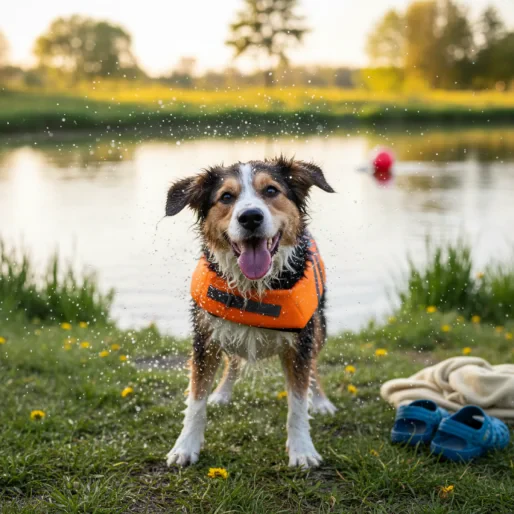
The BVA and the RSPCA both support the use of buoyancy aids for dogs in open water. Even breeds with strong swimming instincts (Labradors, Springer Spaniels, Irish Water Spaniels) can tire unexpectedly, especially in UK spring conditions where cold and current combine.
Quality canine life jackets are available from UK pet retailers, typically ranging from around £20 to £60 depending on size and features. Proper fit is essential:
- Measure accurately: Use the manufacturer's chart, measuring girth at the widest point of the ribcage and length from the base of the neck to the base of the tail.
- Secure all straps: Neck, chest, and belly straps should be snug enough to prevent the jacket sliding forward over the head or rotating sideways, but loose enough to fit two fingers between strap and body.
- Test the dorsal handle: Gently lift the dog by the handle on dry ground. The jacket should distribute weight evenly without riding up or compressing the throat.
- Check leg freedom: The dog should walk, trot, and paddle normally. Chafing behind the front legs is a common issue to watch for.
- Controlled water test first: Before any open water outing, allow the dog to wear the jacket in shallow, calm water to build confidence and verify the fit.
Leptospirosis Vaccination: Especially Important for UK Swimmers
Leptospirosis (Weil's disease in humans) is caused by Leptospira bacteria found in water contaminated by infected animal urine, particularly rats. UK canals, slow rivers, and standing water are recognised transmission environments. The BVA includes leptospirosis vaccination as part of its recommended core vaccination protocol for dogs in the UK. Dogs that regularly swim in open water should have their leptospirosis vaccination kept fully up to date, as discussed with their veterinary practice during annual health checks.
Post-Swim Ear Care
Breeds enormously popular in the UK, such as Cocker Spaniels, Springer Spaniels, and Golden Retrievers, have floppy ears that trap moisture after swimming. This creates ideal conditions for otitis externa (outer ear canal infection). The Royal College of Veterinary Surgeons (RCVS) Practice Standards guidance supports proactive ear care for dogs with regular water exposure:
- Gently lift each ear flap and blot visible moisture with a soft cloth or cotton ball immediately after swimming.
- If advised by your vet, apply a veterinary-approved ear drying solution.
- Allow the ear flaps to remain open for a few minutes to promote air circulation.
- Monitor over the following 24 to 48 hours for head shaking, scratching, redness, odour, or discharge. Any of these warrant a veterinary appointment.
What to Pack for a UK Spring Swim Outing
- A canine life jacket, properly fitted
- A long line (roughly 5 to 10 metres) for initial introductions to new water spots
- Fresh drinking water from home, so the dog is less inclined to drink from the river or lake
- Absorbent towels and a thermal blanket
- A windbreak (even the open boot of the car works well)
- A basic first aid kit: antiseptic wipes, styptic powder, tick removal tool (UK tick activity increases sharply from March)
- Poo bags, as always, to comply with local authority requirements and the Countryside Code
When to Seek Veterinary Help
Contact a veterinary practice promptly if your dog shows any of the following after swimming:
- Vomiting, diarrhoea, or appetite loss within hours (possible cyanotoxin exposure or waterborne infection)
- Persistent shivering, lethargy, or weakness after adequate drying (possible hypothermia or cold water tail/limber tail syndrome)
- Head shaking, ear scratching, redness, or foul odour from ears within 24 to 72 hours (possible otitis externa)
- Coughing, laboured breathing, or nasal discharge (possible water aspiration)
- Skin irritation, hot spots, or rashes (possible contact dermatitis from agricultural runoff or pollutants)
- Lameness or reluctance to move (possible musculoskeletal strain or injury from submerged obstacles)
Never adopt a "wait and see" approach with suspected algae toxin exposure. This is always an emergency.
Contact your registered vet's out-of-hours service or find your nearest Vets Now emergency clinic.
All UK vet practices must provide 24/7 emergency cover. Your vet's answerphone will direct you to the on-call service.
Building a Safe Spring Routine
The five-minute pre-swim site check, a well-fitted life jacket, awareness of water temperature, and a quick post-swim ear dry: together, these habits address the most common and most serious risks UK dogs face in spring waterways. Swimming remains one of the best forms of canine exercise available: low impact, excellent for cardiovascular fitness, and deeply enjoyable for water-loving breeds. On non-swim days, exercises that build core stability can complement water fitness; Dog Balance Exercises at Home: A Progressive Guide offers a structured programme suitable for dogs at any fitness level.
Approached with consistent, sensible precautions, spring open water swimming is one of the most rewarding activities you and your dog can share across the British countryside.
Frequently Asked Questions
Content Disclosure
This article was created using state-of-the-art AI models with human editorial oversight. It is intended for informational and entertainment purposes only and does not constitute veterinary medical advice. Always consult a licensed veterinarian for your pet's specific health needs. Learn more about our process.