
In this article
- Key Takeaways for Hong Kong Aquarists
- Why Hong Kong Summers Are Especially Dangerous for Aquariums
- Side-by-Side Comparison for Hong Kong Conditions
- Option 1: Aquarium Cooling Fans in Hong Kong
- Option 2: Aquarium Chillers (the Hong Kong Standard)
- Option 3: DIY and Emergency Methods
- Typhoon Season: The Hidden Aquarium Risk
- Choosing by Tank Size: Hong Kong Recommendations
- Decision Checklist for Hong Kong Aquarists
- Practical Tips for Hong Kong Aquariums
Key Takeaways for Hong Kong Aquarists
- Hong Kong's summer humidity (often above 80%) severely limits evaporative fan performance, making chillers the more reliable option for most setups from May through September.
- Indoor temperatures in Hong Kong flats commonly exceed 30 °C when air conditioning is off, putting tropical fish at risk and making coldwater species like axolotls nearly impossible to keep without active cooling.
- Compact living spaces require careful planning for chiller placement, as these units exhaust warm air and need ventilation clearance.
- Typhoon season power outages present a serious secondary risk; battery air pumps and contingency plans are essential during signal 8 and above.
- Costs in HKD range from roughly $120 to $400 for clip-on fans, and $1,200 to $6,500 or more for aquarium chillers, depending on capacity.
Why Hong Kong Summers Are Especially Dangerous for Aquariums
Hong Kong's subtropical climate creates a uniquely challenging environment for aquarium keeping. From late May through September, daytime temperatures regularly reach 33 °C or higher, while relative humidity frequently sits between 80% and 95%. These conditions persist for weeks at a time, making short-term fixes unreliable.
Water retains heat far longer than air. When a flat's ambient temperature climbs above 28 °C (common even with windows open), aquarium water follows within hours. Elevated water temperature reduces dissolved oxygen, accelerates bacterial growth, and places physiological stress on fish, shrimp, and corals. Species such as crystal red shrimp, axolotls, and many SPS corals can suffer irreversible damage within hours once water exceeds their upper tolerance threshold.
For aquarists in Hong Kong, proactive cooling is not optional during summer. Reactive measures during a hot spell are far less effective than having equipment installed and tested before temperatures rise.
SPCA Hong Kong / Emergency Vet Clinics
Contact the SPCA Hong Kong or your nearest 24-hour emergency veterinary clinic.
Several private veterinary hospitals in Hong Kong offer round-the-clock emergency care.
Side-by-Side Comparison for Hong Kong Conditions
| Factor | Clip-On Aquarium Fans | Aquarium Chillers | DIY and Household Methods |
|---|---|---|---|
| Best tank size | Nano to small (up to roughly 100 L) | Medium to large (75 L and above) | Any size, temporary only |
| Typical purchase cost (HKD) | $120 to $400 | $1,200 to $6,500+ | Near zero to minimal |
| Cooling capacity | 1 to 2 °C below ambient in Hong Kong humidity; up to 4 °C in drier conditions | Holds a precise set point regardless of ambient temperature or humidity | Unpredictable; typically 1 to 2 °C temporarily |
| Energy use | Very low (2 to 10 watts per fan) | Moderate to high (50 to 500+ watts depending on unit) | Negligible unless running household AC |
| Effectiveness in HK humidity | Significantly reduced above 80% RH | Unaffected by humidity | Variable and unreliable |
| Space required | Minimal; clips to tank rim | Needs floor or shelf space plus ventilation clearance | Minimal |
Option 1: Aquarium Cooling Fans in Hong Kong
How they work
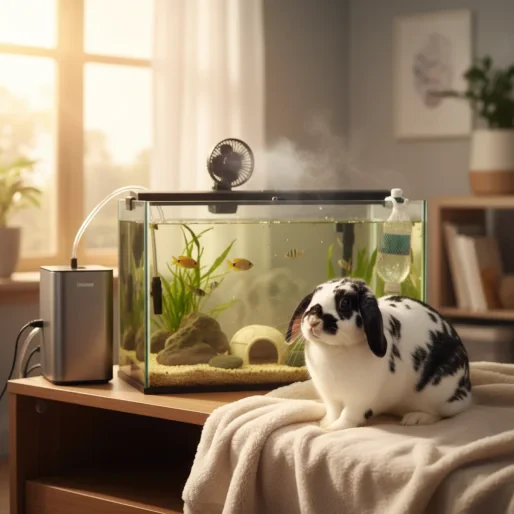
Clip-on fans sit on the tank rim and blow air across the water surface, accelerating evaporation. Because evaporation is endothermic, it draws heat from the water. Many models include a built-in thermostat.
The humidity problem
This is the critical issue for Hong Kong. Evaporative cooling depends on the difference between the water surface and the surrounding air's moisture capacity. When relative humidity exceeds 80%, which is the norm from June through August in Hong Kong, evaporation slows dramatically. Where a fan might drop water temperature 3 to 4 °C in a dry climate, the same unit in a Kowloon flat with windows open may achieve only 1 to 2 °C of cooling.
Fans become more effective when used in an air-conditioned room, as AC lowers both temperature and humidity. However, relying on continuous AC to make a fan work raises the question of whether a chiller would be the more direct investment.
When fans still make sense in Hong Kong
- Small freshwater tanks (under 60 L) housing hardy tropical species such as guppies, platies, or common tetras that tolerate temperatures up to 30 °C.
- Supplementary cooling alongside air conditioning, taking some load off the AC.
- Planted tanks where a modest reduction of 1 to 2 °C is sufficient to keep plants and livestock comfortable.
Estimated costs
Single clip-on fan units are typically available from around $120 to $200 HKD at aquarium shops. Dual or quad fan arrays range from $250 to $400 HKD. Monthly electricity cost is negligible, typically well under $10 HKD. However, increased evaporation means more frequent top-offs, and in marine tanks, rising salinity from evaporation demands careful monitoring.
Option 2: Aquarium Chillers (the Hong Kong Standard)
Why chillers are so common here
Walk through any established aquarium shop in Mong Kok and chillers are prominently displayed. There is good reason: in Hong Kong's climate, a chiller is widely regarded as essential rather than optional equipment for reef tanks, marine setups, shrimp breeding tanks, and any system housing species that require water below 26 °C.
Chillers use a refrigeration compressor to actively extract heat from water pumped through the unit. An internal thermostat maintains a precise set point (typically within 0.5 °C), cycling the compressor as needed. Because they use active refrigeration rather than evaporation, humidity has zero effect on performance.
Practical considerations for Hong Kong flats
- Heat exhaust: Chillers expel warm air. In a compact Hong Kong flat, placing a chiller inside a closed cabinet or against a wall without clearance creates a feedback loop where expelled heat raises room temperature, forcing the chiller to work harder. Ensure at least 15 to 20 cm of clearance around the unit and adequate room ventilation.
- Noise: Compressor chillers produce a noticeable hum and vibration. In small flats where the tank might be in a bedroom or combined living area, this is worth considering. Placing the chiller on a rubber mat can reduce vibration transfer.
- Plumbing: Inline chillers connect between a canister filter outlet and the return. Ensure the pump or filter flow rate matches the chiller's specifications. Most 1/10 HP chillers suit tanks of 100 to 300 L with flow rates around 500 to 1,500 L per hour.
Estimated costs
Small chillers rated for 100 to 200 L typically cost $1,200 to $2,500 HKD. Mid-range units suitable for 200 to 500 L reef tanks commonly range from $2,500 to $4,500 HKD. Larger or premium units can exceed $6,500 HKD. Monthly electricity costs vary significantly depending on ambient temperature and compressor cycling frequency, but $40 to $160 HKD per month during summer is a realistic estimate for a 1/10 HP unit running in a non-air-conditioned room.
Best suited for
- Marine and reef aquariums of any size (corals can bleach with sustained temperatures just 1 to 2 °C above their comfort zone).
- Axolotl keepers (axolotls require water below roughly 20 °C, impossible to achieve with fans alone in a Hong Kong summer).
- Discus, crystal red shrimp, and other heat-sensitive species.
- Any tank above 100 L where the owner cannot guarantee continuous air conditioning.
Option 3: DIY and Emergency Methods
DIY approaches serve as emergency stopgaps, not summer strategies. Common methods include floating sealed frozen bottles in the tank, partial water changes with slightly cooler dechlorinated water, removing the tank lid for surface gas exchange, and aiming a household fan at the water surface.
In Hong Kong's sustained summer heat, these methods are particularly unreliable. Frozen bottles melt within two to three hours. Manual water changes are time-consuming and risk thermal shock if not carefully temperature-matched. A household fan faces the same humidity limitations as a dedicated aquarium fan.
The one DIY approach that does work well in Hong Kong, if budget allows, is running household air conditioning to cool the room. For fishrooms or multi-tank setups, keeping the room at 24 to 25 °C via AC is often more cost-effective than fitting individual chillers to every tank.
Typhoon Season: The Hidden Aquarium Risk
Hong Kong's typhoon season (roughly June to October) overlaps almost entirely with the hottest months. When the Hong Kong Observatory raises Typhoon Signal No. 8 or above, power outages can occur. A blackout during a 34 °C day means filters, chillers, and fans all stop working simultaneously.
Preparation steps specific to Hong Kong typhoon readiness:
- Battery-operated air pumps: Keep at least one charged and ready. Dissolved oxygen drops as temperature rises, and without filtration, oxygen depletion is the most immediate threat.
- Frozen bottles on standby: Store sealed bottles in the freezer before typhoon season. They serve as a genuine emergency measure when power is out.
- Uninterruptible power supply (UPS): For high-value reef tanks, a UPS can keep a wavemaker or air pump running for several hours.
- Avoid feeding during outages: Uneaten food in warm, unfiltered water deteriorates quality rapidly.
Choosing by Tank Size: Hong Kong Recommendations
Nano and small tanks (under 60 L)
A clip-on fan may suffice if the room is air-conditioned during the hottest hours and the tank houses hardy tropical species. For nano reef tanks or shrimp breeding setups, a small chiller is strongly recommended given Hong Kong's humidity levels.
Medium tanks (60 to 200 L)
A chiller rated at 1/10 HP is the standard recommendation for this range in Hong Kong. Fans alone are unlikely to maintain safe temperatures during extended hot spells without continuous AC support.
Large tanks (200 L and above)
A properly sized chiller matched to the tank volume and expected ambient temperature differential is considered essential. Some hobbyists use fans as a supplementary measure to reduce how frequently the chiller compressor cycles, extending its lifespan and lowering electricity costs.
Decision Checklist for Hong Kong Aquarists
- What species do you keep? Research the upper temperature tolerance of every species in the tank. The most sensitive species determines your cooling needs.
- Do you run air conditioning consistently during summer? If AC keeps the room below 26 °C reliably, fans may be adequate for hardy species. If AC use is intermittent or the tank is in an un-airconditioned room, plan for a chiller.
- What is your flat's ventilation like? A chiller needs airflow. If space is very tight, consider whether a wall-mounted unit or positioning the chiller near a window is feasible.
- What is your budget for purchase and running costs? Factor in summer electricity. A chiller costs more upfront but prevents expensive livestock losses.
- Do you have a typhoon contingency plan? Battery air pumps, frozen bottles, and a plan for extended outages are essential in Hong Kong.
Practical Tips for Hong Kong Aquariums
- Use a digital thermometer with a high-temperature alarm. This inexpensive tool provides early warning before temperatures reach critical levels.
- Switch to LED lighting. LED fixtures produce substantially less heat than older fluorescent or metal halide units, reducing the cooling load on your system.
- Minimise direct sunlight. Hong Kong flats with south or west-facing windows can receive intense afternoon sun. Use blinds or reposition the tank away from direct exposure.
- Increase surface agitation. Higher oxygen exchange at the surface helps fish cope with warmer water. An airstone or adjusted filter outlet assists with this.
- Reduce feeding during heat spikes. Warmer water holds less oxygen and breaks down waste faster. Slightly reduced feeding helps maintain water quality.
- Plan before purchasing livestock. Prospective owners should factor cooling costs into the total cost of care before acquiring temperature-sensitive species. The Agriculture, Fisheries and Conservation Department (AFCD) oversees animal welfare in Hong Kong, and responsible aquatic retailers will discuss setup requirements, including temperature management, before selling sensitive species.
For those exploring other aspects of responsible pet care, the Spring Hazard Briefing Every Pet Sitter Needs covers seasonal risks across multiple pet types, and Why Senior Dogs and Cats Overheat Faster looks at how warm weather affects companion animals more broadly.
Frequently Asked Questions
Content Disclosure
This article was created using state-of-the-art AI models with human editorial oversight. It is intended for informational and entertainment purposes only and does not constitute veterinary medical advice. Always consult a licensed veterinarian for your pet's specific health needs. Learn more about our process.