Thailand's monsoon months bring warm, humid, overcast conditions that quietly destabilise home aquariums through low oxygen, algae blooms and power cuts. This step-by-step guide covers temperature control, aeration, algae prevention, equipment protection and a practical weekly maintenance schedule for July and August.
Key Takeaways
- Warm water holds less oxygen. As tank temperature climbs above roughly 28C, dissolved oxygen falls while fish metabolism rises, so surface agitation becomes more important than ever during the rainy season.
- High room humidity slows evaporative cooling. The trick that works in the dry season (a fan blowing across the water) loses much of its power when the air is already saturated, so plan for multiple cooling methods.
- Overcast spells do not stop algae. Long grey days often mean owners leave lights on longer, and warm, nutrient-rich water plus extended photoperiod is a reliable recipe for green water and film algae.
- Power cuts are the biggest single risk. A filter that sits idle for hours can lose its beneficial bacteria colony and then return polluted water to the tank when it restarts.
- Stability beats perfection. A steady 28C is far safer than a tank that swings between 26C and 31C in a day.
- Fish showing gasping at the surface, rapid gill movement or sudden collapse need immediate action, and an aquatic veterinarian should be contacted if symptoms persist after oxygen and temperature are corrected.
Why July and August Are Harder Than the Hot Season
Many aquarium keepers in Thailand brace for the March to May heat and then relax when the monsoon arrives. That is a mistake. The rainy season does lower peak air temperatures slightly, but it replaces dry heat with a combination of conditions that is arguably more difficult for a closed aquatic system.
Relative humidity in Bangkok, Chiang Mai and the southern provinces frequently sits in the 80 to 95 percent range through July and August. Night-time temperatures often stay above 25C. Cloud cover reduces the day-to-night temperature swing outdoors, but indoors, where air conditioning cycles on and off unpredictably, tanks can still experience meaningful shifts. Add frequent short power interruptions during thunderstorms, and the result is a system under constant low-grade stress.
Professional aquatic husbandry guidance consistently emphasises that fish tolerate a wide range of stable conditions far better than they tolerate rapid change. This is the principle that should govern every decision in the sections below. Owners who already follow the general principles in our guide to aquarium oxygen and heat in Thailand's hot season will find the rainy season requires an adapted version of the same toolkit, and those dealing with water chemistry drift may also want to read about monsoon aquarium nitrate and pH management.
Preparation: What You Need Before the Rains Settle In
Essential Monitoring Equipment
- A reliable digital thermometer placed away from the heater, ideally with a min/max memory function so you can see overnight lows and afternoon highs you were not present to observe.
- A second thermometer at the opposite end of the tank. Large or long tanks can develop temperature gradients of one to two degrees, and knowing this changes where you position your flow.
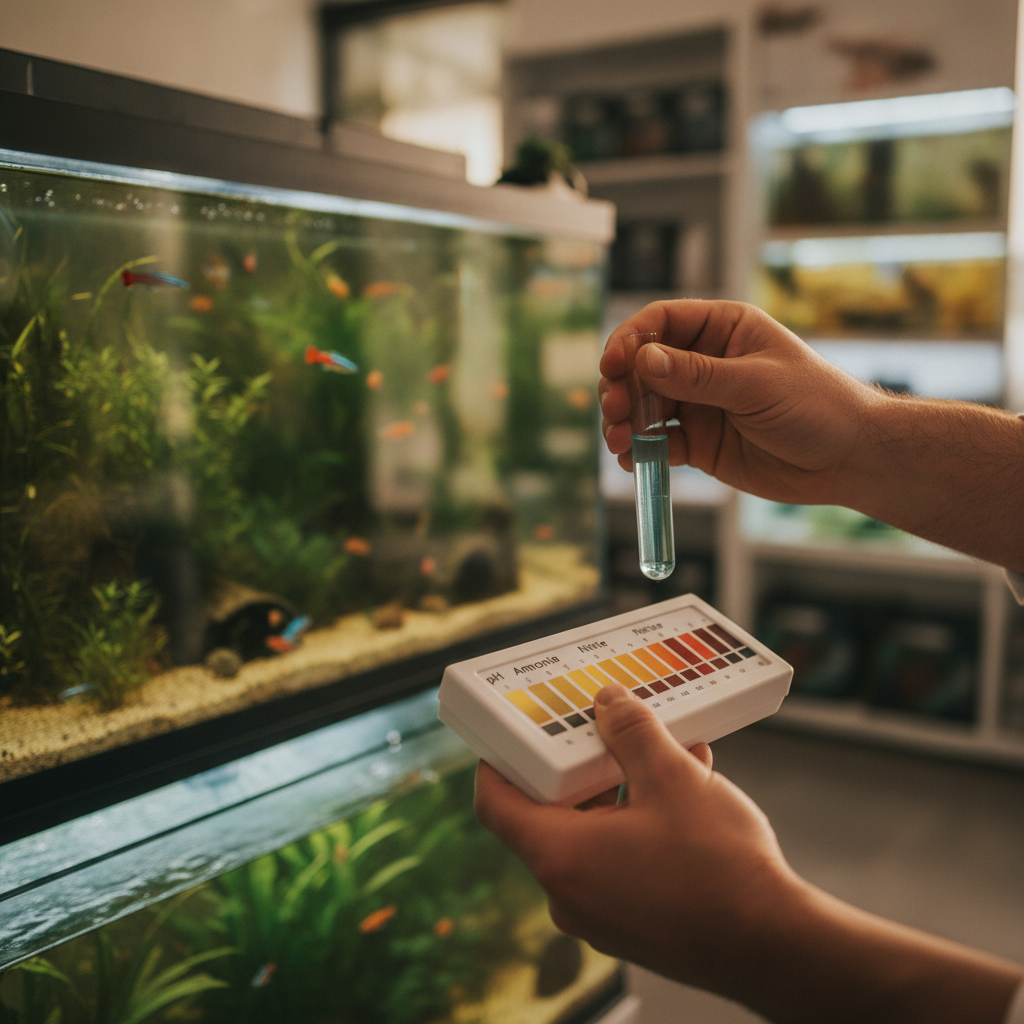
- A liquid test kit covering ammonia, nitrite, nitrate and pH. Test strips are convenient but drift in accuracy when stored in humid conditions, so keep them sealed with desiccant or switch to liquid reagents for the wet months.
- A room hygrometer. Knowing whether indoor humidity is 65 percent or 90 percent tells you immediately how much evaporative cooling you can expect.
Cooling and Aeration Hardware
- An air pump with airstone or sponge filter, sized generously. This is your oxygen insurance policy.
- Clip-on cooling fans designed for aquarium rims, or a small desk fan positioned to skim the surface.
- A spare battery-powered air pump with fresh batteries, or a USB air pump paired with a power bank. This is the single most valuable purchase for the monsoon season.
- Frozen water bottles (never loose ice) prepared in advance and stored in the freezer.
Power Protection
- A surge protector for all aquarium equipment. Lightning-related surges are a genuine risk during Thai thunderstorms and can destroy a heater controller instantly.
- A drip loop on every cable, meaning the cord hangs below the socket before rising to it, so condensation and splashes run off rather than into the outlet.
- An uninterruptible power supply (UPS) if budget allows, running at minimum the filter and air pump. Even a modest unit can bridge the short cuts that make up most monsoon outages.
Step-by-Step: Stabilising Tank Temperature in High Humidity
Step 1: Establish Your Baseline Range
For a week, record the tank temperature at the same three times each day: early morning, mid-afternoon and late evening. Most owners are surprised by what they find. A tank that reads a comfortable 27C when checked after work may have peaked at 30.5C at three in the afternoon.
Your target for most tropical community species is a stable band, commonly cited as around 24C to 27C for many community fish, with a maximum acceptable daily variation of about one degree. Some species tolerate warmer water, but oxygen availability, not fish preference, becomes the limiting factor above roughly 28C.
Step 2: Set the Heater as a Floor, Not a Ceiling
Most owners struggle with this the first time because it feels counter-intuitive. During the rainy season your heater is not there to warm the tank, it is there to stop the tank dropping when an air-conditioned room cools overnight or a heavy storm passes through. Set it a degree or two below your typical daytime temperature. If the tank sits at 29C in the afternoon, setting the heater to 26C means it only engages if the water falls that far, preventing a sudden nocturnal drop while never adding unwanted heat.
Step 3: Use Evaporative Cooling Realistically
A surface fan cools by accelerating evaporation. In dry air, this can pull two to three degrees off a tank. At 90 percent humidity, expect considerably less, perhaps under a degree. It is still worth using, but do not rely on it alone.
To get the most from a fan in humid conditions:
- Angle it across the surface rather than straight down, which increases surface area exchange without creating a strong draught on the water column.
- Remove or partially open the tank lid so humid air can escape rather than recirculating under the glass.
- Run a dehumidifier or the room air conditioner on dry mode if available, which lowers room humidity and restores the fan's effectiveness.
- Top up evaporation losses with dechlorinated water at tank temperature. Evaporation concentrates dissolved minerals, so replacing it matters for stable hardness and pH.
Step 4: Cool Air Rather Than Water Where Possible
Air conditioning the room is the most stable cooling method available. If you run the air conditioner only in the evening, the tank will experience a drop after sunset and a climb through the day. Where possible, set a constant moderate room temperature rather than aggressive cycling.
Step 5: Emergency Cooling Done Safely
If the tank exceeds roughly 30C and fish are showing stress, float a sealed frozen water bottle in the tank. Check the temperature every fifteen minutes and remove the bottle once you have dropped one to two degrees. Never add ice directly, never add cold tap water in volume, and never aim to cool more than about two degrees in an hour. A rapid drop causes thermal shock, which can be more damaging than the original heat.
Step-by-Step: Managing Oxygen in Warm Water
This is the section that saves fish. Water at 30C holds meaningfully less dissolved oxygen than water at 25C, while warm fish burn through what remains faster. Beneficial bacteria and decomposing organic matter also consume oxygen, so a well-stocked, warm, slightly overdue-for-cleaning tank can drop to dangerous levels overnight when plants stop photosynthesising and begin respiring.
Step 1: Maximise Surface Agitation
Gas exchange happens almost entirely at the water surface. Lower your filter outlet or angle a spray bar so it creates visible ripple across the whole surface. A gentle boil at one corner is far less effective than broad, even movement.
Step 2: Add Dedicated Aeration
Run an air pump with an airstone continuously through July and August, not just when problems appear. Position it so rising bubbles create a circulation loop that turns over the whole water column. A sponge filter driven by the same pump adds biological filtration and aeration together, and it keeps working if your main filter fails.
Step 3: Manage the Overnight Window
The lowest oxygen point in a planted tank is roughly one hour before lights come on. Plants have been respiring all night. If you keep a heavily planted tank, increase aeration overnight specifically, either by running the air pump only after lights out or by increasing its output on a timer.
Step 4: Reduce Oxygen Demand
- Feed lightly. Uneaten food decomposes and consumes oxygen while releasing ammonia. In warm water, reduce portions and consider one fasting day per week for adult fish, though this should not be applied to fry or to species requiring frequent small meals.
- Remove decaying plant matter and siphon detritus promptly.
- Postpone adding new fish until the season stabilises. Increasing bioload during the hottest, lowest-oxygen weeks is a common and avoidable error.
Step-by-Step: Preventing Algae Blooms During Long Overcast Spells
Grey skies do not protect a tank from algae. In fact, monsoon conditions create three algae drivers at once: warm water speeds algal growth, owners extend artificial lighting to compensate for gloom, and rainy season top-ups plus heavier feeding raise nutrient levels.
Step 1: Discipline the Photoperiod
Put the aquarium light on a timer and cap it at six to eight hours daily. Resist the temptation to add hours because the room feels dark. Consider a split photoperiod, for example four hours in the morning and four in the evening with a gap between, which gives plants usable light while denying algae the long uninterrupted exposure it favours.
Step 2: Control Nutrients
- Test nitrate weekly. Rising nitrate through the wet season is a warning that water changes or feeding need adjusting.
- Keep phosphate down by not overfeeding and by removing waste promptly.
- Check that any water used for top-ups is not contributing nutrients. Collected rainwater in particular can carry airborne contaminants and should not be used untreated.
Step 3: Watch for Indirect Sunlight
Tanks near windows can still receive substantial diffuse light on overcast days. If you are fighting green water, move the tank or apply a blind on that side for the season.
Step 4: Respond to a Bloom Correctly
If green water appears, do not immediately do a huge water change, which removes free-floating algae but leaves nutrients and often triggers a rebound. Instead reduce lighting to three to four hours or blackout the tank entirely for two to three days with the filter and aeration running, feed minimally, and then resume with a shortened photoperiod. Increase aeration during a blackout, as dying algae consumes oxygen as it decomposes.
Step-by-Step: Protecting Filters and Heaters Through Power Cuts
During a Short Cut (Under Two Hours)
- Switch on the battery or USB air pump immediately. Oxygen is the priority.
- Leave the tank lid partly open to assist gas exchange.
- Do not feed. Fish need less food and less oxygen demand during an outage.
- Keep the room dark and quiet to reduce fish activity.
During a Longer Cut (Over Two Hours)
The concern shifts to the filter's biological media. Beneficial nitrifying bacteria are aerobic and begin to die once oxygen in the stagnant filter is exhausted, typically within a few hours. When power returns, the filter can push decomposing material and ammonia back into the tank.
- After about an hour without power, remove the filter media (sponges, ceramic media) and suspend it in the tank water where the air pump is running. This keeps the bacteria oxygenated.
- Insulate the tank if the room is cooling: wrap the sides with towels or a blanket. In Thai monsoon conditions overheating is more likely than cooling, so monitor rather than assume.
- Manually stir the surface with a clean cup every twenty to thirty minutes if you have no battery pump, pouring water back from a height to break the surface.
When Power Returns
- Before restarting a canister or hang-on filter that has been off for several hours, take out the media, rinse it in a bucket of tank water, and discard the stagnant water inside the housing. Do not let that water enter the tank.
- Restart the filter and observe flow.
- Check that the heater has resumed and is not stuck on, which can happen with a failed thermostat.
- Test ammonia and nitrite twelve and twenty-four hours later. A small bacterial die-off can cause a temporary spike.
Preventing Heater Damage
If a power cut occurs while water level is low or if a heater is exposed to air, the glass can crack when power returns. Keep water topped up, always position heaters fully submerged and horizontal where the design allows, and replace any heater older than roughly three to five years before the wet season rather than during it.
Weekly Maintenance Schedule for July and August
Daily (Five Minutes)
- Check both thermometers and note the reading.
- Observe fish at feeding time: gill rate, position in the tank, appetite, fin posture.
- Confirm filter flow and air pump output are normal.
- Remove any uneaten food after three to five minutes.
Twice Weekly
- Test ammonia and nitrite. During settled months monthly may suffice, but the monsoon is not a settled month.
- Wipe condensation from lids, hoods and light units. Persistent moisture in electrical fittings is a fire and failure risk in humid conditions.
- Top up evaporation with dechlorinated, temperature-matched water.
Weekly
- Water change of 20 to 25 percent, with replacement water matched to within one degree of tank temperature. Use a thermometer in the bucket rather than judging by hand.
- Siphon the substrate in rotation, covering roughly one third of the tank floor each week rather than disturbing everything at once.
- Test nitrate and pH, and record the figures. A written log makes trends visible long before they become emergencies.
- Clean the glass and remove visible algae.
- Check equipment cables, plugs and drip loops for moisture or corrosion.
Fortnightly
- Rinse mechanical filter media (floss, coarse sponge) in removed tank water, never tap water, which kills beneficial bacteria with chlorine.
- Verify heater accuracy against your independent thermometer.
- Check battery pump batteries and replace or recharge.
Monthly
- Full filter service, staggered so mechanical and biological media are never cleaned in the same session.
- Inspect airline tubing for perishing, and replace airstones, which clog and reduce output over time.
- Review stocking and feeding levels against the season.
What to Watch For During and After
Early Warning Signs
- Fish hanging near the surface or at the filter outflow. This is oxygen-seeking behaviour and is the clearest single warning of low dissolved oxygen.
- Rapid or laboured gill movement compared with normal baseline.
- Reduced appetite or fish refusing food they usually take eagerly.
- Increased hiding, clamped fins, or resting on the substrate in normally active species.
- Cloudy water developing over one to two days, which often indicates a bacterial bloom following a filter disturbance or organic overload.
- Sudden pH movement, particularly after heavy top-ups or a large water change.
After a Heat or Outage Event
Fish that appear to recover can remain immunosuppressed for one to two weeks. Watch for secondary problems: white spot (ich), fungal patches, fin edges looking ragged, or unusual flicking against decor. Keep water quality pristine during this window, maintain steady temperature, and avoid introducing new fish, new decor or dietary changes.
When to Call an Aquatic Veterinarian
Honest assessment matters here. Much of aquarium care is genuinely home-manageable, but some situations are not, and delay costs lives. Contact an aquatic veterinarian or an experienced fish health professional promptly if:
- Multiple fish die within twenty-four hours without an obvious, correctable water quality cause.
- Fish continue gasping after temperature has been stabilised and vigorous aeration has been running for several hours, which can indicate gill damage, parasitic gill infestation or toxin exposure rather than simple oxygen shortage.
- You see haemorrhaging, ulceration, severe bloating with raised scales, or protruding eyes. These suggest systemic disease that requires diagnosis rather than guesswork.
- Fish show neurological signs such as spiralling, loss of balance or inability to remain upright.
- A disease spreads through the tank despite correct water parameters.
- You are considering any medication. Over-the-counter treatments are frequently misapplied, several reduce dissolved oxygen further, and some are dangerous to invertebrates or scaleless fish. In warm monsoon water the margin for error narrows considerably.
Aquatic veterinary services are available in Bangkok and several regional centres in Thailand, and many will advise remotely on water test results. Bringing a recent written log of temperature, ammonia, nitrite, nitrate and pH readings will make that consultation far more useful.
Difficulty and Realistic Expectations
Rainy season aquarium management is moderate in difficulty. The individual tasks are simple, but the discipline of daily observation and weekly logging is what separates a stable tank from a crisis tank. Owners who lose fish in July and August rarely do so because they lacked equipment. They lose fish because a slow drift went unnoticed until a power cut or a hot afternoon pushed the system past its limit.
Set up your monitoring, buy the battery air pump, put the light on a timer, and keep the log. Those four steps handle the large majority of monsoon aquarium problems before they start.
This article is for educational purposes and does not replace advice from a qualified aquatic veterinary professional. Seek professional guidance for any suspected disease or persistent unexplained losses.
Frequently Asked Questions
Why does my aquarium get hotter during Thailand's rainy season even though it feels cooler outside? ↓
How long can my fish survive a power cut during a monsoon storm? ↓
Should I turn off my aquarium heater completely in July and August? ↓
Why is algae worse during overcast weeks when there is less sunlight? ↓
Is it safe to use collected rainwater for top-ups during the monsoon? ↓
My fish are gasping at the surface but the temperature is normal. What should I check? ↓

Emma Lawson
Practical Pet Care Educator
Practical pet home care specialist — clear, step-by-step guidance grounded in veterinary nursing standards.
Content Disclosure
This article was created using state-of-the-art AI models with human editorial oversight. It is intended for informational and entertainment purposes only and does not constitute veterinary medical advice. Always consult a licensed veterinarian for your pet's specific health needs. Learn more about our process.