Smart habitat monitors now offer automated UVB tracking, real-time temperature and humidity alerts, and data logging for reptile and amphibian enclosures. But does this technology actually help prevent common health problems like metabolic bone disease?
Key Takeaways
- Smart habitat monitors use IoT sensors to track temperature, humidity, and UVB output in real time, sending alerts to owners via smartphone apps.
- Poor husbandry, particularly incorrect temperature gradients, inadequate UVB exposure, and improper humidity, remains the leading cause of preventable illness in captive reptiles and amphibians.
- Automated data logging can help owners identify slow environmental drift before clinical signs appear, potentially reducing the risk of conditions like metabolic bone disease (MBD) and respiratory infections.
- No monitoring device replaces veterinary diagnosis: technology supports better husbandry but cannot treat disease.
- Choosing a monitor depends on species requirements, enclosure type, and whether the owner needs basic alerts or detailed trend analysis.
Why Habitat Conditions Matter More Than Most Owners Realise
Reptiles and amphibians are ectothermic, meaning they depend entirely on external heat sources to regulate metabolism, digestion, immune function, and behaviour. Unlike mammals that maintain a stable core temperature internally, a bearded dragon or dart frog relies on the microclimate inside its enclosure. When temperature, humidity, or ultraviolet light drifts outside the species' preferred range, the consequences are not immediate but cumulative: over weeks or months, sub-optimal conditions quietly degrade organ function, calcium metabolism, and immune response.
According to the Merck Veterinary Manual, the most common health problems in captive reptiles, including nutritional secondary hyperparathyroidism (the clinical name for metabolic bone disease), respiratory infections, and dysecdysis (abnormal shedding), trace back to husbandry errors rather than infectious agents. Professional veterinary consensus consistently identifies environment as the single most important variable in reptile and amphibian health.
What Smart Habitat Monitors Actually Do
Smart habitat monitors represent a category of connected devices that go beyond a simple analogue thermometer stuck to the glass. Current systems typically include some or all of the following capabilities:
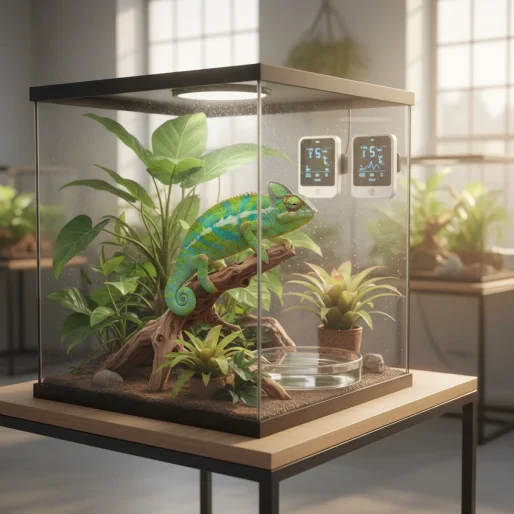
- Wireless temperature and humidity sensors placed at multiple points within the enclosure (basking zone, cool zone, substrate level) that report readings to a central hub or app.
- UVB output tracking using sensors that measure ultraviolet irradiance at the animal's basking distance, alerting owners when bulb output drops below effective levels.
- Data logging and trend analysis that records environmental parameters over days, weeks, or months, allowing owners and veterinarians to review historical conditions.
- Automated alerts pushed to a smartphone when readings fall outside user-defined safe ranges, including power outage notifications.
- Integration with controllers that can adjust heating elements, misting systems, or lighting schedules automatically in response to sensor data.
Some systems allow connection of up to five sensors per gateway, enabling monitoring of multiple enclosures from a single app. More advanced setups, often used in zoos and research facilities, incorporate predictive analytics and remote firmware updates.
How UVB Tracking Works
UVB bulbs degrade over time. A bulb that produced adequate UVB irradiance when new may fall below therapeutic levels within six to twelve months, yet it still emits visible light, giving owners no visual cue that output has dropped. UVB sensors measure irradiance (typically in microwatts per square centimetre) at the animal's basking spot, providing objective data rather than relying on a calendar-based bulb replacement schedule.
This matters because UVB exposure drives cutaneous vitamin D3 synthesis in many reptile species. Research referenced in the Merck Veterinary Manual indicates that UVB exposure, rather than dietary vitamin D supplementation alone, may be critically important for calcium metabolism and skeletal health, particularly in species like green iguanas. Without adequate UVB, calcium absorption falters, and the parathyroid glands compensate by pulling calcium from bone, eventually producing the soft jaws, limb deformities, and pathologic fractures characteristic of MBD.
The Science Behind Common Husbandry Related Diseases
Metabolic Bone Disease (MBD)
MBD, more precisely called nutritional secondary hyperparathyroidism, is widely regarded as the most common bone disorder encountered in reptile veterinary practice. The underlying mechanism involves three interconnected factors:
- Dietary calcium deficiency or an inverted calcium to phosphorus ratio
- Insufficient UVB radiation for vitamin D3 synthesis
- Temperatures too low to support proper digestion and nutrient absorption
Clinical signs include pliable or rubbery mandibles, reluctance to move, tremors or twitching, bowed limbs, shell softening in chelonians, and pathologic fractures. Veterinary sources note that while many reptiles respond well to treatment when caught early, skeletal deformities that have already formed are usually permanent.
A smart monitor that tracks UVB output and basking zone temperature can flag both of the environmental contributors (insufficient UVB and inadequate thermal gradient) before clinical signs appear, potentially reducing MBD incidence when combined with correct nutrition. For more on understanding nutritional science for pets, see Functional Ingredients in Pet Food: What Science Says.
Respiratory Infections
Respiratory infections in reptiles often develop when ambient temperatures drop below the species' preferred optimum temperature zone (POTZ), suppressing immune function, or when humidity is either too high (promoting bacterial and fungal growth) or too low (drying mucous membranes). A monitor that logs temperature dips, particularly overnight drops that owners may never notice, provides actionable data. If a reptile presents with open-mouth breathing, nasal discharge, or wheezing, a veterinarian reviewing weeks of logged environmental data can more quickly identify the husbandry cause.
Dysecdysis (Abnormal Shedding)
Retained shed, particularly around the toes, tail tip, and spectacle (eye cap) in snakes, is strongly correlated with low humidity during the shedding cycle. Species like ball pythons typically need humidity in the range of 50 to 70 percent, with increases during active shedding. Smart humidity sensors that alert owners when levels drop can help prevent retained shed before it causes constriction injuries or eye infections.
Amphibian Specific Concerns: Chytridiomycosis and Skin Health
Amphibians breathe and absorb water through their skin, making them exceptionally sensitive to environmental conditions. The chytrid fungus Batrachochytrium dendrobatidis (Bd) thrives in specific temperature ranges, generally between 17 and 25 degrees Celsius. Research published in peer-reviewed journals has shown that amphibians maintained at temperatures above 25 degrees Celsius for sustained periods can clear Bd infections, while those kept in the pathogen's optimal range are at higher risk. Smart monitors that track enclosure temperatures and alert owners to sustained periods within that risk window could, in theory, support better management of quarantine enclosures and at-risk collections.
Does the Data Actually Help Prevent Health Problems?
This is the critical question, and the honest answer is: it depends on what owners do with the information.
Where Monitors Add Clear Value
- Detecting equipment failure: A heat lamp burning out overnight or a thermostat malfunctioning can create life-threatening temperature drops. Power outage alerts are arguably the most immediately life-saving feature of smart monitors.
- Revealing gradual drift: An enclosure that slowly loses 2 degrees Celsius per month due to a declining heat emitter will not trigger alarm bells for an owner checking a thermometer once daily. Trend graphs make slow changes visible.
- UVB bulb accountability: Replacing bulbs based on measured output rather than arbitrary six-month schedules means animals are neither exposed to ineffective old bulbs nor wasting functional ones.
- Veterinary consultations: Environmental data logs give reptile veterinarians objective information that dramatically improves diagnostic accuracy. Rather than relying on an owner's recollection that the enclosure is "around 85 degrees," a clinician can review actual temperature curves.
Where Monitors Fall Short
- Data without action is meaningless: An alert that goes ignored offers no protection. Studies and clinical observations consistently show that owner education, not technology alone, determines husbandry quality.
- Sensor placement matters: A single sensor placed at the wrong height or distance from the basking spot can provide reassuring but inaccurate data. Multiple sensors at species-appropriate positions are essential.
- They do not measure everything: No current consumer monitor tracks air quality (ammonia from soiled substrate), water quality parameters for semi-aquatic species, or the nutritional content of feeder insects. These remain manual responsibilities.
- False sense of security: An owner who sees "green" status on an app might assume everything is fine, neglecting direct observation of the animal's behaviour, body condition, and feeding response.
Technology is most effective as a supplement to, not a substitute for, attentive daily observation and regular veterinary checkups. To understand how AI-driven tools are evolving in pet health more broadly, see AI Pet Health Apps in 2026: Tools Ranked and Compared.
Choosing the Right Monitor for Your Setup
Not every keeper needs the same level of monitoring. The decision should be guided by species sensitivity, enclosure complexity, and practical needs.
Basic Monitoring (Single Sensor, App Alerts)
Suitable for hardier species kept in simple enclosures: leopard geckos, corn snakes, or adult bearded dragons in well-established setups. A single wireless temperature and humidity sensor with smartphone alerts covers the essentials and is typically the most affordable entry point.
Multi-Zone Monitoring (Multiple Sensors, Data Logging)
Recommended for species with strict thermal gradient requirements (chameleons, many tropical lizards) or high-humidity species (crested geckos, dart frogs). Multiple sensors placed at the basking spot, cool end, and substrate level provide a complete picture. Data logging is valuable for owners who want to correlate environmental trends with feeding, shedding, or behavioural patterns.
Integrated Automation (Sensors Plus Controllers)
Best suited for complex bioactive enclosures, breeding setups, or collections of multiple animals. These systems connect sensors to thermostats, misting systems, and lighting controllers, making automated adjustments. Professional breeders, research labs, and zoos increasingly rely on this level of integration for consistent results across large numbers of enclosures.
Regardless of complexity, always verify sensor accuracy against a calibrated reference thermometer and hygrometer before trusting readings. Inexpensive sensors can drift significantly, and uncalibrated data is potentially worse than no data at all.
Practical Tips for Getting the Most From Your Monitor
- Place sensors where the animal actually sits: Measure temperature at the basking surface, not the air two inches above it. For arboreal species, mount sensors at perching height.
- Set alert thresholds conservatively: If a species' POTZ ranges from 27 to 32 degrees Celsius, set low alerts at 26 rather than waiting for a drop to 22.
- Review weekly trend data, not just live readings: A daily glance at current temperature is useful. A weekly review of trends is where monitors reveal their real value.
- Share data with your veterinarian: Export logs before reptile wellness visits. Environmental data can shape dietary recommendations, supplement schedules, and UVB bulb replacement timing.
- Replace UVB bulbs based on measured output: If the sensor shows irradiance has dropped below the recommended range for the species, replace the bulb regardless of how many months it has been in use.
- Do not neglect direct observation: Watch for changes in appetite, activity level, colour, posture, and shedding quality. No sensor detects early signs of illness as reliably as an attentive owner.
For insights into budgeting for veterinary care, including exotic animal specialists, visit Vet Visit Costs: Budget Alternatives Pet Owners Need. Owners keeping aquatic or semi-aquatic species may also benefit from Aquarium Cooling: Fans vs Chillers vs DIY Ranked.
When to See Your Vet and What to Ask
Smart monitors can identify environmental problems, but they cannot diagnose disease. A veterinary visit is essential when any of the following occur:
- The animal stops eating for more than one to two weeks (shorter for small or juvenile animals)
- Visible swelling of the jaw, limbs, or joints
- Open-mouth breathing, mucus bubbles at the nostrils, or audible wheezing
- Retained shed that does not resolve after a humidity adjustment and a soak
- Lethargy, tremors, or inability to right itself when turned over
- Any skin discolouration, lesions, or unusual texture changes in amphibians
When booking the appointment, ask the following:
- "Can I send you my enclosure's environmental data logs in advance?"
- "Based on my species' needs, are my temperature gradients and UVB levels within the recommended range?"
- "Should we run blood calcium and phosphorus levels to check for early MBD?"
- "How often should this species have a wellness exam given its age and setup?"
Veterinarians who specialise in reptile and amphibian medicine (often credentialed through the Association of Reptilian and Amphibian Veterinarians, or ARAV) will be familiar with interpreting environmental data alongside clinical findings. Awareness of evolving pet ownership regulations may also be helpful: see New Pet Ownership Laws in 2026: A Global Guide.
The Bottom Line: Technology as a Tool, Not a Cure
Smart habitat monitors represent a genuine step forward in reptile and amphibian husbandry. The ability to track UVB degradation, detect overnight temperature crashes, and log humidity trends over weeks provides a layer of environmental awareness that was previously unavailable to most keepers. For species with narrow environmental tolerances, this data can meaningfully reduce the risk of husbandry-related disease.
However, monitors are tools, not solutions. They work best when paired with species-specific husbandry knowledge, proper nutrition (including calcium supplementation and gut-loaded feeder insects), and regular veterinary care from a practitioner experienced in herpetological medicine. The most sophisticated sensor in the world cannot compensate for an owner who does not understand what the numbers mean or what to do when they change.
Used thoughtfully, smart monitors close the gap between what owners think is happening in the enclosure and what is actually happening, and that gap is where most preventable reptile and amphibian health problems begin.
Frequently Asked Questions
Can a smart habitat monitor prevent metabolic bone disease in reptiles? ↓
How many sensors do I need in a reptile enclosure? ↓
Do UVB sensors tell me when to replace my reptile's UVB bulb? ↓
Are smart habitat monitors useful for amphibians as well as reptiles? ↓
Should I share my habitat monitor data with my veterinarian? ↓

Dr. James Harrington
Veterinarian & Pet Health Writer
Veterinarian and health writer — translating complex medical topics into clear, actionable guidance for pet owners.
Content Disclosure
This article was created using state-of-the-art AI models with human editorial oversight. It is intended for informational and entertainment purposes only and does not constitute veterinary medical advice. Always consult a licensed veterinarian for your pet's specific health needs. Learn more about our process.