Ireland's greyhound racing industry means thousands of dogs retire each year and need homes. This guide covers behaviour, legal requirements, and practical care tailored to Irish adopters.
Key Takeaways
- Ireland is one of the largest greyhound racing countries in the world, meaning a steady supply of retired dogs need rehoming through organisations like the Irish Retired Greyhound Trust (IRGT) and Homes for Unwanted Greyhounds (HUG).
- Retired greyhounds are calm indoors, typically sleeping 16 to 18 hours a day, and require only moderate daily exercise of around 20 to 30 minutes.
- Prey drive is a hardwired sighthound trait, not a behavioural failure, and requires structured management including secure lead walking and muzzle conditioning.
- Irish law requires all dogs to be microchipped and registered on an approved database, and owners must hold a valid dog licence.
- Ireland's wet, cool climate presents specific care considerations for greyhounds, whose thin coats and low body fat make them vulnerable to cold and damp conditions.
Why Ireland Is Unique for Greyhound Adoption
Ireland has one of the most active greyhound racing industries in the world, regulated by Greyhound Racing Ireland (GRI) under the Welfare of Greyhounds Act 2011. This legislation established welfare standards for racing greyhounds including requirements for breeding establishments and traceability. However, the scale of the industry means that large numbers of greyhounds retire from racing each year and need pet homes.
Several well established rescue organisations operate across Ireland. The Irish Retired Greyhound Trust (IRGT), which works in partnership with GRI, facilitates adoptions and provides guidance to new owners. Independent charities such as Homes for Unwanted Greyhounds (HUG), RIGHT (Rehoming Irish Greyhounds Team), and Clare Greyhound Sanctuary also play vital roles. These organisations typically assess each dog's temperament, conduct small animal testing where appropriate, and provide post-adoption support.
Adoption fees in Ireland generally range from around €100 to €200 depending on the organisation. This typically covers initial veterinary checks, vaccinations, neutering or spaying, and microchipping.
Legal Requirements for Greyhound Owners in Ireland
Before bringing a retired greyhound home, Irish adopters need to understand several legal obligations under the Control of Dogs Act 1986 and subsequent regulations.
- Dog licence: All dog owners in Ireland must hold a valid dog licence, available from your local post office. An annual licence costs €20, while a lifetime licence costs €140.
- Microchipping: All dogs must be microchipped with an ISO 11784 compliant chip and registered on an approved database by 12 weeks of age. Most retired greyhounds will already be chipped through the racing registration system, but owners should verify the chip is registered to their details on an approved Irish database such as Fido.ie or the Irish Kennel Club database.
- Muzzling: Greyhounds are not classified as a restricted breed in Ireland. Unlike in Northern Ireland, there is no legal requirement to muzzle a greyhound in public in the Republic of Ireland. However, many adopters choose to maintain muzzle use as a safety precaution, particularly during the early transition period or in areas with small dogs and wildlife.
- Lead requirements: All dogs must be kept under effectual control in public places. Greyhounds should be walked on a lead in any unfenced area, as their prey drive makes reliable off lead recall extremely difficult to achieve.
The Adjustment Period: What to Expect in an Irish Home
Rescue organisations commonly reference the "three, three, three" framework: three days of sensory overload, three weeks for emerging personality, and three months toward full settlement. This is particularly relevant for Irish homes because many retired racing greyhounds have spent their entire lives in outdoor kennel environments at tracks and training facilities around the country.
The First Three Days
Expect your greyhound to be overwhelmed. Many racing greyhounds have never encountered household features that Irish pet owners take for granted: stairs, tiled or wooden floors, glass doors, washing machines, kettles, and televisions. Freezing on slippery floors is extremely common. Placing non-slip mats or rugs on tiled hallways and kitchen floors creates safe pathways while the dog builds confidence.
Keep the house quiet. Limit visitors. Offer food in a calm, low traffic area. Provide a clearly defined resting space away from household activity.
Three Weeks: Personality Emerges
Around the three week mark, the dog's true temperament surfaces. This is when owners may first notice separation distress, noise sensitivity, or resource guarding behaviour. Dogs who lived in group kennel settings may struggle with being left alone. Gradual alone time training, starting with absences of just a few minutes and building up slowly, is the recommended approach.
Establishing a predictable daily routine is especially important. Greyhounds raised in racing environments are accustomed to highly structured schedules, and routine can be deeply reassuring during transition.
Three Months and Beyond
Most greyhounds have settled into household life by three months, though some require six months or longer to fully decompress. Dogs with limited socialisation or those who experienced harsh training methods may take longer.
Managing Prey Drive in Irish Settings
Ireland's countryside, suburban estates, and even urban parks are home to cats, rabbits, foxes, and hares. For a retired greyhound whose chase instinct has been reinforced through racing, these environments present genuine management challenges.
Prey drive is a normal, genetically influenced behaviour in sighthounds. It is not aggression and it is not a training failure. The predatory sequence (orient, eye, chase, grab) is hardwired and was actively reinforced during the dog's racing career.
Practical Management
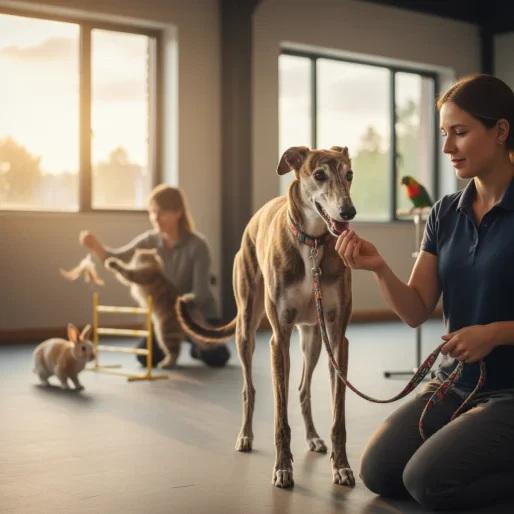
- Secure lead walking: Use a correctly fitted martingale collar, as standard buckle collars can slip over a greyhound's narrow skull. A sturdy lead of 1 to 1.5 metres is appropriate for roadside walking. In secure open spaces, a long line of 5 to 10 metres offers a compromise between freedom and safety.
- Muzzle conditioning: Even though muzzling is not legally required in the Republic, maintaining positive muzzle associations is strongly recommended. Many retired greyhounds arrive already comfortable with basket muzzles from their racing days. Pair muzzle wearing with high value treats to maintain a positive association.
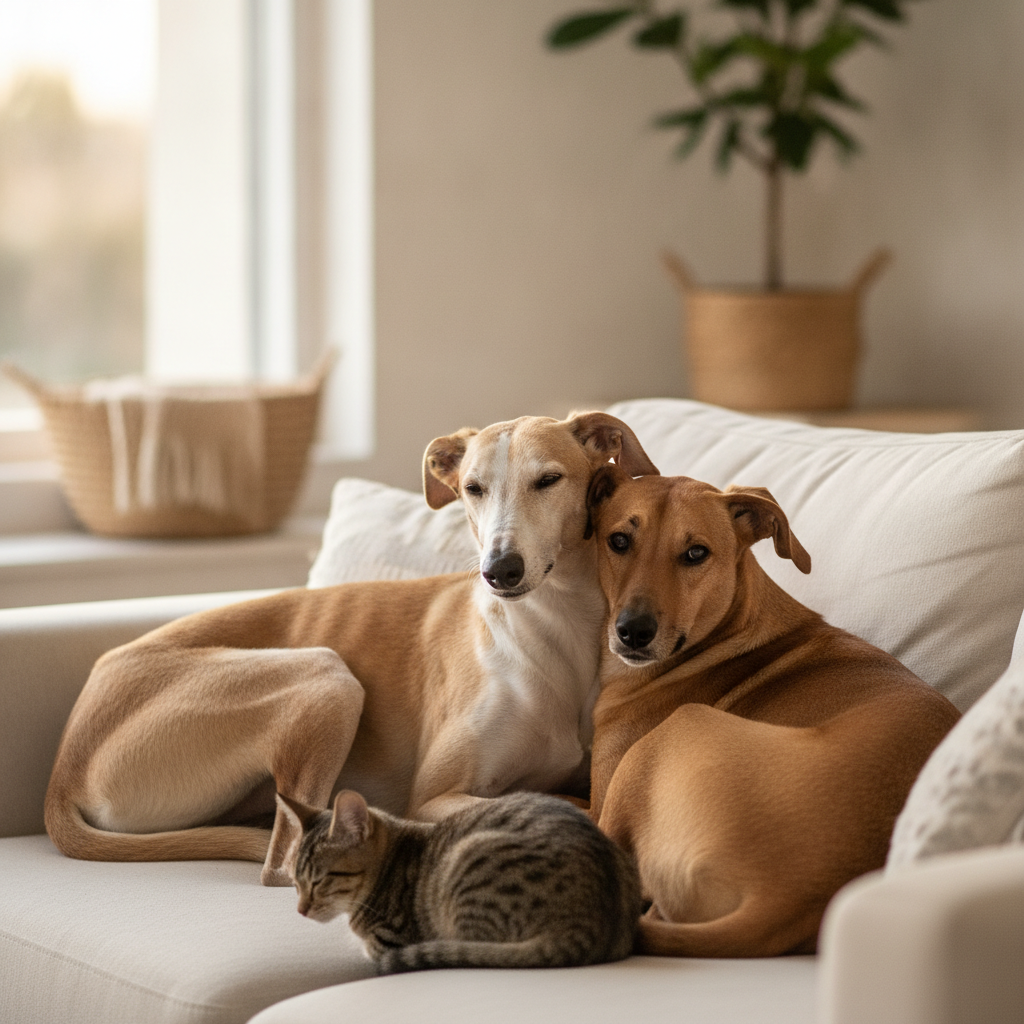
- Household separation: If the home includes cats, small dogs, or other small pets, baby gates and closed doors are essential. Physical separation is responsible management, not a failure.
- Controlled introductions: For greyhounds assessed as potentially suitable for living with cats, follow a gradual desensitisation protocol. Begin with scent exchange (swapping bedding), progress to visual exposure at a distance below the dog's reactivity threshold, and reinforce calm behaviour.
Ireland's Climate and Greyhound Care
Ireland's temperate maritime climate, with frequent rain, high humidity, and cool temperatures even in summer, presents specific challenges for greyhounds. Their thin single-layer coats and very low body fat provide minimal insulation.
Cold and Wet Weather
During autumn and winter, when temperatures regularly drop to 0 to 5°C and rain is persistent, a waterproof, fleece lined coat is essential for walks. Greyhounds can lose body heat rapidly, and hypothermia is a genuine concern for thin, low fat dogs in prolonged wet conditions. After wet walks, dry the dog thoroughly, paying attention to the chest and belly.
Indoors, ensure the dog's bed is away from draughts and cold floors. An orthopaedic or memory foam bed is strongly recommended because greyhounds' bony prominences (elbows, hocks, hips) are highly susceptible to pressure sores. Provide multiple blankets for nesting, as greyhounds instinctively arrange bedding to create warmth.
Summer Considerations
Irish summers are generally mild, but greyhounds can overheat during warmer spells above 20°C, particularly during exercise. Walk during cooler parts of the day (early morning or evening) and always carry water.
Sleep, Nesting, and the "Roaching" Posture
New owners are often surprised by how much their greyhound sleeps. Resting for 16 to 18 hours per day is entirely normal for the breed. This is not a sign of illness, provided the dog is alert and engaged during waking hours.
Greyhounds exhibit strong nesting behaviour: circling, pawing at bedding, dragging blankets into piles, and "roaching" (lying on their backs with legs in the air). Roaching is a reliable indicator of comfort and relaxation, as dogs experiencing fear or anxiety rarely expose their belly in this way.
For older retired greyhounds showing joint stiffness or reduced mobility, Dog Hydrotherapy After Surgery: Costs and Guide for Ireland can support comfort and quality of life.
When to Seek Professional Help
If fear, anxiety, or predatory behaviour escalates despite consistent management over two to four weeks, professional assessment is warranted. In Ireland, Veterinary Ireland (the professional body representing veterinary surgeons) can help locate a veterinary practitioner with behavioural expertise. The Animal Behaviour and Training Council (ABTC) register also lists qualified clinical animal behaviourists who work in Ireland.
Seek professional assessment if:
- Fear responses escalate despite consistent counter-conditioning efforts.
- The dog displays aggression (growling, snapping, biting) in any context.
- Self-injurious behaviour occurs, such as excessive licking, tail chewing, or escape attempts causing physical harm.
- Separation distress is severe, with vocalisation lasting more than 30 minutes, destructive behaviour, or house soiling despite being otherwise house trained.
A veterinary behaviourist may recommend pharmacological support alongside behaviour modification. Medications such as selective serotonin reuptake inhibitors can lower baseline anxiety enough for training protocols to take effect.
UCD Veterinary Hospital / Local Emergency Vet
Call your vet's emergency out-of-hours number or contact the UCD Veterinary Hospital in Dublin.
Irish vet practices provide out-of-hours emergency contact details on their answerphone message.
First Week Checklist for Irish Adopters
- Orthopaedic bed with washable cover, plus two or more soft blankets for nesting.
- Correctly fitted martingale collar (available from most Irish pet retailers).
- Waterproof, fleece lined dog coat suitable for Irish weather.
- Non-slip mats or rugs for tiled and wooden floors.
- Baby gates for room separation, especially in multi-pet households.
- A basket muzzle with high value treats for positive conditioning.
- Valid dog licence (€20 annual or €140 lifetime from your local post office).
- Confirmation that the dog's microchip is registered to your details on an approved Irish database.
- A written daily schedule shared with all household members.
- Contact details for your local veterinary practice and a qualified animal behaviourist.
Diet and Health During Transition
The stress of rehoming can affect a greyhound's digestive system. Gradual food transitions over 7 to 10 days, mixing increasing proportions of new food with the previous diet, help reduce gastrointestinal upset. For evidence based digestive support options, the probiotics guide offers helpful guidance.
Greyhounds are also known to be sensitive to certain anaesthetic agents, particularly barbiturate based drugs, due to their low body fat and unique metabolism. Ensure your veterinary practice is aware they are treating a sighthound, as dosing protocols may differ from other breeds of similar weight.
If you plan to travel with your greyhound, review the 2026 EU Pet Travel Rules: What Irish Owners Need early to ensure microchip, rabies vaccination, and pet passport requirements are met.
Frequently Asked Questions
Do greyhounds need to be muzzled in public in Ireland? ↓
How much does it cost to adopt a retired greyhound in Ireland? ↓
Are retired greyhounds suitable for Irish weather? ↓
Can retired greyhounds live with cats in Ireland? ↓
Where can I adopt a retired greyhound in Ireland? ↓

David Okafor
Certified Animal Behaviourist
Certified animal behaviourist — science-based strategies for fear, anxiety, reactivity, and behavioural challenges.
Content Disclosure
This article was created using state-of-the-art AI models with human editorial oversight. It is intended for informational and entertainment purposes only and does not constitute veterinary medical advice. Always consult a licensed veterinarian for your pet's specific health needs. Learn more about our process.