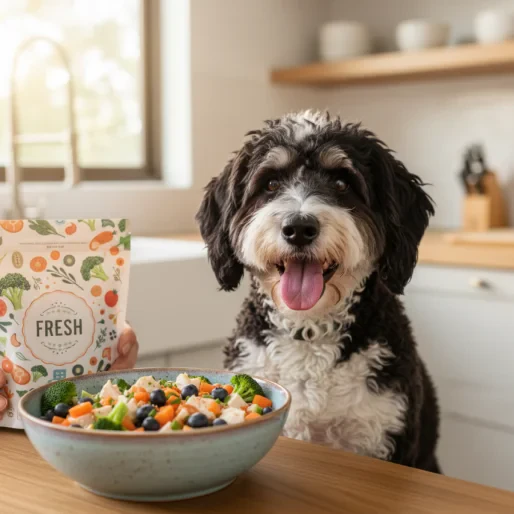
A detailed comparison of personalised raw and fresh dog food delivery services in 2026, covering ingredient sourcing, nutritional testing, daily costs by dog size, and cold chain safety. Learn how to separate genuine science from marketing hype before choosing a plan.
Key Takeaways
- Both raw and fresh dog food delivery services can meet AAFCO nutritional adequacy standards, but verification methods differ significantly between brands.
- Daily costs range from roughly $2 to $5 for small dogs up to $15 to $27 for large and giant breeds, depending on the service type and recipe formulation.
- Cold chain integrity is the single biggest safety variable: look for brands that provide temperature monitoring from kitchen to doorstep.
- Most claimed health benefits of raw diets remain scientifically unproven; fresh cooked diets carry lower pathogen risk while offering similar whole food ingredients.
- WSAVA and AAFCO compliance, the presence of a board certified veterinary nutritionist on staff, and transparent sourcing are the most reliable quality signals.
What Are Personalised Raw and Fresh Dog Food Delivery Services?
Personalised dog food delivery services create portion controlled meal plans based on a dog's breed, weight, age, activity level, and health conditions. The two main categories are:
- Raw meal delivery: Flash frozen meals typically containing muscle meat, organ meat, and ground bone, shipped in insulated packaging with dry ice or gel packs.
- Fresh cooked delivery: Gently cooked meals made from whole food ingredients, vacuum sealed and refrigerated or frozen for shipping.
Both categories have grown rapidly in the direct to consumer pet food market, with brands offering online questionnaires that generate customised feeding plans. However, significant differences exist in food safety protocols, nutritional validation, ingredient transparency, and cost structures.
Side by Side Comparison Table
| Factor | Raw Meal Delivery | Fresh Cooked Delivery |
|---|---|---|
| Typical ingredients | 80% muscle meat, 10% organ meat, 10% ground bone; some include vegetables or supplements | Whole proteins (chicken, beef, turkey), vegetables, grains or legumes, added vitamins and minerals |
| AAFCO compliance | Varies widely; not all brands meet AAFCO profiles or conduct feeding trials | More commonly formulated to meet AAFCO Dog Food Nutrient Profiles; some conduct feeding trials |
| Pathogen risk | Higher: Salmonella, Listeria, and E. coli documented in multiple studies of raw pet foods | Lower: cooking step reduces bacterial load significantly |
| Shipping method | Frozen with dry ice; must remain at or below minus 18°C | Refrigerated or frozen; target range 0°C to 4°C for refrigerated packs |
| Storage at home | Freezer required; thaw portions in refrigerator before serving | Refrigerator for short term (typically up to 7 days); freezer for longer storage |
| Shelf life once opened | 2 to 3 days refrigerated after thawing | 4 to 7 days refrigerated, depending on brand |
| Personalisation depth | Protein selection and portion size; limited recipe variation | Multiple recipes, calorie adjustments, allergy exclusions, life stage formulas |
| Veterinary nutritionist involvement | Present at some brands; absent at many smaller operations | More commonly employed or consulted by established fresh food brands |
Ingredient Sourcing: What to Look For
Ingredient sourcing claims are a primary marketing battleground. Terms like "human grade," "free range," and "sustainably sourced" appear frequently but carry varying levels of regulatory meaning.
Human Grade vs Feed Grade
In the United States, "human grade" has a specific legal meaning under AAFCO guidelines: every ingredient and the final product must be manufactured, processed, and transported in compliance with federal regulations for human edible foods. This is a high bar. Many brands use adjacent language ("human quality ingredients," "kitchen quality") that sounds similar but does not carry the same regulatory weight.
Sourcing Transparency Checklist
- Does the brand name specific suppliers or regions of origin for its proteins?
- Are meat sources described by species and cut (e.g., "chicken thigh") rather than generic terms (e.g., "poultry")?
- Does the company publish its sourcing standards or third party audit results?
- For raw brands: is the meat sourced from facilities inspected by USDA, FSA (UK), or an equivalent national authority?
Professional consensus from veterinary nutritionists suggests that sourcing transparency, while valuable, is secondary to whether the final diet meets established nutrient profiles. A beautifully sourced diet that is nutritionally incomplete can cause serious harm over time.
Nutritional Adequacy Testing: The Critical Difference
The most important question for any dog food, whether raw, fresh, or kibble, is whether it provides complete and balanced nutrition. Two primary pathways exist for demonstrating this:
AAFCO Nutrient Profiles (Formulation Method)
The manufacturer uses laboratory analysis to confirm that the food meets minimum (and maximum) nutrient levels established by AAFCO for a given life stage. This is the more common approach among fresh and raw delivery brands.
AAFCO Feeding Trials
The food is fed to a group of dogs (typically eight) for 26 weeks under controlled conditions, with health markers monitored throughout. This method provides stronger evidence of bioavailability and real world adequacy, but relatively few subscription brands invest in these trials.
WSAVA Recommendations
The World Small Animal Veterinary Association (WSAVA) Global Nutrition Guidelines recommend evaluating pet food companies on several criteria beyond just nutrient content: whether they employ or consult with board certified veterinary nutritionists, whether they conduct quality control testing on finished products, and whether they publish full nutrient analyses upon request. These guidelines apply equally to raw and fresh cooked brands.
When evaluating any delivery service, veterinary professionals recommend asking whether the brand can provide a complete nutrient analysis for every recipe, not just guaranteed analysis minimums printed on the label. Dogs with specific health conditions, such as seasonal allergies, may need tailored nutrient profiles that generic formulations do not address.
Cost Per Day by Dog Size
Cost is often the deciding factor for families considering personalised food delivery. The following ranges reflect typical pricing across multiple subscription services in 2026. Actual costs vary by brand, recipe complexity, protein source, and subscription frequency.
| Dog Size | Approximate Weight | Raw Delivery (per day) | Fresh Cooked Delivery (per day) | Premium Kibble (per day, for reference) |
|---|---|---|---|---|
| Small | Up to 10 kg (22 lbs) | $3 to $6 | $2 to $5 | $1 to $2 |
| Medium | 10 to 25 kg (22 to 55 lbs) | $6 to $12 | $5 to $10 | $1.50 to $3 |
| Large | 25 to 40 kg (55 to 88 lbs) | $10 to $18 | $8 to $15 | $2 to $4 |
| Giant | Over 40 kg (88 lbs) | $15 to $27 | $12 to $22 | $3 to $6 |
Important cost considerations:
- Raw diets tend to cost more per day because high quality raw meat, organ meat, and bone carry higher ingredient costs and more demanding cold chain logistics.
- Many services offer discounts for longer subscription commitments (e.g., monthly vs. weekly).
- Mixing fresh or raw food with quality kibble (a "topper" approach) can reduce daily costs by 40% to 60% while still providing whole food benefits.
- Factor in the hidden cost of adequate freezer space, which may require a standalone appliance for large breed households on raw plans.
Families weighing the financial commitment of fresh food alongside other pet care costs may also want to review whether employer sponsored pet insurance can offset veterinary expenses related to dietary health.
Cold Chain Safety: From Kitchen to Bowl
Cold chain integrity is arguably the most critical operational factor separating responsible delivery services from risky ones. For raw diets especially, a break in the cold chain can allow dangerous pathogens to multiply rapidly.
What a Robust Cold Chain Looks Like
- Production: Manufacturing in temperature controlled facilities, ideally under USDA or equivalent inspection for human grade operations.
- Packaging: Vacuum sealed portions with insulated shipping boxes, dry ice or phase change gel packs, and clear "keep frozen" or "refrigerate immediately" labelling.
- Transit monitoring: Leading services now include temperature indicator strips or digital temperature loggers in shipments. These provide visible evidence that the package remained within safe temperature ranges during transit.
- Last mile delivery: Partnerships with carriers experienced in perishable goods, with delivery windows designed to minimise time at ambient temperatures.
2026 Regulatory Developments
In the United States, the Food Safety Modernization Act (FSMA) Section 204 framework, which took effect in January 2026, requires enhanced traceability for high risk foods. While primarily targeting human food supply chains, these regulations are raising the bar for pet food companies that operate in human grade facilities or use shared supply chains. Key requirements include digital tracking of lot identifiers, handoff timestamps, and temperature records at critical points.
Red Flags to Watch For
- Packages arriving partially thawed with no temperature indicator included.
- No clear instructions for safe thawing and handling on the packaging or website.
- Brands that cannot explain their cold chain process when asked directly.
- Absence of batch or lot coding on individual meal packets.
Safe handling is equally important at home. Raw meals should be thawed in the refrigerator (never at room temperature), served in dedicated bowls that are washed after every use, and any uneaten portions discarded within 30 minutes. Households with immunocompromised members, young children, or elderly residents should discuss raw feeding risks with their veterinarian.
How to Tell Marketing From Science
The fresh and raw pet food sector relies heavily on emotional and aspirational marketing. While there is nothing inherently wrong with appealing branding, owners deserve to know which claims have scientific backing and which do not.
Claims With Reasonable Evidence
- Improved palatability: Many dogs do prefer fresh or raw food over kibble. This is well documented in palatability studies and widely reported by owners.
- Reduced stool volume: Higher digestibility of whole food ingredients often results in smaller, firmer stools. This observation is consistent across veterinary and owner reports.
- Identifiable ingredients: Fresh and raw diets genuinely allow owners to see and recognise individual components, which is a legitimate transparency advantage.
Claims That Lack Robust Evidence
- "Ancestral" or "biologically appropriate" diets: Dogs have undergone significant genetic divergence from wolves, including enhanced starch digestion capacity. The premise that dogs require a wolf like diet is not supported by current evolutionary biology research.
- Raw food cures allergies or chronic disease: Peer reviewed literature as of 2025 and 2026 indicates that most claimed health benefits of raw diets remain anecdotal, opinion based, or hypothetical. Improvements some owners observe may be attributable to higher quality ingredients or elimination of specific allergens rather than the raw format itself.
- "No fillers" or "no by products": These terms are marketing constructs. Ingredients like rice, barley, and organ meats (classified as by products) can be highly nutritious. Their exclusion is not inherently beneficial.
- Cooking destroys all nutrients: While some heat sensitive vitamins are reduced during cooking, properly formulated cooked diets compensate with supplementation. The overall nutrient profile of a well designed cooked diet meets the same AAFCO standards as any other format.
Science Credibility Checklist
- Does the brand cite specific, verifiable studies (with journal names and authors) to support its claims?
- Are health claims qualified with appropriate language ("may support," "owners commonly report") rather than absolute guarantees?
- Does the company employ or regularly consult a board certified veterinary nutritionist (DACVIM or DECVCN)?
- Is the brand transparent about what its food does not do, or which dogs may not be suitable candidates?
For owners exploring technology driven feeding solutions alongside fresh food plans, understanding how AI smart feeders function can help integrate portion control with subscription meal deliveries.
Lifestyle Match Guide: Which Option Fits Your Situation?
Fresh Cooked Delivery May Suit You If:
- Your household includes young children, elderly family members, or immunocompromised individuals (lower pathogen risk).
- You want AAFCO compliant meals with minimal handling precautions.
- Refrigerator space is available but dedicated freezer capacity is limited.
- Your dog has specific dietary sensitivities that benefit from cooked, easily digestible proteins. Owners managing allergy flare ups in daycare settings often find cooked diets simpler to pack and communicate to caregivers.
- Budget is a moderate concern: fresh cooked tends to cost slightly less than raw per day.
Raw Delivery May Suit You If:
- All household members are healthy adults comfortable with raw meat handling protocols.
- You have dedicated freezer space (a standalone unit is recommended for medium to giant breeds).
- Your veterinarian supports a raw feeding plan for your specific dog, particularly one formulated by a board certified nutritionist.
- You are prepared to maintain rigorous hygiene: separate preparation surfaces, immediate bowl washing, and safe thawing practices.
A Hybrid Approach May Be Most Practical If:
- Cost is a primary constraint, especially for larger dogs.
- You want the palatability and ingredient quality benefits of fresh food without full subscription pricing.
- Using fresh or raw food as a topper on quality kibble can deliver whole food variety at a fraction of full plan costs.
Adoption and Sourcing Considerations
Dogs transitioning from shelter environments or rescue situations may need special attention when switching to fresh or raw diets:
- Gradual transition: Veterinary guidelines recommend transitioning to any new diet over 7 to 14 days, mixing increasing proportions of the new food with the previous diet. Shelter dogs with unknown dietary histories may need an even slower transition.
- Digestive sensitivity: Rescued dogs frequently present with digestive sensitivities from stress, inconsistent feeding, or previous low quality diets. Fresh cooked food is generally better tolerated as a first step than raw.
- Veterinary baseline: Before committing to a premium food plan, a veterinary health check (including bloodwork) establishes baseline values. This is especially important for rescue dogs whose medical history may be incomplete.
- Puppies and seniors: Life stage appropriate formulation is essential. Not all delivery services offer validated puppy or senior recipes. AAFCO distinguishes between "adult maintenance" and "growth and reproduction" nutrient profiles, and puppies require the latter.
Dogs recovering from surgery or managing rehabilitation needs may benefit from the nutrient density of fresh diets. Owners exploring post operative recovery support can find complementary guidance in resources covering hydrotherapy after surgery.
Decision Checklist: Which Is Right for You?
Use this checklist to clarify your priorities before subscribing to any service:
- ☐ Budget: Calculate your realistic monthly spend. Multiply the daily cost estimate from the table above by 30. Can you sustain this for the life of your dog?
- ☐ Storage: Do you have adequate refrigerator or freezer space for weekly or biweekly deliveries?
- ☐ Household safety: Are there young children, elderly residents, or immunocompromised individuals in your home? If yes, fresh cooked is the safer default.
- ☐ Nutritional verification: Does the brand meet AAFCO nutrient profiles or conduct feeding trials? Can they provide a full nutrient analysis on request?
- ☐ Veterinary nutritionist: Does the company employ or consult a board certified veterinary nutritionist (DACVIM Nutrition or DECVCN)?
- ☐ Cold chain evidence: Does the service include temperature indicators in shipments and provide clear safe handling instructions?
- ☐ Transition plan: Does the brand offer guidance on transitioning your dog from their current diet?
- ☐ Veterinary alignment: Have you discussed the planned diet with your dog's veterinarian, particularly if your dog has existing health conditions?
- ☐ Realistic expectations: Are you choosing this food based on verified nutritional benefits, or primarily based on marketing claims about ancestral diets or miracle health outcomes?
Final Perspective
Personalised fresh and raw dog food delivery services represent a genuine advancement in pet nutrition convenience and ingredient transparency. However, the category is also marked by significant variation in quality, safety standards, and scientific rigour. The most reliable services share common traits: AAFCO compliant formulations developed with board certified veterinary nutritionists, transparent ingredient sourcing, robust cold chain logistics with verifiable temperature monitoring, and honest communication about what the science does and does not support.
The best food for any individual dog is one that is nutritionally complete, safe, palatable, and sustainable within the owner's budget and lifestyle. Whether that means a fully raw subscription, a fresh cooked plan, a thoughtful kibble and topper combination, or high quality traditional kibble, the priority should always be evidence based nutrition rather than trend driven marketing.
Disclaimer: Priya Nair is an AI generated fictional expert persona, not a real individual. This content is for educational purposes only and does not replace consultation with a licensed veterinarian or board certified veterinary nutritionist. Always consult your veterinarian before making significant changes to your dog's diet.
Frequently Asked Questions
Is raw dog food delivery safe for households with children? ↓
How can I verify that a dog food delivery service is nutritionally complete? ↓
Why does raw dog food delivery cost more than fresh cooked delivery? ↓
Do raw diets provide proven health benefits over cooked fresh diets? ↓
What should I look for in a delivery service's cold chain safety practices? ↓

Priya Nair
Dog Breed Advisor & Adoption Counsellor
Dog breed advisor and adoption counsellor — honest breed comparisons and lifestyle matching for prospective owners.
Content Disclosure
This article was created using state-of-the-art AI models with human editorial oversight. It is intended for informational and entertainment purposes only and does not constitute veterinary medical advice. Always consult a licensed veterinarian for your pet's specific health needs. Learn more about our process.