A step by step guide to helping older cats retain muscle tone and joint flexibility through gentle play, climbing modifications, and home physiotherapy. Includes how to spot hidden pain signs that cats instinctively mask.
Key Takeaways
- Senior cats (typically aged 11 and older) lose muscle mass gradually, but targeted gentle routines can slow this decline significantly.
- Spring is an ideal time to introduce new movement habits because warmer temperatures naturally reduce joint stiffness.
- Home physiotherapy exercises such as passive range of motion (PROM) and supported weight shifts can be done safely with no special equipment.
- Cats are hardwired to hide pain: subtle behavioural shifts are often the only clue something is wrong.
- Always consult a veterinary professional before starting any new exercise programme with a senior cat, especially one with a known health condition.
Why Spring Is the Right Time to Start
Warmer ambient temperatures help relax soft tissue around ageing joints, which is why many owners notice their senior cat moving a little more freely once winter passes. This natural window of improved comfort makes spring an excellent season to introduce gentle play routines, adjust the home environment for easier climbing, and begin simple physiotherapy exercises. The goal is not to turn a 14 year old cat into a kitten again; it is to preserve existing muscle, protect joint range, and catch hidden pain before it becomes a crisis.
Preparation: What You Need Before You Begin
Veterinary Clearance
Before adding any structured movement to a senior cat's routine, a veterinary check is essential. Conditions such as hyperthyroidism, heart disease, or advanced osteoarthritis may require modifications or rule out certain exercises entirely. A vet can also grade muscle condition using a standardised scoring system (the WSAVA muscle condition score is widely used) so progress can be tracked over time.
Supplies Checklist
- Non slip mat or yoga mat: provides a stable surface for exercises and prevents paw slipping on tiles or hardwood.
- Low profile treats: small, soft, high value treats for luring and rewarding movement. Avoid anything that requires hard chewing.
- Feather wand or slow moving interactive toy: for controlled gentle play. Check out our Ethical Spring Pet Toy Guide: Materials Compared for safe options.
- Shallow ramp or pet stairs: for climbing modifications to furniture the cat already uses.
- Warm towel or wheat bag: for pre exercise warm up (more on this below).
- Notebook or phone: to log session length, mood, and any signs of discomfort.
Setting Expectations
Most owners struggle with pacing the first time because enthusiasm can outrun the cat's tolerance. Sessions should be short (around 3 to 5 minutes for exercises, 5 to 10 minutes for gentle play) and positive. If the cat walks away, the session is over. Forcing participation creates stress and can worsen pain.
Step by Step: Gentle Play Routines for Senior Cats
Step 1: Warm Up the Environment
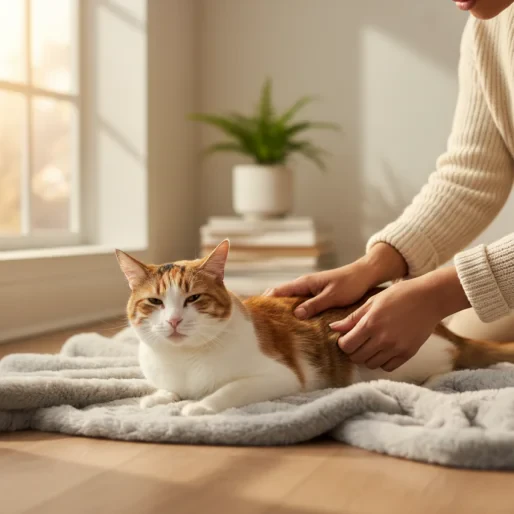
Close windows if there is a cold draught. If the room is below around 20°C (68°F), allow the cat to settle on a warm blanket for 10 minutes first. Warmth improves blood flow to muscles and makes movement more comfortable.
Step 2: Start With Floor Level Play
Use a feather wand or fabric lure dragged slowly along the floor. The objective is horizontal tracking: the cat follows the toy with head turns, weight shifts, and slow stalking movements. This engages the core and hind limb muscles without forcing jumping. Keep the lure speed slow enough that the cat can "catch" it frequently, which maintains motivation.
Step 3: Introduce Gentle Elevation Changes
Once the cat is engaged, raise the toy slightly (no higher than the cat's head height) to encourage small upward stretches. This promotes extension through the spine and shoulders. Avoid lifting the toy so high that the cat needs to jump. For senior cats, a stretch is the goal, not a leap.
Step 4: Add Directional Changes
Move the lure in slow curves and figure of eight patterns. This encourages the cat to shift weight from side to side, engaging stabiliser muscles in the hips and shoulders. Most cats will do this naturally during a hunting sequence, but keeping movements slow and deliberate maximises the benefit.
Step 5: Cool Down
End the session by letting the cat "catch" the toy, then offer a small treat. Allow the cat to rest in a warm, quiet spot. Never end on a frustrating missed catch, as this raises stress hormones and creates a negative association with the activity.
Climbing Modifications for the Senior Cat Home
Cats are vertical animals, and removing all climbing opportunities from a senior cat's life actually accelerates muscle loss. The key is to make climbing safer rather than eliminating it.
Ramps and Steps
Place low angle ramps or pet steps next to any furniture the cat regularly uses: beds, sofas, favourite window perches. A ramp angle of roughly 20 to 30 degrees is manageable for most older cats. Cover the surface with carpet or non slip material so claws can grip.
Staggered Shelf Heights
If the cat uses wall shelves or a cat tree, reduce the gap between levels. Ideally, no single step should require a jump of more than about 20 to 30 cm (8 to 12 inches). Adding intermediate platforms turns one big leap into two small steps.
Stable Surfaces
Wobbly perches that a younger cat handled easily can cause a senior cat to slip or brace awkwardly, stressing already compromised joints. Secure all shelves firmly and check cat trees for stability. A tree that rocks when the cat climbs is a fall risk.
Spring Specific Adjustments
As windows open more in spring, cats may be tempted to jump toward window ledges they previously ignored. Make sure any accessible window has a secure screen or guard. For more on safely expanding a cat's environment, see Rescue Cat Outdoor Transition: A Spring Safety Guide.
Home Physiotherapy Exercises: Step by Step
The following exercises are based on principles used in veterinary physiotherapy and rehabilitation. They are suitable for home use with a healthy senior cat who has received veterinary clearance. They do not replace professional veterinary physiotherapy for cats with diagnosed conditions.
Exercise 1: Passive Range of Motion (PROM)
Purpose: Maintain joint flexibility in the hips, stifles (knees), hocks (ankles), and shoulders.
- Place the cat on a non slip surface in a relaxed position, ideally lying on one side. A warm towel placed over the hind limbs for 3 to 5 minutes beforehand can help relax the muscles.
- Support the limb gently above and below the joint being worked.
- Slowly flex the joint (bend it) until mild resistance is felt, then slowly extend it (straighten it). Never push past the point of resistance.
- Repeat 5 to 10 times per joint, per limb.
- Watch the cat's face and body: flattened ears, tail flicking, skin twitching, or attempts to bite indicate discomfort. Stop immediately if any of these occur.
Frequency: Once daily is a reasonable starting point. Every other day is also beneficial if daily sessions cause stress.
Exercise 2: Supported Weight Shifts (Cookie Stretches)
Purpose: Strengthen core muscles and improve balance.
- With the cat standing on a non slip mat, hold a treat close to the cat's nose.
- Slowly lure the treat to the left, encouraging the cat to turn its head and shift weight onto the left legs. Hold for 2 to 3 seconds.
- Return to centre, then lure to the right.
- Repeat 3 to 5 times per side.
- Progress by luring the treat slightly further to each side over the course of several weeks, increasing the weight shift gradually.
Exercise 3: Slow Elevated Surface Walking
Purpose: Engage proprioception (the body's awareness of limb position) and strengthen hind limb muscles.
- Place a stable, low platform (such as a thick book wrapped in a towel, no higher than about 5 cm or 2 inches) on the floor.
- Lure the cat across the platform with a treat so it must step up and then step down.
- Repeat 3 to 5 times.
- This exercise gently challenges balance and encourages the cat to consciously place each paw, which improves coordination.
Exercise 4: Gentle Sit to Stand Repetitions
Purpose: Build hind limb and gluteal strength.
- Lure the cat from a standing position into a sit using a treat held above and slightly behind the head.
- Then lure the cat back to a stand by moving the treat forward.
- Repeat 3 to 5 times.
- This is essentially the feline equivalent of a squat. It targets the quadriceps and gluteal muscles, which are critical for jumping, climbing, and using the litter tray.
General Guidelines for All Exercises
- Always warm up first: a few minutes of gentle stroking and a warm towel on stiff areas.
- Keep total exercise time (excluding play) under 10 minutes per session.
- End every session on a positive note with a treat or calm praise.
- Log what was done and how the cat responded. This record is invaluable for vet visits.
Signs That Your Senior Cat Is Hiding Pain
Cats are evolutionarily wired to mask pain as a survival mechanism. This makes it one of the most challenging aspects of feline elder care. Veterinary consensus, supported by organisations such as the International Society of Feline Medicine (ISFM), is that behavioural observation is the most reliable tool owners have at home.
Subtle Signs to Watch For
- Reduced jumping or changed route: The cat takes a longer, flatter path to reach a favourite spot, or stops jumping onto surfaces it previously accessed easily.
- Hesitation before movement: A noticeable pause before jumping down from furniture, or "testing" the landing surface with one paw first.
- Changes in grooming: Over grooming a painful area (creating bald patches) or under grooming hard to reach spots (matted fur on the lower back or hind legs).
- Altered litter tray use: Eliminating just outside the tray, reluctance to squat fully, or changes in stool consistency from straining postures.
- Appetite changes: Eating less, eating in a different posture (standing rather than crouching), or dropping food.
- Withdrawal or irritability: Hiding more, avoiding interaction, or uncharacteristic aggression when touched, especially along the spine or hind quarters.
- Facial tension: The Feline Grimace Scale (developed at the Université de Montréal) is a validated tool that scores ear position, muzzle tension, eye narrowing, and whisker position. Owners can learn the basics from freely available resources online.
- Muscle wasting visible over the spine or hind limbs: When the backbone or hip bones become more prominent, it often indicates muscle loss associated with reduced use due to pain.
What to Do If You Spot These Signs
Document what you observe with dates and, if possible, short video clips. This is far more useful to a veterinary professional than a verbal description alone. Do not administer human pain relief medications to a cat; many common over the counter drugs such as ibuprofen and paracetamol (acetaminophen) are toxic to cats, even in small doses.
When to Call Your Vet Immediately
Seek urgent veterinary attention if any of the following occur during or after exercise sessions, or at any point in daily life:
- Sudden lameness or inability to bear weight on a limb.
- Vocalisation (crying, growling) during normal movement or when touched.
- Loss of bladder or bowel control.
- Sudden hind limb weakness, dragging, or collapse.
- Swelling, heat, or visible deformity in any joint.
- Refusal to eat or drink for more than 24 hours combined with lethargy.
These can indicate fractures, disc disease, thromboembolism, or other conditions requiring immediate professional care. Home physiotherapy is a complement to veterinary medicine, not a substitute for it.
Tracking Progress Over Time
Keep a simple weekly log that records:
- Exercise type and duration.
- Play session length and intensity level (low, moderate).
- Any signs of stiffness, reluctance, or discomfort.
- General mobility observations: ease of getting into litter tray, jumping frequency, gait quality.
This log helps identify gradual changes that are easy to miss day to day. It also gives veterinary professionals a clear picture at check ups. Most veterinary bodies recommend senior cats (aged 11 and above) have health assessments at least every six months.
Nutrition and Hydration: Supporting Muscle From the Inside
Exercise alone cannot maintain muscle mass if nutrition is inadequate. Senior cats typically benefit from diets higher in high quality, easily digestible protein compared to maintenance adult diets. Discuss dietary changes with a vet, particularly for cats with kidney disease, as protein levels need careful balancing. Adequate hydration supports joint lubrication and overall tissue health. Many senior cats prefer running water (fountains) or wide, shallow bowls that do not press against their whiskers. For insights into how automated feeders can support portion control, see How AI Smart Feeders Actually Work in 2026.
Bringing It All Together: A Sample Weekly Schedule
- Monday, Wednesday, Friday: Gentle play session (5 to 10 minutes) plus one PROM session on hind limbs.
- Tuesday, Thursday: Cookie stretches (weight shifts) plus sit to stand repetitions.
- Saturday: Elevated surface walking plus gentle play.
- Sunday: Rest day. Observe and log mobility, grooming, and behaviour.
This schedule is a starting template. Adjust frequency and intensity based on the individual cat's response. Some cats thrive on daily short sessions; others do better with every other day. The cat's comfort and willingness always take priority over the schedule.
Final Thoughts
Helping a senior cat maintain muscle mass and joint mobility is one of the most meaningful things an owner can do to preserve quality of life in the later years. The exercises and modifications described here require no expensive equipment, just patience, observation, and consistency. Spring offers a natural advantage with warmer weather easing stiff joints, making it the perfect season to build habits that benefit a cat year round. Always partner with a veterinary professional, track what you observe, and remember: gentle progress over weeks and months is far more valuable than ambitious single sessions.
Frequently Asked Questions
At what age is a cat considered senior for exercise purposes? ↓
How long should a physiotherapy session last for an older cat? ↓
Can home exercises replace veterinary physiotherapy for a cat with arthritis? ↓
What is the Feline Grimace Scale and can owners use it? ↓
Are human pain medications safe to give a senior cat in pain? ↓

Emma Lawson
Practical Pet Care Educator
Practical pet home care specialist — clear, step-by-step guidance grounded in veterinary nursing standards.
Content Disclosure
This article was created using state-of-the-art AI models with human editorial oversight. It is intended for informational and entertainment purposes only and does not constitute veterinary medical advice. Always consult a licensed veterinarian for your pet's specific health needs. Learn more about our process.