
In this article
- Key Takeaways
- Why Philippine Heat Is a Year-Round Daycare Concern
- Humidity Changes the Risk Equation
- Climate-Controlled vs. Outdoor Daycare: At a Glance
- Climate-Controlled Daycare: What Philippine Facilities Should Offer
- Outdoor Daycare: Dry Season and Wet Season Risks
- Breed Considerations in the Philippine Context
- Philippine Regulatory Context
- Cost Considerations in the Philippine Market
- Decision Checklist for Filipino Dog Owners
Key Takeaways
- Philippine heat is a year-round welfare concern, not a seasonal one: the dry season (tag-araw) from March to May regularly produces temperatures of 34 to 38C with very high humidity, but heat risk persists across most of the year in lowland Philippine cities.
- High humidity is the critical multiplier: Philippine relative humidity frequently exceeds 80 percent during midday hours, significantly reducing the effectiveness of panting as a cooling mechanism and lowering the practical threshold of heat risk below 30C in many conditions.
- Shih Tzus and French Bulldogs, two of the most popular breeds among Filipino pet owners, are brachycephalic and face elevated heat risk: climate-controlled daycare should be the standard for these dogs, not an optional premium.
- Outdoor facilities carry a dual seasonal risk: heat stress during the dry season and leptospirosis exposure during wet season flooding are both genuine concerns that require facility-specific verification.
- The Animal Welfare Act (Republic Act 8485, as amended by RA 10631) and Bureau of Animal Industry (BAI) registration requirements provide the regulatory baseline, but responsible facility selection goes substantially beyond minimum compliance.
Why Philippine Heat Is a Year-Round Daycare Concern
In temperate climates, pet owners face a relatively defined hot season where elevated care is required. In the Philippines, the calculation is different. PAGASA weather data consistently shows that most lowland Philippine cities, including Metro Manila, Cebu, and Davao, experience ambient temperatures above 30C for the majority of the year, not just during the March-to-May dry season. The dry season represents the peak, not the entirety, of the heat welfare challenge.
The heat index, which accounts for the combined effect of temperature and relative humidity on perceived temperature, is the more clinically relevant figure for assessing canine heat risk in Philippine conditions. When ambient temperature reaches 33C with 85 percent relative humidity, a combination that is routine during Philippine daytime hours across much of the year, the heat index regularly exceeds 40C. This is well above the threshold at which dogs engaged in active group play face a meaningful risk of heat exhaustion. Owners selecting daycare facilities should treat this as a year-round infrastructure question rather than something to address only during the hottest months.
Humidity Changes the Risk Equation
Dogs regulate body temperature primarily through panting, which works by evaporating moisture from the upper respiratory tract. This mechanism relies on the surrounding air being able to absorb water vapour. In Philippine conditions, where relative humidity frequently reaches 80 to 90 percent during peak hours, the air is already close to saturation and evaporative cooling through panting becomes substantially less efficient. A dog panting at 32C in Manila's midday humidity faces a greater thermoregulatory challenge than one panting at the same temperature in a drier climate. This is the reason Philippine conditions can produce heat-related illness at temperatures that global benchmarks might classify as moderate risk rather than high risk.
Veterinary guidance aligned with positions of the Philippine Veterinary Medical Association (PVMA) emphasises that heat and humidity combinations, rather than temperature alone, should drive facility selection decisions in tropical climates. For dogs with compromised thermoregulatory capacity, including brachycephalic breeds and senior animals, the effective danger threshold is meaningfully lower than a simple 30C reading suggests.
Climate-Controlled vs. Outdoor Daycare: At a Glance
| Factor | Climate-Controlled Daycare | Outdoor Daycare |
|---|---|---|
| Heat and humidity management | Active cooling maintains play areas typically at 20 to 24C with controlled humidity | Dependent on shade quality, ventilation, and ambient conditions |
| Risk during tag-araw (dry season) | Low in a well-maintained facility | High without robust shade, cooling infrastructure, and enforced rest periods |
| Risk during wet season | Protected from flooding; indoor sanitation protocols are required | Flood exposure creates leptospirosis risk; facility drainage is critical |
| Suitability for brachycephalic breeds | Recommended; Shih Tzus and French Bulldogs require this level of care in Philippine conditions | Not recommended above 28C for flat-faced breeds |
| Typical cost range | Around ₱1,200 to ₱2,500 per day and above | Around ₱300 to ₱1,200 per day depending on facility quality |
| Weather reliability | Year-round; not subject to typhoon disruption or cancellation | Vulnerable to typhoon cancellations and post-typhoon flooding |
| Regulatory compliance | Easier to maintain BAI-aligned sanitation standards in controlled indoor environments | Variable; outdoor sanitation and rodent control require active ongoing management |
Climate-Controlled Daycare: What Philippine Facilities Should Offer
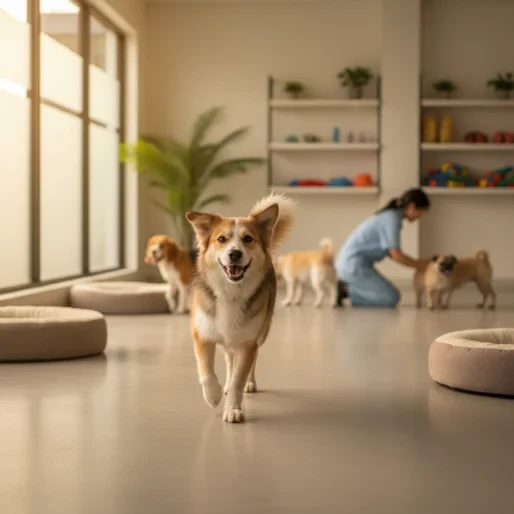
Given that Philippine conditions combine sustained high temperatures with very high humidity for most of the year, a genuinely climate-controlled daycare means more than a single air conditioning unit at the entrance. The entire active play area, including water stations, rest zones, and any temporary holding spaces, should be maintained at a temperature that supports safe thermoregulation in active dogs, typically below 24C, throughout the full operating day including midday hours.
When visiting a facility, a practical check is to arrive during midday operating hours rather than during a cooler morning tour, and to ask staff to show thermostat or environmental monitoring readings in the play area. Reputable facilities log temperature and humidity as part of daily operations rather than relying on staff estimates. Air quality is particularly relevant in Philippine daycare facilities because of the prevalence of brachycephalic breeds among urban pet owners. Poorly ventilated indoor spaces accumulate ammonia from urine, which irritates already-compromised airways in flat-faced dogs. Quality facilities combine active cooling with adequate ventilation rather than treating these as competing priorities.
Staff ratios during peak play hours are a critical welfare indicator. Professional daycare standards broadly suggest a ratio of one trained staff member per 10 to 15 dogs during active group play as a working benchmark, with closer monitoring appropriate for mixed groups containing high-risk dogs. Ask directly what this ratio is and what formal animal welfare training staff have completed. A facility unable to answer clearly warrants caution. In the event of any heat emergency during daycare hours, having an emergency veterinary contact immediately accessible is essential:
Emergency Veterinary Clinic
Contact your nearest emergency veterinary clinic or call your vet immediately.
Metro Manila has several 24-hour veterinary clinics. In provincial areas, contact the municipal veterinarian.
Outdoor Daycare: Dry Season and Wet Season Risks
Outdoor daycare is not automatically unsuitable in the Philippines, but it operates under dual seasonal pressures that do not apply in most other climates: heat stress during the dry season and leptospirosis exposure during wet season flooding. Responsible outdoor operators address both risks explicitly rather than treating them as separate problems for different months.
Shade, Surface Standards, and Cooling Infrastructure
Shade coverage sufficient for all enrolled dogs to rest simultaneously at any point during the day is the non-negotiable baseline. Shade from purpose-built structures such as galvanised roofing, sail cloths, or permanent pergolas provides more reliable protection than sparse tree cover, which gaps as the sun moves through the day. In Philippine midday conditions, ground surface temperatures on concrete or paving under direct sunlight can reach substantially higher than ambient air temperature, representing a burn risk to paw pads and a significant secondary heat source. Grass, rubber matting, or wood chips under shade structures are considerably safer surfaces for resting dogs.
Active cooling infrastructure, including misting fans, shallow wading areas, and cooling mats in shaded zones, meaningfully reduces heat load for dogs in outdoor settings and should be standard in any Philippine outdoor daycare operating during daytime hours. These are not luxury additions in a tropical climate; they are basic welfare infrastructure.
Activity Scheduling During Philippine Conditions
Responsible outdoor operators in the Philippines schedule high-intensity group play before 9am and after 4:30pm during the dry season, and maintain enforced rest during the hottest part of the day. When assessing a facility, ask specifically what dogs are doing between 11am and 3pm on a hot day, and what supervised rest looks like operationally rather than in principle. A vague or dismissive answer is a meaningful signal about how seriously the facility treats heat management as a welfare responsibility.
Leptospirosis and the Wet Season Risk
This is a risk factor specific to the Philippine context that is largely absent from global daycare guidance. During the wet season from approximately June to November, flooding in many Philippine urban and suburban areas creates conditions where leptospirosis exposure is a genuine risk for dogs in outdoor environments. Leptospira bacteria, shed in the urine of infected rodents, survive in floodwater and contaminated soil and can infect dogs through skin abrasions or mucous membranes during contact with affected surfaces.
Before enrolling a dog in any outdoor facility, owners should ask about the facility's flood history, drainage infrastructure, and rodent control programme. Leptospirosis vaccination is not covered under the mandatory rabies vaccination requirement of the Anti-Rabies Act of 2007 (Republic Act 9482), but is strongly advisable for dogs with outdoor exposure in the Philippines. Confirming that a dog's leptospirosis vaccination is current before daycare enrolment is responsible practice, and owners should verify that the facility similarly requires proof of current vaccination from all enrolled dogs as a condition of participation.
Breed Considerations in the Philippine Context
The Philippine dog population includes a distinctive mix of local and imported breeds, and heat risk applies very differently across these groups.
Aspins (Asong Pinoy)
The Aspin, the Philippine native dog, is generally leaner in build, short-coated, and broadly adapted to tropical conditions through generations of acclimatisation. As a group, Aspins carry lower baseline heat risk compared with cold-climate breeds introduced to the Philippines. However, lower baseline risk does not mean no risk. Aspins engaged in sustained high-intensity group play during peak heat hours, without adequate water access or shade, remain vulnerable to heat exhaustion. The same facility standards apply, and wet season leptospirosis risk is equally relevant for Aspins with outdoor exposure.
Shih Tzus, French Bulldogs, and Other Brachycephalic Breeds
Shih Tzus and French Bulldogs are consistently among the most popular breeds with Filipino pet owners, particularly in Metro Manila and other urban centres. Both are brachycephalic, meaning they have structurally compressed upper airways that make thermoregulation through panting significantly less efficient than in normally conformed dogs. In Philippine conditions combining heat and high humidity, this physiological limitation creates a genuine welfare concern from temperatures as low as 26 to 28C, well below the midday norms of the dry season. Pugs, Bulldogs, Boxers, and Cavalier King Charles Spaniels fall into the same high-risk category. For these dogs, climate-controlled daycare is the appropriate standard of care in Philippine conditions, not an optional premium service.
Golden Retrievers and Double-Coated Breeds
Golden Retrievers and Labrador Retrievers are popular family pets across the Philippines and carry moderate-to-elevated heat risk in sustained high-humidity conditions. Outdoor daycare above 30C for double-coated breeds should require demonstrably rigorous shade, active cooling, and rest-period protocols, and owners should apply the same careful facility assessment as they would for any higher-risk dog.
Philippine Regulatory Context
Daycare facilities operating in the Philippines should hold current Bureau of Animal Industry (BAI) registration and operate in compliance with the Animal Welfare Act (Republic Act 8485, as amended by Republic Act 10631), which provides the foundational legal standard for the care and treatment of animals under human custody. Owners are entitled to ask facilities for their registration documentation as part of the pre-enrolment process, and a facility unwilling to provide this warrants scrutiny.
Under the Anti-Rabies Act of 2007 (Republic Act 9482), annual rabies vaccination is mandatory for all dogs in the Philippines. Reputable daycare facilities should require proof of current rabies vaccination alongside other core vaccinations as a condition of enrolment. Barangay-level animal registration requirements vary by local government unit and should be confirmed with the relevant LGU, though registration does not substitute for vaccination verification at the facility level.
Cost Considerations in the Philippine Market
Climate-controlled daycare in Philippine urban centres typically ranges from around ₱1,200 to ₱2,500 or more per day for full-day care, with variation based on location, group size, and included services. Quality outdoor facilities with proper shade structures, cooling infrastructure, and adequate staffing typically range from around ₱600 to ₱1,200 per day. Basic outdoor arrangements with minimal infrastructure can be found at lower price points, but these generally correspond to the highest-risk operational profiles in Philippine conditions.
A useful comparative frame: veterinary treatment for heat-related illness in the Philippines, depending on severity and the speed of intervention, can range from around ₱3,000 for supportive care following mild heat exhaustion to ₱20,000 or more for hospitalisation and intensive management of serious heatstroke. The monthly cost differential between a quality climate-controlled facility and a basic outdoor arrangement is typically modest relative to these potential emergency costs, and the welfare case for investing in the former is strong for any dog in a higher-risk category.
Decision Checklist for Filipino Dog Owners
About Your Dog
- Is your dog a brachycephalic or flat-faced breed such as a Shih Tzu, French Bulldog, Pug, or similar? If yes: climate-controlled daycare is strongly recommended for Philippine conditions above 26C.
- Is your dog over eight years of age, clinically overweight, or does it have a diagnosed cardiac or respiratory condition? If yes: prioritise climate-controlled facilities and consult your veterinarian before any daycare enrolment.
- Is your dog an Aspin or a lean short-coated breed? Lower baseline heat risk applies, but facility standards still matter and wet season leptospirosis risk is equally relevant.
- Is your dog's leptospirosis vaccination current? If considering any outdoor facility, this should be confirmed and documented before enrolment.
- Has your dog previously shown signs of heat sensitivity, including persistent shade-seeking, reluctance to move in warm conditions, or laboured panting at temperatures that do not affect other dogs similarly? If yes: outdoor daycare above 30C is not appropriate.
About the Facility
- Is the facility registered with the BAI and operating in compliance with the Animal Welfare Act?
- For outdoor facilities: what is the flood history of the property, and what drainage and rodent control infrastructure is in place for the wet season?
- Does the facility require proof of current rabies and leptospirosis vaccination from all enrolled dogs?
- Can staff confirm the temperature and humidity of the active play area at midday, and is this monitored by equipment rather than estimated by staff?
- Is shade coverage sufficient for all enrolled dogs to rest simultaneously, and does it remain effective as the sun moves through the day?
- Are rest periods during peak heat hours, typically 11am to 3pm, enforced operationally and not merely described in principle?
- Is there a written emergency protocol for heat-related illness that you can review before enrolling?
- What is the staff-to-dog ratio during active group play, and are staff formally trained in animal first aid including recognition of heat stress?
At temperatures above 30C combined with Philippine humidity levels, the difference between a well-managed daycare facility and a poorly managed one is not a matter of comfort preference. It is a question of clinical risk. Filipino dog owners who visit facilities at peak operating hours, verify vaccination and regulatory compliance, and match facility type to their dog's specific physiology are making the decision that genuinely protects their furbaby's long-term wellbeing.
Frequently Asked Questions
Content Disclosure
This article was created using state-of-the-art AI models with human editorial oversight. It is intended for informational and entertainment purposes only and does not constitute veterinary medical advice. Always consult a licensed veterinarian for your pet's specific health needs. Learn more about our process.